The European Space Agency’s Herschel space telescope has captured this gorgeous new view of the famed Eagle Nebula.

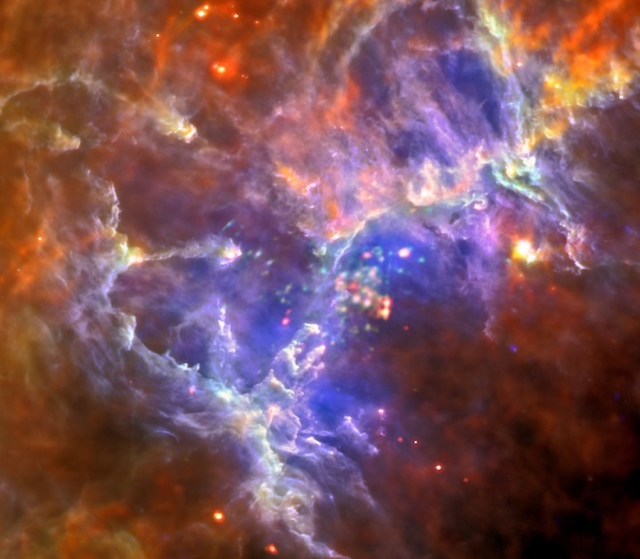

The European Space Agency’s Herschel space telescope has captured this gorgeous new view of the famed Eagle Nebula.
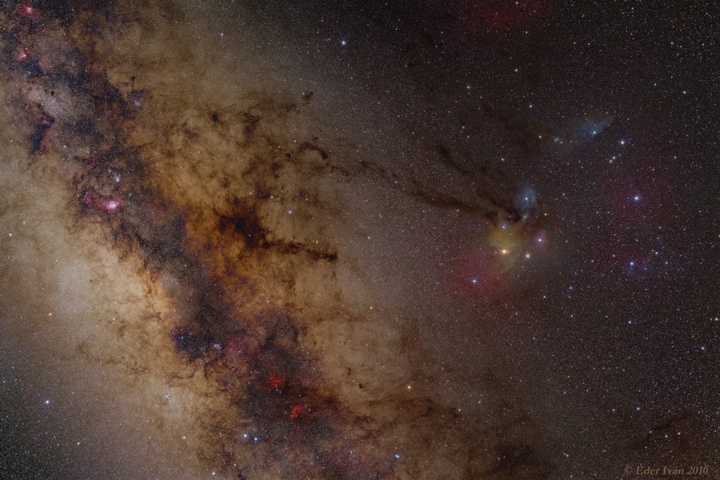
A Wide Field Image of the Galactic Center
Image Credit & Copyright: Ivan Eder
Explanation: From Sagittarius to Scorpius, the central Milky Way is a truly beautiful part of planet Earth’s night sky. The gorgeous region is captured in this wide field image spanning about 30 degrees. The impressive cosmic vista, taken in 2010, shows off intricate dust lanes, bright nebulae, and star clusters scattered through our galaxy’s rich central starfields. Starting on the left, look for the Lagoon and Trifid nebulae, the Cat’s Paw, while on the right lies the Pipe dark nebula, and the colorful clouds of Rho Ophiuchi and Antares (right). The actual center of our Galaxy lies about 26,000 light years away and can be found here.
WOW

Comet Lovejoy and the ISS
Image Credit: Left – Carlos Caccia, (Intendente Alvear, Argentina) / Right – Dan Burbank (ISS Expedition 30, NASA)
Explanation: On December 24, Comet Lovejoy rose in dawn’s twilight, arcing above the eastern horizon, its tails swept back by the solar wind and sunlight. Seen on the left is the comet’s early morning appearance alongside the southern Milky Way from the town of Intendente Alvear, La Pampa province, Argentina. The short star trails include bright southern sky stars Alpha and Beta Centauri near the center of the frame, but the long bright streak that crosses the comet tails is a little closer to home. Waiting for the proper moment to start his exposure, the photographer has also caught the International Space Station still glinting in the sunlight as it orbits (top to bottom) above the local horizon. The right panel is the near horizon view of Comet Lovejoy from the space station itself, captured only two days earlier. In fact, Dan Burbank, Expedition 30 commander, recorded Comet Lovejoy rising just before the Sun in a spectacular video (linked here). Even considering the other vistas available from low Earth orbit, Burbank describes the comet as “the most amazing thing I have ever seen in space.”

Artist’s conception of a terraformed Mars. Credit: Wikimedia Commons
Awesome picture from this article. Wether we should TerraForm Mars. For you non geeks Terra = Earth TerraForm means to ‘adjust’ a worlds Environment to fit humans and life forms from Earth. Now on a world with existing viable ecology (life) this would be unconscionable but on a dead or dead ended environment I’d vote ASAP. … Arguments can be had on both sides, I just hope we get to have those arguments.

NASA’s Dawn spacecraft has spiraled closer and closer to the surface of the giant asteroid Vesta. (Credit: NASA/JPL-Caltech/UCLA/MPS/DLR/IDA)
At this detailed resolution, the surface shows abundant small craters, and textures such as small grooves and lineaments that are reminiscent of the structures seen in low-resolution data from the higher-altitude orbits. Also, this fine scale highlights small outcrops of bright and dark material.
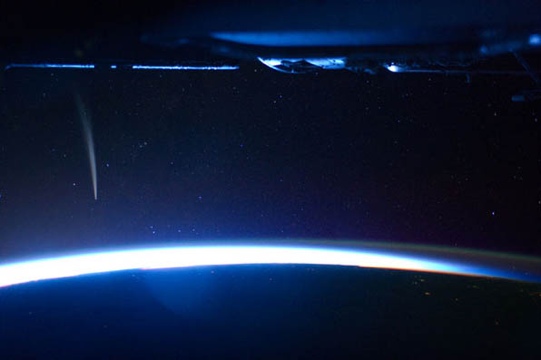
Comet Lovejoy after its spectacular close pass around the sun put on a fabulous show for an ISS astronaut. At max it was ~10x the moons apparent diameter.

As the poster at arstechnia says this is fascinating stuff and i hope it remains so for a very long time.
Astronomers find a star system where a red giant appears to have swallowed two Jupiter-like planets, then later spit out their cores, which now orbit as small, rocky planets.
via Remains of gas giants, swallowed by red giant star, now orbit as small planets.
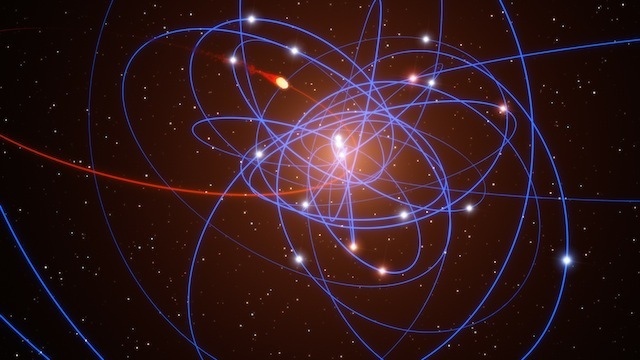
Astronomers have spotted a cloud of gas with three times the mass of the Earth on a near-collision course with the Milky Way\s central black hole.
This Spaceflight Now article discusses the Kepler Orbital Observatory’s discovery of two “smallish” worlds (within a few percentage points of Earth) orbiting a star 1000 light years away. This proves that 1) Kepler can ‘see’ worlds of this size and 2) that such worlds are not radically rare since there are two in the first few dozen discovered. However both orbit too close to their star for us one’s probably got a surface temp of ~1500 the other a relatively ‘cool’ 800. Other interesting thing is that the other planets spotted (all way to close to the star) are gas ‘pigmy giants.’
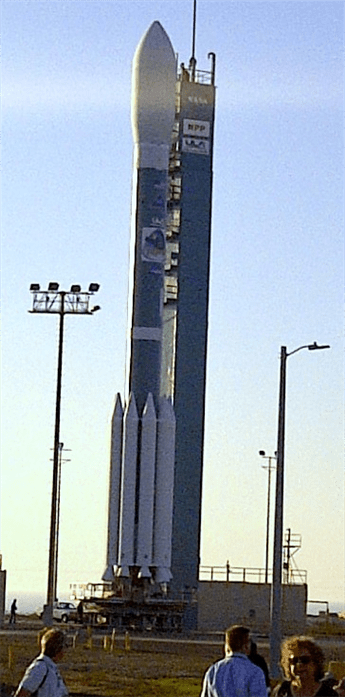
A great reflective article, I have seen 2 launches both in Florida, one an Atlas the other a Delta, both commercial, both with hundreds of others, both indescribably moving because of the awesome symbolism as much as anything else.

 This World and Others