How Physics Empowers Free Will in a Deterministic Universe

Why determinism never felt right to me — and how modern physics actually opens the door to real agency.

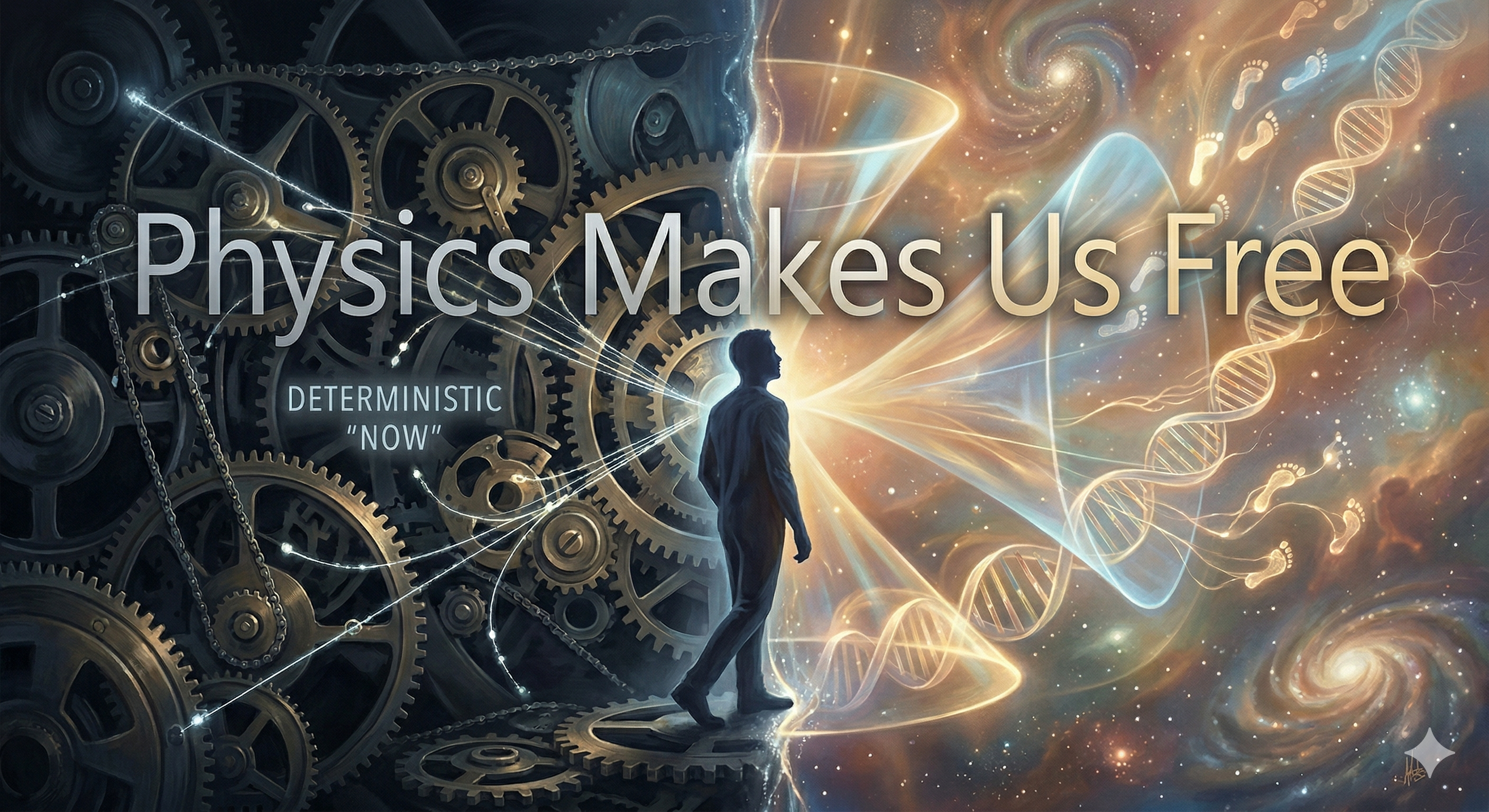
For years, the idea of hard determinism has bothered me. It clashes with how life actually feels. The universe as a giant clockwork machine—every particle with a fixed position and momentum, every event preordained from the Big Bang—sounds elegant in theory. But it implies that everything I’ve ever done or will do was inevitable. My choices? Just an illusion.

Hard determinists often present this view with a certain intellectual swagger, as if it signals deep sophistication. Yet many of them still look both ways before crossing the street. As Stephen Hawking wryly observed: “I have noticed that even those who assert that everything is predestined… still look both ways before they cross the road.”

That quip captures the tension. If the future is fixed, why bother acting at all? The view also carries an eerie resemblance to extreme Calvinism—some are saved, some damned, and nothing you do in this life ultimately changes the script. It never sat right with me, either intellectually or existentially.

Then I encountered the work of physicist and philosopher Jenann Ismael, particularly her book How Physics Makes Us Free. Link Her approach resonated strongly with an intuition I’d been developing for years: determinism and free will are not mutually exclusive. Physics doesn’t enslave us—it enables a deeper kind of freedom.

The “Now” Problem: Why the Instant is Trivial

Imagine the universe at a single frozen instant—the “Now.” In that timeless 3D snapshot, every particle has a position and energy vector. Past events fully determine what happens next. It looks perfectly deterministic.

But here’s the catch: that “Now” has no real existence for any actual observer. Relativity imposes strict limits. No particle (or person) can access information from outside its past light cone. At the exact moment of “Now,” that light cone has zero depth—nothing from even a tiny distance away has had time to reach you. Complete information about the universe is impossible in the present.

Laplace’s Demon—the hypothetical super-intellect that knows every particle’s state and can predict the entire future (or past)—assumes a “God’s-eye view from nowhere.” Modern physics makes that view untenable. Any real system faces data latency, noise, uncertainty, and computational irreducibility. The demon’s omniscience is a fantasy.

In short, strict determinism at the instantaneous “Now” (what I’ve called the InP, or Instant-Point) is technically true but functionally trivial. It tells us almost nothing useful about how agents like us actually operate.

Memory: The Engine of Agency

Freedom emerges not in the frozen instant, but across time through accumulated memory and structure.

Even in a blind, non-living universe, basic thermodynamics creates imprints: a rock scars the ground when it falls; waves erode a shoreline. These are primitive forms of “memory”—the past shaping the future through persistent physical traces.

Life takes this to another level. Biology is essentially memory in action. RNA, DNA, neural patterns—these are systems that record what worked and what didn’t. Evolution itself is a memory process: successful patterns persist and build upon one another.

Over eons, this scales up:

  • Simple input → output (basic matter)
  • Input → memory/comparison → internal model → action → output (living organisms)

A frog snaps at a fly. A squirrel flees at a predator’s scent. A honeybee dances to communicate nectar locations to the hive. These are not random reflexes but decisions grounded in accumulated history and pattern-matching.

Humans take it further. Language, culture, and shared knowledge externalize memory, allowing us to build on the experiences of countless others. Our decisions arise from rich internal models shaped by personal and collective history—not from some magical spark that violates physics, but from the universe’s own lawful processes.

The agent does decide. The cause of the action lies in the person’s internal identity and accumulated experience. Labeling that “determined” is technically accurate but misses the point. It’s how we function.

The Generalized Good as an Attractor

This memory-driven agency isn’t aimless. Over deep time, beings with even modest volition tend to optimize for what they perceive as “good”—survival, order, flourishing. Humans are guidable, not perfectible. We make mistakes and fall for bad influences, but signals from reality (what works vs. what fails catastrophically) are powerful if we’re willing to heed them.

History shows progress: fewer people in extreme poverty, fewer dying in wars (in percentage terms, at least). Our ancestors weren’t ignorant fools; their traditions often encoded hard-won lessons. Change isn’t inherently good, but neither is stasis. The “generalized good” acts as a global attractor, even if local maxima vary by time, place, and culture.

In deprived environments (think North Korea), external options shrink, yet people still imagine and yearn for “other worlds.” The internal model remains a generator of possibility.

My Thesis

Free will is not a violation of physics. It is the high-level, computational process of an autonomous agent using the universe’s built-in memory—personal, biological, and cultural—to steer itself through time.

Determinism at the microscopic level may hold, but it becomes trivial once you account for relativity, light cones, computational limits, and the reality of embedded agents. What matters is that you are the one deciding, drawing on your history and internal model. There is no external puppet master. The causes flow through you.

Physics doesn’t rob us of freedom. By creating a world with persistent memory, evolving complexity, and embedded perspectives, it makes genuine agency possible.

That’s why the universe feels open rather than claustrophobic. That’s how physics makes us free.

Aliens? The Science Says no….but does it?

Artist’s concept of interstellar object1I/2017 U1 (‘Oumuamua) as it passed through the solar system after its discovery in October 2017. The aspect ratio of up to 10:1 is unlike that of any object seen in our own solar system. Image Credit: European Southern Observatory / M. Kornmesser
From NASA Article

The first known interstellar object to visit our solar system, 1I/2017 U1 ‘Oumuamua, was discovered Oct. 19, 2017 by the University of Hawaii’s Pan-STARRS1 telescope, funded by NASA’s Near-Earth Object Observations (NEOO) Program, which finds and tracks asteroids and comets in Earth’s neighborhood. While originally classified as a comet, observations revealed no signs of cometary activity after it slingshotted past the Sun on Sept. 9, 2017 at a blistering speed of 196,000 miles per hour (87.3 kilometers per second). It was briefly classified as an asteroid until new measurements found it was accelerating slightly, a sign it behaves more like a comet.

This very deep combined image shows the interstellar object ‘Oumuamua at the center of the image. It is surrounded by the trails of faint stars that are smeared as the telescopes tracked the moving comet. Credit: ESO/K. Meech et al.
From NASA Article

The second image is to make you think. Given one of our very powerful telescopes that faint dot circled in the center is all we ever saw of Oumuamua. With our computational tools we could detect that it was accelerating and get an idea of the surface composition but the data we collected was negligible (though also amazing given the distance and velocity of this objectively tiny object.)

Image credit: Kris Snibbe/Harvard file photo.
From Extraterrestrial, Oumamua as Artifiact

Extraterrestrial: On ‘Oumuamua as Artifact

by PAUL GILSTER on FEBRUARY 23, 2021

The reaction to Avi Loeb’s new book Extraterrestrial (Houghton Mifflin Harcourt, 2021) has been quick in coming and dual in nature. I’m seeing a certain animus being directed at the author in social media venues frequented by scientists, not so much for suggesting the possibility that ‘Oumuamua is an extraterrestrial technological artifact, but for triggering a wave of misleading articles in the press. The latter, that second half of the dual reaction, has certainly been widespread and, I have to agree with the critics, often uninformed.

The article in CentauriDreams, as always excellent, discusses the reaction to the book which is very much in line with the arguments of the book itself.

The author of the Book a Harvard Astronomer of high repute, says that the data actually points to Oumuamua being an artifact and that since that theory best fits the data…then it is/was an extraterrestrial visitor. He then goes on review other theories and the way that the science community came together to present a ‘consensus’ that was more about PR and making the life of the average person in the broad community of sky explorers easier rather than doing the hard work of explaining multiple theories and sets of data that left the question very open and leaving a starkly amazing option in play.

Essentially this is about the science and the science community but also about Journalism in its debauched epoch. Many of us grew up with science being pushed as a noble, maybe the last noble, adventure. With heroes and a few villains. Heroes of the mind and of letters and video who didn’t get shot at or mugged or even have to live rough. Carl Sagan, Attenborough, many other names come to mind.

The problem is that these men and women were scientists, academics, with deep knowledge, if often deeply attached to one trope, and great communicators. Far too many of those who followed were/are attached to a trope and its alignment with their desired outcome. Without the background/willingness to understand that even the most beautiful theory may be utterly wrong and always HAS to be able to stand up to any counter evidence presented.

Also the scientific community, once quite a small community is now huge, with all the pressures of a large bureaucratic endeavor to go along to get along; careerism; group think; cliques; etc. And especially in ‘charismatic’ endeavors like space the pressure is to be ‘in the consensus’ and ‘never be caught wrong footed in the lime light.’

Cheers….

CPU’s the Universe and Everything

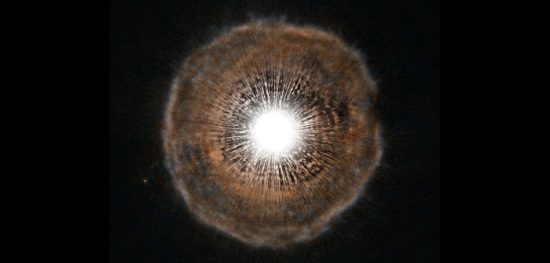
The image from an interesting article on the ultimate in cloud computing. Hubble image of the asymptotic giant branch star U Camelopardalis. This star, nearing the end of its life, is losing mass as it coughs out shells of gas. Credit: ESA/Hubble, NASA and H. Olofsson (Onsala Space Observatory).

Seems like there must have been a mash up of astrophysics/cosmology/cybernetics a couple of weeks ago there have been a series of articles about computers and the universe. One series pointing out that once could conceive of using the AGB stars in their ‘dusting mode’ (above) as a computing engine.

But on the other side there have been a couple of articles that touch on the metaphysical (philosophical basis of reality) concept that we and our universe, are one vast simulation.

…Oxford philosopher Nick Bostrom’s philosophical thought experiment that the universe is a computer simulation. If that were true, then fundamental physical laws should reveal that the universe consists of individual chunks of space-time, like pixels in a video game. “If we live in a simulation, our world has to be discrete,”….

From: New machine learning theory raises questions about nature of science

….a discrete field theory, which views the universe as composed of individual bits and differs from the theories that people normally create. While scientists typically devise overarching concepts of how the physical world behaves, computers just assemble a collection of data points…..

From: New machine learning theory raises questions about nature of science

…A novel computer algorithm, or set of rules, that accurately predicts the orbits of planets in the solar system….

… devised by a scientist at the U.S. Department of Energy’s (DOE) Princeton Plasma Physics Laboratory (PPPL), applies machine learning, the form of artificial intelligence (AI) that learns from experience, to develop the predictions.

Qin (pronounced Chin) created a computer program into which he fed data from past observations of the orbits of Mercury, Venus, Earth, Mars, Jupiter, and the dwarf planet Ceres. This program, along with an additional program known as a ‘serving algorithm,’ then made accurate predictions of the orbits of other planets in the solar system without using Newton’s laws of motion and gravitation. “Essentially, I bypassed all the fundamental ingredients of physics. I go directly from data to data,” Qin said. “There is no law of physics in the middle…

…”Usually in physics, you make observations, create a theory based on those observations, and then use that theory to predict new observations,” said PPPL physicist Hong Qin, author of a paper detailing the concept in Scientific Reports. “What I’m doing is replacing this process with a type of black box that can produce accurate predictions without using a traditional theory or law.”…

From: New machine learning theory raises questions about nature of science

Ok so now I am going to go a bit sideways and you may want to just go on about your internet day. But while I laude Qin and his team I have a bit of an issue with what he claims re the basis is Philosophy. Not the claim that the discrete field theory sparked his concept exploration. But that the actual system he developed has anything to say about that metaphysical theory.

Taking nothing away from the team what I see seems like a straightforward application of machine learning. In fact a relatively simple one though I would laude the whole idea of applying it to physics in general. A very interesting though, like many interesting insights, oddly obvious is retrospect. (Sorry for the repeated Though clauses…I absolutely see this as fascinating insight…and possibly extremely important…it just seems like D’oh in retrospect.)

As physics is very much aligned with mathematics (I think because the discovery of each was feedback on the other) and mathematics and cybernetics are also deeply intwined it should come as no surprise that computer systems designed to create black box solutions, when fed the right kind of data, will create a black box model of physical phenomena.

The output of science are tools that allow us to predict finite things about the universe we live in, repeatably and accurately. These tools are often used by engineers to enable technologyy that make life better for everyone.

But in many ways this is an engineers (relatively narrow) viewpoint. To some large degree an engineer does not care why the tool works, only that it does and how accurately. Counter to that, a strength of the theory based + mathematical model approach is that it gives you a tool to link the rest of reality to the ‘discrete’ piece you are working on right now. A jumping off point or a linking point to other theories that allows us to move onto other problems and link the

And/But (you knew it was coming) i wonder if this has anything to do with discrete field theory per se. Maybe if the learning algorithm used had that in it this would show something of that nature, but otherwise I do not see this as showing anything in particular other than the ability of learning systems which are in some sense continuous not discrete systems to develop predictive models directly from the data (as Qin says) rather than through the labor intensive methods of theory extraction and proof that has been the basis for scientific exploration since it first evolved in the Middle Ages.

Again BUT, it has been getting harder to develop these ‘deep’ theories. Look at the colliders and other tools that physicists use these days to probe the depths of our reality. In this world there are many things, like Qin’s next test with Nuclear Fusion, where an engineering model might be much more valuable than a ‘theory of this’ if it can be captured and used in a fraction of the time.

It’s all good, fascinating, wonderful…but let’s not get ahead of ourselves.

WOW! A cool SETI theory…

Figure: The Wow! Signal. The peak is 32 times the signal to noise ratio of the observations. Courtesy of Sam Morrell. (From the article)

Not much more to be said so I post the intro to the article from Centauri Dreams, about an article/Theory by James Benford. Cool…

Was the Wow! Signal Due to Power Beaming Leakage?

by PAUL GILSTER on JANUARY 22, 2021

The Wow! signal has a storied history in the SETI community, a one-off detection at the Ohio State ‘Big Ear’ observatory in 1977 that Jim Benford, among others, considers the most interesting candidate signal ever received. A plasma physicist and CEO of Microwave Sciences, Benford returns to Centauri Dreams today with a closer look at the signal and its striking characteristics, which admit to a variety of explanations, though only one that the author believes fits all the parameters. A second reception of the Wow! might tell us a great deal, but is such an event likely? So far all repeat observations have failed and, as Benford points out, there may be reason to assume they must. The essay below is a shorter version of the paper Jim has submitted to Astrobiology.

A little air, a bit of heat, some light

What Global Warming? 148 New (2020) Scientific Papers Affirm Recent Non-Warming, A Degrees-Warmer Past at WattsUpWithThat

Climate Change Horror Porn is another tool of the apparat to frighten us. In realty there is an objective truth out there…none of us know it. Two sides largely aligned Left and Right though not precisely have taken sides and because the liberal left is ascendant and deeply intwined in academia and the media they are trying to ‘scare us straight.’ It might be well intentioned in many cases, but ideologues, abusers, users and grifters have gathered around a powerful ideological tool that can be used to manipulate the population.

  • The science such as it is….which is a lot…but not what you are told it is by the media and the ideologues who want to use it.
    • Climate science
      • What climate was/is/will be:
        • Is based on models of how the whole atmosphere, hydrosphere and lithosphere work.
          • Early simple models were very illuminating.
          • Complex models are horribly sensitive to incorrect knowledge and unknowns.
        • A lot of it is based on prior history comparing things like plant and sea life growth vs temperature, CO2 etc.
          • But most of this knowledge is based on proxies up until a decade or at most two ago.
          • Plus sparse and non technical accounts up until the modern era
          • Has a sparse and erratic technical record from about a century and a half.
          • Decent deep record for a couple of decades.
          • Can see what it is today in fair but not omniscient detail.
        • We model the future based on models that we ‘test’ against the past. Like the stock market sometimes these models can do an ok job. But that is only because of parameter fiddling to ‘match the curves.’ The models are by necessity highly simplified and often just plain wrong. For example:
          • recent discovery that cloud impact on surface temperature can increase not decrease surface temperature. And that it may depend on where you are in the world.
          • Recent discovery that CO2 concentration’s affect on green house is not linear and tapers quickly at higher concentrations.
          • That the planetary heat balance is highly affected by cooling at the poles, and that the magnetosphere/sun link into the climate also is highly linked at the poles.
          • Etc.
        • While the first climate models that brilliant men and women came up with less than a century ago have been proven to be largely correct, the details are practically, hardly better modeled today than they were in the 1950’s.
        • Today there are literally hundreds of complex computer models and that are run many times with many different start parameters. They generate families of predictions, effectively at random. Those predictions are never even close to right at a rate greater than chance.
Continue reading

Icy moons, exciting targets of exploration

The Interior of Enceladus Looks Really Great for Supporting Life
Article in UniverseToday on one of Saturn’s moons

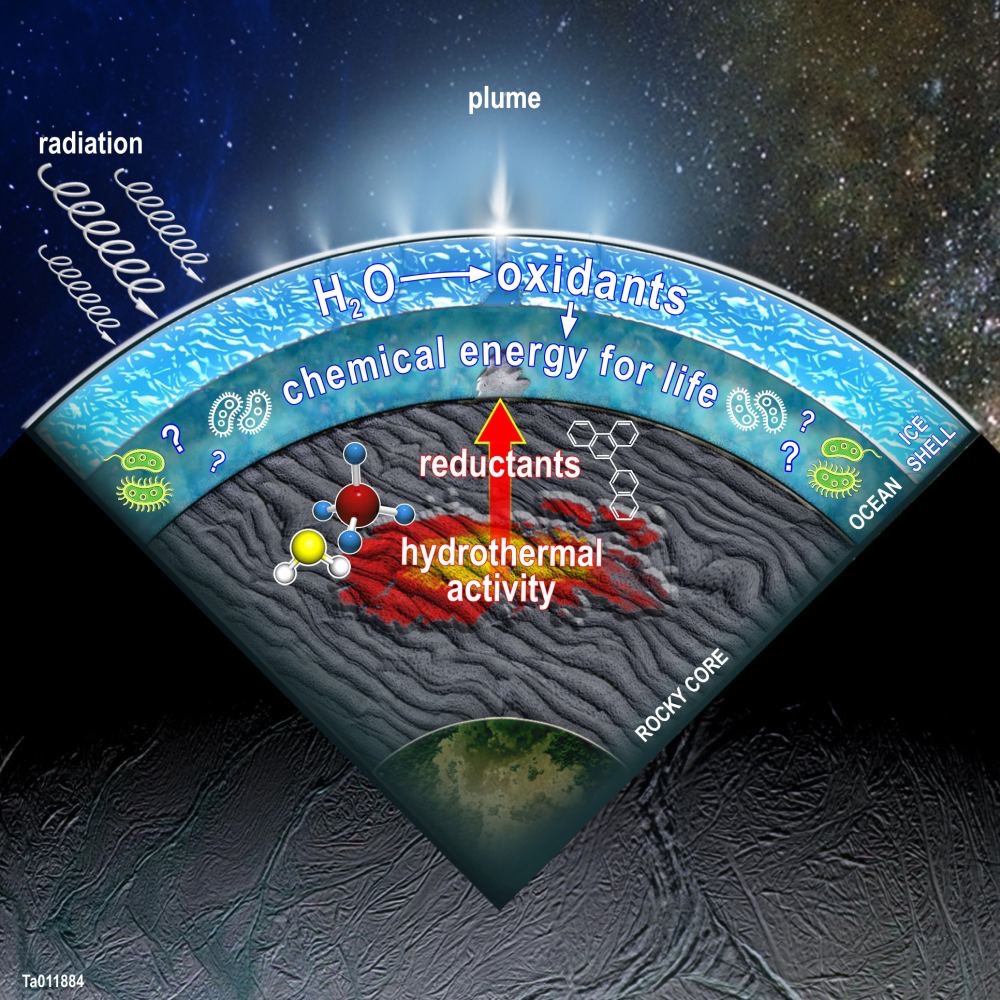
In the early days of space exploration it was the rocky planets, particularly Mars and Venus that held some hope of significant life. Though those with the tools of observation and analysis were pretty negative and life in the rest of the solar system looked impossible. But as our knowledge and tools expanded the icy moons quickly became of interest because as cold region natives know, ice is not a bad insulator and a couple of miles of it would protect a lake. These days it seems pretty clear that Icy Moons often have oceans, seas or lakes inside, and the heat that melts the ice from underneath (from orbital stresses and or radioactive decay) could quite conceivably support life.

The article linked discusses model based research based on data from earlier orbiters and flybys. It shows that notionally their are several mechanisms that could be feeding nutrients and energy sources into the ocean of Enceladus, at a rate suffient to support a significant biome.

There are lots of other interesting articles on space at universe today website, take a look.

Noble Intention = Elite Pretension Elites, intentions, nobility, lies

I do not know the answer to the question: What can we do to slow the the spread of an airborne disease such as COVID 19. What I do know is that approaches with some history have been massively abused. Often with ‘noble’ intentions but to the detriment of the populace.

  • Quarantine – traditionally the people who have the disease. In this case the people most obviously at risk, the elderly. Where this has been implemented it seems to help, BUT the negative impact on the individuals and their family are significant. In the end will this be shown to have been a disaster because of the isolation killing tens of thousands by suicide and drug overdose? Also abuse of this by sending infected into ‘isolation’ wards that weren’t sufficiently isolated killed thousands.
    • The ultimate abuse of quarantine is the tyrannical lock downs, has damaged the economy to the detriment of everyone and in all likelihood killed tens of thousands if not more through overdose, suicide and delay of medical attention to lethal but treatable medical problems.
  • Social Distancing – a modern form of soft quarantine (needs very specific circumstances to mean much.) Where companies implemented for critical staff it appears reasonable, its bland plastering on ever floor in every stored seems silly.
  • Masks – traditional but misunderstood: It stops you from spreading vastly more than catching. Along with social distancing it is reasonable for limiting spread if followed well enough.
  • Crowds indoors – known bad BUT: space and air handling is very important, driving many gatherings into homes was a stupidly obvious result of stopping certain types of events.
  • Crowds outdoors – People need to get out and sunlight and exercise, good feelings are seriously helpful. And the chances of spreading especially in the day is near nil. Health enhancements massively outweigh risks for most. Of course then supporting rioting at night made the rules look political and stupid.
  • Restaurants/bars – Obvious targets of concern. But crowd limitations and rules about cleaning and masking mitigate issues. The ability to get out and mingle in reasonably controlled environment along with the support of the economy outweigh risks.

At the start of all this if the elite (gov’t, medical, media) had acted with open clarity about what was known and unknown. There might have been a chance to get through the last nine months without the breakdown we are seeing.

Politics, especially ‘orange man bad’ was a starting point for the majority of the elite, spin, narcissism and gotcha were key issues especially in what was seen as an existential election year. Lies, more lies and counter lies to control of information, opinion and public activity spun out so that the general populace at this point pretty much ignores whatever is said other than as a sort of televised comedy/drama.

The following and at the link is a fairly mild analysis of the issue from the CATO institute via Instapundit

The main political conflict in recent years is between experts or elites and non‐experts. For lack of a better word, the non‐experts are called populists. Their complaints have been specific: Elites and experts are arrogant, they have different values, they condescend in annoying ways, they ignore the sometimes legitimate concerns of populists, among others. Experts say that they should be listened to because they’re more knowledgeable. We see it in debates on every issue from climate change to trade, immigration, and everything in between.

CATO Institute: Against the Noble Lie – COVID 19s Edition (March of 2020)

Noble intention = Elite pretension

Catching the Watcher | NaNoWriMo 2012 | Day 11

Onwards and upwards into the black!

  • Target Word Count 50,000 Target Average Words Per Day 1,667
  • Words Written Today 2,701
  • Total Words Written 21,771
  • Current Day 11
  • Average Per Day 1,979
  • Words Remaining 28,229
  • Days Remaining 20
  • At This Rate I Will Finish On November 25, 2012
  • Words Per Day To Finish On Time 1,412

So someone might ask what is the world like in the 2060’s and how do I know? To which I reply I obviously cannot know, look at what the smart futurists in 1960 thought the world would be like in the 21st century…for example 2001 (still the best(only) ‘hard’ sci fi movie ever.)

Turn the question around, what was the world like in 1960, transistor just invented, first men in space.  But those who were adults in the think of it had grown up during an incredible step change in technology over twenty years and they expected it to continue.. Of course many of the technologies that had gone through that step change had pretty much peaked out (the 737 flew first time only a few years later, the B52 was in service.) But technology they thought was peaking (computers, radios, etc) were really only on the ramp towards immense changes. Then if you look twenty years on 1980 and twenty years on again 2000, you get some idea of the ramps of change in tech and society. You also get the randomization of events in the real world; tsunami’s, revolutions, wars, demagogues, political movements, etc.

What I try to do is pick the tech, economic social and political ramps looking at 10,15,20 year slices and wrap that all up and come up with a history that makes some sense of the background of the story I am telling.  It’s not perfect and I do not expect any of my predictions to come true, but its fun and interesting to think about.

Rocky remains of Red Giants Last meal spotted

Two hot rocks and their flaky white dwarf

As the poster at arstechnia says this is fascinating stuff and i hope it remains so for a very long time.

Astronomers find a star system where a red giant appears to have swallowed two Jupiter-like planets, then later spit out their cores, which now orbit as small, rocky planets.

via Remains of gas giants, swallowed by red giant star, now orbit as small planets.