One Two Three Four, We Could Get A Nuclear War

One Two Three Four, We Could Get A Nuclear War.

ARES a AWST blog….

“money quotes:”

Watts argued that many countries are no longer pursuing nuclear weapons as a direct counter to U.S. nuclear power, but to compensate for relatively weak conventional forces. That includes Russia, where Watts cites president Vladimir Putin’s emphasis on the importance of nuclear weapons, and post-Cold-War doctrinal writings that talk about using limited nuclear attacks as “demonstration and de-escalation” strikes, to deter or terminate a large-scale nuclear war.

…it’s like a police department whose only force option is to blow up the entire block where the perpetrator lives.

Indeed, U.S. extended deterrence is something that not enough people think about when they advocate further cuts in U.S. nuclear forces. The American “umbrella” covers nations such as South Korea, Japan and Turkey, which have the industrial and technological capability to go nuclear very quickly if they feel that they can no longer rely on the U.S.

Watts warns, “limited use of low-yield nuclear weapons will become the new normal and give rise to a second nuclear age whose dangers and uncertainties will dwarf those of the first.”

20130418-213438.jpg

Crap!

Anti-drone Laser, the Navy steps forward

20130408-174621.jpg
From Wired as so often, this came out the week of SAS(SeaAirSpace) in DC, a conference/exhibition by the Navy League (the premier Naval support/booster society.)

Lasers are used every day for cutting sheet metal, the main issue in weaponizing has become compactness, cooling, and beam forming over miles not inches. The line of sight, zero time of flight nature of its sting, along with some ability to vary your effect and to choose what sort of damage you do (shown in the video), low chance of collateral damage AND the low cost per shot make even a modestly powerful laser weapon a very interesting for ships deployed in zones where the threat can be very low tech but hard to discriminate from non threat till very late, or where you would rather disable than destroy.

China Aircraft Carrier / Navy needs proper context

20130322-091837.jpg

20130322-091858.jpg

Wired and others have been nattering about the Chinese carrier, it’s nascent flight wing, how crappy the hardware is, how hard the job is, etc, etc. working to defuse the China threat they think is being blown up by the Pentagon and congressional hawks.

Look at the two pictures above, the time from first flight to rational threat back ‘in the day’ was a few years, the big gun guys were laughing the whole time. That Fighter struggling off the Lianoning is a threat today if need be, and you do not have to impress an admiral to be able to sink his fleet. No it’s no realistic threat today but don’t make the mistake of equating little with none, the US capability with the capability required to be a threat, or today with forever. The US CVN capability is essentially static or downtrend, China is on the edge of asymptotic rise, with a century and millions of man years of prior experience across the world to pull up on. As other articles in have discussed, what really is a CV in the 21st century? So how long could it be till a Chinese CV threat is more than a wild card? Not long is my estimate.

Going quietly (slowly) into that good night

Wired, Danger Room piece on after the aircraft carrier.

20130320-115250.jpg

The Montford Point landing platform is essentially a cut down supertanker ( the predecessors of today’s Ultra Large Crude-oil Carriers, ULCC) which can ballast down and ‘lean’ so hovercraft can come aboard in open sea. One option is to similarly use this type of craft or similarly modified commercial hulls as cheap almost disposable carriers as needed. A sub divided double hull tanker is very hard to sink and the hull plates are sufficient to keep out small arms and splinters. Plus armoring and fire fighting kits are available and cheap today. The ‘fighting’ bit’ would essentially be a mod kit (a skin) that can be updated, moved around, even stored ready for war, the hull could be almost any commercial large bulk carrier. Heck large container ships are very fast today as are some RoRos, so you don’t even lose much strategic deployment speed.

It’s been the same ever since, except Worse!

From EDN(electronic Design News) a fascinating history of a WWII bomber remote control gunsight, and it’s failure, repeatedly, while the bureaucrats insisted on pushing it forward. Great things were done during WWII but not without cost and not without clearly showing the strengths an weaknesses of the bureaucratic ‘blue model’ way of doing complex programs (at the time the only practical method of management.)

20130317-155639.jpg

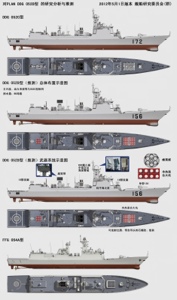
China’s Maturing Modern Navy

20120907-204311.jpg

The Chinese Navy ( sometimes still called the PLAN/People’s Liberation Army Navy/) appears to have finished it’s experimentation~development with their premier surface combatant, the medium DDG 052C/D producing a rough equivalent of the western Aegis (at least in their boosters eyes.) the ship very obviously follows western design concepts but appears to be a very competent design, at least from “it’s likely right if it ‘looks’ Good metric,” though the radar and computer part of the system are probably not that good, yet. This good article in the Diplomat discusses this and its implications in some detail.