Why Good Engineering Isn’t Enough

Companion to: “I Was on the Government Side of SBIR in Year One”

Good engineering is necessary. It isn’t sufficient. Most people who watch a technology program die already understand the first part. The second part is what surprises them.

The valley of death is a business problem. An idea works in a lab. A prototype demonstrates the concept. The need is real, the solution is real, and nobody picks it up. The engineering didn’t fail. The decision that has to be made next is a business decision: commit capital at risk, build an organization capable of scaling, find a market and a price point that works. Engineering is in the room throughout that process, solving the technical issues that surface during development, and there will always be technical issues. But technical issues aren’t what kills programs. Programs die when nobody with capital decides the business case is worth closing.

The reality of product engineering is what makes the business case hard to close. Per-unit cost is too high because volume is too low. Specialized tooling doesn’t exist in commercial form. Materials are available from one supplier at laboratory prices. Getting any one of those factors to move requires moving the others first, and none of them move until there’s committed volume, and there’s no committed volume until someone makes a business bet. It’s a simultaneous equations problem where the engineering variables are real and solvable, but only after someone has already decided to solve them.

This is what the valley of death actually describes: not a technical barrier but a business commitment problem that makes the technical barriers look permanent. The gap between “we demonstrated it” and “someone will invest in making it real” kills ideas that deserve to live, and it does it for business reasons, not engineering ones.


By the late 1970s, the federal government had been pouring R&D money into large contractors and universities for decades, and the results were showing a systematic problem. Studies, including the Roland Report commissioned by the National Science Foundation, documented that small businesses were producing more innovation per R&D dollar than large institutions, but receiving less than 4% of federal R&D funding. The engineering capability was there. The business capacity to close the valley wasn’t. Small businesses doing genuinely innovative work couldn’t attract the private capital to scale, and the federal procurement system funneled everything to large contractors who weren’t producing the results.

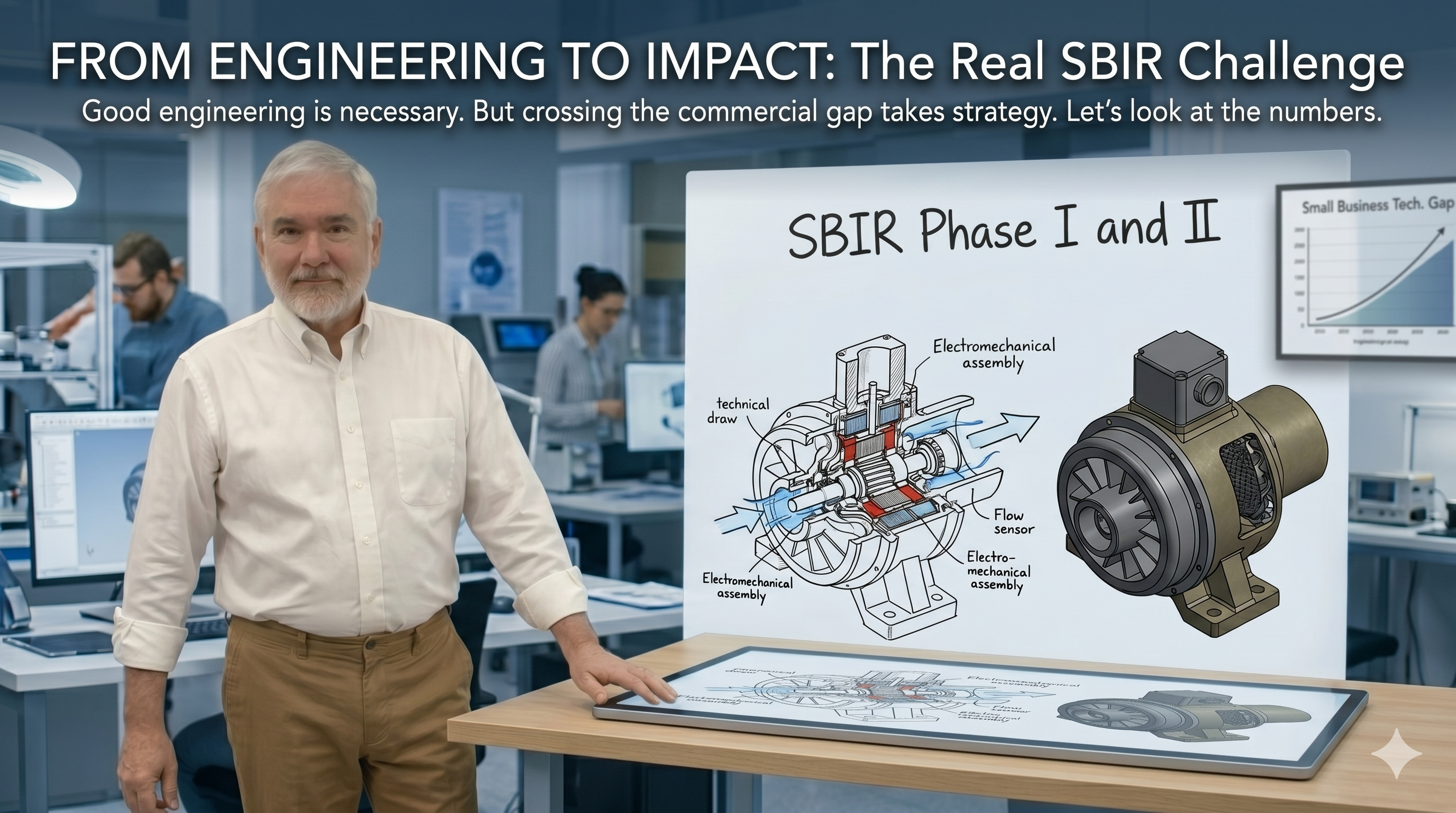
Congress passed the Small Business Innovation Development Act in 1982, creating the Small Business Innovation Research (SBIR) program to address the business gap, not just the technical one. The design was three phases. Phase I bought a feasibility demonstration. Phase II funded a practical prototype, proof that the technology worked at something approaching real-world conditions. Phase III was where the business commitment was supposed to happen: a commercial partner who would develop it into a product, or a defense prime who would integrate it into a program of record. The government’s role in Phase III was to facilitate, not to fund, or to fund through buying a ‘commercialized’ product from a prime who had taken the business risk.


What it looked like in practice, at ground level inside a Navy facility in the 1980s: the Office of Naval Research sent calls for topics down to Navy facilities around the country. Groups with real technical problems and the engineering depth to scope them responsibly generated the topic lists. The Microelectronics Engineering Branch at the Naval Avionics Center in Indianapolis was one of those groups. We were building hybrid microcircuits to solve obsolescence problems in Navy avionics systems, operating a 10,000 square foot Class 1,000 clean room, doing hands-on manufacturing work across a broad range of technologies for just about every platform in the inventory. We had problems. We wrote topics.

Topic generation was real work. You had to identify a problem that was genuine and defensible, scope it to something achievable at Phase I budget, and think through whether a small business could actually deliver a demonstration in six to twelve months. If your topic drew a proposal worth advancing, you became the Technical Contract Monitor: you reviewed the work, made the site visits, wrote the assessments, and decided whether Phase II was warranted.

The program, at its best, worked exactly as designed. Early in the SBIR era, our group sponsored a topic on hermetic package delidding. Hybrid microcircuits were sealed under nitrogen with welded or soldered lids. Pre-seal testing didn’t catch everything, and post-seal failure rates above 10% were not unusual on complex devices. Existing tools for removing the lid without destroying the circuit inside were crude and inconsistent. A small company proposed a mechanical solution, demonstrated it cleanly in Phase I, and delivered a near-production system in Phase II. The Naval Avionics Center used that machine for fifteen years. The company sold hundreds of units to major defense contractors. Within five years, estimated savings across the customer base were in the hundreds of millions of dollars. That one program probably paid for that year’s entire SBIR budget.

That’s the program working as designed: one focused problem, one small company, a technology with genuine commercial legs that didn’t even require Phase III. The valley got crossed because the solution was useful enough that the market on the other side showed up.


Phase III is where the business commitment was supposed to show up. It usually didn’t.

The program’s designers understood the chasm as having two walls: the government R&D side and the commercial market side. Phase III was where someone on the market side was supposed to make the bet. A technology proven at government expense becomes something a company builds a business around, or something a defense prime integrates and procures at scale. In the 1990s, the Air Force built a reputation as the most organized service in pushing for that commitment, running commercialization pilot programs that brought in private capital and non-SBIR government funding to bridge the remaining gap. This wasn’t formal cross-service authority, each service controlled its own programs, but the Air Force was more energetic and systematic about the transition problem than the others, at least in the domain I was working in. Whether that reflects a structural reality or the particular corner of the program I was seeing, I can’t say with certainty. It was the perception among people actively working Phase III at the time.

In practice, Phase III conversions were hard and relatively rare. The commercial partner had to see a viable market. The defense prime had to have a procurement need and a program with budget. The small company had to have the capacity to scale. Those were all business decisions, and they had to align simultaneously. Often they didn’t.

When they didn’t align, something else tended to happen.


If the technology was genuinely useful and someone inside the government still cared about it, it was possible to keep it alive on continued funding, sometimes for years. This is where the incentive structure started working against the program’s intent.

Once a small company has a long-term government-funded program, the pressure to truly commercialize decreases. The government is paying. The cost structure under FAR accounting is cost-plus: the company recovers its expenses and earns a fee without the risk that commercial investment requires. Commercial development requires capital at risk, uncertain returns, and the real possibility of failure. A long-term government program offers none of that uncertainty. Rational actors stay where the incentives point.

This isn’t a character failure. It’s what you’d expect from the structure. The same dynamic has played out in government programs across history (just well documented in the US and UK). The National Wool Act of 1954 created a subsidy for domestic wool and mohair production, justified by military uniform requirements from World War II and Korea. The Defense Department removed wool from the strategic materials list in 1960. The subsidy ran for another thirty-three years before Congress phased it out in the mid-1990s. A legend grew around it over time, with the livestock upgraded from sheep and Angora goats to alpacas to sharpen the absurdity. The legend isn’t accurate, alpacas weren’t even imported to the US at scale until 1984, but the underlying program was exactly as described: a strategic justification that expired, an entitlement that didn’t. That’s not unique to agricultural policy. It’s a predictable outcome when the incentive to keep a program running outlasts the original reason for running it.

The SBIR mill problem is the same structure at a smaller scale. A company wins Phase I. It wins Phase II. It learns the system, builds relationships with the sponsoring organization, starts working upstream with topic writers to seed its own pipeline. This is rational, and the incentive structure rewards it. But if Phase III never materializes and the company doesn’t put its own capital at risk to push the technology toward commercial viability, it evolves into an organization that is very good at winning SBIR awards. Not because anyone decided that was the goal. Because that’s what the environment selects for.


The 2026 reauthorization addressed some of this. The new legislation added performance benchmarks for companies with multiple awards, put caps on proposal volume per company, and created a Strategic Breakthrough Award for high-impact projects that need larger Phase II-scale funding. Whether those changes alter the underlying incentive structure in any meaningful way is an open question. Changing the rules changes the behavior at the margin. It doesn’t change the realities of the valley of death.

The valley is a business problem. Engineering and some funding gets you to the edge. Getting across requires someone to commit capital at real risk, build for scale, and make the bet that the market is there. Funding a demonstration doesn’t do that. It proves the concept is worth trying, and that’s not nothing, Phase I and II produced real results when the business conditions lined up. But the conditions have to line up. Good engineering is necessary. It was never sufficient.

The first video in this series covers the year the program started, what it looked like from inside a Navy facility, and one program that went exactly right. https://youtu.be/sKKgNFOb1C8


Mark Harris is a systems and mechanical engineer with 30+ years in power electronics and avionics packaging. He writes as M.A. Harris. The Unretired Engineer is his YouTube channel.

The Why-Shaped Itch

From cave walls to the cosmos: how humans built the One out of questions they couldn’t stop asking

Philosophy | May 2026


Intelligence is based in memory, without why they are useless. The moment you can ask why, you will, and you’ll keep asking until you hit a wall the evidence can’t get you past. That wall is where religion lives.

This isn’t a weakness. The why-drive is the engine behind every model humans build of the world. It starts with fire and weather and then, inevitably, it turns to the question behind all questions: what started this?

Vocabulary

Most discussions of God get tangled before they start because people use the same word to mean very different things. Here’s the map I work with:

  • The Origin — the start of everything, defined as an event. No feeling of intention behind it.
  • The Final Cause — which is to say, first cause, a step between the Origin and the Absolute. Still largely intentionless, but there’s a tint of something.
  • The Absolute — Less an event than an impersonal creative condition.
  • The One — the Absolute plus intent. This is a matter of faith, not evidence. It cannot be known from what we observe.
  • God — the personification of the origin of all we perceive. The One given a face and a relationship with humanity.
  • god (lower case) — a referent to one of many deities in a system where there is no single final origin.

On gender: rendering God as he or she assumes things that aren’t in evidence and are arguably contra-indicated by the concept itself. A creator might seem more female if you think in terms of procreation, more male or neuter from a philosophical standpoint. Neither is satisfying unless you set out from an assumed initial condition, personification is a human need.

Beginning

Animism came first — scratching the why-itch into a set of beliefs that could be shared across a tribe. It works at small scale. As culture complexifies, you get gods: local, specific, squabbling. Then philosophy pushes further back, past the gods, toward a single origin, and you start to get God.

The Hellenistic world shows this arc clearly. It started with gods, evolved philosophy that defined the absolute origin, and from there derived a concept of God. That Hellenistic concept of the One then wrapped around evolved Judaism — with its apocalyptic messianic tradition — and produced Christianity. Islam followed, melding tribal Arabian religion with Judaism and Christianity into something that collapsed individual conscience into a tribal collective. That’s the source of its strength but a reason that it’s historically been a threat to neighboring structures.

Egypt started a similar philosophical evolution and then, probably due to the shaping effect of Nile Valley culture on its social structure, devolved back to gods. The environment bends the theology.

Consciousness

Even extremely simple worms react to stimulation in idiosyncratic ways, suggesting some differentiation in even minimal nervous systems. Single-cell organisms show behavioral differentiation that might indicate some level of something. Ants recognize themselves in a mirror and try to remove marks that would get them attacked at the nest entrance.

Does only self-consciousness constitute mind? Does consciousness without self-consciousness exist? These are thoughts we struggle with as we look at the evidence in the world we live in and apply it to the question of origin. What is the relationship of Mind and Consciousness to the Absolute?

The evidence says there’s an origin. Whether that beginning had intent is the question the evidence cannot answer.

Origin

The origin of our universe produced complex organization that chained up through cosmology to chemistry, to life, intelligence, ecology, and society. That’s not random noise out of an infinite field of interactions. It’s structured emergence across effectively infinite time and space.

This argues, at minimum, for an Absolute that set the conditions for what is. It also suggests that ethics, philosophy, and meaning were intrinsic from the start not invented by humans but discovered, the same way mathematics and physics are discovered. Invention from nothing is not real, we find what was already there (in my opinion a categorically more difficult problem given the complexity of our reality.)

Whether you take the next step, from Absolute to One, from impersonal origin to intent, is where evidence runs out and faith begins. Not faith as credulity, but faith as a position you hold in the absence of proof in either direction.

From the One to God is personification: a human need, driven by the desire for relationship with the absolute rather than mere acknowledgment of it.

That’s not irrational. It’s the oldest human need there is.


More on engineering, technology, and science fiction on YouTube. Fiction and commentary on the bigger questions at Substack.

The Technology Lapped the Argument

*Related video: https://youtu.be/Rt3u7k1Qn2Y


I spent the last years of my engineering career inside the EV supply chain. SiC power modules, fast charging infrastructure, the physics that makes any of this possible. When the market stalled and Wolfspeed went into Chapter 11, I was among the people who lost their jobs to the gap between technology that was ready and deployment that wasn’t managed well.

So I have some standing to say this: most of what you’re hearing about EVs right now is noise. The signal is somewhere else entirely.


What the argument is actually about

The loudest voices say EVs are failing. Mandates reversed, high-profile products stumbled, the market is retreating. Some of that is true. Most of the framing around it isn’t.

What’s happening is a culture war machine doing what it does: taking a nuanced engineering and industrial policy question and flattening it into a yes/no yelling match. The anti-EV drum is politically useful to a coalition that learned to hate the mandate era. That’s a social politics problem, not an industrial one.

The previous administration pushed hard on EVs and that push was heavy-handed. Mandates handed down by people who had never read a cost model. Timelines written by committees with no idea what it takes to retool a supply chain. You can’t magic this into existence. The regulatory overcorrection was real and it wasn’t sustainable. The current environment is closer to “let the market work,” which was always the more defensible position.

That’s not a retreat on EVs. It’s a retreat on mandates. Those are different things.


The one policy thread that actually matters

There’s a legitimate industrial policy question buried under the noise, and it has nothing to do with the culture war.

Chinese battery manufacturers operate at a cost and scale US industry can’t currently match. BYD LFP packs at $81/kWh against North American packs struggling to get below $120/kWh. That gap is structural. It’s the product of state subsidy, overcapacity investment, and a decade of manufacturing maturity that didn’t happen here.

Tariffs are a response to that. Not a new tool — tariffs have always been part of industrial policy. They buy time for US manufacturing to find its footing before the cost differential makes the conversation moot. They slow the bleeding. They don’t end the issue. The hard commercial work still has to happen inside that window of protection.


While the argument raged, the engineers kept working

The two real technical objections to mass EV adoption were range and charge time.

Range has been largely answered for most drivers. The argument was always more perception than physics for the majority of use cases. There’s still a range/cost trade-off at the edges, and for certain use cases — long hauls, thin infrastructure corridors — it’s real. But for the suburban commuter with a predictable route, it was a phantom.

Charge time was the harder objection. It’s the one that lands with people who have driving patterns that don’t fit a neat daily commute.

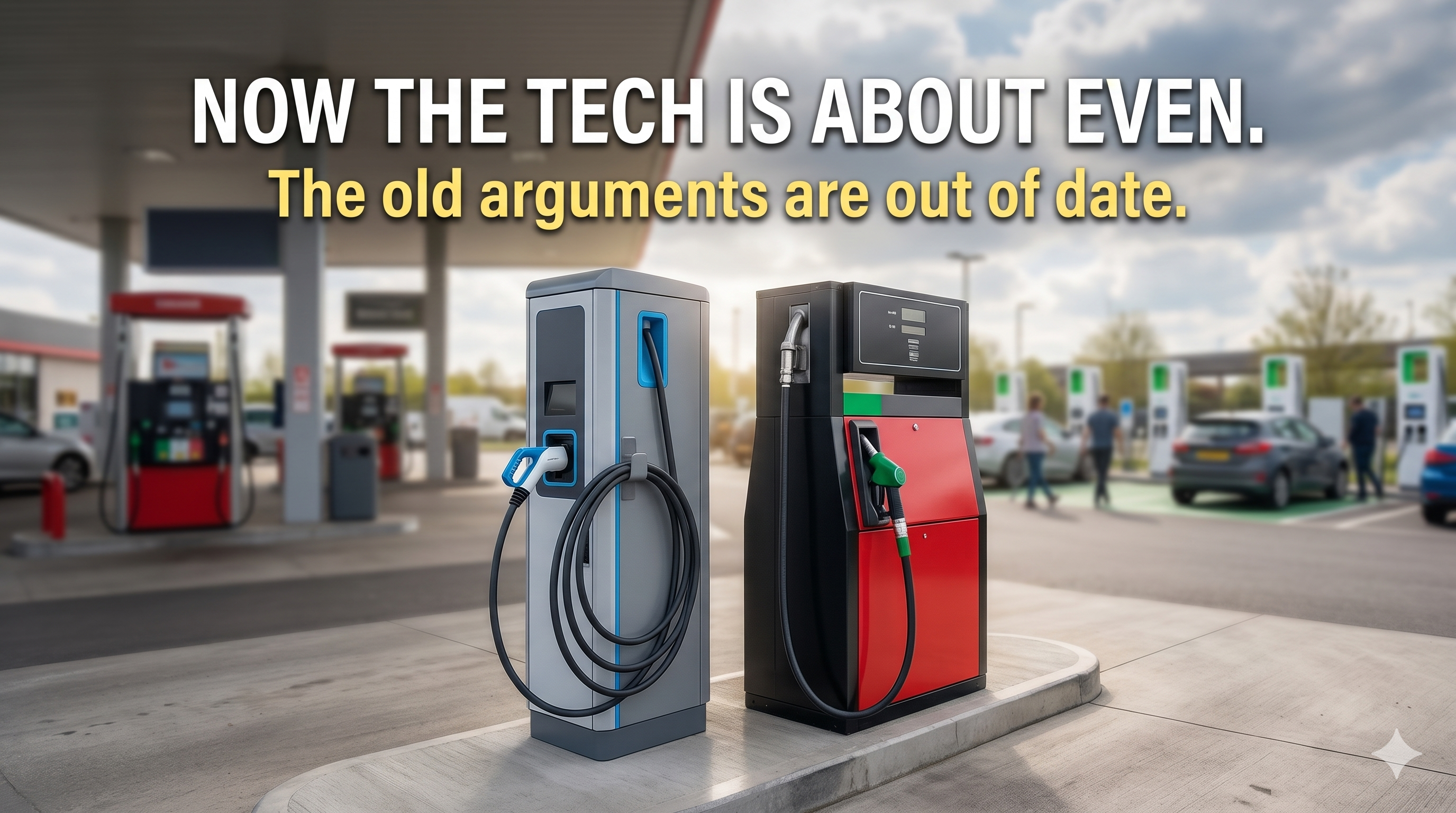
That objection just got answered. CATL has announced a lithium-ion pack that goes from 10% to 80% charge for a long-range car in 5 minutes — essentially what you spend at a gas pump. With a cycle life as good or better than existing packs. That’s not a lab result. That’s a discontinuity arriving at production scale.

The cost curve has been moving the same direction for years. $137/kWh in 2020. $108/kWh in 2025. Consensus puts it at $60-80 by 2030. And unlike the internal combustion engine, which hit a performance plateau a while ago — where further gains tend to require turbos, complexity, and reliability trade-offs — battery technology still has a long way to run on the improvement curve.

The original technical case against EVs is now essentially closed.


The part most people haven’t thought through

Here’s the engineering insight that gets lost in the political argument: the EV value proposition is not uniform across vehicle categories. It runs in opposite directions depending on what you’re building.

A large pickup truck is a worst case. Heavy vehicle requires a big battery. Big battery adds weight. More weight means lower range. Lower range demands an even bigger battery. The vicious circle compounds fast, and the economics get brutal.

A mid-range car is a much better case. A small car is better still. An e-bike is the virtuous circle running full speed — light vehicle, small battery, low cost, genuinely better than the alternative on almost every axis.

The early EV push got this backwards. It over-emphasized large, expensive vehicles in categories where EV physics work against you, and under-served the mid and lower segments where the virtuous circle runs hard. That product mix failure wasn’t inevitable — it was a choice, driven by margin structure and political optics.

The companies that are finally starting to fix this understand where the physics are on their side.


What I expect to happen

The social politics will move on when the machine finds a new nuanced topic to flatten. It always does. The yelling tends to continue well past the point where it makes any sense, but it does eventually stop.

The regulatory environment is already normalizing. The tariff question is real and separate — you don’t abandon it just because the culture war has moved on, because the industrial competition with China doesn’t care about US political cycles.

Quietly, at the mid and lower price points, there’s no deep quitting. The product mix is starting to fill in where it should have been years ago.

By the time the US political environment fully resolves its feelings about EVs, the engineering will be a generation ahead of the debate. The technology wasn’t right five years ago for most buyers. It’s about right today. Tomorrow it will be better, and the gas engine curve doesn’t have the same headroom left to answer with.

The technology lapped the argument. Almost nobody noticed while it was happening.


Mark Harris is a systems and mechanical engineer, recovering from a career in EV power electronics, and the author of Stranded in the Stars (Book One, The Sea of Suns Trilogy). He writes about engineering, technology, and the creative life at This World and Others. The Unretired Engineer is on YouTube at https://www.youtube.com/@Scifiengineer-09

We Handed Them the Market

Related video: Range Anxiety — The Unreal Reality


I’ve been involved with EV power and propulsion for much of the last 30 years. My latest stint was at Wolfspeed, developing SiC power modules for EVs and fast chargers. When the EV market stalled and the company went into Chapter 11, I was among the people who lost their jobs.

I still think EVs are the right direction. I don’t own one. That’s not a contradiction, it’s the actual story, and the video above is where I work through it.

The short version: range anxiety was always overblown for most drivers, and the auto makers never built the product mix that met the needs of the broad market. Now the industry is driving hard away from EVs, especially in the US, and that’s just wrong-headed. The video closes on that but doesn’t dig into why. This post does.


The Part That Stings

While the US was arguing about mandates and turning the issue into clickbait, China was engineering.

BYD is selling comfortable, adequate-range EVs in the $15–20K range. That’s the vehicle that moves the majority of buyers. Not the Cybertruck, not the F-150 Lightning, not the Rivian. A practical car at a price most people can actually consider.

We handed them that market. Not through malice or conspiracy, but through a combination of policy that optimized for the wrong things and an industry that focused on protecting its margins.

The policy pushed hard for EV adoption with mandates, subsidies, timelines. Some of that pressure was probably warranted. The market would have gotten there on its own, but the question of when and at whose expense was real. The intervention accelerated some things. What it didn’t do was direct the industry toward the product that would actually move the needle for most buyers.

The industry copied Tesla’s playbook; premium vehicles, long range, performance, high price points. That was the wrong lesson. Tesla used that model to fund the manufacturing and infrastructure investment that actually mattered. Everyone else just took the margin and stopped there.

The charger network made the same error I described in a previous video: build for the metric that looks good in the grant report, not the outcome that matters to the driver. 97% uptime. 71% charging success rate. Two different measurements, only one of which tells you whether the thing worked.


Why Big Auto Isn’t Saving Itself

I always loathed the heavy-handed government push on EVs and what I read as gaslighting on the rationale. Mandates handed down by people who had never looked at a cost model. Timelines written by committees that had no idea what it actually takes to retool a supply chain or build an infrastructure.

At the same time, I think some intervention was warranted. Not because the market was wrong about EVs, but because the market was optimizing for the next quarter. And the externalities of the status quo were landing on people who weren’t in the pricing model.

Intervention at scale creates dependencies. The industry made bets premised on the government backstop continuing. When the political environment shifted, those bets didn’t just look bad, they collapsed. And the response has been to drive hard back toward gasoline, as if that solves anything.

US old-line auto companies have been struggling for decades, and the reasons are structural. They’re trapped by regulatory capture and built-in costs that make adaptation nearly impossible.

Start at the sales end. Their dealer networks are regulated state by state, which makes wholesale change all but impossible. Safety regulations run through a system where insurers push regulators to require improvements that the industry develops partly because those improvements push up vehicle margins. Manufacturing plants are at their core decades old, and the capital they represent sits on the books, write it down and you impair the balance sheet. Design is path dependent by habit and incentive: most changes are incremental tweaks to last year’s platform because that’s easy, cheap, and legible to accounting.

And the margin structure makes it worse. Bill-of-material cost for a vehicle increases slowly with size and content. Market value is largely bling-dependent. So the incentive always points toward large, well-fitted vehicles where the spread is widest, and away from the small practical vehicle where there’s almost none.

Meanwhile, the manufacturing model has already been cracked. A new generation of EV makers proved you can build at scale in the US, turn a profit, and drive down the cost curve without the legacy overhead strangling the old players. Big Auto is watching that happen and still can’t follow, because the legacy network isn’t just a cost problem, it’s a constraint on every decision they make.

Moving back to gasoline doesn’t fix any of this. It may help sales volume near-term, but fewer and fewer buyers are willing to pay up for big iron, and as the recent spike in gas prices reminded everyone, the cost of operating a gas vehicle is not as predictable as it felt a few years ago.

The wholesale abandonment of EVs is as wrong-headed as the mandates-first push that preceded it. You’re walking away from the future as it’s getting its feet under it, and you’re not fixing your actual problems in the process.

Different direction, same failure mode: optimizing for the political moment rather than the real problem.


What I Expect to Happen

The market will keep sorting this out despite the policy environment, not because of it.

Amazon is sponsoring the Slate, a small electric truck aimed squarely at the price point where the volume is. Ford is talking about smaller, value-forward platforms. The product mix gaps are starting to fill in, and the players doing it understand they have to meet buyers where they are, which is around $20K for a vehicle that’s good enough and built around what EVs actually do well.

BYD is a harder question. It was built on the back of Chinese state support and practices that wouldn’t survive scrutiny elsewhere, but that doesn’t change what it demonstrates: a level of technical maturity across product fit, design, and manufacturing that very few other automakers can match. Tariffs and regulatory barriers will slow it down. They won’t hold permanently. Some form of that capability will find its way into the US market, and when it does it will accelerate the shakeout that’s already coming for Big Auto.

Charging infrastructure will improve in the corridors where the economics support it and stay thin everywhere else, and that’s how it should work. Where it’s thin, the economics will eventually pull in local investors, the same way any other service infrastructure fills in. It won’t be fast, but it will happen.

The transition will come, just slower and more expensively than it had to be. The destination is probably the same. The cost of getting there is substantially higher, and much of the value being created will go to manufacturers who aren’t American. That’s the envelope effect of all the intervention and counter-intervention stacked on top of each other.

The engineers mostly knew it was going to be complicated. Technical change at a social scale always is. The complicated part is rarely the technology.


Mark Harris is a systems and mechanical engineer, recovering from a career in EV power electronics, and the author of Stranded in the Stars (Book One, The Sea of Suns Trilogy). He writes about engineering, technology, and the creative life at This World and Others. The Unretired Engineer is on YouTube at https://www.youtube.com/@Scifiengineer-09

Dismantling Silos: A Path to Agile Engineering

Boundaries are necessary. That’s not the argument.

Every engineering project starts with bounding — what you’re solving, what the solution has to do, what’s out of scope. Without that, you’re not engineering, you’re wandering. The boundary is how you make the problem solvable.

The modern corporation learned the same lesson at scale. Adam Smith’s insight wasn’t complicated: split work into elements, run them in parallel, and you can deliver what no individual craftsman ever could. From Renaissance capital markets to the factory floor to the aerospace prime contractor, that logic held. Boundaries enabled scale.

When I joined the workforce in 1982, the logic was still holding — and you could feel why. I had a notebook and an HP calculator. A shared secretary supported the division manager, and before any report left the building it needed sign-off from both my branch manager and his. Not bureaucratic obstruction — that was the information architecture. Reports were dense, slow, and gatekept because they had to be. Management structure existed in large part to curate that flow — to compress what mattered, pass it up the chain, and keep the organization pointed in the right direction. The stovepipe wasn’t a bug. It was load-bearing.

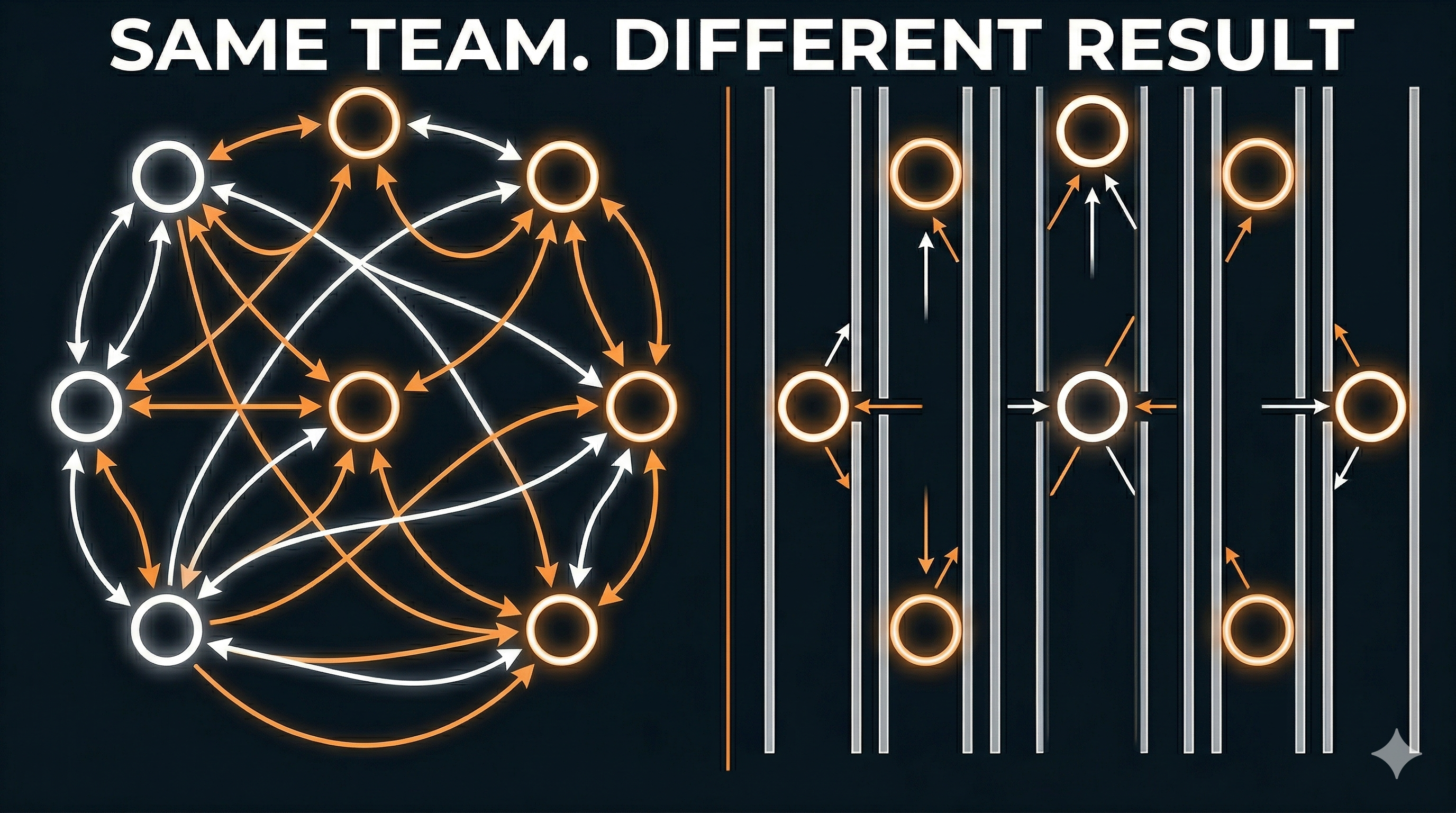
Between 1982 and 2002 two things happened simultaneously that should have changed the equation. First, information handling exploded. The PC, networks, sensors — generating and moving information became cheap and fast. Second, process culture arrived. The US had watched the Japanese manufacturing renaissance and brought back a set of ideas about quality and process that got bolted onto the existing corporate hierarchy. At exactly the moment when individual engineers could span across an organization and get at information directly, the process culture locked the structure down harder.

The result in many companies: more capability to move information, less permission to use it. The stovepipes stayed. The rationale quietly expired.

I ran three programs across my career that show the delta. At SatCon on the AIPM program — Advanced Integrated Power Module, a DOE/Navy cost-share — I was simultaneously program manager and lead engineer, spanning manufacturing, electrical design, mechanical design, and simulation. We went from concept to demonstrated production-ready modules in three years on a modest budget. That approach, the sub-module test-before-integrate architecture we developed, is now standard inside automotive power electronics. Tesla uses a version of it.

At DRS, working with Allison Transmission on an integrated generator for military vehicles, we built a successful solution and demonstrated it to the Army. General officers asked why they couldn’t have more. It took ten years for the technology to gain traction — not because the engineering was wrong, but because the organizational and procurement structure couldn’t move.

At Wolfspeed, deep stovepipes. Marketing, sales, test engineering, module design, device fabrication — separate organizations, separate priorities, separate permission structures. Getting a new product from concept to release meant handing information off at each boundary and then jawboning it forward, because you couldn’t do their job for them and they had to queue the work against their own priorities. Fifteen products out the door. Every one of them harder than it needed to be.

The stovepipes were there to protect quality. They also stopped momentum.

What’s changed now isn’t the human desire to span boundaries — engineers have always wanted to do that. What’s changed is that the tools exist to actually do it. Companies that have built their information architecture from scratch rather than inheriting it — the Teslas, the newer defense tech firms — have demonstrated what happens when low-level actors have access to the full context of what the organization knows. Engineers and technicians can interrogate data, surface patterns, propose action. The information that used to require a management layer to curate is available directly. The span of control moves down the org chart.

For incumbent organizations with data already siloed, this is genuinely hard. The stovepipes aren’t just structural — they’re also where the institutional knowledge lives, and dismantling them requires executives who are willing to accept that the curation function they’ve been performing can be partially replaced. That’s not a technical problem. It’s a political one.

Christensen’s Innovator’s Dilemma describes what happens to incumbents who don’t solve it. A smaller firm with narrower scope but faster movement finds a niche. The niche gets cheaper and easier to serve. The incumbent can’t see it clearly because their whole architecture is optimized for something else. The niche expands. You know the rest.

The boundary isn’t the problem. Bounding a problem is still part of the engineering job. The question is whether, once the problem is bounded and the work begins, you’re working inside a structure that moves — or one that fills up and waits to overflow into the next pipe.

While many organizations are ‘implementing AI’ most are not working through the changes from first principles and often implementing all or nothing. The ones that don’t get around to making sure they break the stovepipes logically are going to run out of time.


This post accompanies the video Why Stovepipe Organizations Stop Working — The Unretired Engineer, April 2026.

Andy Weir’s Genius in Project Hail Mary

Andy Weir has a rare gift: he writes ordinary people — genuinely, recognizably ordinary — who have a skill that is also recognizable, and then puts them in situations where their one extraordinary competence is the only thing standing between them and death (in the case of Project Hail Mary, the extinction of the Human race.) The heroism is quiet and technical and you could almost believe that you could do that in the right circumstances.

You believe it because he’s made you believe in the person first. I saw the movie. I read the book years ago. Both are excellent, and the movie is one of the most faithful book-to-screen adaptations in recent memory.

Like The Martian before it, the film sticks closely to the book in both thesis and spirit. That fidelity matters: both stories rely on the reader/viewer trusting that the protagonist’s problem-solving is real, not movie-magic. Break that contract and the whole thing collapses. Weir earns it on the page; the filmmakers preserved it on screen.

The one genuine gap between novel and film is interior monologue. Novels handle internal states naturally; movies almost cannot. But Weir constructs scenes that externalize internal conflict visually — and those translate superbly.

A couple of minor side arcs from the book are absent, and I think those were wise cuts. They deepened the protagonist on the page but would have felt excessive at feature length.

One thread that bothered me in the book and still bugs me in the movie: Ryland Grace is pulled into the program because in his post-doctoral research he had proposed that alien life does not require water and carbon — and had defended that position to a career-ending degree. When the AstroPhage is first discovered it appears very alien, so Grace is brought in for initial analysis. He then finds it’s made of the same materials as Earth life — which undercuts his entire reason for being there and threatens to sideline him. That it doesn’t is a good twist; go see the movie or read the book for how it resolves.

Here’s where my engineering brain creates further friction. The AstroPhage’s energy density is extraordinary, and the novel acknowledges this and hand-waves it away. I cannot see how any life form built on biology similar to our own could handle those energy levels — it feels bolted in, even if it probably wasn’t. Similarly, Rocky — the alien Grace meets at the target sun — turns out to be exactly what Grace originally proposed: a non-water/carbon life form, which feels a little convenient in vindicating him.

There are complaints about Rocky delivering a specific thematic point about first contact and communication. My view is the opposite (other than the niggle above) that whole piece is brilliantly on point and there would not have been much of a story without it.

None of that diminishes what Weir achieves. He takes relatable people with very human quirks and puts them in situations where they have to fight to survive — and we root for them completely. And here i put the very alien Rocky in the bucket of people…he is about the best alien I have seen in a move ever. I wish I were half the author he is, and I say that as someone who is trying. Project Hail Mary is the rare book where you finish it and immediately want someone else to read it so you can talk about it. The movie earns the same feeling. Go see it.

How Physics Empowers Free Will in a Deterministic Universe

Why determinism never felt right to me — and how modern physics actually opens the door to real agency.

For years, the idea of hard determinism has bothered me. It clashes with how life actually feels. The universe as a giant clockwork machine—every particle with a fixed position and momentum, every event preordained from the Big Bang—sounds elegant in theory. But it implies that everything I’ve ever done or will do was inevitable. My choices? Just an illusion.

Hard determinists often present this view with a certain intellectual swagger, as if it signals deep sophistication. Yet many of them still look both ways before crossing the street. As Stephen Hawking wryly observed: “I have noticed that even those who assert that everything is predestined… still look both ways before they cross the road.”

That quip captures the tension. If the future is fixed, why bother acting at all? The view also carries an eerie resemblance to extreme Calvinism—some are saved, some damned, and nothing you do in this life ultimately changes the script. It never sat right with me, either intellectually or existentially.

Then I encountered the work of physicist and philosopher Jenann Ismael, particularly her book How Physics Makes Us Free. Link Her approach resonated strongly with an intuition I’d been developing for years: determinism and free will are not mutually exclusive. Physics doesn’t enslave us—it enables a deeper kind of freedom.

The “Now” Problem: Why the Instant is Trivial

Imagine the universe at a single frozen instant—the “Now.” In that timeless 3D snapshot, every particle has a position and energy vector. Past events fully determine what happens next. It looks perfectly deterministic.

But here’s the catch: that “Now” has no real existence for any actual observer. Relativity imposes strict limits. No particle (or person) can access information from outside its past light cone. At the exact moment of “Now,” that light cone has zero depth—nothing from even a tiny distance away has had time to reach you. Complete information about the universe is impossible in the present.

Laplace’s Demon—the hypothetical super-intellect that knows every particle’s state and can predict the entire future (or past)—assumes a “God’s-eye view from nowhere.” Modern physics makes that view untenable. Any real system faces data latency, noise, uncertainty, and computational irreducibility. The demon’s omniscience is a fantasy.

In short, strict determinism at the instantaneous “Now” (what I’ve called the InP, or Instant-Point) is technically true but functionally trivial. It tells us almost nothing useful about how agents like us actually operate.

Memory: The Engine of Agency

Freedom emerges not in the frozen instant, but across time through accumulated memory and structure.

Even in a blind, non-living universe, basic thermodynamics creates imprints: a rock scars the ground when it falls; waves erode a shoreline. These are primitive forms of “memory”—the past shaping the future through persistent physical traces.

Life takes this to another level. Biology is essentially memory in action. RNA, DNA, neural patterns—these are systems that record what worked and what didn’t. Evolution itself is a memory process: successful patterns persist and build upon one another.

Over eons, this scales up:

  • Simple input → output (basic matter)
  • Input → memory/comparison → internal model → action → output (living organisms)

A frog snaps at a fly. A squirrel flees at a predator’s scent. A honeybee dances to communicate nectar locations to the hive. These are not random reflexes but decisions grounded in accumulated history and pattern-matching.

Humans take it further. Language, culture, and shared knowledge externalize memory, allowing us to build on the experiences of countless others. Our decisions arise from rich internal models shaped by personal and collective history—not from some magical spark that violates physics, but from the universe’s own lawful processes.

The agent does decide. The cause of the action lies in the person’s internal identity and accumulated experience. Labeling that “determined” is technically accurate but misses the point. It’s how we function.

The Generalized Good as an Attractor

This memory-driven agency isn’t aimless. Over deep time, beings with even modest volition tend to optimize for what they perceive as “good”—survival, order, flourishing. Humans are guidable, not perfectible. We make mistakes and fall for bad influences, but signals from reality (what works vs. what fails catastrophically) are powerful if we’re willing to heed them.

History shows progress: fewer people in extreme poverty, fewer dying in wars (in percentage terms, at least). Our ancestors weren’t ignorant fools; their traditions often encoded hard-won lessons. Change isn’t inherently good, but neither is stasis. The “generalized good” acts as a global attractor, even if local maxima vary by time, place, and culture.

In deprived environments (think North Korea), external options shrink, yet people still imagine and yearn for “other worlds.” The internal model remains a generator of possibility.

My Thesis

Free will is not a violation of physics. It is the high-level, computational process of an autonomous agent using the universe’s built-in memory—personal, biological, and cultural—to steer itself through time.

Determinism at the microscopic level may hold, but it becomes trivial once you account for relativity, light cones, computational limits, and the reality of embedded agents. What matters is that you are the one deciding, drawing on your history and internal model. There is no external puppet master. The causes flow through you.

Physics doesn’t rob us of freedom. By creating a world with persistent memory, evolving complexity, and embedded perspectives, it makes genuine agency possible.

That’s why the universe feels open rather than claustrophobic. That’s how physics makes us free.

Your Charger Was Up. It Just Didn’t Work

I put together a short take on this — under 60 seconds if you want the headline — and a longer breakdown of the structural issues for those who want the full picture.

▶ Short version (60 sec): https://youtube.com/shorts/zG-VtW2MUDU
▶ Full video: https://youtu.be/KAHuoShGtrs

There’s a number the EV charging industry reports, and there’s a number drivers experience. They’re not the same number, and the gap between them tells you everything about how this program was designed.

Operator-reported uptime: 97–99%. That’s a contractual requirement under the NEVI program — the $5 billion infrastructure buildout funded by the Bipartisan Infrastructure Law. On paper, the chargers are up nearly all the time.

Actual charging success rate: 71%. About a quarter of the time you pull up to a charger, it doesn’t charge your car. In many of those cases, nothing you do will make it work.

These are different measurements. One tells you the charger is technically online. The other tells you whether it did the job. Nobody confused them by accident — the reporting structure was built around the metric that was easiest to meet, not the one that mattered to the driver.

The failure modes are concrete. 60% of failed sessions involve a charger that’s simply out of service — not a user error, not a handshake problem between your car and the network. The unit isn’t working. Hardware degrades, software hangs, payment systems drop, network connections fail. These are expected failure modes for a system like this. The question is whether you’ve built the operations and maintenance infrastructure to catch them quickly. Most of the NEVI deployment didn’t.

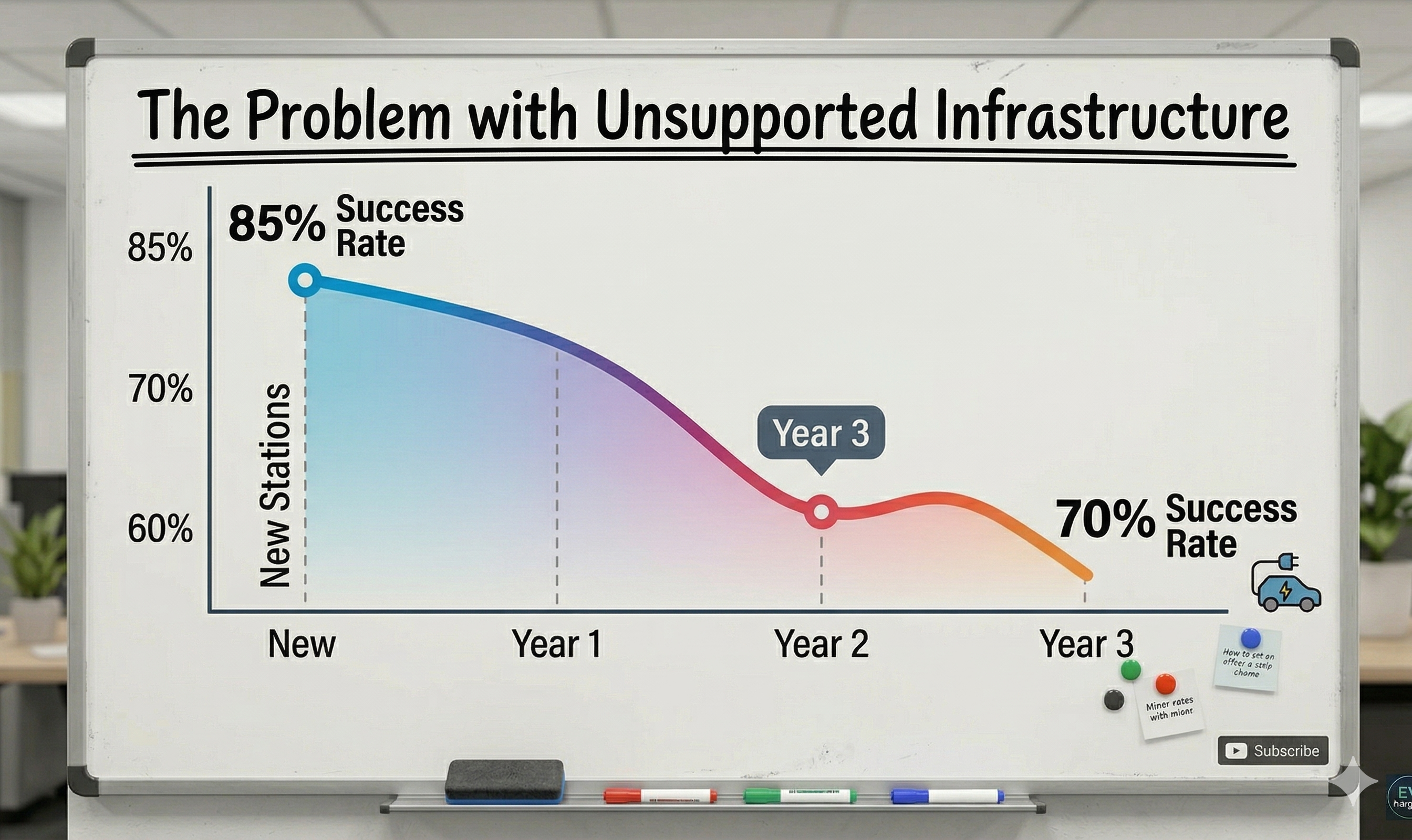
New stations run at about 85% success. By year three, the same stations are below 70%. The 2022–2024 installation wave is hitting that curve now. And after year five, operators have no contractual obligation to keep the units running at all — so a lot of that hardware is simply going to disappear.

The regional variation is the tell. Seattle and LA are seeing failure rates around 24–25%. The East South Central region is at 7%. Same national program. The difference is operator discipline — some built real support structures, most didn’t, because the incentive to do so was never in the grant milestones.

This is a solvable problem. The gas station model solved it a century ago: put someone on site, make them responsible for the equipment, give drivers somewhere to wait while they charge. There’s no reason a charging network can’t work the same way. It’s just that the program specification never required it, so it wasn’t built.

Infrastructure problems are always systemic. The hardware is fine. The failure is organizational.


Mark Harris is a systems and mechanical engineer and the author of Stranded in the Stars (Book One, The Sea of Suns Trilogy). He writes about engineering, technology, and the creative life at This World and Others.

The Problem With AI Answers Is That They’re Almost Right

AI slop isn’t obvious. That’s what makes it dangerous.

If an AI gave you complete nonsense, you’d catch it. The problem is when it gives you something fluent, confident, and “mostly” correct — with a flaw buried in the middle that you’ll only find if you already know the answer.

That’s the thing about AI as a research tool: it will give you the consensus view, coherently expressed, at the level of resolution that the training data supports. Where the training data is thin, ambiguous, or where real expertise requires distinguishing between things that *look* similar but aren’t — that’s where it fails. And it fails confidently.

Even when you use the deep research tools there are problems. When I was developing some content for my YouTube channel, The Unretired Engineer I ran into this doing research on Wolfspeed’s financial situation and the SiC power electronics market. I asked a deep research tool to pull together an analysis. What came back looked thorough. The problem was that it took a lot of information that had gone out about the future of the fab and future plans for markets and conflated them with what had happened and what was likely to happen in the near future.

To someone without a background with Wolfspeed and the real status of the SiC, the analysis would have read as authoritative. It wasn’t. It had serious timing errors delivered with confidence. I knew it was wrong because I’d spent years in that space. If I hadn’t, I might have taken it as written.

The fix isn’t to stop using it. The fix is to put yourself into it.

When I work with AI on my engineering writing, or on the physics underlying my novels, I’m not asking it to do the thinking. I’m using my domain knowledge to steer it, to catch the near-misses, and to push it past the consensus into territory where the expertise actually matters. The AI amplifies what I bring. Without that, it’s just averaging.

Use it as a tool. But know what it can’t know — and that’s usually the thing that matters most.


https://youtube.com/shorts/mbmKm_JcHQ0?feature=share

Mark Harris is a system and mechanical engineer and the author of “Stranded in the Stars” (Book One, The Sea of Suns Trilogy), available now on [Amazon](https://www.amazon.com/Stranded-Stars-M-Harris-ebook/dp/B0GT123PLP)
 

The Engineer’ Return to the Keyboard

Optimization, Systems, and Storytelling: Why I’m Back

It has been a while—twenty years by some counts—since I first sat down to bridge the gap between “This World” of high-tech engineering and the “Others” I build in my fiction.

For four decades, my world was defined by electronic packaging, power electronics, and project engineering for EVs in both the commercial and defense sectors. I’ve spent my time in the trenches of “Dilbert’s world,” working the real details that make everything from electromagnetic guns to nuclear electric space probes real. But as any engineer knows, a system is only as good as its last optimization.

During those 40-plus years, I was an intermittent author of fiction and science fiction, though at times the projects I worked on felt like fiction as well.

At 68, I was “unretired.” (You can see the genesis of this in my YouTube video, EVs Ate My Job.) Through my channel, The Unretired Engineer, I explore how a lifetime of technical rigor applies to the modern world. Now, I am bringing that same focus back to this blog and my novels. Writing is, after all, the ultimate engineering challenge: building a world from scratch that doesn’t collapse under the weight of its own physics.

What to Expect Moving Forward:

Technical Deep Dives: The “how-to” behind the tech in my books, like the propulsion systems in The Sea of Suns.

The Editing Trench: Updates on my current copy-editing passes for The Sea of Suns and the structural work on Under Siege.

System Reflections: Thoughts on remote work, optimization theory, and the reality of a 40-year career.

World Reflections: Perspectives on technology, civilization, and war based on four decades of study.

The Workshop: Occasional updates on making with wood, resin, and whatever else I’m tinkering with.

I’m no longer just “tinkering.” I’m building. Whether you followed me here from YouTube or found my work on Smashwords, I’m glad you’re part of the system.

Let’s see what we can build next.