
We Handed Them the Market

Related video: Range Anxiety — The Unreal Reality


I’ve been involved with EV power and propulsion for much of the last 30 years. My latest stint was at Wolfspeed, developing SiC power modules for EVs and fast chargers. When the EV market stalled and the company went into Chapter 11, I was among the people who lost their jobs.

I still think EVs are the right direction. I don’t own one. That’s not a contradiction, it’s the actual story, and the video above is where I work through it.

The short version: range anxiety was always overblown for most drivers, and the auto makers never built the product mix that met the needs of the broad market. Now the industry is driving hard away from EVs, especially in the US, and that’s just wrong-headed. The video closes on that but doesn’t dig into why. This post does.


The Part That Stings

While the US was arguing about mandates and turning the issue into clickbait, China was engineering.

BYD is selling comfortable, adequate-range EVs in the $15–20K range. That’s the vehicle that moves the majority of buyers. Not the Cybertruck, not the F-150 Lightning, not the Rivian. A practical car at a price most people can actually consider.

We handed them that market. Not through malice or conspiracy, but through a combination of policy that optimized for the wrong things and an industry that focused on protecting its margins.

The policy pushed hard for EV adoption with mandates, subsidies, timelines. Some of that pressure was probably warranted. The market would have gotten there on its own, but the question of when and at whose expense was real. The intervention accelerated some things. What it didn’t do was direct the industry toward the product that would actually move the needle for most buyers.

The industry copied Tesla’s playbook; premium vehicles, long range, performance, high price points. That was the wrong lesson. Tesla used that model to fund the manufacturing and infrastructure investment that actually mattered. Everyone else just took the margin and stopped there.

The charger network made the same error I described in a previous video: build for the metric that looks good in the grant report, not the outcome that matters to the driver. 97% uptime. 71% charging success rate. Two different measurements, only one of which tells you whether the thing worked.


Why Big Auto Isn’t Saving Itself

I always loathed the heavy-handed government push on EVs and what I read as gaslighting on the rationale. Mandates handed down by people who had never looked at a cost model. Timelines written by committees that had no idea what it actually takes to retool a supply chain or build an infrastructure.

At the same time, I think some intervention was warranted. Not because the market was wrong about EVs, but because the market was optimizing for the next quarter. And the externalities of the status quo were landing on people who weren’t in the pricing model.

Intervention at scale creates dependencies. The industry made bets premised on the government backstop continuing. When the political environment shifted, those bets didn’t just look bad, they collapsed. And the response has been to drive hard back toward gasoline, as if that solves anything.

US old-line auto companies have been struggling for decades, and the reasons are structural. They’re trapped by regulatory capture and built-in costs that make adaptation nearly impossible.

Start at the sales end. Their dealer networks are regulated state by state, which makes wholesale change all but impossible. Safety regulations run through a system where insurers push regulators to require improvements that the industry develops partly because those improvements push up vehicle margins. Manufacturing plants are at their core decades old, and the capital they represent sits on the books, write it down and you impair the balance sheet. Design is path dependent by habit and incentive: most changes are incremental tweaks to last year’s platform because that’s easy, cheap, and legible to accounting.

And the margin structure makes it worse. Bill-of-material cost for a vehicle increases slowly with size and content. Market value is largely bling-dependent. So the incentive always points toward large, well-fitted vehicles where the spread is widest, and away from the small practical vehicle where there’s almost none.

Meanwhile, the manufacturing model has already been cracked. A new generation of EV makers proved you can build at scale in the US, turn a profit, and drive down the cost curve without the legacy overhead strangling the old players. Big Auto is watching that happen and still can’t follow, because the legacy network isn’t just a cost problem, it’s a constraint on every decision they make.

Moving back to gasoline doesn’t fix any of this. It may help sales volume near-term, but fewer and fewer buyers are willing to pay up for big iron, and as the recent spike in gas prices reminded everyone, the cost of operating a gas vehicle is not as predictable as it felt a few years ago.

The wholesale abandonment of EVs is as wrong-headed as the mandates-first push that preceded it. You’re walking away from the future as it’s getting its feet under it, and you’re not fixing your actual problems in the process.

Different direction, same failure mode: optimizing for the political moment rather than the real problem.


What I Expect to Happen

The market will keep sorting this out despite the policy environment, not because of it.

Amazon is sponsoring the Slate, a small electric truck aimed squarely at the price point where the volume is. Ford is talking about smaller, value-forward platforms. The product mix gaps are starting to fill in, and the players doing it understand they have to meet buyers where they are, which is around $20K for a vehicle that’s good enough and built around what EVs actually do well.

BYD is a harder question. It was built on the back of Chinese state support and practices that wouldn’t survive scrutiny elsewhere, but that doesn’t change what it demonstrates: a level of technical maturity across product fit, design, and manufacturing that very few other automakers can match. Tariffs and regulatory barriers will slow it down. They won’t hold permanently. Some form of that capability will find its way into the US market, and when it does it will accelerate the shakeout that’s already coming for Big Auto.

Charging infrastructure will improve in the corridors where the economics support it and stay thin everywhere else, and that’s how it should work. Where it’s thin, the economics will eventually pull in local investors, the same way any other service infrastructure fills in. It won’t be fast, but it will happen.

The transition will come, just slower and more expensively than it had to be. The destination is probably the same. The cost of getting there is substantially higher, and much of the value being created will go to manufacturers who aren’t American. That’s the envelope effect of all the intervention and counter-intervention stacked on top of each other.

The engineers mostly knew it was going to be complicated. Technical change at a social scale always is. The complicated part is rarely the technology.


Mark Harris is a systems and mechanical engineer, recovering from a career in EV power electronics, and the author of Stranded in the Stars (Book One, The Sea of Suns Trilogy). He writes about engineering, technology, and the creative life at This World and Others. The Unretired Engineer is on YouTube at https://www.youtube.com/@Scifiengineer-09

Your Charger Was Up. It Just Didn’t Work

I put together a short take on this — under 60 seconds if you want the headline — and a longer breakdown of the structural issues for those who want the full picture.

▶ Short version (60 sec): https://youtube.com/shorts/zG-VtW2MUDU
▶ Full video: https://youtu.be/KAHuoShGtrs

There’s a number the EV charging industry reports, and there’s a number drivers experience. They’re not the same number, and the gap between them tells you everything about how this program was designed.

Operator-reported uptime: 97–99%. That’s a contractual requirement under the NEVI program — the $5 billion infrastructure buildout funded by the Bipartisan Infrastructure Law. On paper, the chargers are up nearly all the time.

Actual charging success rate: 71%. About a quarter of the time you pull up to a charger, it doesn’t charge your car. In many of those cases, nothing you do will make it work.

These are different measurements. One tells you the charger is technically online. The other tells you whether it did the job. Nobody confused them by accident — the reporting structure was built around the metric that was easiest to meet, not the one that mattered to the driver.

The failure modes are concrete. 60% of failed sessions involve a charger that’s simply out of service — not a user error, not a handshake problem between your car and the network. The unit isn’t working. Hardware degrades, software hangs, payment systems drop, network connections fail. These are expected failure modes for a system like this. The question is whether you’ve built the operations and maintenance infrastructure to catch them quickly. Most of the NEVI deployment didn’t.

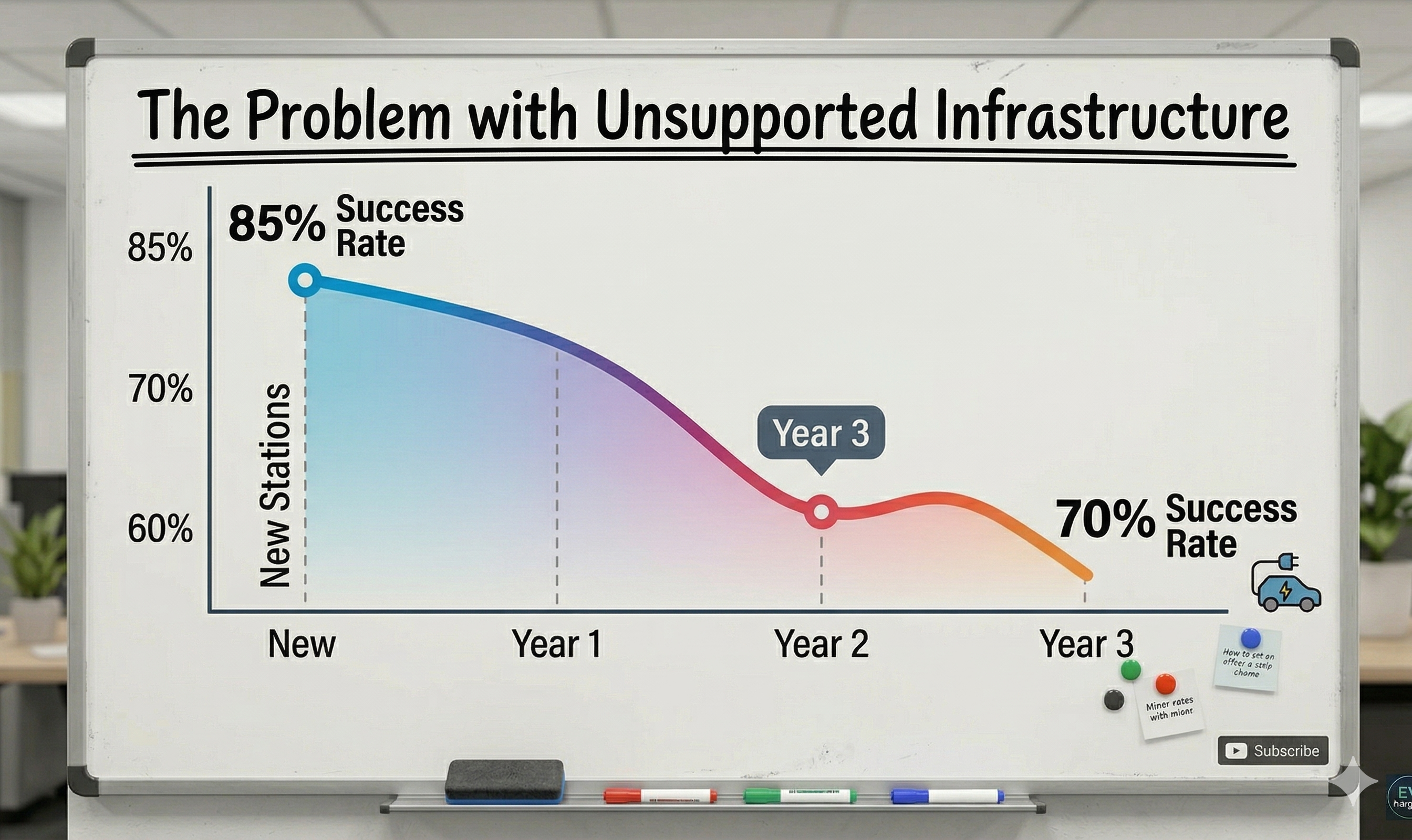
New stations run at about 85% success. By year three, the same stations are below 70%. The 2022–2024 installation wave is hitting that curve now. And after year five, operators have no contractual obligation to keep the units running at all — so a lot of that hardware is simply going to disappear.

The regional variation is the tell. Seattle and LA are seeing failure rates around 24–25%. The East South Central region is at 7%. Same national program. The difference is operator discipline — some built real support structures, most didn’t, because the incentive to do so was never in the grant milestones.

This is a solvable problem. The gas station model solved it a century ago: put someone on site, make them responsible for the equipment, give drivers somewhere to wait while they charge. There’s no reason a charging network can’t work the same way. It’s just that the program specification never required it, so it wasn’t built.

Infrastructure problems are always systemic. The hardware is fine. The failure is organizational.


Mark Harris is a systems and mechanical engineer and the author of Stranded in the Stars (Book One, The Sea of Suns Trilogy). He writes about engineering, technology, and the creative life at This World and Others.

Grumpy elders…

Not much more to say there. Other than everything I hear about what Elizabeth II has indicated publicly, is what I would expect from the grandest of ladies, polite and deflecting rather than the hard right to the chops the little bitches both deserve.

My personal weekend grumpy gripe is the shit show from the idioechelon’s of the DoD about mean things that Tucker Carlson says.

The operational uniformed men and women in the services and the working level folks in the DoD are 99.999% good folks. But unfortunately in this day and age the fraction that works its way to the top is the dregs not the cream.

Do Not Trust DoD! DoD is Asshole!

And

I worked in one of the Navy Industrially Funded Facilities for 15+ years before the assholes in industry finally paid congress enough to get them to shut down those generators of expertise and providers of reasonable cost special projects. I got a PhD level training in technology and the management of technology working on electronics and packaging at NAC, the Naval Avionics Facility, of fond memory.

Do not trust Congress! Congress is Asshole!

Thought for the age

Governments have no resources. They only have spending power insofar as they can arrogate to themselves a percentage of private production; meaning government spending is a consequence of economic growth rather than an instigator. The same applies to “money.” It’s not wealth; rather it’s an agreement about value that enables the movement of actual wealth. In short, abundantly circulated money is a consequence of production as opposed to an instigator.

Forbes article via RealClearMarkets

Space news this week

Articles at Space.Com, SpaceNews, etc.

NASA Has decided to launch one of its astrophysics craft on Falcon Heavy as well as the first parts of Lunar GateWay. These had putatively been ‘assigned’ by congress to the Senate Launch System also known as the Space Launch System (SLS) or what I call the Big Boeing Boondoggle (B3). Hopefully this is a sign of NASA and congressional common sense (I known! Who’d’a thought?) The B3 made some sense until Falcon Heavy was proven now it’s a vast resource ($ and brains) sink that we could do without.

So Boeing is also screwing us because NASA once more has to go to Russia to buy seats to the space station. The notes all imply SpaceX Dragon could cause this…but the reality it is only because Boeing Starliner is late and still in question.

On other Boeing Space Crap, why is it that we have paid billions for the Orion spacecraft for ‘ ‘ Deep SPACE Exploration’ ‘ and that looks a lot like the StarLiner which we paid some towards as well? OK Boeing put up something towards StarLiner…but look I work(ed) in this sector for a long time. Companies in it rarely really put much if anything up in reality. They game money and work are fungible. The contractors make the money coming in for one program cover work that they use on others, calling it ‘in kind contribution.’ And it is, in a green eye-shady way but not in any sense like work coming from the real cSpace sector.

Looking at SLS and new push into space, and the SLS and Orion craft, Boeing and NASA have evolved into a ‘married couple.’ Congressional parsimony and special interest driven oversight cause this all the time. NASA cannot really compete anything in the system because once Boeing got the main contract they could make it far too expensive for anyone else to get the work. Boeing then pulls in subs from all over the country (with political weight as important as technical or cost) to make sure that congress stays satiated. This is a negative way of looking at it and you can spin it positive with some ‘necessary’ downsides. The reality is that for large government programs (due to regulation, oversight and parsimony) you get very very little choice once the program is past early concept. Costs are baked in and out of control almost as soon as metal starts getting bent.

It’s cold and I’m cranky…nuff said…cheers

Of ratchets and slopes, slippery or otherwise

Crossbow and the crank/ratchet for cocking it medieval period, WikiCommons

As commented on before I pay attention to Scott Adams of Dilbert fame as an interesting thinker with a fairly well defined but undefinable political gestalt. Uber liberal realist Trump supporter is maybe the best description.

One of his mantra’s is that Slippery Slopes are Not a Thing.

The following is my interpretation of his position.

A point of view/policy item with a broad ‘option space’ and supporters on both ends, say like gun control, will slide in a direction that is acceptable to the general polity (something like the Overton Window) until some point it will no longer be acceptable. Those who wish to push the policy towards one end or the other will eventually meet resistance and be unable to move the policy further ‘their way’ until some change occurs. That change may move the policy ‘back’ or ‘forward’ but it is acceptability that controls. This says that the idea of a ‘slippery slope ‘with its imagery of reaching a point where you lose control and slide to some end point it false on its face.

Having thought about this I agree with the premise in a general sense.

Two, I think important, quibbles:

1) That in a highly emotional and very dynamic situation such as one might have in the ancient Demos of Greece, or say a Constitutional Congress, a French State Committee…, the slippery slope appears to me to be a real threat. The whole of the polity is in the fight as it were and there is no stable base of opinion to dampen high flights of rhetoric and emotion. In such situations you have a tendency to move to the end state without the intermediary and if this is then enforced on the outside world the results are likely to be calamitous if the topic is one with a high degree of emotional attachment with the broader public. The Demos were tiny isolated city states and they killed a few important people and destroyed themselves but it was in the end fairly evolutionary. The US constitution was very conservative in its basis and while the result was ‘liberal’ it was not that crazy and was in line with most of the populous, plus it was a huge area with a tiny population, where malcontents could often go west if they wanted. The French Revolution was a bloody multi decadal disaster because it didn’t have any other damper than time and blood….To a large degree I don’t see this as that active other than in a Social Network Today…to some degree it explains some of the crap that goes on in odd corners of the web.

2) More important than 1) is the fact that the ratchet is IMO real. That once a law or regulation is in place it tends to create a new baseline and constituency. If the issue is fairly hot there will be pushback but in general people are for stability and a law or regulation will become entrenched. It only takes time for that to then be the jumping off point for a new effort to extend whatever policy. This may not be very logical on its face but it is a reality and is one of the reasons that any human system tends to atrophy with time. So the party who tends to desire more law and regulation have a tendency to have the edge here and they will turn the crank on the ratchet whenever they get the chance.

While England is not the US in any sense one should look at it as a bit of a case study, though the lack of the 2nd Amendment is a huge factor. A century ago guns were rare more because of their cost than anything else. Then regulation started to build up. Because of no 2A and it was very gradual there was not much push back. Today not only is any kind of firearm in private possession effectively illegal so are any edged/pointed device inclusive of scissors. The ratchet is real…the slippery slope is a thing only in very constrained cases.

For Values of Duh

I used to be an IEEE member though I am an ME. IEEE spectrum is a great tech magazine and site. They have an article up Why Aren’t COVID Tracing Apps More Widely Used? , that seems a bit clueless, it starts…..

a new study suggests that trust and transparency are barriers for broader acceptance of the apps

Sub head of above

So…they needed a study to find this out? A type of app that tracks your location at all times and provides that to an cloud AI so it can figure out who you have been talking to, has trust issues, given what we KNOW about big tech?

Sheesh….

The Woke Purge is Beginning

From Maggies Farm: The Woke Purge is Beginning in total because it’s short and very clear:

“ Parler being dumped by Amazon Web Services wasn’t the first shot. Gab was in 2018. Gab is still around, though it is private now and subscription only. That may be the future for Parler and others like it which fill a need.

But going private isn’t the only solution, there are other solutions. But private is probably bes. However, being aware and adept at meeting the Progressive/Leftist challenges to free speech is essential. I am particularly fond of The Mises Institute’s approach.

This is a space in which I’m uniquely informed and aware. I’ve been seeing this slowly developing for years, and it’s been a growing concern. I’ve been told for years “oh it will never get that bad” and now it really is that bad. Many said Net Neutrality was necessary because the provider of the pipes would throttle, reduce and limit ability for sites and apps to work. Ironically, the purported supporters of Net Neutrality are the very same businesses who are throttling free speech – you know, the free speech they felt Net Neutrality was required to prevent OTHERS FROM THROTTLING THEM. Except, they will argue, ‘this is different’. It’s not. And Net Neutrality would have given these tech oligarchs more power to do this very kind of thing.

That said, because all this has happened slowly at first, then suddenly (due to the Capitol incident), Hemingway’s description of bankruptcy fits these moves restricting the freedoms on speech very well. When it’s taken, unlike bankruptcy – which is usually noticeable, this is going largely unnoticed and unmentioned. Or, at least, it’s being done in a manner many consider ‘acceptable’. Because the main beneficiaries are the very groups doing damage to free speech – the tech oligopolists. Who know ‘better than you’ about how things should be done, how you should live your life, and what you can or should say.

Don’t get me wrong. Tech in’t bad. Social media isn’t bad. It’s not inherently evil. It is ambivalent to morality. But individuals themselves can be good or bad, and as a result can have overbearing and long-lasting impacts on our realities. I’m sure Gutenberg was not loved by leaders of the day and “War of the Worlds” certainly sent many scurrying to talk of the damage radio can do. TV was described as a “vast wasteland” and Bill Gates felt there was little commercial value to the internet.

What is happening now requires individual awareness and action. It does NOT require fighting or violence. Just intelligence and smart, cordial and meaningful action. The Progessives are just starting, in my view. I don’t believe violence will help solve issues – it will be used to justify positions. But being louder, smarter and more aware will make a difference.Posted by Bulldog in Hot News & Misc. Short Subjects at 17:06 | Comments (10) | Trackbacks (0)
. “

Freedom vs Liberty

We talk a lot about freedom but it seems to me that this is a word that has a lost its gravitas in the current era. Maybe the older more difficult word liberty is the one we should use when we talk about fundamentals.

Freedom starts with that word Free, which may have had a noble meaning once but essentially triggers the ‘free stuff’ consumer sales instinct today. Free education, Free care, Free food, Free….whatever it is you think someone should have a right to for whatever reason.

The very word Free has been degraded to a economic term that means ‘worth less’ or worthless. One could see this as intentional neo-marxist thought war. It is certainly one of the reasons that a lot of low info types don’t realize that what they are asking for is has a great cost. Gov’t Free stuff is not free.

The word Liberty still has its gravitas. When you say you have liberty of conscience, liberty of person, liberty of property, liberty of word, liberty of action, you are saying things that seem to have weight and maybe make you and others think.

The US was set up as a nation of individual liberty, the individual sovereign over the government, the state strictly limited in its ability to interfere with the individual.

Giving up Freedom of speech to some seems almost trivial, it was free after all right? But if you are saying the government is effectively limiting your liberty of conscience, word and action, I think even those with a limited understanding of the issue might think again.

My read on the Capital crud storm

So I got a concerned eMail from an aunt in England after the crud storm in DC yesterday. Below is my way longer than she probably wanted explanation of what was going on after pointing out that the ‘broke’ media over reported something while casting the worst possible light on it. Below that is a take on the political posturing that led up to it.

The reality is that 4 years ago the Democratic Party screwed up and did not cheat sufficiently to beat the groundswell of support that carried Trump to the presidency. The apparatchiks who thought they had a lock on the future of the country were horrified.

They started a low level insurgency in the gov’t and in the streets where of municipalities where they had absolute hold. Make no mistake, up until yesterday every place you heard about that was having street protests and really riots and violence were in deeply Democratic centers where the mayors and councils could neuter the police and had already neutered the ability of the people to push back.

This last time the Democratic Party was prepared for the Trump support and overwhelmed it. To my mind it looks like cheating put Biden over the top, but that is hard to prove since it would have been a passively cellular network of cheating in densely populated centers they already controlled. Suppressing Trump votes (which were still huge by historical standards) and expanding their own. Much of the issue both pro and con were changing the rules due to ‘COVID’ and a huge concerted drive by both sides to expand the vote, providing a jungle of confusion regarding the reality.

What is going on now is a knock on to that. The reality is that the laws regarding our national elections (in a republic of very differently governed states) are Byzantine in their complexity. What I think few have realized until this last 2 months is that the system has no real way of dealing with systemic breakdown in voting which is highly state centric. While the ‘news’ says that the thousands of accusations of fraud have been ‘proven’ invalid nothing like that has happened. Except in a few trivial cases nothing has actually reached the point of presenting proof. In every significant case the court has refused to take the case because:1) The protest should have been made before the election, once the election happened the protest is void (even though there was no time before the election to know what was happening.) 2) The person(s) making the protest had no standing because they were not directly harmed. 3) The court did not have jurisdiction and thus even if they took the case could not remedy any fault found. 4) The court did not have any remedy period…which is essentially what the US Supreme Court said when the States protested other States patently fraudulent election results.

The above and Trumps refusal to back down is what triggered yesterday which was very peaceful until an idiot shot an unarmed protestor in the capital building where she in fact had something of a right (as a citizen) to be. It should also be noted that this was a Potemkin affair, the Mayor (deep rabid Democrat) pulled the police and closed things down to enable violent rioting (that did not happen.) Also pulled the police from the capital and the protective services essentially did not push back when the crowds started building up. Then the politicos went into deep political posturing for the cameras thus providing all sorts of wonderful propaganda fodder for the ‘new.’

Should the invasion have happened, no. Did Trump make it possible, yes. Did his opposition PULL the crowds in for propaganda purposes, YES. Did the capital burn down or suffer any significant damage, NO.

What you see is the marxist left pulling the liberal idiots into their grip so that they can start stripping the country of its assets as they have been doing in the UK for the last couple of decades (from my view over the pond.)

An interesting blog piece on the background I discussed above from Mark Tapscott at Instapundit:

“….. the more fundamental question is whether Congress has the authority to set aside a state’s Electoral College votes. In my view, there are two key aspects of the question:

First, is there sufficient evidence of fraud in states like Georgia, Pennsylvania, Arizona, and others to justify the decisions of Republican senators Ted Cruz of Texas and Josh Hawley of Missouri to register objections to the acceptance of their Electoral College votes? I haven’t had the opportunity to review all of the evidence for all of the allegations, but, as explained, for example, in this
“American Thought Leaders” interview on The Epoch Times with the Data Integrity Group, the evidence of vote manipulation in multiple states is substantial and cries out for a critical investigation.

Second, Congress has an absolute right to set aside the Electoral College votes, according to President Abraham Lincoln, who
told Congress on February 9, 1865, that “the two Houses of Congress, convened under the twelfth article of the Constitution, have complete power to exclude from counting all electoral votes deemed by them to be illegal, and it is not competent for the Executive to defeat or obstruct that power by a veto …”

The
process seen in Wednesday’s Joint Session, interrupted as it was by the riot around and within the Capitol, was conducted as prescribed in the Constitution. Each properly framed and submitted objection to the acceptance of a state’s certified Electoral College votes gets two hours of debate in the Senate and the House, at the end of which members of both chambers vote on whether to accept or reject the objection.

Congress considered objections in 1969 (the “faithless elector” of North Carolina) and 2005 (Democrat objection to awarding Ohio’s votes to President George W. Bush) under this process and rejected the propositions. But Congress could have accepted the objections, which would have left Electoral College votes on the floor.

This reality should not surprise anybody who is familiar with the manner in which the Founders wrote the Constitution as a “legislative supremacy” document. So long as the Senate and House are of one will, Congress has, as Willmoore Kendal and George Carey
wrote, “all of the ultimate weapons in any showdown with either of the other two branches.”

Congress doesn’t like a program or action favored by the President? Congress can defund it. To cite but two examples: Congress doesn’t like how the Supreme Court is ruling? Congress can change the composition of the Court. If Congress has the will, the Founders gave it the power to do pretty much as it pleases so long as it respects the Bill of Rights.

Bottom Line: There is substantial evidence that Congress could have relied upon,
had it chosen to do so, in deciding to exclude the Electoral College votes of any of the challenged states Wednesday and thereby made either Joe Biden or Donald Trump our next Chief Executive.

Had I been a senator or representative Wednesday, I would have voted to uphold the challenges presented for Arizona and Pennsylvania (as well as those planned prior to the riot for Georgia, Michigan, Wisconsin and Nevada), on the basis of the Data Integrity Group’s statistical analysis, not because doing so would have given Trump another four years in office, but because somebody ought to go to jail after pulling off what is likely the biggest election theft in American history.

Either we have honest elections or we don’t.

UPDATE: Thanks to reader CptNerd for
this link to much easier to read version of the full Lincoln quote. I used the Congressional Globe link because the whole page makes interesting, though difficult to decipher in places, reading.”

Nuff said…