
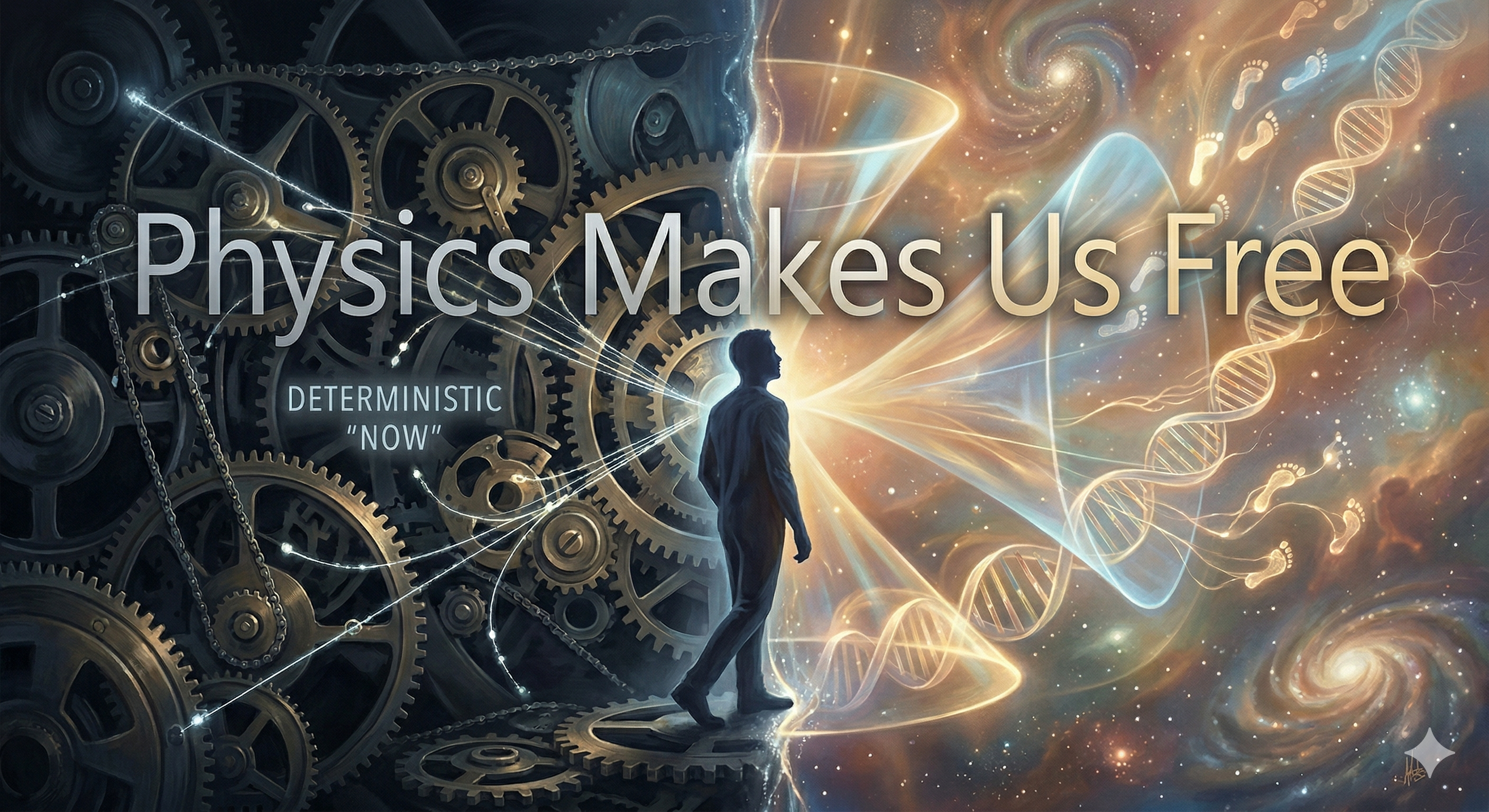
Why determinism never felt right to me — and how modern physics actually opens the door to real agency.
For years, the idea of hard determinism has bothered me. It clashes with how life actually feels. The universe as a giant clockwork machine—every particle with a fixed position and momentum, every event preordained from the Big Bang—sounds elegant in theory. But it implies that everything I’ve ever done or will do was inevitable. My choices? Just an illusion.
Hard determinists often present this view with a certain intellectual swagger, as if it signals deep sophistication. Yet many of them still look both ways before crossing the street. As Stephen Hawking wryly observed: “I have noticed that even those who assert that everything is predestined… still look both ways before they cross the road.”
That quip captures the tension. If the future is fixed, why bother acting at all? The view also carries an eerie resemblance to extreme Calvinism—some are saved, some damned, and nothing you do in this life ultimately changes the script. It never sat right with me, either intellectually or existentially.
Then I encountered the work of physicist and philosopher Jenann Ismael, particularly her book How Physics Makes Us Free. Link Her approach resonated strongly with an intuition I’d been developing for years: determinism and free will are not mutually exclusive. Physics doesn’t enslave us—it enables a deeper kind of freedom.
The “Now” Problem: Why the Instant is Trivial
Imagine the universe at a single frozen instant—the “Now.” In that timeless 3D snapshot, every particle has a position and energy vector. Past events fully determine what happens next. It looks perfectly deterministic.
But here’s the catch: that “Now” has no real existence for any actual observer. Relativity imposes strict limits. No particle (or person) can access information from outside its past light cone. At the exact moment of “Now,” that light cone has zero depth—nothing from even a tiny distance away has had time to reach you. Complete information about the universe is impossible in the present.
Laplace’s Demon—the hypothetical super-intellect that knows every particle’s state and can predict the entire future (or past)—assumes a “God’s-eye view from nowhere.” Modern physics makes that view untenable. Any real system faces data latency, noise, uncertainty, and computational irreducibility. The demon’s omniscience is a fantasy.
In short, strict determinism at the instantaneous “Now” (what I’ve called the InP, or Instant-Point) is technically true but functionally trivial. It tells us almost nothing useful about how agents like us actually operate.
Memory: The Engine of Agency
Freedom emerges not in the frozen instant, but across time through accumulated memory and structure.
Even in a blind, non-living universe, basic thermodynamics creates imprints: a rock scars the ground when it falls; waves erode a shoreline. These are primitive forms of “memory”—the past shaping the future through persistent physical traces.
Life takes this to another level. Biology is essentially memory in action. RNA, DNA, neural patterns—these are systems that record what worked and what didn’t. Evolution itself is a memory process: successful patterns persist and build upon one another.
Over eons, this scales up:
- Simple input → output (basic matter)
- Input → memory/comparison → internal model → action → output (living organisms)
A frog snaps at a fly. A squirrel flees at a predator’s scent. A honeybee dances to communicate nectar locations to the hive. These are not random reflexes but decisions grounded in accumulated history and pattern-matching.
Humans take it further. Language, culture, and shared knowledge externalize memory, allowing us to build on the experiences of countless others. Our decisions arise from rich internal models shaped by personal and collective history—not from some magical spark that violates physics, but from the universe’s own lawful processes.
The agent does decide. The cause of the action lies in the person’s internal identity and accumulated experience. Labeling that “determined” is technically accurate but misses the point. It’s how we function.
The Generalized Good as an Attractor
This memory-driven agency isn’t aimless. Over deep time, beings with even modest volition tend to optimize for what they perceive as “good”—survival, order, flourishing. Humans are guidable, not perfectible. We make mistakes and fall for bad influences, but signals from reality (what works vs. what fails catastrophically) are powerful if we’re willing to heed them.
History shows progress: fewer people in extreme poverty, fewer dying in wars (in percentage terms, at least). Our ancestors weren’t ignorant fools; their traditions often encoded hard-won lessons. Change isn’t inherently good, but neither is stasis. The “generalized good” acts as a global attractor, even if local maxima vary by time, place, and culture.
In deprived environments (think North Korea), external options shrink, yet people still imagine and yearn for “other worlds.” The internal model remains a generator of possibility.
My Thesis
Free will is not a violation of physics. It is the high-level, computational process of an autonomous agent using the universe’s built-in memory—personal, biological, and cultural—to steer itself through time.
Determinism at the microscopic level may hold, but it becomes trivial once you account for relativity, light cones, computational limits, and the reality of embedded agents. What matters is that you are the one deciding, drawing on your history and internal model. There is no external puppet master. The causes flow through you.
Physics doesn’t rob us of freedom. By creating a world with persistent memory, evolving complexity, and embedded perspectives, it makes genuine agency possible.
That’s why the universe feels open rather than claustrophobic. That’s how physics makes us free.
 This World and Others