Companion to: “I Was on the Government Side of SBIR in Year One”
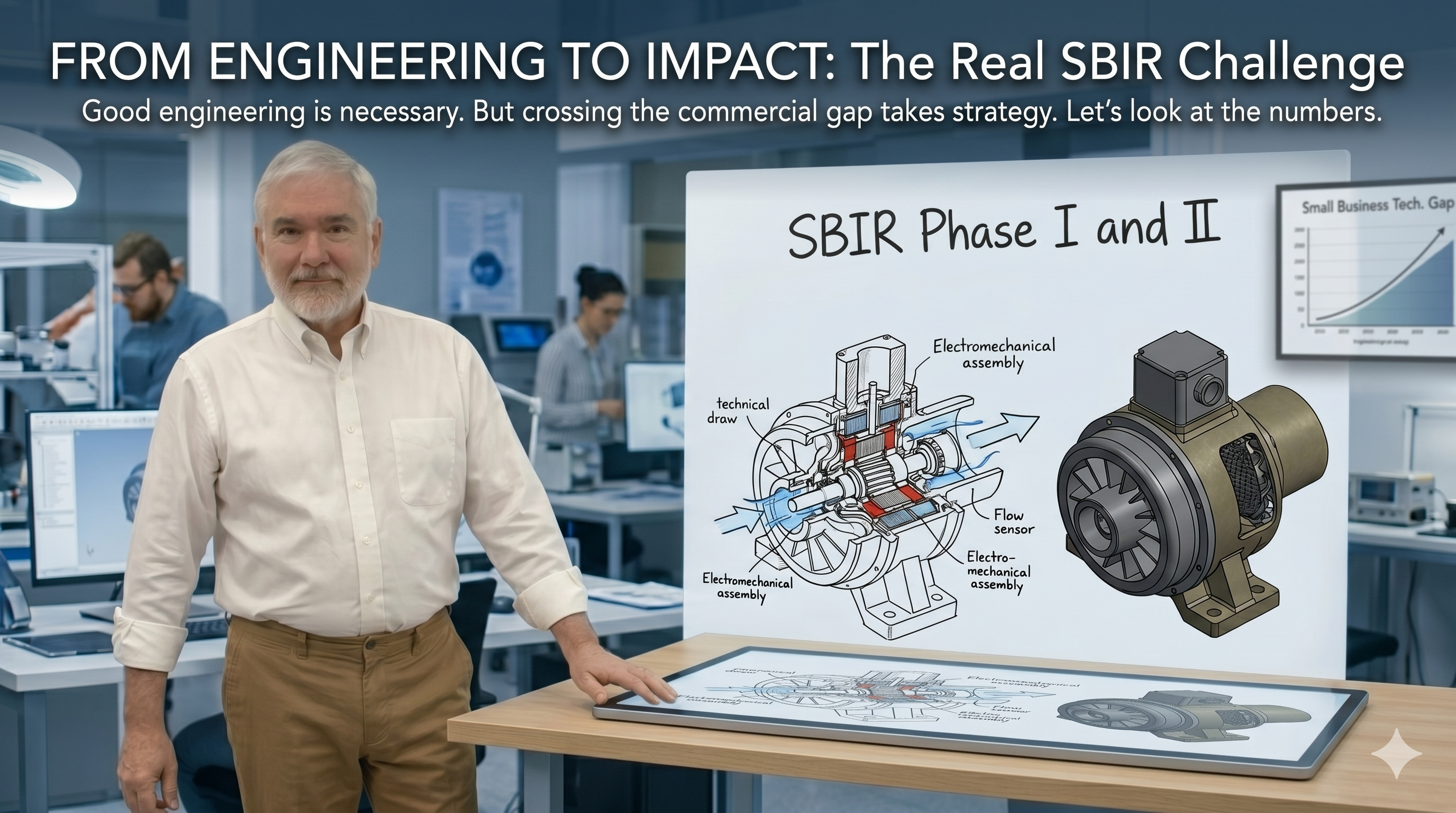
Good engineering is necessary. It isn’t sufficient. Most people who watch a technology program die already understand the first part. The second part is what surprises them.
The valley of death is a business problem. An idea works in a lab. A prototype demonstrates the concept. The need is real, the solution is real, and nobody picks it up. The engineering didn’t fail. The decision that has to be made next is a business decision: commit capital at risk, build an organization capable of scaling, find a market and a price point that works. Engineering is in the room throughout that process, solving the technical issues that surface during development, and there will always be technical issues. But technical issues aren’t what kills programs. Programs die when nobody with capital decides the business case is worth closing.
The reality of product engineering is what makes the business case hard to close. Per-unit cost is too high because volume is too low. Specialized tooling doesn’t exist in commercial form. Materials are available from one supplier at laboratory prices. Getting any one of those factors to move requires moving the others first, and none of them move until there’s committed volume, and there’s no committed volume until someone makes a business bet. It’s a simultaneous equations problem where the engineering variables are real and solvable, but only after someone has already decided to solve them.
This is what the valley of death actually describes: not a technical barrier but a business commitment problem that makes the technical barriers look permanent. The gap between “we demonstrated it” and “someone will invest in making it real” kills ideas that deserve to live, and it does it for business reasons, not engineering ones.
By the late 1970s, the federal government had been pouring R&D money into large contractors and universities for decades, and the results were showing a systematic problem. Studies, including the Roland Report commissioned by the National Science Foundation, documented that small businesses were producing more innovation per R&D dollar than large institutions, but receiving less than 4% of federal R&D funding. The engineering capability was there. The business capacity to close the valley wasn’t. Small businesses doing genuinely innovative work couldn’t attract the private capital to scale, and the federal procurement system funneled everything to large contractors who weren’t producing the results.
Congress passed the Small Business Innovation Development Act in 1982, creating the Small Business Innovation Research (SBIR) program to address the business gap, not just the technical one. The design was three phases. Phase I bought a feasibility demonstration. Phase II funded a practical prototype, proof that the technology worked at something approaching real-world conditions. Phase III was where the business commitment was supposed to happen: a commercial partner who would develop it into a product, or a defense prime who would integrate it into a program of record. The government’s role in Phase III was to facilitate, not to fund, or to fund through buying a ‘commercialized’ product from a prime who had taken the business risk.
What it looked like in practice, at ground level inside a Navy facility in the 1980s: the Office of Naval Research sent calls for topics down to Navy facilities around the country. Groups with real technical problems and the engineering depth to scope them responsibly generated the topic lists. The Microelectronics Engineering Branch at the Naval Avionics Center in Indianapolis was one of those groups. We were building hybrid microcircuits to solve obsolescence problems in Navy avionics systems, operating a 10,000 square foot Class 1,000 clean room, doing hands-on manufacturing work across a broad range of technologies for just about every platform in the inventory. We had problems. We wrote topics.
Topic generation was real work. You had to identify a problem that was genuine and defensible, scope it to something achievable at Phase I budget, and think through whether a small business could actually deliver a demonstration in six to twelve months. If your topic drew a proposal worth advancing, you became the Technical Contract Monitor: you reviewed the work, made the site visits, wrote the assessments, and decided whether Phase II was warranted.
The program, at its best, worked exactly as designed. Early in the SBIR era, our group sponsored a topic on hermetic package delidding. Hybrid microcircuits were sealed under nitrogen with welded or soldered lids. Pre-seal testing didn’t catch everything, and post-seal failure rates above 10% were not unusual on complex devices. Existing tools for removing the lid without destroying the circuit inside were crude and inconsistent. A small company proposed a mechanical solution, demonstrated it cleanly in Phase I, and delivered a near-production system in Phase II. The Naval Avionics Center used that machine for fifteen years. The company sold hundreds of units to major defense contractors. Within five years, estimated savings across the customer base were in the hundreds of millions of dollars. That one program probably paid for that year’s entire SBIR budget.
That’s the program working as designed: one focused problem, one small company, a technology with genuine commercial legs that didn’t even require Phase III. The valley got crossed because the solution was useful enough that the market on the other side showed up.
Phase III is where the business commitment was supposed to show up. It usually didn’t.
The program’s designers understood the chasm as having two walls: the government R&D side and the commercial market side. Phase III was where someone on the market side was supposed to make the bet. A technology proven at government expense becomes something a company builds a business around, or something a defense prime integrates and procures at scale. In the 1990s, the Air Force built a reputation as the most organized service in pushing for that commitment, running commercialization pilot programs that brought in private capital and non-SBIR government funding to bridge the remaining gap. This wasn’t formal cross-service authority, each service controlled its own programs, but the Air Force was more energetic and systematic about the transition problem than the others, at least in the domain I was working in. Whether that reflects a structural reality or the particular corner of the program I was seeing, I can’t say with certainty. It was the perception among people actively working Phase III at the time.
In practice, Phase III conversions were hard and relatively rare. The commercial partner had to see a viable market. The defense prime had to have a procurement need and a program with budget. The small company had to have the capacity to scale. Those were all business decisions, and they had to align simultaneously. Often they didn’t.
When they didn’t align, something else tended to happen.
If the technology was genuinely useful and someone inside the government still cared about it, it was possible to keep it alive on continued funding, sometimes for years. This is where the incentive structure started working against the program’s intent.
Once a small company has a long-term government-funded program, the pressure to truly commercialize decreases. The government is paying. The cost structure under FAR accounting is cost-plus: the company recovers its expenses and earns a fee without the risk that commercial investment requires. Commercial development requires capital at risk, uncertain returns, and the real possibility of failure. A long-term government program offers none of that uncertainty. Rational actors stay where the incentives point.
This isn’t a character failure. It’s what you’d expect from the structure. The same dynamic has played out in government programs across history (just well documented in the US and UK). The National Wool Act of 1954 created a subsidy for domestic wool and mohair production, justified by military uniform requirements from World War II and Korea. The Defense Department removed wool from the strategic materials list in 1960. The subsidy ran for another thirty-three years before Congress phased it out in the mid-1990s. A legend grew around it over time, with the livestock upgraded from sheep and Angora goats to alpacas to sharpen the absurdity. The legend isn’t accurate, alpacas weren’t even imported to the US at scale until 1984, but the underlying program was exactly as described: a strategic justification that expired, an entitlement that didn’t. That’s not unique to agricultural policy. It’s a predictable outcome when the incentive to keep a program running outlasts the original reason for running it.
The SBIR mill problem is the same structure at a smaller scale. A company wins Phase I. It wins Phase II. It learns the system, builds relationships with the sponsoring organization, starts working upstream with topic writers to seed its own pipeline. This is rational, and the incentive structure rewards it. But if Phase III never materializes and the company doesn’t put its own capital at risk to push the technology toward commercial viability, it evolves into an organization that is very good at winning SBIR awards. Not because anyone decided that was the goal. Because that’s what the environment selects for.
The 2026 reauthorization addressed some of this. The new legislation added performance benchmarks for companies with multiple awards, put caps on proposal volume per company, and created a Strategic Breakthrough Award for high-impact projects that need larger Phase II-scale funding. Whether those changes alter the underlying incentive structure in any meaningful way is an open question. Changing the rules changes the behavior at the margin. It doesn’t change the realities of the valley of death.
The valley is a business problem. Engineering and some funding gets you to the edge. Getting across requires someone to commit capital at real risk, build for scale, and make the bet that the market is there. Funding a demonstration doesn’t do that. It proves the concept is worth trying, and that’s not nothing, Phase I and II produced real results when the business conditions lined up. But the conditions have to line up. Good engineering is necessary. It was never sufficient.
The first video in this series covers the year the program started, what it looked like from inside a Navy facility, and one program that went exactly right. https://youtu.be/sKKgNFOb1C8
Mark Harris is a systems and mechanical engineer with 30+ years in power electronics and avionics packaging. He writes as M.A. Harris. The Unretired Engineer is his YouTube channel.