Andy Weir’s Genius in Project Hail Mary

Andy Weir has a rare gift: he writes ordinary people — genuinely, recognizably ordinary — who have a skill that is also recognizable, and then puts them in situations where their one extraordinary competence is the only thing standing between them and death (in the case of Project Hail Mary, the extinction of the Human race.) The heroism is quiet and technical and you could almost believe that you could do that in the right circumstances.

You believe it because he’s made you believe in the person first. I saw the movie. I read the book years ago. Both are excellent, and the movie is one of the most faithful book-to-screen adaptations in recent memory.

Like The Martian before it, the film sticks closely to the book in both thesis and spirit. That fidelity matters: both stories rely on the reader/viewer trusting that the protagonist’s problem-solving is real, not movie-magic. Break that contract and the whole thing collapses. Weir earns it on the page; the filmmakers preserved it on screen.

The one genuine gap between novel and film is interior monologue. Novels handle internal states naturally; movies almost cannot. But Weir constructs scenes that externalize internal conflict visually — and those translate superbly.

A couple of minor side arcs from the book are absent, and I think those were wise cuts. They deepened the protagonist on the page but would have felt excessive at feature length.

One thread that bothered me in the book and still bugs me in the movie: Ryland Grace is pulled into the program because in his post-doctoral research he had proposed that alien life does not require water and carbon — and had defended that position to a career-ending degree. When the AstroPhage is first discovered it appears very alien, so Grace is brought in for initial analysis. He then finds it’s made of the same materials as Earth life — which undercuts his entire reason for being there and threatens to sideline him. That it doesn’t is a good twist; go see the movie or read the book for how it resolves.

Here’s where my engineering brain creates further friction. The AstroPhage’s energy density is extraordinary, and the novel acknowledges this and hand-waves it away. I cannot see how any life form built on biology similar to our own could handle those energy levels — it feels bolted in, even if it probably wasn’t. Similarly, Rocky — the alien Grace meets at the target sun — turns out to be exactly what Grace originally proposed: a non-water/carbon life form, which feels a little convenient in vindicating him.

There are complaints about Rocky delivering a specific thematic point about first contact and communication. My view is the opposite (other than the niggle above) that whole piece is brilliantly on point and there would not have been much of a story without it.

None of that diminishes what Weir achieves. He takes relatable people with very human quirks and puts them in situations where they have to fight to survive — and we root for them completely. And here i put the very alien Rocky in the bucket of people…he is about the best alien I have seen in a move ever. I wish I were half the author he is, and I say that as someone who is trying. Project Hail Mary is the rare book where you finish it and immediately want someone else to read it so you can talk about it. The movie earns the same feeling. Go see it.

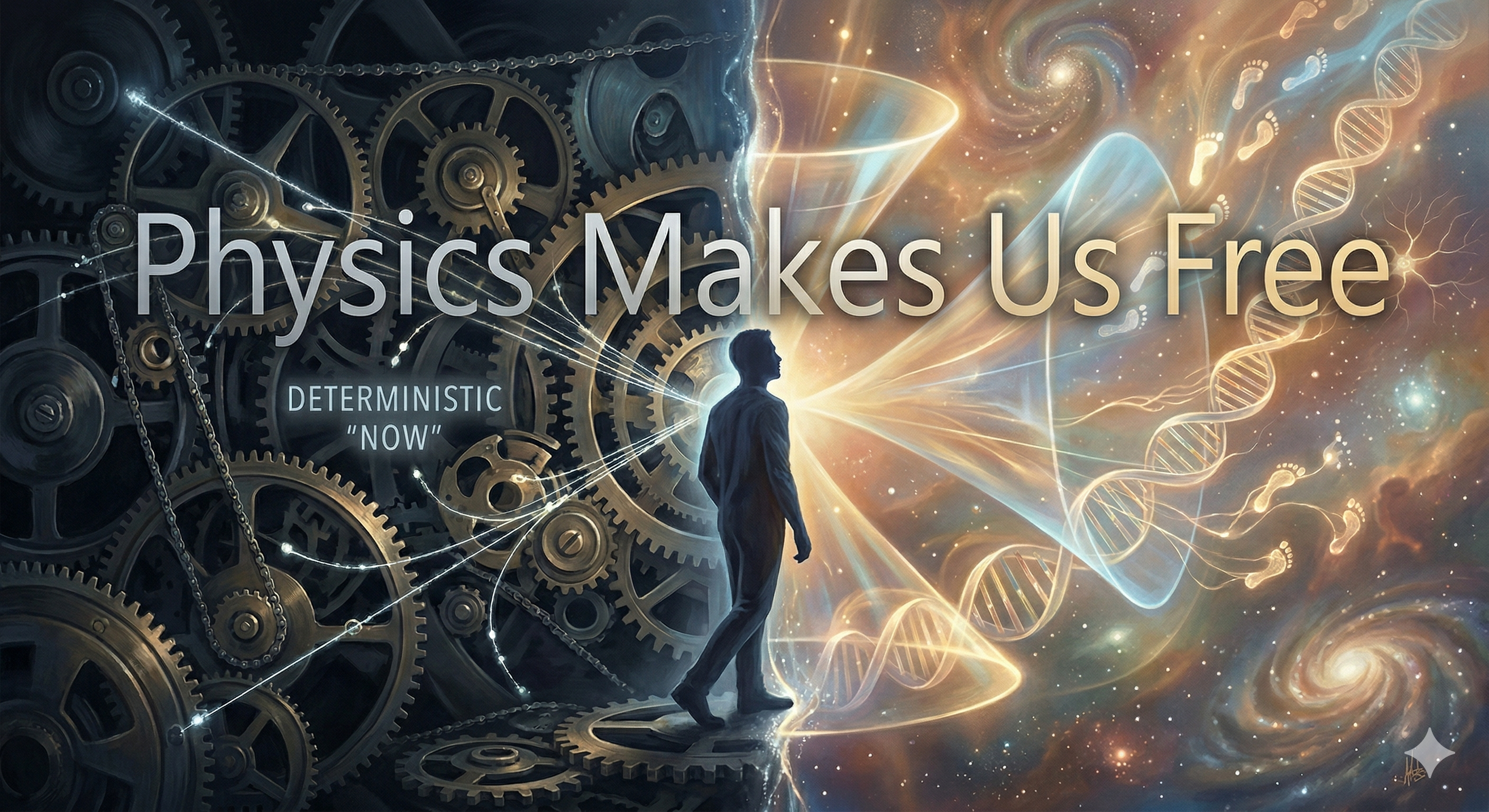
How Physics Empowers Free Will in a Deterministic Universe

Why determinism never felt right to me — and how modern physics actually opens the door to real agency.

For years, the idea of hard determinism has bothered me. It clashes with how life actually feels. The universe as a giant clockwork machine—every particle with a fixed position and momentum, every event preordained from the Big Bang—sounds elegant in theory. But it implies that everything I’ve ever done or will do was inevitable. My choices? Just an illusion.

Hard determinists often present this view with a certain intellectual swagger, as if it signals deep sophistication. Yet many of them still look both ways before crossing the street. As Stephen Hawking wryly observed: “I have noticed that even those who assert that everything is predestined… still look both ways before they cross the road.”

That quip captures the tension. If the future is fixed, why bother acting at all? The view also carries an eerie resemblance to extreme Calvinism—some are saved, some damned, and nothing you do in this life ultimately changes the script. It never sat right with me, either intellectually or existentially.

Then I encountered the work of physicist and philosopher Jenann Ismael, particularly her book How Physics Makes Us Free. Link Her approach resonated strongly with an intuition I’d been developing for years: determinism and free will are not mutually exclusive. Physics doesn’t enslave us—it enables a deeper kind of freedom.

The “Now” Problem: Why the Instant is Trivial

Imagine the universe at a single frozen instant—the “Now.” In that timeless 3D snapshot, every particle has a position and energy vector. Past events fully determine what happens next. It looks perfectly deterministic.

But here’s the catch: that “Now” has no real existence for any actual observer. Relativity imposes strict limits. No particle (or person) can access information from outside its past light cone. At the exact moment of “Now,” that light cone has zero depth—nothing from even a tiny distance away has had time to reach you. Complete information about the universe is impossible in the present.

Laplace’s Demon—the hypothetical super-intellect that knows every particle’s state and can predict the entire future (or past)—assumes a “God’s-eye view from nowhere.” Modern physics makes that view untenable. Any real system faces data latency, noise, uncertainty, and computational irreducibility. The demon’s omniscience is a fantasy.

In short, strict determinism at the instantaneous “Now” (what I’ve called the InP, or Instant-Point) is technically true but functionally trivial. It tells us almost nothing useful about how agents like us actually operate.

Memory: The Engine of Agency

Freedom emerges not in the frozen instant, but across time through accumulated memory and structure.

Even in a blind, non-living universe, basic thermodynamics creates imprints: a rock scars the ground when it falls; waves erode a shoreline. These are primitive forms of “memory”—the past shaping the future through persistent physical traces.

Life takes this to another level. Biology is essentially memory in action. RNA, DNA, neural patterns—these are systems that record what worked and what didn’t. Evolution itself is a memory process: successful patterns persist and build upon one another.

Over eons, this scales up:

  • Simple input → output (basic matter)
  • Input → memory/comparison → internal model → action → output (living organisms)

A frog snaps at a fly. A squirrel flees at a predator’s scent. A honeybee dances to communicate nectar locations to the hive. These are not random reflexes but decisions grounded in accumulated history and pattern-matching.

Humans take it further. Language, culture, and shared knowledge externalize memory, allowing us to build on the experiences of countless others. Our decisions arise from rich internal models shaped by personal and collective history—not from some magical spark that violates physics, but from the universe’s own lawful processes.

The agent does decide. The cause of the action lies in the person’s internal identity and accumulated experience. Labeling that “determined” is technically accurate but misses the point. It’s how we function.

The Generalized Good as an Attractor

This memory-driven agency isn’t aimless. Over deep time, beings with even modest volition tend to optimize for what they perceive as “good”—survival, order, flourishing. Humans are guidable, not perfectible. We make mistakes and fall for bad influences, but signals from reality (what works vs. what fails catastrophically) are powerful if we’re willing to heed them.

History shows progress: fewer people in extreme poverty, fewer dying in wars (in percentage terms, at least). Our ancestors weren’t ignorant fools; their traditions often encoded hard-won lessons. Change isn’t inherently good, but neither is stasis. The “generalized good” acts as a global attractor, even if local maxima vary by time, place, and culture.

In deprived environments (think North Korea), external options shrink, yet people still imagine and yearn for “other worlds.” The internal model remains a generator of possibility.

My Thesis

Free will is not a violation of physics. It is the high-level, computational process of an autonomous agent using the universe’s built-in memory—personal, biological, and cultural—to steer itself through time.

Determinism at the microscopic level may hold, but it becomes trivial once you account for relativity, light cones, computational limits, and the reality of embedded agents. What matters is that you are the one deciding, drawing on your history and internal model. There is no external puppet master. The causes flow through you.

Physics doesn’t rob us of freedom. By creating a world with persistent memory, evolving complexity, and embedded perspectives, it makes genuine agency possible.

That’s why the universe feels open rather than claustrophobic. That’s how physics makes us free.

Time


Enrique Zafra

Time is fundamental, it is much of what ‘being’ is about. It is central to reality. It is central to our lived experience, it is central to our hopes and dreams. But as central as it is, it is still an enigma.

Time is a knotty problem for physics, metaphysics, philosophy, religion, something fundamental to our existence and experience but for thousands of years and billions of person hours of contemplation and analysis it escapes understanding. Like others down the centuries I find that the more I think about it the harder to grasp it becomes.

Pragmatically there is only the local now, a few moments from the past and a glance into the future. Practically there is the Past and the Future, now is just a transition from one to the other.

What is time? It seems like it is about change, and times arrow is provided by entropy, the slow winding down of the universe.

Existence, the now, is only the Plank Time instant. What stitches the universe together are memory(enabled by change) and imagination (enabled by memory.)

One option of quantum physics says that it is the conscious mind that ‘collapses’ the probability function to one reality. In that view it is our mind-memory that provides a crashing rock against which universal potentiality breaks into reality. Is it us, stitching together the universe?

Why do we talk about timespace? Because time has no meaning without space and space no meaning without time. Imagine an infinite cube of arbitrary complexity. Without time nothing about it has any meaning. You cannot travel from one point to another, there is no energy, because no movement, nothing can move, because movement is about change of location and that has no meaning with no time. Equally, without space, time has no meaning, there is nothing to change, one could say something can endure or wind down but without space for that to occur it has no meaning.

So we ‘live’ in timespace that we instantiate and make objective. It is still real in that the physics of it are fixed (probably) but is it possible that it is our (or other consciousnesses) that take possibility and harden it to reality and inflate the universe around us, out to the limits of our questing minds?

Maybe….

CPU’s the Universe and Everything

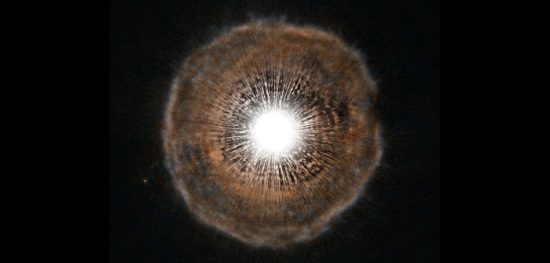
The image from an interesting article on the ultimate in cloud computing. Hubble image of the asymptotic giant branch star U Camelopardalis. This star, nearing the end of its life, is losing mass as it coughs out shells of gas. Credit: ESA/Hubble, NASA and H. Olofsson (Onsala Space Observatory).

Seems like there must have been a mash up of astrophysics/cosmology/cybernetics a couple of weeks ago there have been a series of articles about computers and the universe. One series pointing out that once could conceive of using the AGB stars in their ‘dusting mode’ (above) as a computing engine.

But on the other side there have been a couple of articles that touch on the metaphysical (philosophical basis of reality) concept that we and our universe, are one vast simulation.

…Oxford philosopher Nick Bostrom’s philosophical thought experiment that the universe is a computer simulation. If that were true, then fundamental physical laws should reveal that the universe consists of individual chunks of space-time, like pixels in a video game. “If we live in a simulation, our world has to be discrete,”….

From: New machine learning theory raises questions about nature of science

….a discrete field theory, which views the universe as composed of individual bits and differs from the theories that people normally create. While scientists typically devise overarching concepts of how the physical world behaves, computers just assemble a collection of data points…..

From: New machine learning theory raises questions about nature of science

…A novel computer algorithm, or set of rules, that accurately predicts the orbits of planets in the solar system….

… devised by a scientist at the U.S. Department of Energy’s (DOE) Princeton Plasma Physics Laboratory (PPPL), applies machine learning, the form of artificial intelligence (AI) that learns from experience, to develop the predictions.

Qin (pronounced Chin) created a computer program into which he fed data from past observations of the orbits of Mercury, Venus, Earth, Mars, Jupiter, and the dwarf planet Ceres. This program, along with an additional program known as a ‘serving algorithm,’ then made accurate predictions of the orbits of other planets in the solar system without using Newton’s laws of motion and gravitation. “Essentially, I bypassed all the fundamental ingredients of physics. I go directly from data to data,” Qin said. “There is no law of physics in the middle…

…”Usually in physics, you make observations, create a theory based on those observations, and then use that theory to predict new observations,” said PPPL physicist Hong Qin, author of a paper detailing the concept in Scientific Reports. “What I’m doing is replacing this process with a type of black box that can produce accurate predictions without using a traditional theory or law.”…

From: New machine learning theory raises questions about nature of science

Ok so now I am going to go a bit sideways and you may want to just go on about your internet day. But while I laude Qin and his team I have a bit of an issue with what he claims re the basis is Philosophy. Not the claim that the discrete field theory sparked his concept exploration. But that the actual system he developed has anything to say about that metaphysical theory.

Taking nothing away from the team what I see seems like a straightforward application of machine learning. In fact a relatively simple one though I would laude the whole idea of applying it to physics in general. A very interesting though, like many interesting insights, oddly obvious is retrospect. (Sorry for the repeated Though clauses…I absolutely see this as fascinating insight…and possibly extremely important…it just seems like D’oh in retrospect.)

As physics is very much aligned with mathematics (I think because the discovery of each was feedback on the other) and mathematics and cybernetics are also deeply intwined it should come as no surprise that computer systems designed to create black box solutions, when fed the right kind of data, will create a black box model of physical phenomena.

The output of science are tools that allow us to predict finite things about the universe we live in, repeatably and accurately. These tools are often used by engineers to enable technologyy that make life better for everyone.

But in many ways this is an engineers (relatively narrow) viewpoint. To some large degree an engineer does not care why the tool works, only that it does and how accurately. Counter to that, a strength of the theory based + mathematical model approach is that it gives you a tool to link the rest of reality to the ‘discrete’ piece you are working on right now. A jumping off point or a linking point to other theories that allows us to move onto other problems and link the

And/But (you knew it was coming) i wonder if this has anything to do with discrete field theory per se. Maybe if the learning algorithm used had that in it this would show something of that nature, but otherwise I do not see this as showing anything in particular other than the ability of learning systems which are in some sense continuous not discrete systems to develop predictive models directly from the data (as Qin says) rather than through the labor intensive methods of theory extraction and proof that has been the basis for scientific exploration since it first evolved in the Middle Ages.

Again BUT, it has been getting harder to develop these ‘deep’ theories. Look at the colliders and other tools that physicists use these days to probe the depths of our reality. In this world there are many things, like Qin’s next test with Nuclear Fusion, where an engineering model might be much more valuable than a ‘theory of this’ if it can be captured and used in a fraction of the time.

It’s all good, fascinating, wonderful…but let’s not get ahead of ourselves.

We need a Base or our dreams are fantasy shading into terror.

As limited and degraded as man undeniably is, he yet remains “the proof by contraries” of the divine Prototype and of all that this Prototype implies and determines in relation to man. Not to acknowledge what surpasses us and not to wish to surpass ourselves: … is the very definition of Lucifer. The opposite, or rather the primordial … attitude is this: to think only in reference to what surpasses us and to live for the sake of surpassing ourselves; to seek greatness where this is to be found and not on the plane of the individual and his rebellious pettiness. In order to return to true greatness, man must first of all agree to pay the debt of his pettiness and to remain small on the plane where he cannot help being small; the sense of what is objective on the one hand and of the absolute on the other does not go without a certain abnegation, and it is this abnegation precisely that allows us to be completely faithful to our human vocation.

Logic and Transcendence: A New Translation with Selected Letters
© 2009 World Wisdom, Inc. pg 14, The contradiction of Relativism

OK, so I’m addicted to philosophy right now. Directed here by One Cosmos, a autodidactic philosopher and deeply anti-psychological psychologist of the once great state of California.

While some philosophers and metaphysicians can be opaque in the extreme others are as one should expect extremely good writers with depth and clarity that is remarkable. Others are opaque but readable because what you ‘get’ seems true and sensible and the opacity is often in their use of old words, Greek or Latin words to try and de conflict their meaning from the everyday words that have been so poisoned by intentional obfuscation. The above book is of near preternatural clarity type. I have found another writer, Voeglin the type that makes you want to work at it.

Freedom vs Liberty

We talk a lot about freedom but it seems to me that this is a word that has a lost its gravitas in the current era. Maybe the older more difficult word liberty is the one we should use when we talk about fundamentals.

Freedom starts with that word Free, which may have had a noble meaning once but essentially triggers the ‘free stuff’ consumer sales instinct today. Free education, Free care, Free food, Free….whatever it is you think someone should have a right to for whatever reason.

The very word Free has been degraded to a economic term that means ‘worth less’ or worthless. One could see this as intentional neo-marxist thought war. It is certainly one of the reasons that a lot of low info types don’t realize that what they are asking for is has a great cost. Gov’t Free stuff is not free.

The word Liberty still has its gravitas. When you say you have liberty of conscience, liberty of person, liberty of property, liberty of word, liberty of action, you are saying things that seem to have weight and maybe make you and others think.

The US was set up as a nation of individual liberty, the individual sovereign over the government, the state strictly limited in its ability to interfere with the individual.

Giving up Freedom of speech to some seems almost trivial, it was free after all right? But if you are saying the government is effectively limiting your liberty of conscience, word and action, I think even those with a limited understanding of the issue might think again.

Anthropic principle and our finely-tuned Universe

Anthropic principle and our finely-tuned Universe Ethan Siegel at Starts With A Bang!

How the mis-application of the Anthropic Principle has led factions of scientists away from the search for a natural, physical explanation of our Universe, and why that’s bad for everyone.

20140105-114648.jpgImage credit: ESO / T. Preibisch, via http://www.eso.org/public/images/eso1208a/

One of the first things you notice — and it’s self-evident if you think about it — is that the Universe is full of stuff. This in itself is a wondrous thing, because it didn’t need to be that way.

I’m not a “conservative,” I’m an 18th-century Enlightenment radical

From Charlie Martin at pjmedia.com/lifestyle/ : Does buddhism require you to be a liberal? The short answer is no ….

I don’t think it’s necessarily so. In fact, I think Buddhism, real Buddhism, is inherently more in tune with libertarian “conservative” politics. (This isn’t the place for this particular rant, but I scare-quote “conservative” because I think it’s a bad term. As I was telling someone last night, I’m not a “conservative,” I’m an 18th-century Enlightenment radical.)

Absolutely! So am I.

And regarding the rant….as usual the “liberal” progressives have managed to at once de content and blacken + distort the abstract philosophical meaning of the words conservative and liberal…as I have whined about in the past. Politicians do this to avoid being pinned down, progressives to control the message and short circuit dialogue. Going back to the discussion on political philosophy, progressives often called liberals are not at all about liberty in anything but the most puerile sense and conservatives are generally cautious, not reactionary, and are pro liberty in its more robust sense. Progressives are generally about changing human nature by government fiat.

Libertarians…the old liberals, are about core human rights, property rights, equality before the law, the rule of law, financially competent government, citizen dominated politics, de politicized + meritocratic bureaucracy and minimalist + open regulation. In other words an eighteenth century Enlightenment radical!

Missionary Creep in Egypt by Adam Garfinkle

The American Interest: Missionary Creep in Egypt by Adam Garfinkle
Simply stunning, a revelatory blog on the why the US struggles to make head or tails of what is going on in Egypt and the Middle East. It’s long and has a couple of longer links but it’s well worth it because it explains our bias so clearly, explains the Muslim middle eastern ‘socio-political-theological’ context and then shows the incompatibility of means and ends that have made such a mess of the last decade or more. If you are interested/frustrated by the unfolding mess read this article it’ll give you new context, though it won’t solve the frustration.