
From Keith DuQuette’s The LeftyBosco Picture Show, Jem, is like so many of Mr. DuQuette’s portraits, leaves one wanting to meet them, and remembering better times. Always a flash of warmth.


From Keith DuQuette’s The LeftyBosco Picture Show, Jem, is like so many of Mr. DuQuette’s portraits, leaves one wanting to meet them, and remembering better times. Always a flash of warmth.
In the NDIA’s National Defense magazine’s blog there is a post: Don’t Rush to Buy New Vehicles, Army and Marine Corps Warned
The traditional approach to updating U.S. military hardware — spending years and billions of dollars on next-generation designs — is no longer working for the Army and the Marine Corps as they seek replacements for their combat vehicles.
——
One reason for the military to hold off on buying new vehicles is that there are no technological silver bullets to make military trucks, tanks and personnel carriers less vulnerable to enemy weapons, …. Adversaries can acquire and deploy antitank weapons and roadside bombs much faster and at far less cost than the U.S. military can build countermeasures and survivable vehicles,
——
It’s not clear that the Army or the Marine Corps can “get out of this box,” Outspending the enemy in this case is a losing battle. … “Adversaries’ use of guided weapons, relatively cheap and rapidly fielded anti-armor weapons … threatens to increase significantly the costs incurred by U.S. ground troops in accomplishing their assigned missions,”
——
The Army’s procurement bureaucracy is still reeling from the failure of its $200 Future Combat Systems. Although the follow-on program, the Ground Combat Vehicle, is far more modest, it is not clear that it (will) offer a substantial technological boost compared to existing vehicles
——-
Army buyers might still be somewhat (IMO are totally) deluded by the thinking that doomed the Future Combat Systems. At the time, FCS officials touted the program for its advanced information network, which would give commanders an instant view of the battlefield and allow them to see the enemy without being detected.
After the termination of FCS, the Army continued the push for an advanced communications network, which is now billed as the services number-one modernization priority. The problem, … is that the Army still assumes it can deploy a network at will. “The assumption is that we are operating in a permissive environment … that once we set up the network, nobody is going to tear it down,”
——
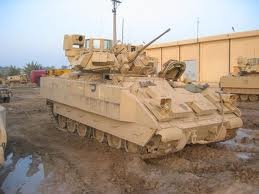
We have operated in a permissive environment, electronically and even threat wise for the past decade at least. We have also operated in a nation building civil war environment in urban, suburban environment. Even in the ‘Stan the military faces an enemy with limited access to weapons beyond RPGs and IEDs but these have proven the Bradley is no longer viable and driven us to develop armored modestly off road vehicles like the Stryker DVH, MATV, and MAXPRO MRAP.
These vehicles use existing technology and are enough over designed to allow for evolution. They are too heavy for the Army and USMC but the effort put into the ‘light weight’ replacement the JLTV Family has already cost huge amounts and the only way the Army/USMC kept the program was mandating a weight(26,000lb), cost ($250,000 ea) and protection (MAXPRO equivalent) and letting everything else float or be a special kit. The program has been a feeding trough for the Mil-Ind-Bandit-complex for several years not for truck builders supported by the Army funding some high end components. In fact the truck builders and high end suppliers have been funding their own pragmatic tech programs based on industrial/commercial insights that in the end the Army and USMC have bought.
Recently a couple of high ups in the acquisition corps said they’ve been meeting the soldiers needs and all the grief about Comanche, Crusader, JLTV EDM, EFV, FCS, etc is all noise. Bull-crap!
Once it might have had some truth, the Army/USMC did projects to build tech and keep design experience honed. Much of the money went to top grade suppliers of engines, suspensions, transmissions, the primes never intended the vehicles to go to production, everyone learnt and had tech on the shelf. Those days are gone.
These days the programs are too tightly focused and the programs are ‘mapped’ to lead to production. So the top tier suppliers go for them, often get more than one ‘team’ funded and develop futuristic Advanced Development Models, designed to highly refined specs that require essentially custom components. To keep their engineering teams fed they keep most of the work in house and over-ride input from the lower tier suppliers they do use. The specifications are too specific and often contradictory, open to interpretation, and all too often evolving. Money swirls down the toilet by the bushel. New management comes in, new ‘baselines’ established more money flushed and eventually the program collapses. Little of the technology is of use elsewhere.
The world class suppliers all largely ignore Army programs because they have spent too much money on programs that are ill conceived and almost bound to fail. Where the automotive industry does work on gov’t programs they try to focus on programs with clear near term needs, like the highly successful, Stryker, MATV, and later MRAPS.
At the end of the day we’ll be better off letting things settle out while we fund evolutionary and component technologies. The thousands of bright young officers coming back from Iraq and the ‘Stan need to settle in, study the world, history and the potential for tightly-constrained battlespaces, they’ll be the ones to figure out what comes next, not the old guard who claim they’re ‘just fine…’
More fascinating stuff from Technology Review | Quantum Biology and the Puzzle of Coherence
Quantum processes shouldn’t survive in hot, wet biological systems and yet a growing body of evidence suggests they do. Now physicists think they know how
This is mind blowing, I’ve thought for some time that quantum effects play a role in life but this says that they are pervasive, and possibly usable in the engineering sense, if so this could well open up another road forward in a vast array of fields of development. very cool, very exciting!
At the end of the day it seems to me that a majority of the human race could be set to work investigating and developing useful ways of using the science we are opening up without making a dent in the amount of such work for the foreseeable future. What we lack is enough trained and willing minds to address the world not opportunities to exploit. The problem is that a vast majority of the human race are not a whole lot better educated / socialized (this is as true of at least a significant number of americans as it is of chinese far workers) than a late medieval peasant and the infrastructure of the world is in the same sad state. I can only hope that the great uplifting that has been going on since the beginning of the British Industrial Revolution continues long enough to get us through the coming knot hole.

The Hoover Institute’s Defining Ideas often has thoughtful, rational topic pieces, like this great one: The Car Insurance Model, by Scott W. Atlas that discusses Health Insurance. All I can say is read it, it essentially lays out an argument that health insurance state regulated is miss regulated and even monopolistic in many areas and before we try the monstrous over regulation layer on top we should look to insure at the county wide level. The state regulators should be the ombudsmen for the people not the lapdog rent providers of the insurance industry they seem these days. He also advocates high deductible insurance and Health Savings Accounts.
Now he does argue against forcing insurers to insure everyone at the same rate for the same coverage. Here I am a lot less certain, maybe because I am overweight, and no longer young, once smoked, etc. I agree that age and perhaps gender should be factors but the more specific you get the less useful insurance becomes (at the extremes {which a totally unregulated totally privacy devoid world of the near future might enable} the only coverage you could get would be for random acts of god…’so sorry to hear about that lightning bolt hitting you, good thing you’re not a cowboy or golfer, we don’t cover lightning strikes on cowboys or golfers without a special rider from Lloyds.’)
But that’s a niggle, basically the argument is the system as is, is broken but fixable with rational, simple changes, let’s start there before layering in more Regulation and gov’t oversight.
From StratPage: A Quiet Farewell For the M-2 Bradley
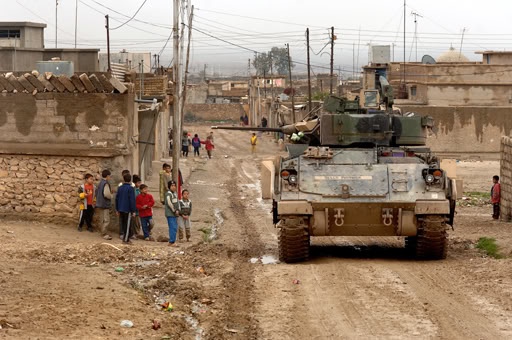
March 5, 2012: One of the little-known casualties of the Iraq war was the American M-2 Bradley IFV (Infantry Fighting Vehicle). Five years ago the U.S. Army stopped using the M-2 in combat. By then it was clear that the enemy was intent on using mines and roadside bombs in a big way and the M-1 tank, Stryker, and MRAP vehicles were much better able to handle these blast weapons than the M-2.
Bradley BUSK probably I
Bradley BUSK possibly a II
The pictures above are from before that quiet withdrawal showing variations of the Bradley Urban Survival Kit BUSK. Compare this with images of the Bradley from the ‘Gulf War’ below:

Bradley in the Gulf War

Bradley moving through ruined Iraqi RG unit
And then this picture of a Bradley from the halcyon days when worries about swarms of Soviet tanks were just beginning to seem like a bad dream:

Bradley probably in Germany in the '80s
The US Army in WWII started out with light, medium and heavy tanks, anti tank vehicles and infantry carriers. This evolved through the 50s and 60s to the Main Battle Tank and the IFV (infantry combat vehicle.) The theory being that the tanks do the running around in front of the enemy getting hammered on with the IFV keeping up with but behind the tanks, hiding when the explosions got too loud and close.
The Army wants its armored-taxi/multi-use-chassis to be as mobile as the tank, carry a squad of infantry, a heavy anti tank weapon, an infantry support weapon, weigh half as much as the tank and be able to survive getting hit by medium calibre weapons. Rather too many metrics to trade off successfully.
Which explains why the Abrams M1 tank is successful (probably destined to be around till circa 2050…and may be the last ‘true’ tank ever) while the Bradley is essentially heading for the scrap pile? The answer is Armor and Power
M1A2SEP 72 tons | 1500hp versus M2 w/BUSK ~38 tons | 400
The ‘tank lite’ nature of the Bradley IFV with the added attraction of its soft gooey center of infantry, has always made them most valuable as far forward as possible, further forward in the battle than ‘safe.’ By the time of the Gulf War they had already been added armor, in the GW they did well, but in Iraq they suffered badly then more and more protection was added. Soon the vehicle was way over weight and because an IFV is a very ‘tight’ design there is no way to increase power. The Army ended up with a vehicle that is too heavy to move and too lightly protected to survive.
The Israelis’ have been on the leading edge of modern armored combat for most of their nation’s history. Their main battle tank design is focused on crew survivability and it can actually carry a couple of extra soldiers for scouting work. The Israeli’s have made IFVs out of old tanks with their turrets removed, not only because they don’t have money to burn but because it made sense, the heavy armor and high power to weight ratio of these vehicles made them much better close companions to main battle tanks than ‘purpose built’ IFVs.
The US army saw this in the combat reports from the last mess in The Lebanon, where the Israelis used the old converted vehicles as well as the more purpose built Namer IFVs. This and our own experience in the Gulf War, Iraq War and Afghanistan, drew the USArmy towards a much more heavily armored (and more powerful) vehicle the GCV (ground combat vehicle.) unfortunately the first iteration of the GCV when priced out by the Military Industrial Bandits was way too expensive for the Army and a more restrained requirement was developed. Which results in this….(read that last with a disgusted tone.)

BAE GCV Candidate

BAE GCV Candidate
A couple of recent image from BAE ( the current defense company incarnation for the group who were responsible for the Bradley) showing their latest GCV concept. This is a typical piece of post realism crap from our defense establishment. Its a hybrid electric vehicle, which failed to the tune of billions burning in FCS and is useless on an armored vehicle. It uses an active defeat systems for a lot of its protection (the little Dalek like warts on its ass.) And yet with a tracked suspension system one moderate IED will render this billion dollar baby dead in its tracks (pun intended.) In a sim its probably extremely good at what it is designed to do, protect the gooey middle and trundle around at some reasonable speed. But the thing has to be fragile as hell, its rather narrow between the eyes and tall so it won’t be able to do side slopes anywhere like the tortoise like MI can etc etc.
This is what happens when you reach the end of the technological road and don’t know where to go. The tank may not be dead but its bastard son the IFV is. My advice to the Army is find another route before you blow more billions on this turkey.
And BAE the current turkey presenter….used to be British Aerospace. Is this the Crown’s way of getting back at the Colonies for that cold seawater tea episode?
A DUAL-USE technology is one that has both civilian and military applications. Enriching uranium is a good example. A country may legitimately do so to fuel power stations. Or it may do so illegitimately to arm undeclared nuclear weapons. Few, however, would think of concrete as a dual-use technology. But it can be. And one country—as it happens, one that is very interested in enriching uranium—is also good at making what is known as “ultra-high performance concrete” (UHPC).
Iran is an earthquake zone, so its engineers have developed some of the toughest building materials in the world. Such materials could also be used to protect hidden nuclear installations from the artificial equivalent of small earthquakes, namely bunker-busting bombs.
The above quote is from this wonderful Economist article, read it, as always clear prose, useful info well presented and minimal spin (&despite what some say that’s about as good as it gets spin wise if you want to explain/make a point.). It’s actually of general interest if you are interested in Civil Engineering or modern buildings and structures.
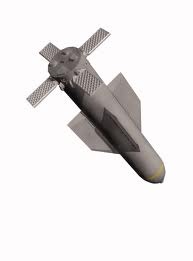
The point is that the US and others have been working on bunker busting for decades. The Massive Ordinance Penetrator shown dropping from a B52 above and in more detail below are the king of the hill right now.

Their reason for existence right now is to hold Iran’s nuclear bunkers at risk. The MOP is supposed to penetrate up to 200 ft of concrete:
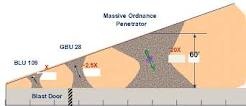
The problem is that the work of Iranian engineers on tough concrete could mop up the MOP. The Iranians have added metal nano fibers and particles as well as fairly ordinary metallic, plastic and ceramic, whiskers, flakes etc to the mix to toughen the concrete in various ways. This work is being done to save lives world wide, including the US since it’s focus is on Earthquake damage reduction. But this is a wonderful example of dual use since exactly the same technology could make future bunkers all but impregnable to conventional weapons, which big as it is the MOP still is.
Bottom line if the best of the best tech were used they might get 6 or more times the strength and testing has shown just doubling concrete strength reduces penetration by more than half!
This is not good news and probably explains this:
Congress ‘Urgently’ Approves $82 Million To Improve Its Biggest Bunker-Buster
Despite this:
The 30,000-lb Massive Ordnance Penetrator Bomb Works So Well It Earned A Rare Honor
It would seem we may soon get a chance to see if the Iranians were smart enough to use the super concrete vs if our super bunker busters can slam, blast, burrow their way in. There is also the question of corruption, in a vastly corrupt civil society using expensive concrete which probably looks like any other concrete is an invitation for shaving. Many is the time when a fortress has fallen because of under spec materials. Also you have the long term espionage and internal strife driven sabotage the story is that bunkers for Nazi super Vengeance weapons were sabotaged by the addition of small amounts of sugar to the mix drastically weakening it.
This would all be a wonderful background for a comedic farce, if so many people’s lives were not at risk.
Enough said….

Instapundit Glenn Reynolds caught this interesting local piece in Knoxville KY (home city of Oak Ridge). Did That Airplane Swallow a Reactor?

The answer of course is yes. The story is pretty interesting and shows that folks were a whole lot more pragmatic about nukes in those days. Not to say they weren’t a little ignorant and a lot cocky but our new day trembling cautiousness is not a reasonable alternative.
That reactor was ‘only’ 100 KW vs a modern reactors multi GW(3 orders of magnitude or 1000x greater) power output. But the DoE is now studying small sealed core reactors as this article discusses in ars technica | Dept. of Energy signs agreements to develop small nuclear generators
Rather than building large, Gigawatt-scale reactor buildings, several companies are developing what are termed small, modular nuclear reactors that produce a few hundred Megawatts of power. These are typically designed to be sealed units that simply deliver heat for use either directly or to generate electricity. When the fuel starts to run down, the reactors will be shipped back to a central facility for refueling. Since they will never be opened on site, many of the issues associated with large plants don’t come into play.

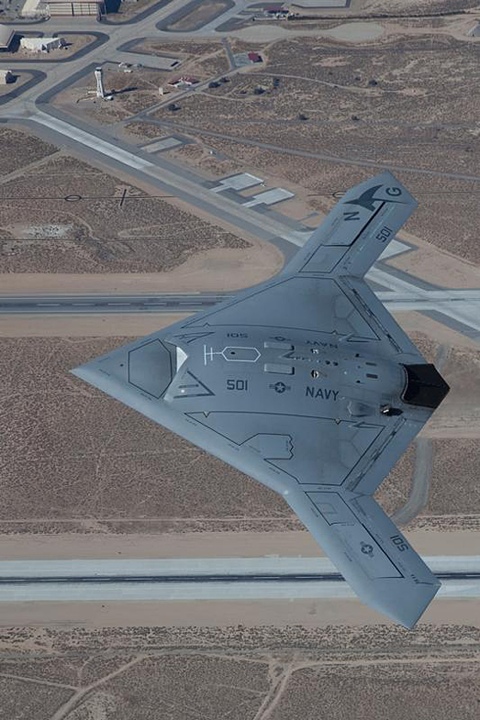
This piece on StratPage rather says it all. It’s kind of interesting, aircraft become more ‘efficient’ in a technical sense of cargo(including fuel/power)/weight as they grow larger…it’s mostly about geometric effects of volume vs. surface area. There is also a tendency to focus on endurance in drones for obvious reasons, which in air vehicles means slow and relatively large wing spans. Consequently the ‘low threat’ generation of UAV’s are all about the same in regards to vulnerability. But the next generation, Quadopters, UCAVs, Avenger, etc, are all higher performance, trading something away for more performance, and will be significantly less vulnerable.
And let’s be clear the first generation were all about experimentation with the basics, not about high intensity combat ops. If you look at a lot of the manned platforms in service, survival in combat has not been a big driver for the last decade.
Walter Russel Mead continues his Blue Model contextualization of the 19th, 20th century. A deeply thoughtful look at what was, why it was, and the beginning of a philosophical platform for looking at what is to come:
A family business circa 19th century model
American kids spent more time in school as a general rule than kids in other parts of the world in the 19th century, but their “book learning” was only one part of a much broader and richer education that prepared them to be productive citizens. Parents taught kids the fundamentals of agriculture and animal husbandry; they taught them the hundreds of skills that went into maintaining a family farm. In urban areas and sometimes on farms, adolescents went to work on nearby farms or serve as apprentices. There they found production units much like the one they came from: the husband and wife were the proprietors of a bustling family enterprise that might include a few hired hands but in which young people and older people lived, learned and worked side by side.
————————
In the 20th century, it became increasingly common for both parents to work in quite different jobs and professions, often many miles from home. Blue collar workers worked in factories and warehouses; pink collar workers in service and clerical positions; professionals and white collar workers in offices.
———————–
If we wonder why marriage isn’t as healthy today in many cases, one reason is surely that the increasing separation of the family from the vital currents of economic and social life dramatically reduces the importance of the bond to both spouses – and to the kids.
———————–
Repetitive factory work taught very little; to put ten-year-olds in a factory for a shift was to deprive them of learning and stunt their intellectual growth. On the other hand, office and administrative work often demanded skills that few children could acquire. It was cruel to put kids in the factories or coal mines; useless to put them in an office.
————————
As the educational system grew more complex and elaborate (without necessarily teaching some of the kids trapped in it very much) and as natural opportunities for appropriate work diminished, more and more young people spent the first twenty plus years of their lives with little or no serious exposure to the world of work.
————————-
In the absence of any meaningful connection to the world of work and production, many young people today develop identities through consumption and leisure activities alone. You are less what you do and make than what you buy and have: what music you listen to, what clothes you wear, what games you play, where you hang out and so forth. These are stunted, disempowering identities for the most part and tend to prolong adolescence in unhelpful ways. They contribute to some very stupid decisions and self-defeating attitudes. Young people often spend a quarter century primarily as critics of a life they know very little about: as consumers they feel powerful and secure, but production frightens and confuses them.
————————-
People often speak of the need to revive vocational and industrial education as a way of reaching students for whom the traditional academic classroom holds little appeal; more basically, education needs to be integrated with the priorities and purposes of life as these young people experience it.
As I said here, complexity and segregation of our lives drove many social changes.
In the 19th century, American communities were small and generally self-managed. Most Americans lived in small towns or in rural areas where government really was something people did for themselves. The “state” scarcely existed; outside port inspectors and postal officials, the federal government was largely invisible. And even at the state level, local communities were much more autonomous than they generally are now. Local mayors and selectmen had very few mandates coming down from on high; people managed their own schools and roads and other elements of their common life by their own lights.
In the 20th century Americans became more politically passive as the state grew. The citizen was less involved in making government and more involved in watching it, commenting on it, and picking candidates who were sold the way other consumer goods are marketed: you voted for which party and candidates you supported, but more and more of the business of government was carried on by permanent civil servants acting under expert guidance. Government did much more to you, and you did less of it yourself.
WRM discusses the urbanization and complexity of life in the 20th century and I think rightly points out that more gov’t was inevitable. I would also point out that the above description of the 19th century was largely true till something like the last thirty years. When I first emerged from my family in the 1980s the vast majority of the land in the US was still governed very lightly. In many ways the differences between Eastern Urban | West Coast Urban | and the light urban cities most other places, were quite extreme. But the basic thrust of the above is not affected one iota by that quibble.
Since work itself was so unrewarding for so many, satisfaction came from getting paid and being able to enjoy your free time in the car or the boat that you bought with your pay. It was a better deal than most people have gotten through history, but the loss of autonomy and engagement in work was a cost, and over time it took a greater and greater toll.
there was a feeling that we needed to keep:
up consumption so the economy could work. It was not just the experience of the Depression that led so many to the conclusion that under consumption was the characteristic problem of a capitalist economy. …… . Many businessmen promoted imperialism in European countries and to some degree in the US because they wanted …….. markets for their goods. When the age of imperialism came to an end, the intensive development of home markets replaced the extensive development of foreign markets in the eyes of many social thinkers and planners……
———————–
Another factor promoted the rise of a consumer economy: the development of new and much more expensive goods required a psychological and institutional shift. If people couldn’t buy cars and refrigerators — to say nothing of houses — on credit, the markets for these goods would be vanishingly small. Americans had traditionally been averse to debt, whether personal or governmental. They thought like producers, for whom debt is sometimes necessary but always a cost. Thrift mattered, and for many Americans it was a point of pride not to buy on credit; if you didn’t have the cash for something, you waited.
That kind of attitude wouldn’t keep the car factories humming. The blue social model involved an unprecedented expansion in the use of credit by private households, large companies and all levels of government. Debt was the mother’s milk of blue prosperity and John Maynard Keynes was the prophet of the blue age. While consumer finance has deep roots in Anglo-American history, with installment plans used to sell goods like furniture and sewing machines well back into the 19th century, the 2oth century became a golden age of consumer credit, and to carry large balances on credit cards, home mortgages and student loans came to seem normal and respectable in a way that would have shocked Americans living in the 19th century.
Between the 1930s and the 1970s this worked better than many of its critics expected. In a relatively closed economy like the US, if more people went into debt to buy more stuff, the demand would stimulate economic growth, which would tend to raise wages and employment. The additional income would offset the cost of carrying the debt and support additional consumption as well.
And so round and round the money went and it all worked. Until globalization began to derail the machine.
But the real problem with the debt-based, consumption-focused blue social model, the one that bothered many social critics even in the days when the blue model was working and looked sustainable, is one of values. A consumption-centered society is ultimately a hollow society. It makes people rich in stuff but poor in soul. In its worst aspects, consumer society is a society of bored couch potatoes seeking artificial stimulus and excitement. They watch programs on television about adventures they will never have. They try to change their consciousness through the consumption of products (entertainment, consumer goods, drugs) rather than by changing the world and accomplishing things. The massive use of recreational and mood altering drugs reflects and embodies the distortions that a passive, consumption-based society produces in human populations over time.

Ultimate Couch Potato Contestant(s)?
The above image could be seen as “The end”…but no its not…humans are only able to take so much passivity (at least at the sociatal level) look at what Putin is facing, 10 years of kleptocracy given a free hand because he has made the lives of more Russian’s better than they ever have been. But now they are sick and tired of the grinding corruption and the insults it produces at every turn. Now even though pretty well off many upper middle class citizens are beginning to look up and ask, ‘what else?’
WRM has been thinking about this for a long time, though not always as an eventually positive thing. In the 1980’s he perceived the oncoming wave of change as a potential tragedy. The competition from low wage countries, from our technical near peers in Europe and Japan, now China, India and elsewhere, along with the equally disruptive changes wrought by automation of all sorts have made the Blue Model unsustainable. The US Model that was the Beacon of the world from the 1950’s to the end of the century is no more and what comes next can only vaguely be seen.
The Blue Model was pretty coherently envisioned by the thinkers of the late 19th and early 20th century (socialists, communists, fascists.) In the long run we ended up pretty much where they thought we would. Unfortunately for their meme we ended up there as the seas of changed washed the foundations out from under the model.
Now we need a new model to strive for as the old one crumbles around us. I move forward by holding to the desire to leave the world a little richer for my passing, but I have no overweening image of the future, I am afraid that the rate of change of change has overcome the human imagination.
And perhaps we shouldn’t think in the grand sweeping, dehumanizing sweeps the great thinkers of the last interregnum did. Maybe we all need to think about things we need to do ourselves and for each other, not to each other. Maybe we should look to the simple guidance and not grand sweeps:
A short but instructive piece on wireless technology and networking, mind opening.


 This World and Others
