
From cave walls to the cosmos: how humans built the One out of questions they couldn’t stop asking
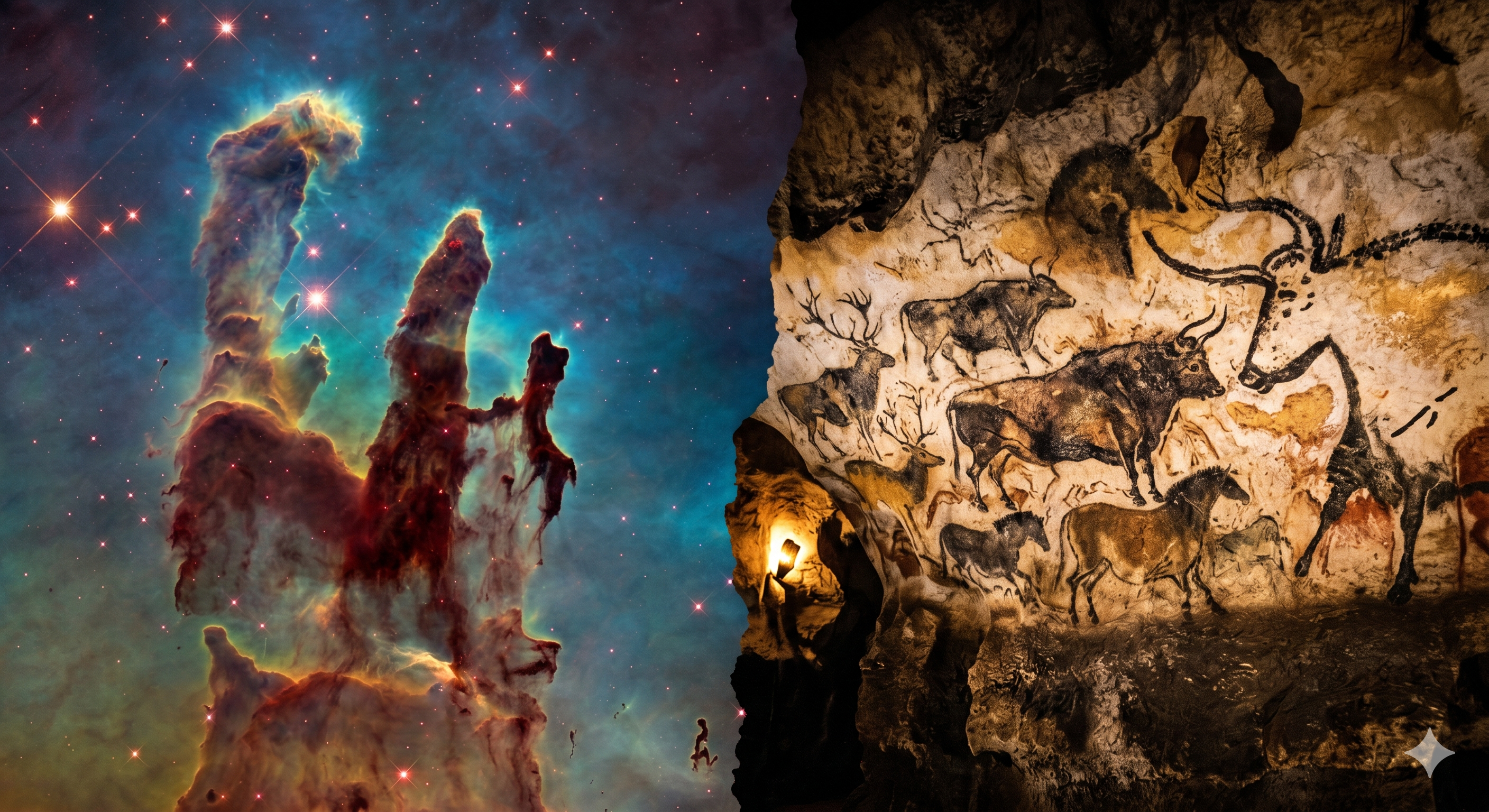
Philosophy | May 2026
Intelligence is based in memory, without why they are useless. The moment you can ask why, you will, and you’ll keep asking until you hit a wall the evidence can’t get you past. That wall is where religion lives.
This isn’t a weakness. The why-drive is the engine behind every model humans build of the world. It starts with fire and weather and then, inevitably, it turns to the question behind all questions: what started this?
Vocabulary
Most discussions of God get tangled before they start because people use the same word to mean very different things. Here’s the map I work with:
- The Origin — the start of everything, defined as an event. No feeling of intention behind it.
- The Final Cause — which is to say, first cause, a step between the Origin and the Absolute. Still largely intentionless, but there’s a tint of something.
- The Absolute — Less an event than an impersonal creative condition.
- The One — the Absolute plus intent. This is a matter of faith, not evidence. It cannot be known from what we observe.
- God — the personification of the origin of all we perceive. The One given a face and a relationship with humanity.
- god (lower case) — a referent to one of many deities in a system where there is no single final origin.
On gender: rendering God as he or she assumes things that aren’t in evidence and are arguably contra-indicated by the concept itself. A creator might seem more female if you think in terms of procreation, more male or neuter from a philosophical standpoint. Neither is satisfying unless you set out from an assumed initial condition, personification is a human need.
Beginning
Animism came first — scratching the why-itch into a set of beliefs that could be shared across a tribe. It works at small scale. As culture complexifies, you get gods: local, specific, squabbling. Then philosophy pushes further back, past the gods, toward a single origin, and you start to get God.
The Hellenistic world shows this arc clearly. It started with gods, evolved philosophy that defined the absolute origin, and from there derived a concept of God. That Hellenistic concept of the One then wrapped around evolved Judaism — with its apocalyptic messianic tradition — and produced Christianity. Islam followed, melding tribal Arabian religion with Judaism and Christianity into something that collapsed individual conscience into a tribal collective. That’s the source of its strength but a reason that it’s historically been a threat to neighboring structures.
Egypt started a similar philosophical evolution and then, probably due to the shaping effect of Nile Valley culture on its social structure, devolved back to gods. The environment bends the theology.
Consciousness
Even extremely simple worms react to stimulation in idiosyncratic ways, suggesting some differentiation in even minimal nervous systems. Single-cell organisms show behavioral differentiation that might indicate some level of something. Ants recognize themselves in a mirror and try to remove marks that would get them attacked at the nest entrance.
Does only self-consciousness constitute mind? Does consciousness without self-consciousness exist? These are thoughts we struggle with as we look at the evidence in the world we live in and apply it to the question of origin. What is the relationship of Mind and Consciousness to the Absolute?
The evidence says there’s an origin. Whether that beginning had intent is the question the evidence cannot answer.
Origin
The origin of our universe produced complex organization that chained up through cosmology to chemistry, to life, intelligence, ecology, and society. That’s not random noise out of an infinite field of interactions. It’s structured emergence across effectively infinite time and space.
This argues, at minimum, for an Absolute that set the conditions for what is. It also suggests that ethics, philosophy, and meaning were intrinsic from the start not invented by humans but discovered, the same way mathematics and physics are discovered. Invention from nothing is not real, we find what was already there (in my opinion a categorically more difficult problem given the complexity of our reality.)
Whether you take the next step, from Absolute to One, from impersonal origin to intent, is where evidence runs out and faith begins. Not faith as credulity, but faith as a position you hold in the absence of proof in either direction.
From the One to God is personification: a human need, driven by the desire for relationship with the absolute rather than mere acknowledgment of it.
That’s not irrational. It’s the oldest human need there is.
More on engineering, technology, and science fiction on YouTube. Fiction and commentary on the bigger questions at Substack.
 This World and Others