
I put together a short take on this — under 60 seconds if you want the headline — and a longer breakdown of the structural issues for those who want the full picture.
▶ Short version (60 sec): https://youtube.com/shorts/zG-VtW2MUDU
▶ Full video: https://youtu.be/KAHuoShGtrs
There’s a number the EV charging industry reports, and there’s a number drivers experience. They’re not the same number, and the gap between them tells you everything about how this program was designed.
Operator-reported uptime: 97–99%. That’s a contractual requirement under the NEVI program — the $5 billion infrastructure buildout funded by the Bipartisan Infrastructure Law. On paper, the chargers are up nearly all the time.
Actual charging success rate: 71%. About a quarter of the time you pull up to a charger, it doesn’t charge your car. In many of those cases, nothing you do will make it work.
These are different measurements. One tells you the charger is technically online. The other tells you whether it did the job. Nobody confused them by accident — the reporting structure was built around the metric that was easiest to meet, not the one that mattered to the driver.
The failure modes are concrete. 60% of failed sessions involve a charger that’s simply out of service — not a user error, not a handshake problem between your car and the network. The unit isn’t working. Hardware degrades, software hangs, payment systems drop, network connections fail. These are expected failure modes for a system like this. The question is whether you’ve built the operations and maintenance infrastructure to catch them quickly. Most of the NEVI deployment didn’t.
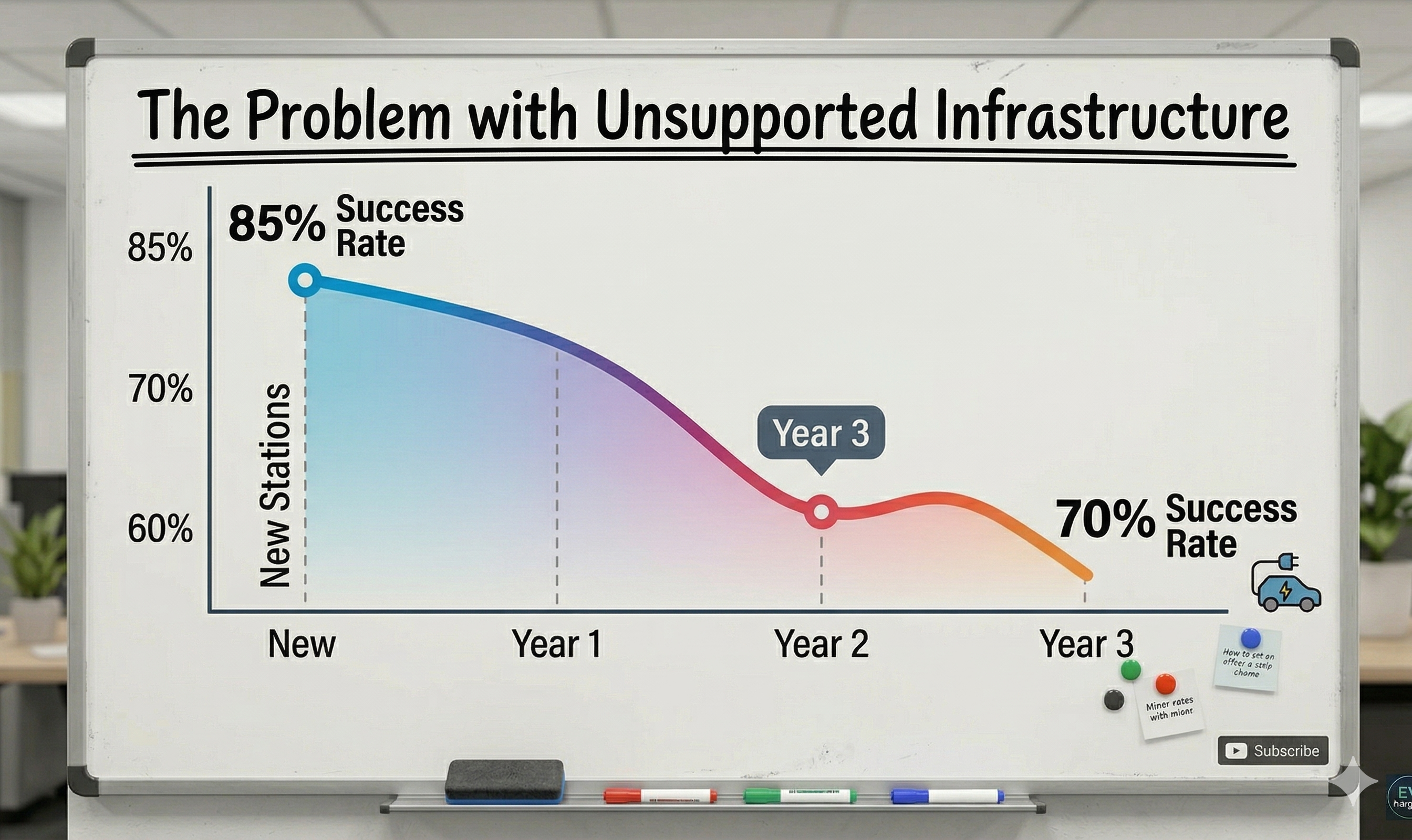
New stations run at about 85% success. By year three, the same stations are below 70%. The 2022–2024 installation wave is hitting that curve now. And after year five, operators have no contractual obligation to keep the units running at all — so a lot of that hardware is simply going to disappear.
The regional variation is the tell. Seattle and LA are seeing failure rates around 24–25%. The East South Central region is at 7%. Same national program. The difference is operator discipline — some built real support structures, most didn’t, because the incentive to do so was never in the grant milestones.
This is a solvable problem. The gas station model solved it a century ago: put someone on site, make them responsible for the equipment, give drivers somewhere to wait while they charge. There’s no reason a charging network can’t work the same way. It’s just that the program specification never required it, so it wasn’t built.
Infrastructure problems are always systemic. The hardware is fine. The failure is organizational.
Mark Harris is a systems and mechanical engineer and the author of Stranded in the Stars (Book One, The Sea of Suns Trilogy). He writes about engineering, technology, and the creative life at This World and Others.
 This World and Others