Future of Computing…Circa 2012…..

20111228-224416.jpg
Just eye-candy from APODnothing to do with computing

Several article/posts at PCMag.com that paint interesting picture of the near future. This one by M. Miller in Forward Thinking discusses next generation chips, tablet chips but also the direction of all chips. At the latest AMD chip conference

…strongly pushing the idea that the future of microprocessors will not be just traditional CPUs, or even the combination of CPUs and graphics processors (GPUs), but instead will consist of all sorts of “heterogeneous” processor cores working together.

In the article there were a couple of interesting tidbits….the doubling in speed with ~doubling of transistors per area faded over the last few years, one of the things driving multi core. Also today’s high end pocketable units have rough equivalency with 2001 supercomputers. Memory and peripheral speed obviously hit that raw performance as well as non optimized development environment.

Then this piece also under Future Thinking, discussing the direction of LCD and AMOELD and related technologies, there are several others not mentioned but this article is a good discussion of the near term mass production technologies.

Then there is an end of 2011 discussion by Tim Bajarin on the coming of Hybrid tablets, something like a Mac Air with a separable screen ~ tablet. I use my iPad (like right now) for a lot of light to medium duty tasks I once had to use my laptop, I sometimes use a Bluetooth keyboard (though not right now.) Can some one could come up with an ultrabook class laptop with enough additional functionality to make the added cost worth it? TB says he thinks WI 8 might be a leader, could be but iOS seems muscular enough….except maybe multi windowing…we’ll have to see.

Dawn’s first low altitude images of Vesta

Circling in

NASA’s Dawn spacecraft has spiraled closer and closer to the surface of the giant asteroid Vesta. (Credit: NASA/JPL-Caltech/UCLA/MPS/DLR/IDA)

At this detailed resolution, the surface shows abundant small craters, and textures such as small grooves and lineaments that are reminiscent of the structures seen in low-resolution data from the higher-altitude orbits. Also, this fine scale highlights small outcrops of bright and dark material.

More images at.
20111227-141532.jpg

Did the ancient Myan’s predict the collapse of human civilization in 2012?

There have been a series of Cassandra video’s floating around this year, actually pretty much from the beginning of the internet.  I think the latest one I keep hearing glancing past is Post America or some such.  Ed Driscoll has a piece on the free fall of California that takes a lot of its material from this piece by Victor Davis Hanson then mentions the book After America from which the following comes:

 In ten years’ time, there will be no American Dream, any more than there’s a Greek or Portuguese Dream. In twenty, you’ll be living the American Nightmare, with large tracts of the country reduced to the favelas of Latin America, the rich fleeing for Bermuda or New Zealand or wherever on the planet they can buy a little time, and the rest trapped in the impoverished, violent, diseased ruins of utopian vanity.

“After America”? Yes. It will linger awhile in a twilight existence, arthritic and ineffectual, declining into a kind of societal dementia, unable to keep pace with what’s happening and with an ever more tenuous grip on its own past. For a while, there may still be an entity called the “United States,” but it will have fewer stars in the flag, there will be nothing to “unite” it, and it will bear no relation to the republic of limited government the first generation of Americans fought for. And life, liberty, and the pursuit of happiness will be conspicuous by their absence.

I agree that things are ugly for certain segments and geographical subsets of the middle class.  But I do not see a wholesale breakdown of the American dream.  On one side the American Dream has always been time and place focused, on the other I see almost as many positive signs as negative if you look at things from a broader perspective.  Conservatives are always going to lament most changes they see around them and conservatives living hyper conservative lifestyles, (i.e. farmers, lawyers, police, military)  are going to see things going to hell with more poignancy. 

The way I see it we got here because of the sequence of bubbles we have lived through, from the Post Cold War Bubble, Tech Bubble, Internet Bubble, a General Bubble (up to 9/11/01) then the Housing Bubble.  All of this essentially enabled the following: 

  • Pandering to gov’t worker unions
  • venal politicians promising money they had no way of knowing would be there
  • Bankers divorced from personal financial risk taking too many risks
  • Stock investors who should know better always expecting smooth growth
  • Managers looking six months ahead instead of six years ahead
  • Apathetic voters:
    • Voters who vote for the guy who ‘looks’ the best
    • Voters who vote for the guy who promises the most
    • Young folks not voting because they’re working 60hours and playing 40.
    • Middle career folks voting on visceral because their working 60hours and then coming home to another 40 of honey dos
  • One issue voters
    • Old folks voting for their pensions with scant consideration for other issues
    • Gov’t workers voting their pocket book  with scant consideration for other issues.
    • Bee in their bonnet rich folks using referendum to drive through special initiatives with no concern for unintended consequences.
    • Bee in their bonnet single issue political movements who vote gut level issues like abortion or church state separation, lower taxes butleave no room for compromise even when most of the realize that compromise is the only way anything will ever really be done
    • Politicians who gutlessly sign pledges that lock out the possibility of compromise, which was the basis on which the US was established.
  • Etcetera, etcetera, etcetera, as the king of Siam famously said

So…what am I saying?

That while I agree with the Cassandra’s that things look very bad this too shall pass, though sadly it’s not certain it will not pass without disorder and death, I expect that the United States will continue to exist for a few more centuries.  The majority of the country understands the general direction we need to go.  This majority does not include the rabid left or the zombie right but it does include many on both sides as well as the middle.

    • A retirement safety net that is much more focused on those in real need at a fraction of the current cost (means tested and not generally available till 75.)
    • A universal retirement savings system that is portable and personally monitored and focused on retiring at 70 only earlier if you have the funds or a real need due to disability.
    • A disability safety net that is probably little changed from today. but any federal mandate has to be funded by block grants from the federal gov’t .
    • Out of work benefits, system probably little changed from today but any federal mandate has to be funded by block grants from the federal govt’
    • Health Coverage:
      • A health insurance safety net focused on kids to 18
      • Universal Health Savings account (not mandatory you use it, not taxed), portable and personally controlled
      • Health insurance available, Insurance companies have to take new people, they can establish different price for different age groups (5 year min span.)  If you sign up as an adult with no prior insurance you will pay a reasonable premium for the first two years (25%)
      • Health cost published by all practitioners on their web pages, visits, shots, etc etc. 
      • Health practitioners are not allowed to charge different groups different prices for the same services.
      • People will pay their own health bills via a Pay Pal or equivalent system.
    • A simple but graduated income tax system without the bands.  I’d propose  simple linear progression from 0% at 10,000 to 20% at  $1 Million. Above $1M ‘income’ is considered capital gains and flat taxed
      • Capital Gains 25%.
      • No exemptions period end of sentence.
      • Special tax deals are special contracts with Department of Treasury / Inland Revenue, which Congress has to sign off on. 
      •  No tax deal can reduce expected tax rate below 10% ever.
    • Restrict the volume of regulations and laws.
      • A whole bunch of restrictions on length and length of effect.
      • You cannot make a regulation ex post facto (after the fact) just like no ex post facto laws restriction in the Constitution.
    • Anti Corruption
      • Congressmen have to put their money in a blind trusts.  No insider trading
      • All donations to all elected officials have to be public record, no restriction on the amount. No privacty for political acts.
      • Special interest groups who target politicians with adds, have to publish their financials and who provided the funds. No privacy rights for political acts.
    • Secrecy Restrictions
      • Debates on laws can be held behind closed doors but a proposed law has to be published on the internet at least ten days before the final vote and no special access for lobbyists etc.
      • Nothing can be held secret for more the 5 years without special and specific reasons agreed to by a committee of the senate and the maximum is 50 years.

  • No program / group above a certain size (10 people, $10 million) can be completely black, it has to have a public face and a public (and honest) reason for existence and its top level budget and basic structure must be public.

    • 5 and only 5 Departments of Executive Gov’t
      • Department of Treasury
      • Department of Defense
      • Department of State
      • Department of the Interior
      • Department of Commerce
      • All other departments shuttered and any necessary functions put in one of the others:
      • All current agencies would fall under one of these departments.  No independent Agencies of Gov’t. But can have an independent board of directors who can act as buffers…&seperate budget line item.
    • Recognize that blanket prohibition never works and establish a new regime for bad drugs including tobacco and alcohol.
    • Get Gov’t out of the marriage business.  Gov’t does care about stable committed partnerships for clear socio-economic reasons but should see it as a contractual issue.  Contract of Family Partnership to replace Marriage License.  Marriages are religious and can be restricted as the religious group sees fit. 

    So OK I got carried away, I’ve cut this list down several times then rebuilt it.  Not sure it’s really coherent but it does reflect my opinion on a number of topics.  I also think it reasonably represents the views of a lot of moderated, be they Republicans, Democrats, Liberals, Conservatives, Libertarians, Progressives….I think.  I may find out I am absolutely wrong….but then that would require folks to read this…..sigh.

    Cheers

    Rocky remains of Red Giants Last meal spotted

    Two hot rocks and their flaky white dwarf

    As the poster at arstechnia says this is fascinating stuff and i hope it remains so for a very long time.

    Astronomers find a star system where a red giant appears to have swallowed two Jupiter-like planets, then later spit out their cores, which now orbit as small, rocky planets.

    via Remains of gas giants, swallowed by red giant star, now orbit as small planets.

    Is Petabyte Storage and the supercomputer going to create the ultimate totalitarian state.

    FuturePundit: Government Total Recall On Past Communications.

    Is Petabyte Storage and the supercomputer going to create the ultimate totalitarian state?  There is some discussion that Syria and Iran already do this….as does the US.  The NSA theoretically only trolls outside the ‘Homeland’ but how can you be sure…isn’t this a bit like th False in one, False in all assumption, Roman lawyers pulled out of their butts a couple of millennia ago.

    Study of the Syrian Rebellion–update and some broader context

    This is an update of the earlier Syrian post. I think these two pieces supplement and bring up to date the ISW paper. First an article on the violence in Syria, which if compared to the white paper seems to show a continuing not accelerating level of violence. The bombings in Damascus would also appear to be part of a continuous ark rather than some large step, though I remain skeptical about who bears responsibility. The other Strapage article is a short discussion about the dueling use of orphans in sectarian violence, these boys and men grew up under awful circumstances and they tend to be easily turned into ruthless fighters. Another article the other day referenced the same socio-economic background for the Iranian Baij irregulars.

    The Struggle for Syria in 2011 | Institute for the Study of War.

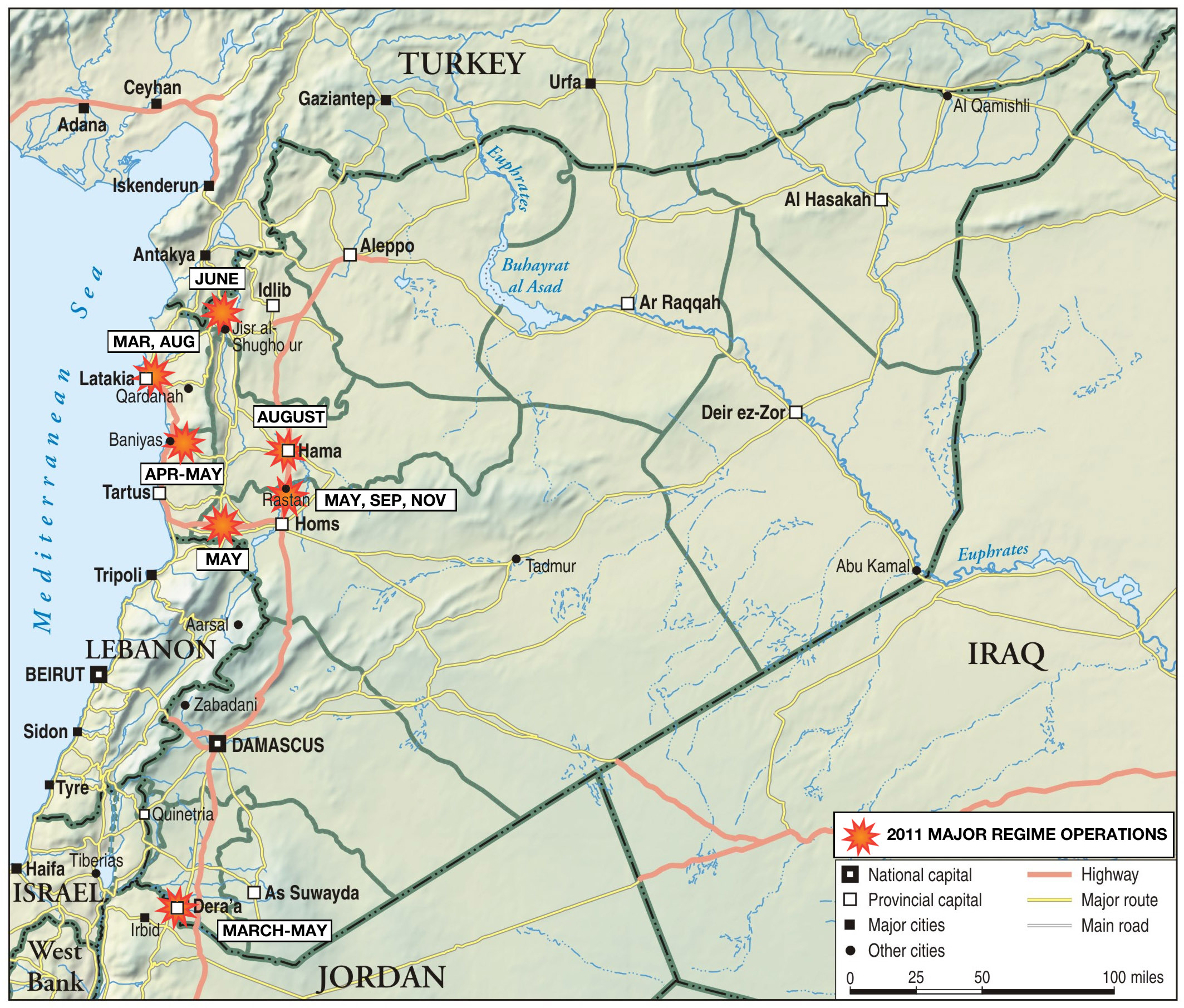
    The scale of unrest in Syria has made it impossible for the regime’s security forces to simultaneously garrison all of the country’s key terrain. The regime has maintained control over Syria’s armed forces, despite limited defections. Therefore, the regime’s strategy has been to maneuver elite forces to key centers of unrest and conduct large clearance operations, using selective brutality in an effort to end the crisis.

    The regime successfully suppressed demonstrations in Dera’a, where the protests began in March 2011, by conducting aggressive clearance operations. This allowed the regime to focus resources elsewhere as the conflict progressed.

    Homs has become the conflict’s center of gravity because of its strategic location and its frequent sectarian violence. The regime attempted to quash Homs’ dissent in May, but emergencies elsewhere in Syria diverted attention and resources. By the time the security forces refocused on Homs in September, peaceful demonstrations had given way to armed resistance.

    Despite large demonstrations in Damascus’ northeast and southwest suburbs, the regime’s security presence and targeting campaign has successfully prevented demonstrations from overrunning downtown Damascus. The size of the pro-regime population in Damascus has also contributed to dampening unrest in the capital. From the beginning of the uprising, the regime has deliberately consolidated its control over the Alawite homeland of Syria’s coastal region. Clearance operations in Latakia, Baniyas, and Tel Kalakh targeted Sunni enclaves and shored up regime lines of communication

    From the Paper, a breakdown of the ethno religious makeup of the Syrian Populaion
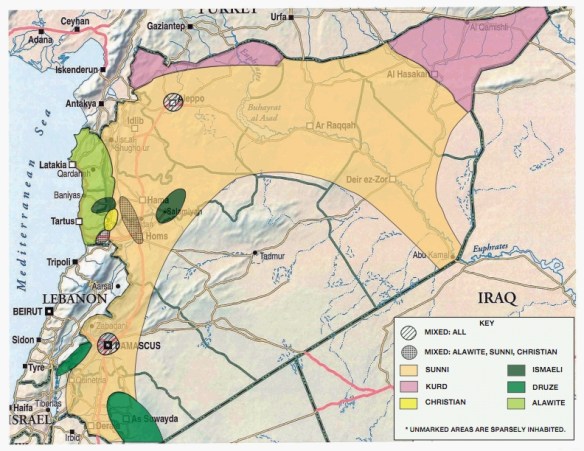
    From the Paper, the distribution of the ethno religious groups in Syria
    From ArticleFrom the Paper, Gov’t Operations this year

    Richard Fernandez at the Belmont Club pointed out this paper and has a very good analysis of it and some other bits, such as this, 58 Foreign Policy Analysts are urging Obama to act regarding Syria. And the article has an interesting lead in picture…

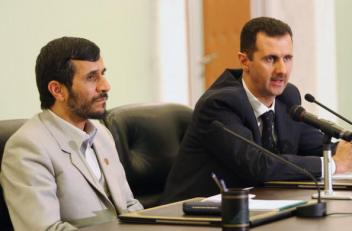
    Our Favorite Middle Eastern Leaders

    Getty Image/ Our Favorite Middle Eastern Leaders

    Now the problem is, which is more important for us to do keep our powder dry ready to deal with Iran, Ahmadinejad (in gray) or do we use assets and energy on Syria, Assad (dark blue) which is the more important world issue? Hands down, right now it would seem that Iran’s nuclear weapons and delivery system development is. Whereas sad Syria is suffering the agonies of realizing that the Dear Leader, is wasting the majority of its subjects potential and that the only way to change that is to change the leadership.

    Now some are asking why can’t we ‘do a Libia’ and I think the argument is that both the socio/economic and military situations are far more complex in Syria, the bad guy and his military are not utterly incompetent and the rebels are dispersed and often ambivalent about the use of violence. I think that the maps and the text show that the majority of the Military Potential of the Anti Assad camp have not become engaged.

    • What happens if Iraq blows up as we go in and blow up Syria, and then we really do have to do something about Iran.
    • Is it possible the Kurd, Shia, Sunni ethno religious cocktail goes cablooey.
    • What if the Kurds get the bit in their tenth regarding a Kurdistan stretching across their ethnic foot print (Turkey, Syria, Iraq and I think Iran)Do the Shia try for Shiastan…and that means bits of Shiadom on the other side of the Sunni Crescent in Iraq and Syria.
    • Do the Sunni go for an Emirate partnered with Saudi Arabia et.al.

    Things could really go to hell…and they may be on their way already regardless of what we or the west in general want.


    This can be interpreted as negative, but is it? And are there other factors?

    Plant Power alone sucks up $$$

    From Technology Can We Build Tomorrow’s Breakthroughs? I think the answer is a resounding yes though I agree there is reason to be cautious.

    Charts discussing manufacturing in the US
    Does this represent net loss or just change?

    As I have discussed before there is at least reasonable evidence that manufacturing in the US is on the upswing and while the charts paint a disappointing picture one has to be a bit careful about what is being measured. If mass production were giving way to boutique build +value add, might one miss it because we are importing what are essentially the bricks and mortar (which we by the way mostly designed or own a big part of) and the customization and final build (with their higher margins and more creative content) is done here?

    There is an interesting section in here dealing with the founder of A123 and then with a couple of solar cell manufacturers.  And the author makes some very telling points.  I think they should be emphasized:

    1. Unless there is a very fundamental change in a product, improving process technology to produce a that product will not start out producing a cheaper product and unless you can get over the hump of higher cost and lower sales the guy with the bog standard product and highly refined standard process will eat you alive.
    2. Controlling one (however important) process or input material does not mean you control the market, a sudden change in market dynamics, possibly one you created, can suddenly pull the prop out from under you and if you only have one prop you are finished.
    3. Getting from prototype to production is horribly expensive especially in a mass market (which are almost by definition price sensitive and commoditzed ones) A first article will cost you K, getting that product in front of customers is likely to cost you 2 time K and getting into production 5 times to 10 times as much again, sometimes many times more. 
      1. Why you Ask? Because you can do a lot of research for say $1M, that’s enough to support three or four researchers for a year.  But once you have to show it to a customer you have to be able to replicate the work and make either a full scale device and or prove you can do so repetitively or have a process that scales from desktop to garage at least and that usually takes 2 or 3 years or 2 or 3 times as much effort and expense.  The when you go to production you now have to build a factory staff it, train the staff, fill out all the paperwork, pay the lawyers to make sure you’re not doing anything illegal etc, etc.  And you then have to make enough of your product to put on the shelf and most of the time you have to price it at well below cost because the first batches and the smaller batches are much, much, MUCH more expensive than the run of the lot will be later and you cannot charge 10x the expected price.  Selling the first  ???  units at an average of 1/?? their actual cost can eat up a huge amount of money.

    The first comment after the article makes the point that established companies have in my way of thinking ‘normalized and processed’ innovation out of their main line business because of the costs.  It is easy to project cost and risk with incremental improvements.   The costs and risks of really new products/processes (disruptive ones) are much more uncertain, and few managers are allowed the latitude to innovate in big, risky ways. 

    But this circles back around, does this in fact facilitate the creative destruction that the US industrial base has depended on.  Once large corporations run by bull-headed industrialists did the risky stuff.  When that generation was replaced by the MBA brigade they froze up.  Then the innovations erupted in a series of mid rankers with mavericks at their head or in a series of entrepreneurial start-ups who then took down many of the old guard.  Are we seeing the wake of another change of phase…

    Anyway a good article but don’t take it as gloom and doom, its pretty evenly pro as well as con.

    Iran-3 tidbits and some commentary…

    Iran, a troubling country, as Persia it dominated troublemaking for the Hellenes and the Romans, though Alexander the Great among other Hellenes ground it down a couple of times. That piece of the world has a long history and has a right to be proud and annoyed when abused which it has been but at the end of the day it is a small backwater that could and should be able to grow to regain much of its glory in the new world but as with most other islamic dominated countries it seems to be unable to slip the bonds of a mindset that is more focused on the past and in some ways on revenge, than on the future and finding ways to let the past lay.

    An update on the loss of the Beast of Kandahar (RQ-170 Stealth Drone)

    December 21, 2011: On December 8th Iran displayed what appeared to be an American RQ-170 jet powered UAV, which they claimed had landed intact in Iran two weeks earlier. Iran claimed they had hijacked the control signals for the RQ-170 and landed it themselves. This seemed highly unlikely but not impossible. Experts on Iranian military immediately suspected something else. First, the Iranians are constantly lying about their military exploits, especially when it comes to developing new weapons and technology. This is apparently done mainly for propaganda as satellite photos never show more than a few prototypes of these wonder-weapons. Then many Americans familiar with the RQ-170 carefully studied the pictures of the “captured” RQ-170 and immediately suspected something was off. For one thing, the RQ-170 shown was the right size and shape but the wrong color. Not just a different color from that seen on many photos of the RQ-170s in Afghanistan but also a color unknown in American military service. A closer examination of the Iranian RQ-170 photos indicated that the Iranians had reassembled an RQ-170 that had crashed and broken into three or more pieces. Then the Iranians apparently gave the UAV a new paint job (which was obvious to anyone seeing those photos.)

    This is another piece about Iran, and its road to hell

    Iran is turning into more of a military than a religious dictatorship. That was made clear when a government official revealed that half of government employees now belong to the Basij (the reservist organization of the Revolutionary Guard, the separate armed forces of the clerics running the government) . This was deliberate. Since the late 1990s the Basij has been establishing units in schools for children of all ages. Using games, toys, and popular children’s activities the kids are indoctrinated into Basij ideology (radical Islam, including the joys of being a suicide bomber). The Basij recruiters have found that their best prospects are from poor or broken families (including orphans). This was the Nazi and Soviet experience. The Romanian communist government did best at this with their secret police (the Securitati) forming much feared units of these orphans. Recruits were selected young and raised to be remorseless and savage operatives. Called “young wolves”, these operatives could be depended on to do anything for the cause. Iran is always looking for plain clothes agents who can terrorize reform minded students and civilians in general. In the last few years, more and more of these Basij operatives, now adults, have been leading the fight against reform minded Iranians, or overseas as agents of Quds. Since Basij is largely a part-time operation many members have a full time government job.

    Obama Moves Toward War With Iran

    In a recent interview with CBS news anchor Scott Pelley, Panetta said “the United States does not want Iran to develop a nuclear weapon. That’s a red line for us”. He continued: “We will take whatever steps are necessary to stop them”. A nuclear Iran is “unacceptable”.  When US secretaries talk about “whatever steps are necessary” they are not usually talking about holding one more meeting of the sanctions committee.  They are thinking shock and awe rather than cookies and tea.

    Panetta said the Iranians could have a bomb in a year or less; we’ve heard this before. The point is, Washington doesn’t believe the mullahs have stopped building. Unless that changes, the Obama administration is headed toward war with Iran, quite possibly before November of 2012.

    OK, I don’t know if I agree with Dr. Meade, I’ve argued more from impression than anything else that there is no appetite in the world for an Iranian war.   But in fact the Saudi’s and the other Gulf Arabs want the suckers taken down before they get nukes.  There is also a lot to be said for the fact that until Iran is put back on a reasonable path Iraq is unlikely to remain stable.  Also the Iranians are the backers of the main troublemakers in Syria and around Israel.  An argument could be made that Iran was always a worse problem that Iraq but that taking out Iraq was easier and it was hoped would make Iran behave itself.  Taking Iraq also took down a potential flanking enemy.  Now with major forces in Afghanistan on one side of Iran and our naval forces on the other there is at least some military realism to taking Iran down.

    • Israel has nukes
    • Pakistan has nukes and is perhaps as likely to proliferate as Iran
    • NK has nukes and is a worse proliferator than anyone else
    • Syria tried to get nukes
    • Libia tried to get nukes
    • Any marginally competent state with an industrial sector can ‘do nukes’ if they get the materials.
    • Would going in and blowing up the Iranian Nuclear program solve anything? ( And I do mean going in, I do not see any way of avoiding putting troops, probably a lot, on the ground to make sure those facilities are blown to dust.) Does this stop proliferation in its tracks or is it a slippery slope? 
    • Pakistan, NK, Iran, Isreal, Syria, Lybia….Each case utterly different and circumstances do matter, hard lines in the sand are rarely possible to draw and live with. 
    • But will others see the take down of Iran (if it happened) as a sign not to go nuclear or as a sign that they should press forward as quickly and quietly as possible.
    • We would have to establish the Obama Doctrine, “we will take down anyone who is going for nuclear weapons”   Could we make it stick?

    Then of course there all the mysterious ‘accidents’ occurring in Iran, is there a covert war going on already?  I am not convinced but I have to say that it seems highly possible.  If so the Iranians aren’t doing well.  The thing that stops me being convinced is that the Iranians aren’t squealing about it and or going all out for retaliatory strikes (see the article above on militarization of Iranian gov’t.) Now its possible that with the tracking tools we have now and in some ways a fairly fine mesh filter for folks coming out of that part of the world we have been able to stop anything, and maybe I hope that’s true.  

    To be honest I would almost rather its just the Iranian’s paying the price for turning away from technical competency for some (invisible to me) religious gain, our spooks being that efficient puts one in mind of all sorts of conspiracy theories.