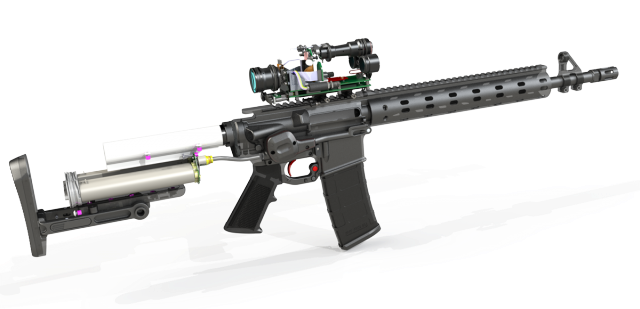
Lasers and rail guns oh my

So linked at the bottom is a file by the congressional research service regarding the progress the Navy is making on laser weapons, rail guns and hyper velocity smart munitions. Not the best topic for Christmas Season but oh well.

A series of articles in the Drive and elsewhere have discussed the progress in laser weapons over the last few years. To recap, a technology that was discovered as a fairly early practical application of quantum theory evolved into an important digital communications tool where the demand for longer distance between repeaters drove the power up to a point where cutting material like paper was practical that evolved into cutting steel which provided the basis for weapons grade systems although the military R&D complex had been exploring alternative paths for decades.

Now real systems (in the sense of shooting down light weight drones or setting outboard motors on fire, as well as dazzling or spotting) are being deployed and fairly aggressive plans are being made. There still remain problems with the technology though many of them are resolvable. And like earlier many pieces are being worked on for civilian reason, not the least in the field of astronomy where light transmission through the atmosphere is important and the brain power is deep and unfettered by military R&D issues.

In the end it is not clear that at sea is the best place to locate a laser weapon but ships are (relatively) big and have (relatively) large power systems so they are a good early trial. If lasers can be of value there they are going to make it other places as the technology improves.

Rail guns…what can you say (I could say a fair amount but won’t) they are the technology of the future and have been my whole adult life. I spent a couple of years involved with them and that is enough to tell me that there are a lot of fundamental problems that appear surmountable in early hand waving but are practically insurmountable as you get closer and closer to reality.

The ‘rail’ part of the gun has most of the problems of a powder gun barrel of erosion, fatigue, stress, compounded by huge electromagnetic forces in the metal itself. Vastly more complex than a simple bang tube. The energy required is huge but not only that it has to be released in a controlled manner at several times the rate of an explosion since the energy and the power are both higher than the propellant ‘burn’ of a powder weapon. Modern power electronics can handled this but they are not light and the resultant waste heat instead of exiting the barrel in a plume of plasma is retained in the energy storage device and switching system, none of which can be dowsed with water like you can do with a gun barrel.

Every 5 years or so since the seventies the rail gun has popped up as a candidate to replace the powder cannon of the day. Each time more of the hurdles identified in the last round are knocked down. But then new hurdles appear, often more complex than those dealt with and hidden by the earlier barriers.

And at the end of the day is the result worth the price? In WWI and WWII guns of prodigious range were developed but made no difference in the end. Mostly filling in for fighter bombers when the weather was crappy or the target too diffuse to be worth risking a pilot/aircraft.

In the early days (the 1970’s) of the rail gun its potential range and rate of fire appeared very attractive especially for Naval support gunfire. 100 miles and 10 rounds a minute of lethal kinetic punch were very much of interest to the amphibious forces. Since they were powered by electricity and fuel is relatively cheap + plentiful and the rounds compact, the ‘depth of magazine’ was fantastic. And all of this is still deeply interesting. But. In the end is this really what you need? In WWII through Desert Storm this capability set would have been game changing. Today? Maybe not.

The round designed (successfully) for the rail gun, can fit in any of our current 155mm class cannons. These guns with their 52 caliber barrels can punch the round out to 40 miles or more. The round is guided and has shown the ability to shoot down a cruise missile ! So it is as accurate as you like. It’s ‘shortfall’ in modern ops game theory is that it is a bit slow for shooting down ballistic missiles or reaching the outer theater to shoot down other high performance targets. But there are missiles that can do that and the attrition cost of a missile on that sort of target is worth it.

40 miles is not 100 miles, some targets are out of reach, you cannot stand off as far or reach in as far to destroy targets. But in reality is that an issue? If you think that you are going into amphibious war against hostile beaches maybe. But you have to assume that you can destroy the enemies area denial defenses (Because otherwise why worry about 100mile standoff?) so you can get the amphibious forces in close enough to get on and over the beach at acceptable cost. None of that appears realistic today. While some kind of Eurasian Fascist Empire and air tight anti strategic defenses might create an existential threat that triggered WWIII and the concomitant bloodbath this scenario is simply not on the table now or foreseeable in the next twenty years.

For now we have Taiwan and the South China Sea as the most likely battleground for near peer conflict. ——— OK no one ever really KNOWS what is coming next, the Med, the Baltic, maybe somewhere in Oceana might go south with zingers but none of those have the deep resources required to cause an existential threat or survive an attrition campaign long enough to make the rail gun a potential player——

To continue, while T and SCS are both in their way an argument for that extended range neither is going to be resolved in any way by one weapon. Neither are any other scenarios one might game other that EFE+ATSD above and that ain’t goin to happen (yet.)

So? Lasers…full speed ahead, look to the sky, 150kW on a fighter is a game changer. Rail guns…spend some money, let the Chinese trial their barge, see if they have solved the problems, they haven’t but what do I know? Hyper (or High) velocity smart munitions,…go, go, go power rangers !


Congressional Research Service Report on Lasers, Rail Guns and Hyper Velocity Rounds, via the US Naval Institute Proceedings website.

Batteries Batteries Batteries 

A good artcle on batteries in Power Electronics, triggered by  the Samsung Galaxy Note 7 Debacle, and the not to distant past mess with the ‘hover board’ craze. The article links to a pretty detailed recent study of coming high power density battery technologies.   

The eMagazine http://www.powerelectronicsnews.com/ is a good source on power electronics across the power and technology range. A good way to keep up on a rapidly changing field.

The article talks about a variety of battery chemistries including sodium as shown in the following graphic.

An enormous variety of sodium-ion battery variations are being considered by researchers worldwide as surveyed here regarding their operation voltages versus specific capacities for cathode materials (a) and anode materials (b) in order to find a combination that make them competitive with Li-ion. SOURCE: Macmillan Publishers Ltd

However the main reason I show this graphic is the incredible density of information that the graphic data presenter/artist at Macmillan Publishers was able to insert into a relatively small and simple chart. For me as a technologist this gives me the ability to data dive and compare and contrast very quickly when considering alternatives. My experience in buying reports or data repositiories of one sort or another is that the quality of this sort of chart is key to the value of the document

iPad Pro 12.9″ + Pencil + Keyboard Cover


Looks like any other iPad from any distance

So I’m an iPad Pro user of the 12.9″ kind and I bought the pencil at the same time.  I have been happy with the combo from the first but it has only gotten better with each update of the software.  I take notes on it with penultimate and use various drawing even engineering aps with it. I have to say that for engineering CAD I still like a mouse better but I think that could change with an even bigger pad with the Pro+Pencile experience.

the miraculous Apple pencil (usage will vary)

Recently I started to work on upping my game by learning more about modern programming languages and techniques. I find that the explosion of on line learning assets is mind boggling and the LinkedInLearning (was Lynda.com) is an endless source of nerdly enjoyment. Along with SoloLearn and other toools the world is my oyster. Except that I still don’t like the on screen keyboard, especially when I have a lesson video and programming window open.

The nice if not perfect keyboard cover

I read all the horror stories and kudos and tend to side with the latter. The keyboard is actually pretty good for touch typing (and I know my stuff I write novels, several million words worth, on ThinkPads, sometimes Dell, I buy Leonovo because the keyboards are great and the chassis rugged.) THe package is short enough to sit easily on a tray or on my lapdesk. It’s not awfully heavy (just a awkwardly heavy) and I do in fact change covers frequently, using the plain one when I’m not planning on doing education or writing.

While the combo is not a laptop replacment it is a surrogate of sorts. I’m an addict I know it, I use up 50-80% of the battery almost every day I read fiction and history as well as watch/listen to educational stuff, I spend way too much time on Verge, Wired, Space101, Phys.org, Instapundit and others. With the pencil and the keyboard its essentially a library equivalent briefcase about the size of a thick magazine.

Macworld and others are saying that Pro2 is coming out in the next year, along with a 10.N” and mini 7.N.”, also rumors of a cheap seat. I have to wonder if this is really a refresh of the line, three or four sizes across that range makes sense and I think having the capability to use the pencil and a keyboard cover make a great deal of sense for the line. Not sure about the entry level rumor, does not seem very Apple to me.

Macworld also mentions that in 2018, when the iPhone is probably going AMOLED and possibly bezzless, the Pro line will as well. My question is why not the whole line though the potential for a staged role out of the technology like the alternate year tempo with the iPhone makes sense.

All I can say is that if there is a a New Pro in 2018 with AMOLED flex panel probably smaller overall dimensions and lighter…please keep the battery life the same or make it better…hear me Apple, please!?

Grid growth and wealth

A recent article about the impact of electric grid power expansion in India and Africa peaked my interest and so reviewed some of the papers on the topic spanning decades. While I obviously can’t declare definite conclusions they seem to point to problems with base assumptions made by advocates of broad electrification.

The blog post was a quick review of a couple of recent studies discussing the expansion of electric power to villagers in rural India and Kenya. The studies are very different looking for different things. But they both show that the expected economic boost from the build out of the electrical power grid has not arrived, at least not yet, and some of the data indicates a net negative impact.

In general it appears that the cost of the service is too high to pay off for these poor farmers/villagers is modest at best and in some ways is a net negative.

This is contrary the experience in places and times, most specifically the US where rural electrification was a vast boost to the economy.

The situation needs study but the thing that comes to my mind is that the served populace needs a certain amount of wealth to make use of electricity.  On its own electricity does nothing, its what it enables that is the important thing.  Many of the areas that have already electrified were both relatively wealthy and had existing in service infrastructure that could be made more productive powered by electricity rather than the prior human, animal, steam or wind power.

Today the urge is to spread the grid out into the poorest rural areas, these are subsistence farmers not commercial farmers and these people have little or no infrastructure to make more productive. Not to say that they cannot move up the chain with time but the move from subsistence to commercial farming is non trivial. Transportation infrastructure and marketing/sales infrastructure are critical while cell phones are a huge enabler the rest of the picture is still fuzzy at best.

Also one has to wonder if this uplift isn’t facing a very stiff counter wind from the global economy. It is very cheap to move products in bulk across the major transport networks it could be that farmers, selling a local staple product will find it very hard to compete even if the distance to market is relatively short.

Though this is only one data point, it seems to point out that implementation of small scale solar/battery systems for light and telecom are the most important stepping stone for these subsistence farming communities.  That the improvement of transportation infrastructure might be of value before a major build out of electrical grids.

Limitations of Pay Pal and how it’s side stepping them

I’ve used PayPal for several years now on my iDevices and PC’s, mostly for paying a few monthly subscriptions and moving money between bank and credit union. It also enables me to pay for my minor excesses out of my ‘monthly money’ rather than the family general account. I have bought a couple of big-ticket ‘toy’ items using the credit account and then paying back over a few months, or better saving up then using PP to buy the lusted after item over the net. I think PP is a useful service and I trust it more than I do big bank credit card services though that’s a little player vs. mongo player preference rather than real in-depth analysis.

Pay Pals weakness has been the network effect. In general the more members any network has the more useful it is. While PP is pretty widely spread these days it’s not getting bigger quickly enough and I have continued to use other methods of paying for most things.

PP has solved at least part of this growth problem by moving into the credit card world. Establishing a PayPal Master card in place of its own credit account. This enables users to pay through the immense existing credit card infrastructure but use the PP ‘back office.’

In one sense it’s a bit sad that PP had to just become another credit card. But they do provide a lot of other services and a way to manage and move your money around in the banking system.

Sikorsky S-97 First Flight

There have been several articles regarding the Sikorsky S-97 Raider, which achieved first flight this week. The Sikorsky S-97 Raider prototype takes to the air for the first time

FoxtrotAlpha’s got a good backgrounder on this aircraft, its history and future.

There were some nay sayers in quite a few comments that I hit on a couple of the articles that pooh poohed the coaxial rotor as a limited solution for high speed vertol aircraft.

I think the mistake these folks have is confusing this machine with the older coaxial rotor machines like the Kamov KA-50 below (“Russian Air Force Kamov Ka-50” by Dmitriy Pichugin)

Russian Air Force Kamov Ka-50.jpg

A quick scan of the two pictures, focusing on the rotor mast and then the blades, will show you that there are a lot of differences in the aerodynamics.

Helicopters are speed limited because the blades are moving in respect to the air passing the aircraft. On one side the advancing blade adds to the air speed and at the tip can easily move towards the supersonic where air becomes in-compressible and aerodynamics change radically (which is why the blade tips on high performance helicopter blades are swept like a fighter wing) On the retreating side the blade can quickly reach stall speed and loose lift..

Coaxial rotors have the advantage of putting more energy into the air in a smaller rotor disc. Because the length of the rotor blade has a large impact on the tip speed this reduction means that the aircraft can fly faster before hitting the above limits.  Also since one blade on each side is advancing and the other retreating lift is symmetrical even if the retreating blade looses lift, meaning the aircraft can fly faster.  And indeed the X-2 demo aircraft Sikorsky built as a tech demo before the S-97 hit something like 300 miles per hour while a conventional chopper maxes out at about 150.

The principal difference between the KA50 and S-97 is the type of blade control. The S-97 has a so called rigid blade, which does not have a flapping hinge at the rotor head. The hinge is part of the  conventional blade control system allowing the blades to flutter somewhat as the lift changes through the blades rotation (you can see in the picture of the KA50 that the blades are at various incidences to the path of flight, partly because of the turn but also because of this ‘flapping.’)  The more advanced though simpler and more rugged rigid blade system on the S97 is based on advance composites and aerodynamic control theory.

So why does it matter, why do we need faster helicopters?

Simply put speed up to a certain point is always a winner because it means that for the same cargo load you can move more material in a shorter period of time. It also means you spend less time in any particular point in space which in a military context means you’re less of a target. Fast and being able to land anywhere and hover behind cover are all very interesting to the military.

Harrier jump jets

The other fast vertical take off aircraft, the jump jets like the F35 and the Harrier or the tilt rotor V22 Osbrey are really optimized for vertical take off and landing and fast transit, the jump jets have no real hover capability and the Osprey is a big and somewhat clumsy helicopter. The S97 is much more of a blended capability and its simpler and cheaper than a jump jet or tilt rotor. Sikorsky is hoping that they can convince the DoD to forgo doing too much specmaniship and competitive development and move forward with the coaxial rotor machine for the next generation of vertical lift air mobility platforms.

Of course right now the outlook for anything new is pretty bleak and Sikorsky is probably struggling to figure out where to take the technology they have developed. A typical ‘innovators dilemma the world of modern military acquisition.

Track Points lower price point Precision Guided Firearms

IMG_1043.JPG
So again ars Technica has a great article on Track Points latest products, $10,000 AR15 class weapons with their tracking/guidance package.

This is a remarkable technology and if I wanted to hunt it’s one I’d consider since you’re much more likely to get a clean kill.

These weapon’s make almost anyone a one shot one kill marksman, eroding a little the ‘advantage’ of a professional and increasing my concerns regarding their use in politically motivated murder.

The use of the weapon wit a remote sight also increases my concern in this area though the existing versions are heavy very expensive and near useless at short range.

However those disadvantages will rapidly dwindle, the technology is not that complex and I can see many bells and whistles I would work in over time.

In the not to distant future advanced combat forces will be using this and derived technology on all of their firearms, the battlefield will become deadlier and counter measures, operational, tactical and technical will be deployed.

Some in the political arena will want this tech banned, they may succeed in the short run. Some may demand it become mandatory, with the development of a human target recognition element and over ride…an expansion of the smart gun push.

But for now, it’s a cool use of technology by some pretty savvy guys and it’ll be fascinating to see where it goes.
IMG_1042.PNG