The Technology Lapped the Argument

*Related video: https://youtu.be/Rt3u7k1Qn2Y


I spent the last years of my engineering career inside the EV supply chain. SiC power modules, fast charging infrastructure, the physics that makes any of this possible. When the market stalled and Wolfspeed went into Chapter 11, I was among the people who lost their jobs to the gap between technology that was ready and deployment that wasn’t managed well.

So I have some standing to say this: most of what you’re hearing about EVs right now is noise. The signal is somewhere else entirely.


What the argument is actually about

The loudest voices say EVs are failing. Mandates reversed, high-profile products stumbled, the market is retreating. Some of that is true. Most of the framing around it isn’t.

What’s happening is a culture war machine doing what it does: taking a nuanced engineering and industrial policy question and flattening it into a yes/no yelling match. The anti-EV drum is politically useful to a coalition that learned to hate the mandate era. That’s a social politics problem, not an industrial one.

The previous administration pushed hard on EVs and that push was heavy-handed. Mandates handed down by people who had never read a cost model. Timelines written by committees with no idea what it takes to retool a supply chain. You can’t magic this into existence. The regulatory overcorrection was real and it wasn’t sustainable. The current environment is closer to “let the market work,” which was always the more defensible position.

That’s not a retreat on EVs. It’s a retreat on mandates. Those are different things.


The one policy thread that actually matters

There’s a legitimate industrial policy question buried under the noise, and it has nothing to do with the culture war.

Chinese battery manufacturers operate at a cost and scale US industry can’t currently match. BYD LFP packs at $81/kWh against North American packs struggling to get below $120/kWh. That gap is structural. It’s the product of state subsidy, overcapacity investment, and a decade of manufacturing maturity that didn’t happen here.

Tariffs are a response to that. Not a new tool — tariffs have always been part of industrial policy. They buy time for US manufacturing to find its footing before the cost differential makes the conversation moot. They slow the bleeding. They don’t end the issue. The hard commercial work still has to happen inside that window of protection.


While the argument raged, the engineers kept working

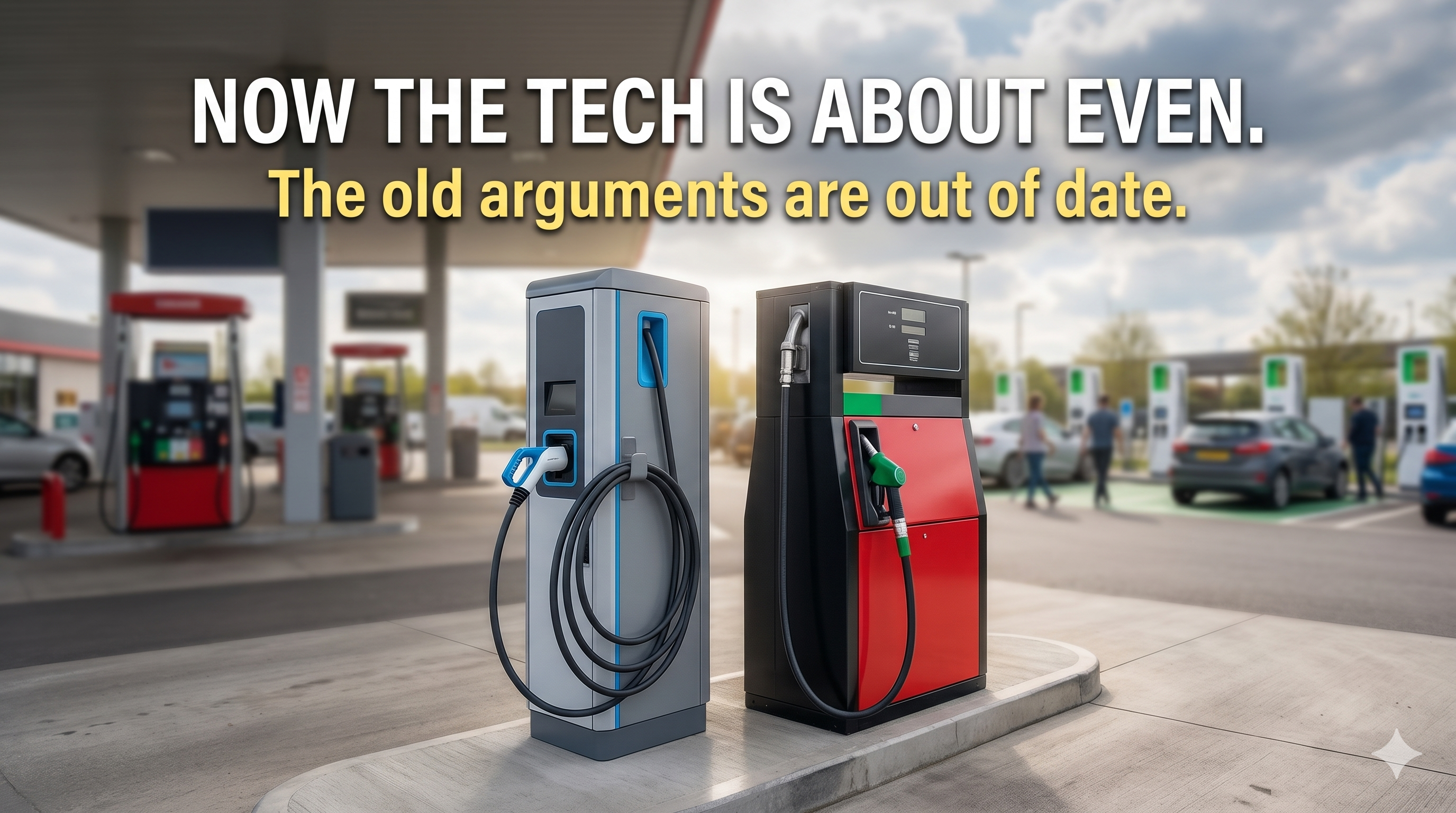
The two real technical objections to mass EV adoption were range and charge time.

Range has been largely answered for most drivers. The argument was always more perception than physics for the majority of use cases. There’s still a range/cost trade-off at the edges, and for certain use cases — long hauls, thin infrastructure corridors — it’s real. But for the suburban commuter with a predictable route, it was a phantom.

Charge time was the harder objection. It’s the one that lands with people who have driving patterns that don’t fit a neat daily commute.

That objection just got answered. CATL has announced a lithium-ion pack that goes from 10% to 80% charge for a long-range car in 5 minutes — essentially what you spend at a gas pump. With a cycle life as good or better than existing packs. That’s not a lab result. That’s a discontinuity arriving at production scale.

The cost curve has been moving the same direction for years. $137/kWh in 2020. $108/kWh in 2025. Consensus puts it at $60-80 by 2030. And unlike the internal combustion engine, which hit a performance plateau a while ago — where further gains tend to require turbos, complexity, and reliability trade-offs — battery technology still has a long way to run on the improvement curve.

The original technical case against EVs is now essentially closed.


The part most people haven’t thought through

Here’s the engineering insight that gets lost in the political argument: the EV value proposition is not uniform across vehicle categories. It runs in opposite directions depending on what you’re building.

A large pickup truck is a worst case. Heavy vehicle requires a big battery. Big battery adds weight. More weight means lower range. Lower range demands an even bigger battery. The vicious circle compounds fast, and the economics get brutal.

A mid-range car is a much better case. A small car is better still. An e-bike is the virtuous circle running full speed — light vehicle, small battery, low cost, genuinely better than the alternative on almost every axis.

The early EV push got this backwards. It over-emphasized large, expensive vehicles in categories where EV physics work against you, and under-served the mid and lower segments where the virtuous circle runs hard. That product mix failure wasn’t inevitable — it was a choice, driven by margin structure and political optics.

The companies that are finally starting to fix this understand where the physics are on their side.


What I expect to happen

The social politics will move on when the machine finds a new nuanced topic to flatten. It always does. The yelling tends to continue well past the point where it makes any sense, but it does eventually stop.

The regulatory environment is already normalizing. The tariff question is real and separate — you don’t abandon it just because the culture war has moved on, because the industrial competition with China doesn’t care about US political cycles.

Quietly, at the mid and lower price points, there’s no deep quitting. The product mix is starting to fill in where it should have been years ago.

By the time the US political environment fully resolves its feelings about EVs, the engineering will be a generation ahead of the debate. The technology wasn’t right five years ago for most buyers. It’s about right today. Tomorrow it will be better, and the gas engine curve doesn’t have the same headroom left to answer with.

The technology lapped the argument. Almost nobody noticed while it was happening.


Mark Harris is a systems and mechanical engineer, recovering from a career in EV power electronics, and the author of Stranded in the Stars (Book One, The Sea of Suns Trilogy). He writes about engineering, technology, and the creative life at This World and Others. The Unretired Engineer is on YouTube at https://www.youtube.com/@Scifiengineer-09

We Handed Them the Market

Related video: Range Anxiety — The Unreal Reality


I’ve been involved with EV power and propulsion for much of the last 30 years. My latest stint was at Wolfspeed, developing SiC power modules for EVs and fast chargers. When the EV market stalled and the company went into Chapter 11, I was among the people who lost their jobs.

I still think EVs are the right direction. I don’t own one. That’s not a contradiction, it’s the actual story, and the video above is where I work through it.

The short version: range anxiety was always overblown for most drivers, and the auto makers never built the product mix that met the needs of the broad market. Now the industry is driving hard away from EVs, especially in the US, and that’s just wrong-headed. The video closes on that but doesn’t dig into why. This post does.


The Part That Stings

While the US was arguing about mandates and turning the issue into clickbait, China was engineering.

BYD is selling comfortable, adequate-range EVs in the $15–20K range. That’s the vehicle that moves the majority of buyers. Not the Cybertruck, not the F-150 Lightning, not the Rivian. A practical car at a price most people can actually consider.

We handed them that market. Not through malice or conspiracy, but through a combination of policy that optimized for the wrong things and an industry that focused on protecting its margins.

The policy pushed hard for EV adoption with mandates, subsidies, timelines. Some of that pressure was probably warranted. The market would have gotten there on its own, but the question of when and at whose expense was real. The intervention accelerated some things. What it didn’t do was direct the industry toward the product that would actually move the needle for most buyers.

The industry copied Tesla’s playbook; premium vehicles, long range, performance, high price points. That was the wrong lesson. Tesla used that model to fund the manufacturing and infrastructure investment that actually mattered. Everyone else just took the margin and stopped there.

The charger network made the same error I described in a previous video: build for the metric that looks good in the grant report, not the outcome that matters to the driver. 97% uptime. 71% charging success rate. Two different measurements, only one of which tells you whether the thing worked.


Why Big Auto Isn’t Saving Itself

I always loathed the heavy-handed government push on EVs and what I read as gaslighting on the rationale. Mandates handed down by people who had never looked at a cost model. Timelines written by committees that had no idea what it actually takes to retool a supply chain or build an infrastructure.

At the same time, I think some intervention was warranted. Not because the market was wrong about EVs, but because the market was optimizing for the next quarter. And the externalities of the status quo were landing on people who weren’t in the pricing model.

Intervention at scale creates dependencies. The industry made bets premised on the government backstop continuing. When the political environment shifted, those bets didn’t just look bad, they collapsed. And the response has been to drive hard back toward gasoline, as if that solves anything.

US old-line auto companies have been struggling for decades, and the reasons are structural. They’re trapped by regulatory capture and built-in costs that make adaptation nearly impossible.

Start at the sales end. Their dealer networks are regulated state by state, which makes wholesale change all but impossible. Safety regulations run through a system where insurers push regulators to require improvements that the industry develops partly because those improvements push up vehicle margins. Manufacturing plants are at their core decades old, and the capital they represent sits on the books, write it down and you impair the balance sheet. Design is path dependent by habit and incentive: most changes are incremental tweaks to last year’s platform because that’s easy, cheap, and legible to accounting.

And the margin structure makes it worse. Bill-of-material cost for a vehicle increases slowly with size and content. Market value is largely bling-dependent. So the incentive always points toward large, well-fitted vehicles where the spread is widest, and away from the small practical vehicle where there’s almost none.

Meanwhile, the manufacturing model has already been cracked. A new generation of EV makers proved you can build at scale in the US, turn a profit, and drive down the cost curve without the legacy overhead strangling the old players. Big Auto is watching that happen and still can’t follow, because the legacy network isn’t just a cost problem, it’s a constraint on every decision they make.

Moving back to gasoline doesn’t fix any of this. It may help sales volume near-term, but fewer and fewer buyers are willing to pay up for big iron, and as the recent spike in gas prices reminded everyone, the cost of operating a gas vehicle is not as predictable as it felt a few years ago.

The wholesale abandonment of EVs is as wrong-headed as the mandates-first push that preceded it. You’re walking away from the future as it’s getting its feet under it, and you’re not fixing your actual problems in the process.

Different direction, same failure mode: optimizing for the political moment rather than the real problem.


What I Expect to Happen

The market will keep sorting this out despite the policy environment, not because of it.

Amazon is sponsoring the Slate, a small electric truck aimed squarely at the price point where the volume is. Ford is talking about smaller, value-forward platforms. The product mix gaps are starting to fill in, and the players doing it understand they have to meet buyers where they are, which is around $20K for a vehicle that’s good enough and built around what EVs actually do well.

BYD is a harder question. It was built on the back of Chinese state support and practices that wouldn’t survive scrutiny elsewhere, but that doesn’t change what it demonstrates: a level of technical maturity across product fit, design, and manufacturing that very few other automakers can match. Tariffs and regulatory barriers will slow it down. They won’t hold permanently. Some form of that capability will find its way into the US market, and when it does it will accelerate the shakeout that’s already coming for Big Auto.

Charging infrastructure will improve in the corridors where the economics support it and stay thin everywhere else, and that’s how it should work. Where it’s thin, the economics will eventually pull in local investors, the same way any other service infrastructure fills in. It won’t be fast, but it will happen.

The transition will come, just slower and more expensively than it had to be. The destination is probably the same. The cost of getting there is substantially higher, and much of the value being created will go to manufacturers who aren’t American. That’s the envelope effect of all the intervention and counter-intervention stacked on top of each other.

The engineers mostly knew it was going to be complicated. Technical change at a social scale always is. The complicated part is rarely the technology.


Mark Harris is a systems and mechanical engineer, recovering from a career in EV power electronics, and the author of Stranded in the Stars (Book One, The Sea of Suns Trilogy). He writes about engineering, technology, and the creative life at This World and Others. The Unretired Engineer is on YouTube at https://www.youtube.com/@Scifiengineer-09

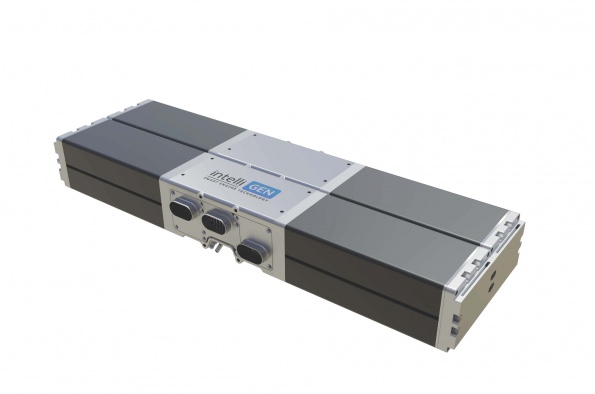
Internal combustion battery…sort of

The center section is essentially 2 combustion chambers back to back, the orange wrap is the ‘stator’ of an electric generator. When the magnets tied to the piston runs through the stator it generates electricity. Then a spring returns the stator to the center and the cycle (2 cycle) starts again.
Green Car Report :Could Free Piston Range Extenders Broaden the Electric Truck Horizon?
One of the ‘cool’ things about a Free Piston Engine is that it can be packaged in a fairly simple block and because of the elimination of the mechanical drive train and residual mechanical controls (valves, cams, etc) the machine can eat different types of fuel and be tuned in a wide variety of ways quite simply. This makes it compatible with battery electric systems on a packaging and mission program ability standpoint.
A simple schematic of the bare bones of a free piston machine. Other uses have been proposed but tying it to a generator and modern power electronics to make it a range extender is pretty interesting. The technology is derivative of the highly refined IC engines of today and the equally long history of electric generators so this should be something that matures pretty quickly.

A Cold day in H__L

This is reputedly a photograph of a test from years ago regarding windmills and icing. Almost the reverse of what it has sometimes been used to represent.
BUT….

Did Frozen Wind Turbines Impact the Texas Freeze? Here’s the Data

BY BRYAN PRESTON FEB 17, 2021

As the graph plainly shows, wind generation choked down but natural gas compensated. Coal and even nuclear power generation dipped. Solar generation has been negligible due to cloud cover and several inches of snow and ice.

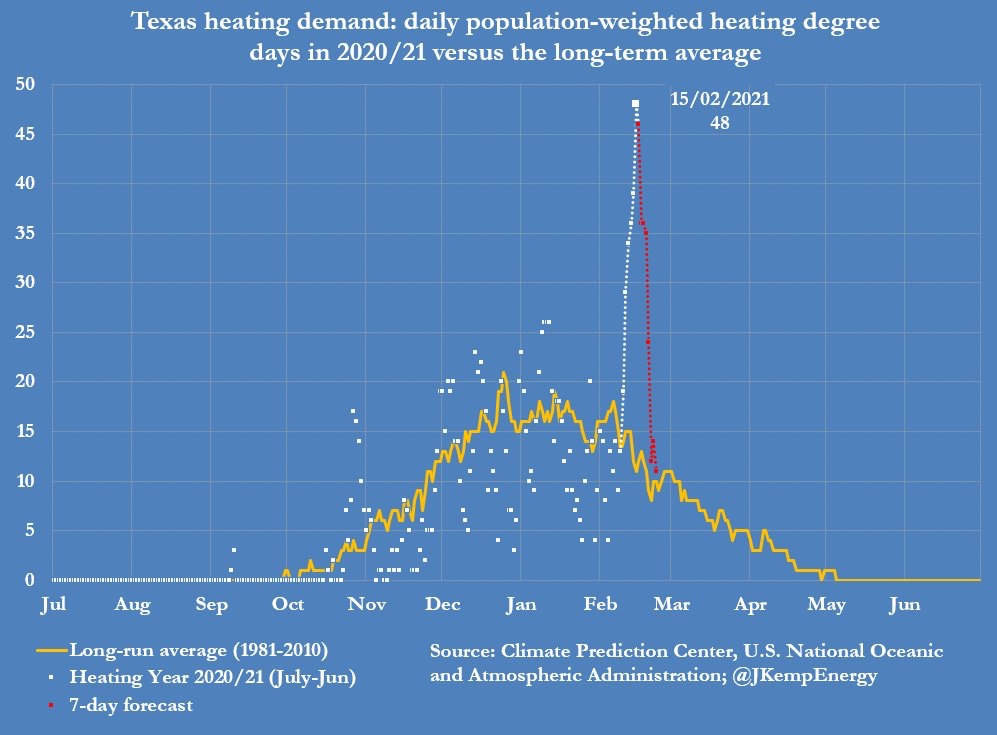
From StreetWiseProfessor: Who Is To Blame for SWP’s (and Texas’s) Forced Outage? “The facts are fairly straightforward. In the face of record demand (reflected in a crazy spike in heating degree days)…

…supply crashed. Supply from all sources. Wind, but also thermal (gas, nuclear, and coal). About 25GW of thermal capacity was offline, due to a variety of weather-related factors. These included most notably steep declines in natural gas production due to well freeze-offs and temperature-related outages of gas processing plants which combined to turn gas powered units into energy limited, rather than capacity limited, resources. They also included frozen instrumentation, water issues, and so on.”

So then Krugman rolls in from the NYT saying ‘Texas’ problem was Windmills is a Lie. ‘ Which itself, while not a lie in Detail, is a lie in Essence. As per some top line thinking in ManhattanContrarian in This Piece Points out:

Total winter generation capacity for the state is about 83 GW, while peak winter usage is about 57 GW. That’s a margin of over 45% of capacity over peak usage. In a fossil-fuel-only or fossil-fuel-plus-nuclear system, where all sources of power are dispatchable, a margin of 20% would be considered normal, and 30% would be luxurious. This margin is well more than that. How could that not be sufficient?

The answer is that Texas has gone crazy for wind. About 30 GW of the 83 GW of capacity are wind.

….sometimes the wind turbines only generate at a rate of 600 MW — which is about 2% of their capacity. And you never know when that’s going to be.

ManhattanContrarian

But/And it IS complicated. 1) You can install deicing systems on windmills but they are expensive to install and maintain and require INPUT of electric power to operate (Texas average weather makes this uneconomic to install.) 2) Texas did this to itself, it has an independent Grid because it IS a country sized state, the grid operator is actually a Bit Wind Crazy…why…because Texas has a lot of wind power. 3) This weather is a Combination of once in a hundred year cold AND snow/cloud cover, which systems are not designed to deal with other than in some degraded manner.

So one can only hope that because it is complicated and is fairly easily shown to be so that the cool heads will be left to work out some solution that prevents this sort of thing happening again. Because yes weather is unpredictable and while this was a 1/100 double header, it did occur and that says that the odds may not be what we think they are and so some mitigation is required. That mitigation is Not more wind, Not stored power, it IS more nuclear +better of all the above, AND better links to the broader national grid, etc, etc.

Myself, I’m planning a new house in the country. Big propane tank, backup generator, solar power, grid tied battery backup, ultra insulated house (for the region.) My prediction is that the grid is going to get worse not better and if you you can, you need to be able to survive without electric power from the mains for a week or more. I can make that possible, though I am in the few percent just because of location, situation, grace of the Infinite.

To explore you need Access

Photo of a nuclear thermal propulsion (NTP) system from the Rover/NERVA programs (left) and a cutaway schematic with labels (right). SOURCE: M. Houts et. al., NASA’s Nuclear Thermal Propulsion Project, NASA Marshall Space Flight Center, August 2018, ntrs.nasa.gov/citations/20180006514.
Space Nuclear Propulsion for Human Mars Exploration
National Academics of Sciences, Engineering and Medicine
National Academies Press
2021
[ParabolicArc Executive Summary, Findings & Recommendations from National Academies Report on Space Nuclear Propulsion
February 13, 2021 Doug Messier
]

While a chemically powered trip to Mars is feasible given the ability to lift a lot of mass so orbit, See SpaceX-Elon Musk, this is probably not the solution you would go for first. I think it makes sense as part of the Vision Setting that Musk does but the preference has always been for nuclear propulsion it enables faster (safer) trips and makes reusability even more effective since the ‘shuttles’ are not spending many months in transit each way.

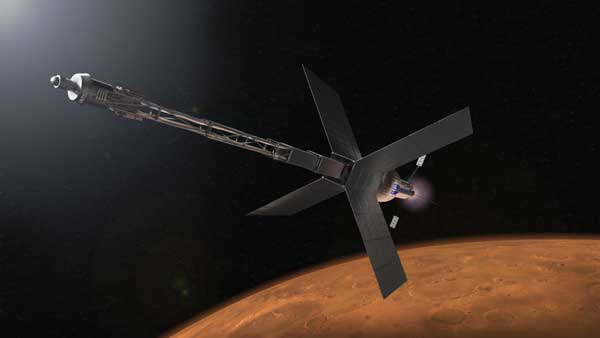
Posit a Freighter something like the illustration below. Departing Mars having dropped of say 2, 3, 4 starships’ worth of cargo. MarsStarships shuttle up and down and provide point to point transport on Mars. EarthStarships shuttle cargo up to earth orbit. Maybe LunarStarships shuttle fuel from production stations on the Moon to reduce the cost of fuel for the starships and the Freighter.

Illustration of a Mars transit habitat and nuclear propulsion system that could one day take astronauts to Mars. (Credits: NASA) [ParabolicArc: Executive Summary, Findings & Recommendations from National Academies Report on Space Nuclear Propulsion February 13, 2021 Doug Messier]

Now you have a system that provides Access to the solar system with significant cargos and the ability to establish and support exploration stations wherever you go.

CPU’s the Universe and Everything

The image from an interesting article on the ultimate in cloud computing. Hubble image of the asymptotic giant branch star U Camelopardalis. This star, nearing the end of its life, is losing mass as it coughs out shells of gas. Credit: ESA/Hubble, NASA and H. Olofsson (Onsala Space Observatory).

Seems like there must have been a mash up of astrophysics/cosmology/cybernetics a couple of weeks ago there have been a series of articles about computers and the universe. One series pointing out that once could conceive of using the AGB stars in their ‘dusting mode’ (above) as a computing engine.

But on the other side there have been a couple of articles that touch on the metaphysical (philosophical basis of reality) concept that we and our universe, are one vast simulation.

…Oxford philosopher Nick Bostrom’s philosophical thought experiment that the universe is a computer simulation. If that were true, then fundamental physical laws should reveal that the universe consists of individual chunks of space-time, like pixels in a video game. “If we live in a simulation, our world has to be discrete,”….

From: New machine learning theory raises questions about nature of science

….a discrete field theory, which views the universe as composed of individual bits and differs from the theories that people normally create. While scientists typically devise overarching concepts of how the physical world behaves, computers just assemble a collection of data points…..

From: New machine learning theory raises questions about nature of science

…A novel computer algorithm, or set of rules, that accurately predicts the orbits of planets in the solar system….

… devised by a scientist at the U.S. Department of Energy’s (DOE) Princeton Plasma Physics Laboratory (PPPL), applies machine learning, the form of artificial intelligence (AI) that learns from experience, to develop the predictions.

Qin (pronounced Chin) created a computer program into which he fed data from past observations of the orbits of Mercury, Venus, Earth, Mars, Jupiter, and the dwarf planet Ceres. This program, along with an additional program known as a ‘serving algorithm,’ then made accurate predictions of the orbits of other planets in the solar system without using Newton’s laws of motion and gravitation. “Essentially, I bypassed all the fundamental ingredients of physics. I go directly from data to data,” Qin said. “There is no law of physics in the middle…

…”Usually in physics, you make observations, create a theory based on those observations, and then use that theory to predict new observations,” said PPPL physicist Hong Qin, author of a paper detailing the concept in Scientific Reports. “What I’m doing is replacing this process with a type of black box that can produce accurate predictions without using a traditional theory or law.”…

From: New machine learning theory raises questions about nature of science

Ok so now I am going to go a bit sideways and you may want to just go on about your internet day. But while I laude Qin and his team I have a bit of an issue with what he claims re the basis is Philosophy. Not the claim that the discrete field theory sparked his concept exploration. But that the actual system he developed has anything to say about that metaphysical theory.

Taking nothing away from the team what I see seems like a straightforward application of machine learning. In fact a relatively simple one though I would laude the whole idea of applying it to physics in general. A very interesting though, like many interesting insights, oddly obvious is retrospect. (Sorry for the repeated Though clauses…I absolutely see this as fascinating insight…and possibly extremely important…it just seems like D’oh in retrospect.)

As physics is very much aligned with mathematics (I think because the discovery of each was feedback on the other) and mathematics and cybernetics are also deeply intwined it should come as no surprise that computer systems designed to create black box solutions, when fed the right kind of data, will create a black box model of physical phenomena.

The output of science are tools that allow us to predict finite things about the universe we live in, repeatably and accurately. These tools are often used by engineers to enable technologyy that make life better for everyone.

But in many ways this is an engineers (relatively narrow) viewpoint. To some large degree an engineer does not care why the tool works, only that it does and how accurately. Counter to that, a strength of the theory based + mathematical model approach is that it gives you a tool to link the rest of reality to the ‘discrete’ piece you are working on right now. A jumping off point or a linking point to other theories that allows us to move onto other problems and link the

And/But (you knew it was coming) i wonder if this has anything to do with discrete field theory per se. Maybe if the learning algorithm used had that in it this would show something of that nature, but otherwise I do not see this as showing anything in particular other than the ability of learning systems which are in some sense continuous not discrete systems to develop predictive models directly from the data (as Qin says) rather than through the labor intensive methods of theory extraction and proof that has been the basis for scientific exploration since it first evolved in the Middle Ages.

Again BUT, it has been getting harder to develop these ‘deep’ theories. Look at the colliders and other tools that physicists use these days to probe the depths of our reality. In this world there are many things, like Qin’s next test with Nuclear Fusion, where an engineering model might be much more valuable than a ‘theory of this’ if it can be captured and used in a fraction of the time.

It’s all good, fascinating, wonderful…but let’s not get ahead of ourselves.

WOW! A cool SETI theory…

Figure: The Wow! Signal. The peak is 32 times the signal to noise ratio of the observations. Courtesy of Sam Morrell. (From the article)

Not much more to be said so I post the intro to the article from Centauri Dreams, about an article/Theory by James Benford. Cool…

Was the Wow! Signal Due to Power Beaming Leakage?

by PAUL GILSTER on JANUARY 22, 2021

The Wow! signal has a storied history in the SETI community, a one-off detection at the Ohio State ‘Big Ear’ observatory in 1977 that Jim Benford, among others, considers the most interesting candidate signal ever received. A plasma physicist and CEO of Microwave Sciences, Benford returns to Centauri Dreams today with a closer look at the signal and its striking characteristics, which admit to a variety of explanations, though only one that the author believes fits all the parameters. A second reception of the Wow! might tell us a great deal, but is such an event likely? So far all repeat observations have failed and, as Benford points out, there may be reason to assume they must. The essay below is a shorter version of the paper Jim has submitted to Astrobiology.

A little air, a bit of heat, some light

What Global Warming? 148 New (2020) Scientific Papers Affirm Recent Non-Warming, A Degrees-Warmer Past at WattsUpWithThat

Climate Change Horror Porn is another tool of the apparat to frighten us. In realty there is an objective truth out there…none of us know it. Two sides largely aligned Left and Right though not precisely have taken sides and because the liberal left is ascendant and deeply intwined in academia and the media they are trying to ‘scare us straight.’ It might be well intentioned in many cases, but ideologues, abusers, users and grifters have gathered around a powerful ideological tool that can be used to manipulate the population.

  • The science such as it is….which is a lot…but not what you are told it is by the media and the ideologues who want to use it.
    • Climate science
      • What climate was/is/will be:
        • Is based on models of how the whole atmosphere, hydrosphere and lithosphere work.
          • Early simple models were very illuminating.
          • Complex models are horribly sensitive to incorrect knowledge and unknowns.
        • A lot of it is based on prior history comparing things like plant and sea life growth vs temperature, CO2 etc.
          • But most of this knowledge is based on proxies up until a decade or at most two ago.
          • Plus sparse and non technical accounts up until the modern era
          • Has a sparse and erratic technical record from about a century and a half.
          • Decent deep record for a couple of decades.
          • Can see what it is today in fair but not omniscient detail.
        • We model the future based on models that we ‘test’ against the past. Like the stock market sometimes these models can do an ok job. But that is only because of parameter fiddling to ‘match the curves.’ The models are by necessity highly simplified and often just plain wrong. For example:
          • recent discovery that cloud impact on surface temperature can increase not decrease surface temperature. And that it may depend on where you are in the world.
          • Recent discovery that CO2 concentration’s affect on green house is not linear and tapers quickly at higher concentrations.
          • That the planetary heat balance is highly affected by cooling at the poles, and that the magnetosphere/sun link into the climate also is highly linked at the poles.
          • Etc.
        • While the first climate models that brilliant men and women came up with less than a century ago have been proven to be largely correct, the details are practically, hardly better modeled today than they were in the 1950’s.
        • Today there are literally hundreds of complex computer models and that are run many times with many different start parameters. They generate families of predictions, effectively at random. Those predictions are never even close to right at a rate greater than chance.
Continue reading

Icy moons, exciting targets of exploration

The Interior of Enceladus Looks Really Great for Supporting Life
Article in UniverseToday on one of Saturn’s moons

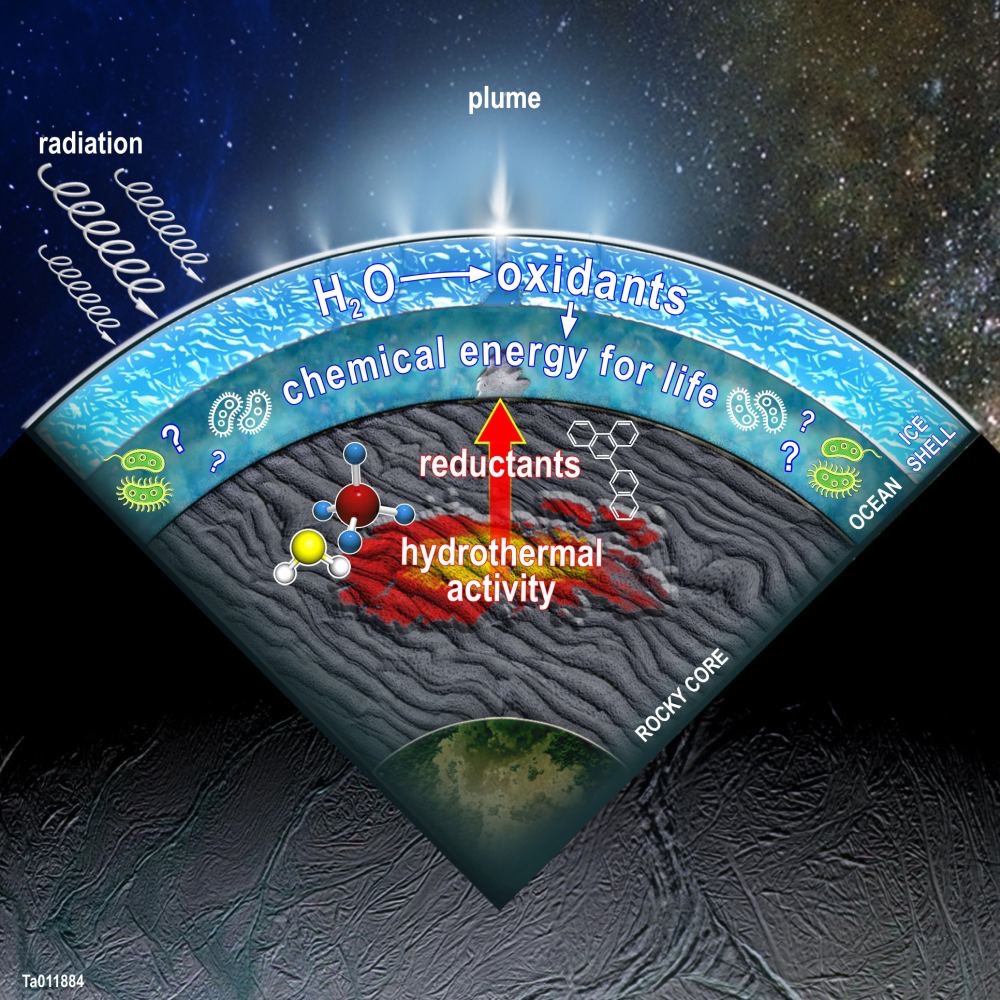
In the early days of space exploration it was the rocky planets, particularly Mars and Venus that held some hope of significant life. Though those with the tools of observation and analysis were pretty negative and life in the rest of the solar system looked impossible. But as our knowledge and tools expanded the icy moons quickly became of interest because as cold region natives know, ice is not a bad insulator and a couple of miles of it would protect a lake. These days it seems pretty clear that Icy Moons often have oceans, seas or lakes inside, and the heat that melts the ice from underneath (from orbital stresses and or radioactive decay) could quite conceivably support life.

The article linked discusses model based research based on data from earlier orbiters and flybys. It shows that notionally their are several mechanisms that could be feeding nutrients and energy sources into the ocean of Enceladus, at a rate suffient to support a significant biome.

There are lots of other interesting articles on space at universe today website, take a look.

Photovoltaic…as I said, it’s real and getting more real.——Why the Price of New Solar Electricity Fell an Incredible 89% in the Last Decade

Our World In Data chart, via SingularityHub
By Jason Dorrier – Dec 13, 2020
This has been in the news but discounted in some ways utility side issues still make this a success story the utilities could do without. A couple of general downside views. Solar modules are a troubling refuse stream until recycling tech hits new highs. The cell modules wear out over time, the wear out and $payback often overlap in the wrong way. Both of these issues should ease in the coming years but you cannot discount them yet. Still this is amazing and it seemed obvious at least 5 years ago, nice that it kept on trend.