DefenseTech calls it a Bomb Truck

20120311-204543.jpg
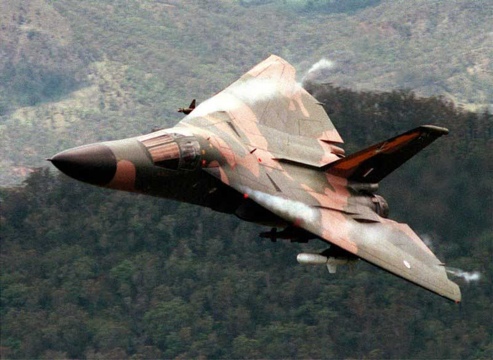
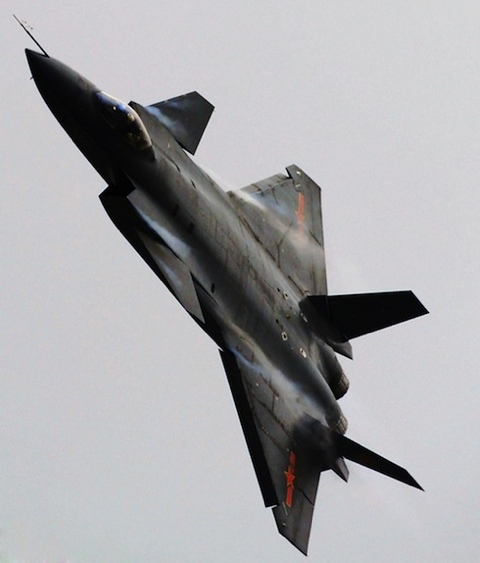
DefenseTech has some Chinese eye candy regarding the large and apparently powerful J-20 in development / trials. They call the aircraft a bomb truck and that seems likely, the analogy to th 70’s vintage FB-111 seems apt.

20120311-205744.jpg
These aircraft are the conceptual descendants of WWII aircraft like the Mosquito.

20120311-205757.jpg
The thing I find peculiar is how open the Chinese are about the testing of the J-20 it’s like a reality TV show. One part of me wants to say the Chinese know everyone will be spying anyway, to reduce the tension, just go ahead and let the pictures be taken, bask in the glow of self righteousness, and the fact you’re saving money. And at the end of the day why does one care, the real secret sauce is deeply buried in the materials and internal details and is not readily apparent on the surface anyway…The other part wonders what’s really going on in some distant corner of the country.

The Army really needs to ‘cool it’s jets'(calm down in the lingo of the ‘Gray Lensman’)

In the NDIA’s National Defense magazine’s blog there is a post: Don’t Rush to Buy New Vehicles, Army and Marine Corps Warned

The traditional approach to updating U.S. military hardware — spending years and billions of dollars on next-generation designs — is no longer working for the Army and the Marine Corps as they seek replacements for their combat vehicles.

——

One reason for the military to hold off on buying new vehicles is that there are no technological silver bullets to make military trucks, tanks and personnel carriers less vulnerable to enemy weapons, …. Adversaries can acquire and deploy antitank weapons and roadside bombs much faster and at far less cost than the U.S. military can build countermeasures and survivable vehicles,

——

It’s not clear that the Army or the Marine Corps can “get out of this box,” Outspending the enemy in this case is a losing battle. … “Adversaries’ use of guided weapons, relatively cheap and rapidly fielded anti-armor weapons … threatens to increase significantly the costs incurred by U.S. ground troops in accomplishing their assigned missions,”

——

The Army’s procurement bureaucracy is still reeling from the failure of its $200 Future Combat Systems. Although the follow-on program, the Ground Combat Vehicle, is far more modest, it is not clear that it (will) offer a substantial technological boost compared to existing vehicles

——-

Army buyers might still be somewhat (IMO are totally) deluded by the thinking that doomed the Future Combat Systems. At the time, FCS officials touted the program for its advanced information network, which would give commanders an instant view of the battlefield and allow them to see the enemy without being detected.

After the termination of FCS, the Army continued the push for an advanced communications network, which is now billed as the services number-one modernization priority. The problem, … is that the Army still assumes it can deploy a network at will. “The assumption is that we are operating in a permissive environment … that once we set up the network, nobody is going to tear it down,”

——
We have operated in a permissive environment, electronically and even threat wise for the past decade at least. We have also operated in a nation building civil war environment in urban, suburban environment. Even in the ‘Stan the military faces an enemy with limited access to weapons beyond RPGs and IEDs but these have proven the Bradley is no longer viable and driven us to develop armored modestly off road vehicles like the Stryker DVH, MATV, and MAXPRO MRAP.

These vehicles use existing technology and are enough over designed to allow for evolution. They are too heavy for the Army and USMC but the effort put into the ‘light weight’ replacement the JLTV Family has already cost huge amounts and the only way the Army/USMC kept the program was mandating a weight(26,000lb), cost ($250,000 ea) and protection (MAXPRO equivalent) and letting everything else float or be a special kit. The program has been a feeding trough for the Mil-Ind-Bandit-complex for several years not for truck builders supported by the Army funding some high end components. In fact the truck builders and high end suppliers have been funding their own pragmatic tech programs based on industrial/commercial insights that in the end the Army and USMC have bought.

Recently a couple of high ups in the acquisition corps said they’ve been meeting the soldiers needs and all the grief about Comanche, Crusader, JLTV EDM, EFV, FCS, etc is all noise. Bull-crap!

Once it might have had some truth, the Army/USMC did projects to build tech and keep design experience honed. Much of the money went to top grade suppliers of engines, suspensions, transmissions, the primes never intended the vehicles to go to production, everyone learnt and had tech on the shelf. Those days are gone.

These days the programs are too tightly focused and the programs are ‘mapped’ to lead to production. So the top tier suppliers go for them, often get more than one ‘team’ funded and develop futuristic Advanced Development Models, designed to highly refined specs that require essentially custom components. To keep their engineering teams fed they keep most of the work in house and over-ride input from the lower tier suppliers they do use. The specifications are too specific and often contradictory, open to interpretation, and all too often evolving. Money swirls down the toilet by the bushel. New management comes in, new ‘baselines’ established more money flushed and eventually the program collapses. Little of the technology is of use elsewhere.

The world class suppliers all largely ignore Army programs because they have spent too much money on programs that are ill conceived and almost bound to fail. Where the automotive industry does work on gov’t programs they try to focus on programs with clear near term needs, like the highly successful, Stryker, MATV, and later MRAPS.

At the end of the day we’ll be better off letting things settle out while we fund evolutionary and component technologies. The thousands of bright young officers coming back from Iraq and the ‘Stan need to settle in, study the world, history and the potential for tightly-constrained battlespaces, they’ll be the ones to figure out what comes next, not the old guard who claim they’re ‘just fine…’

“Quantum Biology and the Puzzle…” quantum WHAT?

More fascinating stuff from Technology Review | Quantum Biology and the Puzzle of Coherence

Quantum processes shouldn’t survive in hot, wet biological systems and yet a growing body of evidence suggests they do. Now physicists think they know how

This is mind blowing, I’ve thought for some time that quantum effects play a role in life but this says that they are pervasive, and possibly usable in the engineering sense, if so this could well open up another road forward in a vast array of fields of development. very cool, very exciting!

At the end of the day it seems to me that a majority of the human race could be set to work investigating and developing useful ways of using the science we are opening up without making a dent in the amount of such work for the foreseeable future. What we lack is enough trained and willing minds to address the world not opportunities to exploit. The problem is that a vast majority of the human race are not a whole lot better educated / socialized (this is as true of at least a significant number of americans as it is of chinese far workers) than a late medieval peasant and the infrastructure of the world is in the same sad state. I can only hope that the great uplifting that has been going on since the beginning of the British Industrial Revolution continues long enough to get us through the coming knot hole.

20120306-202829.jpg

Jaja: Worlds first pressure sensitive iPad Stylus

This project to develop a better iPad Stylus is a Kickstarter, crowd sourced project, i.e. the project is funded by putting the prospectus on the website and asking for a set amount of funding to get to the next level.  This is an approach to funding that is taking off big for many types of effort and holds a great deal of promise for W.R.Mead’s Post Blue Model (on which more later.)

The project itself looks reasonably conceived and has what in some circles is called off ramps, that is pieces of the technology that may be of value in their own right. 

jaja cutaway

jaja cutaway

I do have to say that eventually I think a non-capacitive system, maybe even an old style optical dig pen will be needed in addition to the capacitive if the iPad is to reach its peak functionality.  Which is what this Technology Review blog post, Will Designers Take to the iPad3? talks about.  The answer in my opinion is no, I am not a professional but am somewhat ProAm and I find that while the iPad has its liberating effect (frothed about elsewhere) it still has some irritating downsides at times.

Nano Robots Move Out


Mothership?

A fascinating set of articles came out recently discussing the progress in micro and nano robotic techniques above. Is the picture from a short piece in IEEE Spectrum discussing the work of Dr. Ada Poon at the Standford Poon Group who are working on medical applications of beamed power. 

Poon Group Tech Map

Poon Group Tech Map

The basis is this technical paper (PDF).  Which talks about the chip, it essentially couples the beamed energy with a tiny antenna and converts the energy to a form needed to drive the chip using a electromagnetic propulsion fabricated on chip.  Very cool.  I will also point out that the Poon Group appears to be reasonably focused, some similar organizations I have run across or worked with have gotten way too diffuse and seem to wander off topic all the time.  Dr. Poon is doing a good job focusing on some key enabling technologies in the field.

So every battle platform needs its weapons, and what do you know these guys seem to have just the ticket.

Researchers at the Wyss Institute for Biologically Inspired Engineering at Harvard University have developed a robotic device made from DNA that could potentially seek out specific cell targets.

DNA Nanobot Shell

DNA Nanobot Shell

Obviously they are looking to ways to use this in the form of a more traditional delivery system, say a shot, but the Dreadnought could also use these for delivering deadly loads into exactly the right spot possibly repeatedly over time without repeated shots etc.

On its own very cool, in combination with everything else going on, mind-blowing!!

And yet we also complain about the costs of medicine.  The reason that money is put into these efforts is both altruistic and profit driven:

  • Medicine is after all about making life better for human beings
  • These techniques promise profound effects with minimal collateral damage
  • These devices can be fabricated in their thousands using ultra clean and precise techniques that will both lower cost and improve performance.
  • The price performance should move towards a Moore’s Rule like model of decreasing price AND increasing performance on a steep slope.
  • Conditions untreatable today will be treatable
  • People who would have died will live…some with health issues that will make them a drain on the economy.
  • Early clinical trials and during ramp up and cost recoupment the prices will be high because of limited supply and price controls…and people will complain about the cost of medicine.

And so the cycle will go on.  Do not take my screeds against Health Care costs and the Medical Establishment as any kind of Luddism, I want more technology more quickly, its the only path to better human lives.  What I hate is the almost Medieval Economic model of the existing ME in the US.

AWST | Electric Propulsion for Airliners

Green Operations

Taxi Electric

Powered wheel-drive systems promise to save fuel and reduce emissions at airports
Graham Warwick/Washington

Taxiing to and from the runway on engine power may soon be a thing of the past as development of electric wheel-drive systems progresses, with the promise of reducing fuel consumption, emissions and noise—and potentially increasing airport capacity.

EasyJet will be the first airline to test an electric taxiing system being developed by Honeywell and Safran. Operational trials on the Airbus A320 are expected to begin in 2013. Lufthansa and L-3 Communications tested an electric-taxi technology demonstrator on an A320 at Frankfurt in December. WheelTug plans to demonstrate a system on a Boeing 737-800 in May, “almost certainly in North America,” the start-up says.

The Honeywell/Safran electric green taxiing system (EGTS) uses electric motors on the main landing-gear wheels, powered by the aircraft’s auxiliary power unit (APU). L-3’s GreenTaxi system also powers the main wheels, but WheelTug’s approach is to drive the nosewheels. German aerospace center DLR demonstrated a powered nosegear on an A320 at Hamburg in June 2011, with the electrical power coming from a fuel cell.

WheelTug is testing its motors in the laboratory and expects to begin tests of the complete wheel package in March, says CEO Isaiah Cox. Details of the May demo have yet to be announced. WheelTug is on track for certification and first deliveries for the Boeing 737NG in mid-2013, he says, and talks have begun with A320 operators. Israel airline El Al has signed a memorandum of understanding, and Cox expects to have “1,000 aircraft in backlog” by late this year.

The Honeywell/Safran partnership has acquired an A320, based at Montpelier, France, which it is using to understand loads and deflections on the landing gear. This aircraft will be used for tests of the EGTS beginning this year, says Brian Wenig, vice president of business development at Honeywell Aerospace. Certification of the system for retrofit and forward fit is targeted for 2016.

Lufthansa Technik and teammates L-3, Airbus, Lufthansa and Frankfurt Airport operator Fraport are scrutinizing data from 14 hr. of taxi trials and will complete an economic benefit analysis in March before deciding whether to proceed to a prototype system, says Christian Mutz, project manager of innovation for Lufthansa Technik.

The GreenTaxi demonstrator used off-the-shelf vehicle motors from German subsidiary L-3 Magnet-Motor. Installation required removal of the brakes from the outer wheel on each pair. A container in the cargo bay provided power conditioning and liquid cooling, which Mutz says proved not to be needed, as the motors stayed cooler than the brakes.

Weight is critical, and the Lufthansa team is looking at a lighter pushback-only system as an alternative to the full capability, as well as a hybrid of the two. A pushback-only system would propel the aircraft at 3 mph, compared with a full system that would be capable of taxiing the aircraft at 30-40 mph, Mutz says.

Able to propel the aircraft at up to 28 mph, WheelTug weighs 300 lb. but is “flight weight”-neutral, as less fuel is required for taxiing, the company says. Minimum fuel burn for a 737 taxiing on one engine averages 15 lb./min., and crews typically add 30 min. of fuel weighing 450 lb. for contingencies. Powering the wheels from the APU cuts taxi fuel burn by up to 85%. “Instead of over 200 kg [440 lb.] of taxi contingency fuel, I can load 60 kg, and have the same operational flexibility,” says Chief Pilot Joseph Goldman.

WheelTug’s business plan is to supply systems and spares free to airlines and share the demonstrated savings. “We can show savings to airlines of $600,000-800,000 a year,” says Cox. “That compares with $1.5-2 million a year for reengining.” Honeywell “conservatively estimates” that the EGTS will save an average $160 per segment, and 130 tons of fuel per year per aircraft, for an A320 or 737 operator, says Wenig.

There is still debate over the right approach. Honeywell/Safran and L-3/Lufthansa say the capability to taxi in all conditions can only be provided by powering the main wheels, as there is not enough weight on the nosewheels to provide the required traction. “We have done tests, and demonstrated operation in ice and snow,” counters Cox.

Other potential benefits of electric taxiing include shorter turnaround times and the ability to position aircraft on the runway at noise-constrained airports so takeoffs can begin as soon as the curfew is lifted, generating more slots. But engine makers are concerned about the lack of warm-up time that could result.

20120221-224508.jpg
A picture from Chorus Motors, who owns WheelTug, the motors are in the nose wheel which has no braking system so has lots of room for the motors (don’t get me wrong these are powerful motors for their size weight.)

The issue mentioned above and main reason that this is starting on the 737 and A319 is that these are both big and small at the same time.

Compare the landing gear in the pictures below one of a 737 the other of its biiiiig brother the 777.

20120221-225832.jpg

20120221-225921.jpg

There is much more, % wise, weight on little bro’s front wheel. With friction etc you have a practical propulsion system even in crappy frigid/icy weather, after the planes been sitting for a long time, and the tires have flat spots where they contact the ground. With the 777 there is no way that the front wheel can haul that big boy around.

The article discusses work on main gear but here you have to integrate around the brakes. Now there are reasons this would be good beyond taxing but the brakes are hot and dirty, a much tougher environment and for a big boy you would need a lot more than two driven wheels which makes cabling and drives even more of an issue. But at the end of the day this is probably the way aircraft will move on the ground in twenty some years and those future versions of us will wonder why it took so long.

20120221-231528.jpg
Testing out a main gear electric taxi concept, L3/MagnetMotor and Lufthansa.

Ferret under the cars, the tables, the … Uh shouldn’t go there…

20120218-221136.jpg

Another use for a robot, inspecting for bombs etc, this is the general-robotics Ferret. I find the name of the company interesting it’s turned up in SciFi forever, following General Electric, General Motors, General Mills, General Atomic, etc, etc, it became a claim on greatness then a cliche. The parent company is in electrooptics and it’s influence can be seen in the video glasses. Does not take away from a great idea. I wonder if the inventor was watching his Rumba vacuum under the couch when he had the flash?

From Defense Tech

20120218-215324.jpg
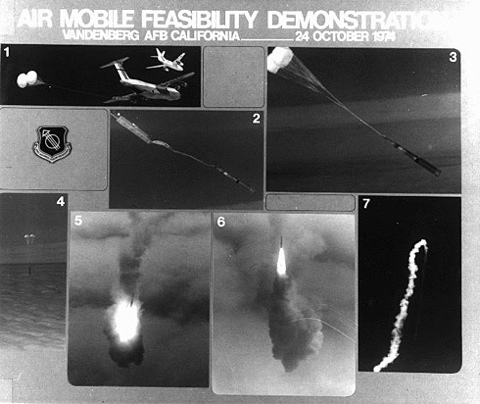
This reminder of fun times past, though one wonders about the prayers of the C5 pilot prior to ignition. I remember seeing this as one of the options explored for the Peacekeeper ICBM follow on to The Minuteman. Must admit that it seems pretty crazy cost wise and if you kept them on the ground most of the time little different from the bomber force. Maybe it made some sense, fly as close to the border as you want then toss in at a shallow angle, mixing up the attack as it were. Of course by the time this was really feasible, there was no point…and history seems to say that much of this kind of thinking was wasted time and energy, the BOOGEYMAN, was only ever a boogeyman, and probably more worried about what we might do to him than what he could do to us.