Free Syrian Army | Counterpoint

http://www.foreignpolicy.com/articles/2012/10/15/Guerrilla_Country_Syria_Jebel_Zawiya


As a counterpoint to Huriyet Daily’s Point of view this article; Guerrilla Country I linked to in Foreign Policy has a different take.  The article is fascinating in its details but the money item is this:

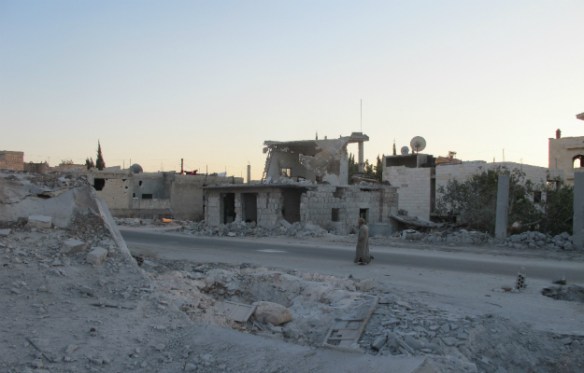
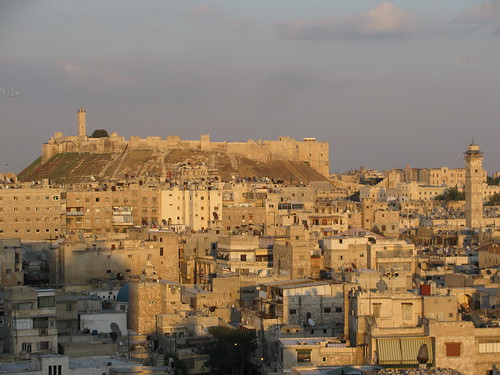
As a no-holds-barred battle rages to the east in the city of Aleppo, the pulse of the Syrian insurrection can be taken in Jabal al-Zawiya. This complex region of hills covered in olive groves and plains entwined with narrow roads of asphalt or dirt is the homeland of Hussein Harmoush, the first officer to publicly defect in 2011, and of Riad al-Asaad, the leading figure of the Free Syrian Army (FSA). Here, the insurrection is deeply rooted in the social fabric: The war these men are waging is always present, and its path is inseparable from their identities.

The FSA’s lack of formal hierarchy appears to be an asset here, as it allows the citizens of the region to organize the insurgency locally and tailor their military response to their environment. Although the rebels in Jabal al-Zawiya recognize a general leadership above them — and though they place themselves under the FSA’s umbrella — these semiautonomous groups of fighters are organized along village and family lines. That gives them several advantages: They have natural intelligence-gathering networks, and they know the terrain like the palms of their hands, having relied on back roads for supplies and secret meetings for many months. These assets, coupled with basic military skills, have allowed them to drive a far superior foe out of the towns.

Now I am far from the sound of guns and have never had the ill luck to be any closer than in an airliner on the original 9/11 but this piece rings true to me.  That is not to say it’s a good thing or bad thing, it is a reasonable facsimile of a fact on the ground.  What it says is that the FSA is probably a lot more effective than numbers and weaponry might indicate.

The FSA does not need to have its boots on the ground everywhere as it has co-opted the local fighting age inhabitants into a cell based ground holding force.  This ground holding force is self-supporting, motivated and dangerous because of its local knowledge and backing.

The FSA assault groups can stay very lean and relatively disbursed and yet have considerable military effect   They can move through the held ground quickly even if on foot because they will have local guides, support and not need a significant logistics tail or carry a lot of food and ammo.  Of course that means they cannot carry out a stand up fight from the move but that should happen rarely since they have eyes everywhere.

That’s not to say the situation sounds good.  The picture and the description are unsettling.  This is a war very much like those in the Balkans during the partisan wars associated with WWI, WWII and the ColdWar.  A war of sects who until the dogs were loosed had lived interlaced with each other for decades if not centuries (not always at peace mind you.) Now with the emperors (dictators) military police no longer suppress all,  distrust and pent-up hate is unleashed and leads down an ever tighter and more destructive spiral.

This is what the US and others should have been trying to prevent, the fragmentation and violation of the populace to a point where their natural distrust of ‘the other’ will make it all but impossible to put a working multi-cultural society back together again.

Lebanon (Syria’s neighbor and sometime satrap) is another multicultural nation in name only, but it has learned to live with its divisions, hopefully it can teach Syrians how to live with theirs when the dogs of war grow sated.

Which Is Worse: To Help the Syrian Rebels or to Do Nothing? | WALTER RUSSELL MEAD

From the Huriyet Daily News:

There are more than 30 different rebel groups, including the most prominent rebel group, the “Free Syrian Army” (FSA), fighting in Syria, according to officials from the most prominent Syrian opposition group, the Syrian National Council (SNC).
The Jihadists, Islamists, pro-al-Qaida and secular groups that are not under the control of the FSA and which are fighting in different areas of Syria against the Syrian regime forces prove how fragmented and disorganized the Syrian rebel groups were in Syria.
According to the SNC media officer, Ahmad al-Halabi, there are more than 30 opposition groups fighting in Syria – of whom only 15 could be identified by Hürriyet Daily News research. “Fifty armed men come together and they form a rebel group. They generally give their groups names from the Quran or the names the towns and areas they are coming from,” Ahmad al-Halabi told the Daily News.
According to SNC officials, there were between 70,000 and 100,000 rebels fighting against the Syrian regime in Syria. The most prominent rebel group, the “Free Syrian Army” (FSA) – who listed its main base as in the southern Turkish city of Hatay on its website – is the best connected with the SNC.

Click to go to PDF of the article (In English)

From WRM’s Via Meadia Post:

Syria is a lot like Lebanon’s bigger, uglier, and meaner brother. The ethnic and religious tensions that produced decades of civil war in Lebanon are also present in Syria. The Assad dictatorship imposed a rigid order on Syria, but as the dictatorship crumbles the divisions are coming back into public view. Unless we were willing to put tens, maybe hundreds of thousands of troops in Syria and keep them there for a long time, often fighting bad guys and getting attacked by suicide bombers, we don’t stand much chance of building and orderly and stable society there, much less an open and free one.

And:

Aiding the less ugly, less bad guys in the Syrian resistance, and even finding a few actual good guys to support, isn’t about installing a pro-American government in post civil war Syria. It’s about minimizing the prospects for a worst-case scenario—by shortening the era of conflict and so, hopefully, reducing the radicalization of the population and limiting the prospects that Syrian society – – – will descend into all-out chaotic massacres and civil conflict.

Understand and agree with this next with a big but…

If the United States hadn’t gotten itself distracted by the ill-considered intervention in Libya, we might have acted in Syria at an earlier stage, when there were some better options on the table. But we are past that now; the White House humanitarians did what humanitarians often do—inadvertently promoting a worse disaster in one place (in this case, Syria) by failing to integrate their humanitarian impulses (in Libya) with strategic reflection. This kind of strategic incompetence is the greatest single flaw in the humanitarian approach to foreign policy. It has led to untold misery in the past and will likely lead to many more bloodbaths in the future. Unfortunately, warm hearted fuzzy brained humanitarianism is one of the world’s greatest killers.

BUT:  There is really no reason we could not have done something earlier and more aggressively in Syria except that it is Silly Time (otherwise known as Presidential Election Quarter) in America.

One hopes that this is not the future for all of Syria, which has already succeeded in bombing its economy and infrastructure back decades.  Somehow when the dogs of war are unleashed the destruction seems immaterial.  Someday the dogs are impounded again and then the red haze recedes leaving behind only tears.

Some thoughts on a tangential topic to truth in a ‘Statesman’s’ world

The famous rant by Colonel Jessep (Nicholson) from A Few Good Men:

You can’t handle the truth! Son, we live in a world that has walls, and those walls have to be guarded by men with guns. Who’s gonna do it? You? You, Lt. Weinburg? I have a greater responsibility than you could possibly fathom. You weep for Santiago, and you curse the marines. You have that luxury. You have the luxury of not knowing what I know. That Santiago’s death, while tragic, probably saved lives. And my existence, while grotesque and incomprehensible to you, saves lives. You don’t want the truth because deep down in places you don’t talk about at parties, you want me on that wall, you need me on that wall. We use words like honor, code, loyalty. We use these words as the backbone of a life spent defending something. You use them as a punchline. I have neither the time nor the inclination to explain myself to a man who rises and sleeps under the blanket of the very freedom that I provide, and then questions the manner in which I provide it. I would rather you just said thank you, and went on your way, Otherwise, I suggest you pick up a weapon, and stand a post. Either way, I don’t give a damn what you think you are entitled to.

Nicholson is able project a charismatic mix of steely conviction with righteousness and psychotic tendencies. He’s homely in a rather attractive sense but his rubber play mask of a face often seems on the brink of either maniacal rage or maniacal laughter…with the understanding that the differences are tiny.

That whole movie left me cold, there was something trite about it and the casting of the oh so cute JAG’s and the oh so over wrought marines was perhaps clever, the setting clever, the words….clever, but what was it all about?

It was all about the delivery of that one monologue and its delivery by someone who was clearly, if only slightly, over the edge, in a place that should not exist.

The movie provided depth to the speech that twists the highest meanings of honor and service into dark and dangerous threats curdled in a place and circumstance that are wholly unnecessary.

And this was long before Guantanamo took on its current gray mantle.

This can be seen as the most powerful anti war movie (without any action) that has ever been created because it says that the things a person has to take on to become a combatant are manipulations and most likely the rational behind it is a lie and the urge to protect, more about power and privilege than caring.

And yet…and yet…I came away with the weird sense, I think intentionally  that Jessep was more hero than villain and the JAGs more (minor) villains than heroes though they were heroes and he was a villain who needed stopping.

In ghostly profile behind Jessep, I see Patton, Stonewall Jackson, Sherman and others, who were in their ways just as nuts,  In an alternate to his fictional world Jessep could have been a great hero and the JAGS might have been slimy villains.

Was any of this the original intent?  Probably and if so its probably great art, in the sense of great playwright’s work and great casting, not so much cinematography or  directing or  acting on anyone’s part other than Nicholson’s.

A Few Good Men and the strange mirrors it casts are more apropos today than they could conceivably have been when it was made.  This movie made today, set in Iraq, Afghanistan or any one of a hundred other places, would not work as well and would create a firestorm of debate but then vanish.

It has been left alone because it says more, more subtly the way it is than it could possibly say if redone in a contemporary venue.  And anyone who tried to remake it would be unable to create the remarkably fine balance that it drew between hero and villain on both sides.

Ship to Shore Connector… Landing Craft Air Cushion, only the Gov’t could make something this cool boooring

 These are the final stage of the powerful conveyor that is the Navy’s Gator Fleet, the numerous, rather ugly, remarkably capable ships that carry the Marines to the far ends of the world and deliver them on the beach when needed.  While this fleet has been mainly a humanitarian instrument for many years now it is one of the principal reasons for the US Navy to be as big and capable as it is.  The US Navy has many tasks the most obvious ones are to keep the sea lanes open for merchant traffic.  While air freight is important these days it is the vast cargo ships carrying oil, ore, containers, and vehicles that really undergird the world merchant economy.  The US Navy also provides our most secure strategic weapon the strategic missile submarine.  The US Navy and the Marines hold at risk every trouble maker with a maritime coast, providing the implicit or explicit threat that major combat boots (and tracks) can be on their ground if they provide the right (or is that wrong) stimulus.

Things to Think About Before Israel Attacks Iran | Defense Media Network

An excelent piece by Larry Bond wargame Designer and author :

For several years, Israel has publicly and explicitly stated that if Iran attempts to develop a nuclear weapon, Israel will attack to prevent the program from succeeding or to destroy Iran’s nuclear capability. This is the most important security threat of the new century.

via Things to Think About Before Israel Attacks Iran | Defense Media Network.

DefenseTech calls it a Bomb Truck

20120311-204543.jpg
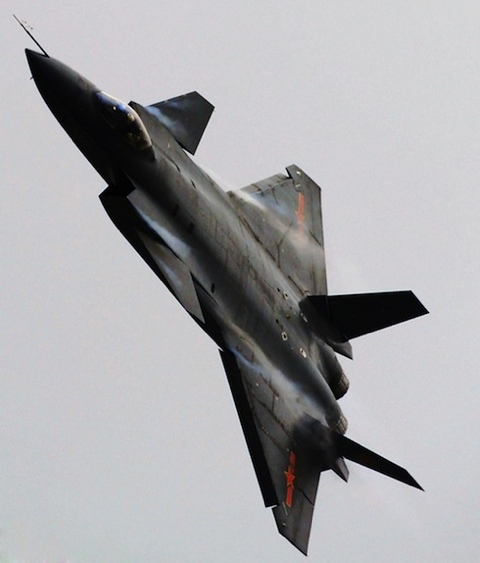
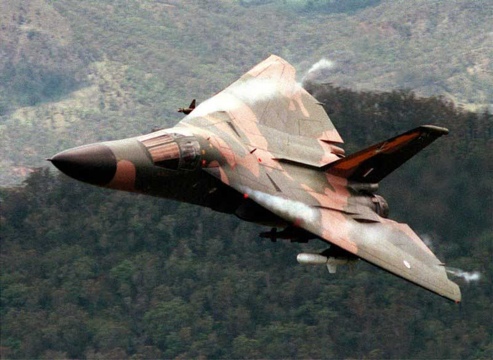
DefenseTech has some Chinese eye candy regarding the large and apparently powerful J-20 in development / trials. They call the aircraft a bomb truck and that seems likely, the analogy to th 70’s vintage FB-111 seems apt.

20120311-205744.jpg
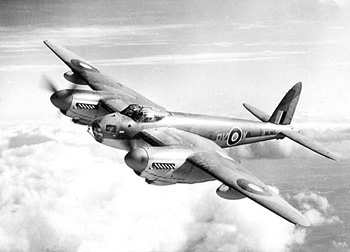
These aircraft are the conceptual descendants of WWII aircraft like the Mosquito.

20120311-205757.jpg
The thing I find peculiar is how open the Chinese are about the testing of the J-20 it’s like a reality TV show. One part of me wants to say the Chinese know everyone will be spying anyway, to reduce the tension, just go ahead and let the pictures be taken, bask in the glow of self righteousness, and the fact you’re saving money. And at the end of the day why does one care, the real secret sauce is deeply buried in the materials and internal details and is not readily apparent on the surface anyway…The other part wonders what’s really going on in some distant corner of the country.

The Army really needs to ‘cool it’s jets'(calm down in the lingo of the ‘Gray Lensman’)

In the NDIA’s National Defense magazine’s blog there is a post: Don’t Rush to Buy New Vehicles, Army and Marine Corps Warned

The traditional approach to updating U.S. military hardware — spending years and billions of dollars on next-generation designs — is no longer working for the Army and the Marine Corps as they seek replacements for their combat vehicles.

——

One reason for the military to hold off on buying new vehicles is that there are no technological silver bullets to make military trucks, tanks and personnel carriers less vulnerable to enemy weapons, …. Adversaries can acquire and deploy antitank weapons and roadside bombs much faster and at far less cost than the U.S. military can build countermeasures and survivable vehicles,

——

It’s not clear that the Army or the Marine Corps can “get out of this box,” Outspending the enemy in this case is a losing battle. … “Adversaries’ use of guided weapons, relatively cheap and rapidly fielded anti-armor weapons … threatens to increase significantly the costs incurred by U.S. ground troops in accomplishing their assigned missions,”

——

The Army’s procurement bureaucracy is still reeling from the failure of its $200 Future Combat Systems. Although the follow-on program, the Ground Combat Vehicle, is far more modest, it is not clear that it (will) offer a substantial technological boost compared to existing vehicles

——-

Army buyers might still be somewhat (IMO are totally) deluded by the thinking that doomed the Future Combat Systems. At the time, FCS officials touted the program for its advanced information network, which would give commanders an instant view of the battlefield and allow them to see the enemy without being detected.

After the termination of FCS, the Army continued the push for an advanced communications network, which is now billed as the services number-one modernization priority. The problem, … is that the Army still assumes it can deploy a network at will. “The assumption is that we are operating in a permissive environment … that once we set up the network, nobody is going to tear it down,”

——
We have operated in a permissive environment, electronically and even threat wise for the past decade at least. We have also operated in a nation building civil war environment in urban, suburban environment. Even in the ‘Stan the military faces an enemy with limited access to weapons beyond RPGs and IEDs but these have proven the Bradley is no longer viable and driven us to develop armored modestly off road vehicles like the Stryker DVH, MATV, and MAXPRO MRAP.

These vehicles use existing technology and are enough over designed to allow for evolution. They are too heavy for the Army and USMC but the effort put into the ‘light weight’ replacement the JLTV Family has already cost huge amounts and the only way the Army/USMC kept the program was mandating a weight(26,000lb), cost ($250,000 ea) and protection (MAXPRO equivalent) and letting everything else float or be a special kit. The program has been a feeding trough for the Mil-Ind-Bandit-complex for several years not for truck builders supported by the Army funding some high end components. In fact the truck builders and high end suppliers have been funding their own pragmatic tech programs based on industrial/commercial insights that in the end the Army and USMC have bought.

Recently a couple of high ups in the acquisition corps said they’ve been meeting the soldiers needs and all the grief about Comanche, Crusader, JLTV EDM, EFV, FCS, etc is all noise. Bull-crap!

Once it might have had some truth, the Army/USMC did projects to build tech and keep design experience honed. Much of the money went to top grade suppliers of engines, suspensions, transmissions, the primes never intended the vehicles to go to production, everyone learnt and had tech on the shelf. Those days are gone.

These days the programs are too tightly focused and the programs are ‘mapped’ to lead to production. So the top tier suppliers go for them, often get more than one ‘team’ funded and develop futuristic Advanced Development Models, designed to highly refined specs that require essentially custom components. To keep their engineering teams fed they keep most of the work in house and over-ride input from the lower tier suppliers they do use. The specifications are too specific and often contradictory, open to interpretation, and all too often evolving. Money swirls down the toilet by the bushel. New management comes in, new ‘baselines’ established more money flushed and eventually the program collapses. Little of the technology is of use elsewhere.

The world class suppliers all largely ignore Army programs because they have spent too much money on programs that are ill conceived and almost bound to fail. Where the automotive industry does work on gov’t programs they try to focus on programs with clear near term needs, like the highly successful, Stryker, MATV, and later MRAPS.

At the end of the day we’ll be better off letting things settle out while we fund evolutionary and component technologies. The thousands of bright young officers coming back from Iraq and the ‘Stan need to settle in, study the world, history and the potential for tightly-constrained battlespaces, they’ll be the ones to figure out what comes next, not the old guard who claim they’re ‘just fine…’

Bradley, son of Bradley, GCV, Pillaging the Colonies…?

From StratPage: A Quiet Farewell For the M-2 Bradley

March 5, 2012: One of the little-known casualties of the Iraq war was the American M-2 Bradley IFV (Infantry Fighting Vehicle). Five years ago the U.S. Army stopped using the M-2 in combat. By then it was clear that the enemy was intent on using mines and roadside bombs in a big way and the M-1 tank, Stryker, and MRAP vehicles were much better able to handle these blast weapons than the M-2.

Bradley BUSK probably I

Bradley BUSK probably I

Bradley BUSK possibly a II

Bradley BUSK possibly a II

The pictures above are from before that quiet withdrawal showing variations of the Bradley Urban Survival Kit BUSK. Compare this with images of the Bradley from the ‘Gulf War’ below:

Bradley in the Gulf War

Bradley in the Gulf War

Bradley moving through ruind Iraqui RG unit

Bradley moving through ruined Iraqi RG unit

And then this picture of a Bradley from the halcyon days when worries about swarms of Soviet tanks were just beginning to seem like a bad dream:

Bradley probably in Germany in the '80s

Bradley probably in Germany in the '80s

The US Army in WWII started out with light, medium and heavy tanks, anti tank vehicles and infantry carriers.  This evolved through the 50s and 60s to the Main Battle Tank and the IFV (infantry combat vehicle.) The theory being that the tanks do the running around in front of the enemy getting hammered on with the IFV keeping up with but behind the tanks, hiding when the explosions got too loud and close.

The Army wants its armored-taxi/multi-use-chassis to be as mobile as the tank, carry a squad of infantry, a heavy anti tank weapon, an infantry support weapon, weigh half as much as the tank and be able to survive getting hit by medium calibre weapons. Rather too many metrics to trade off successfully.

Which explains why the Abrams M1 tank is successful (probably destined to be around till circa 2050…and may be the last ‘true’ tank ever) while the Bradley is essentially heading for the scrap pile?  The answer is Armor and Power

M1A2SEP 72 tons | 1500hp        versus            M2 w/BUSK ~38 tons | 400

The ‘tank lite’ nature of the Bradley IFV with the added attraction of its soft gooey center of infantry, has always made them most valuable as far forward as possible, further forward in the battle than ‘safe.’ By the time of the Gulf War they had already been added armor, in the GW they did well, but in Iraq they suffered badly then more and more protection was added. Soon the vehicle was way over weight and because an IFV is a very ‘tight’ design there is no way to increase power.  The Army ended up with a vehicle that is too heavy to move and too lightly protected to survive.

The Israelis’ have been on the leading edge of modern armored combat for most of their nation’s history.  Their main battle tank design is focused on crew survivability and it can actually carry a couple of extra soldiers for scouting work.  The Israeli’s have made IFVs out of old tanks with their turrets removed, not only because they don’t have money to burn but because it made sense, the heavy armor and high power to weight ratio of these vehicles made them much better close companions to main battle tanks than ‘purpose built’ IFVs. 
The US army saw this in the combat reports from the last mess in The Lebanon, where the Israelis used the old converted vehicles as well as the more purpose built Namer IFVs.   This and our own experience in the Gulf War, Iraq War and Afghanistan, drew the USArmy towards a much more heavily armored (and more powerful) vehicle the GCV (ground combat vehicle.)  unfortunately the first iteration of the GCV when priced out by the Military Industrial Bandits was way too expensive for the Army and a more restrained requirement was developed.   Which results in this….(read that last with a disgusted tone.)

BAE GCV Candidate

BAE GCV Candidate

BAE GCV Candidate

BAE GCV Candidate

A couple of recent image from BAE ( the current defense company incarnation for the group who were responsible for the Bradley) showing their latest GCV concept.  This is a typical piece of post realism crap from our defense establishment.  Its a hybrid electric vehicle, which failed to the tune of billions burning in FCS and is useless on an armored vehicle.  It uses an active defeat systems for a lot of its protection (the little Dalek like warts on its ass.)    And yet with a tracked suspension system one moderate IED will render this billion dollar baby dead in its tracks (pun intended.) In  a sim its probably extremely good at what it is designed to do, protect the gooey middle and trundle around at some reasonable speed. But the thing has to be fragile as hell, its rather narrow between the eyes and tall so it won’t be able to do side slopes anywhere like the tortoise like MI can etc etc.

This is what happens when you reach the end of the technological road and don’t know where to go. The tank may not be dead but its bastard son the IFV is.  My advice to the Army is find another route before you blow more billions on this turkey.

And BAE the current turkey presenter….used to be British Aerospace. Is this the Crown’s way of getting back at the Colonies for that cold seawater tea episode?