
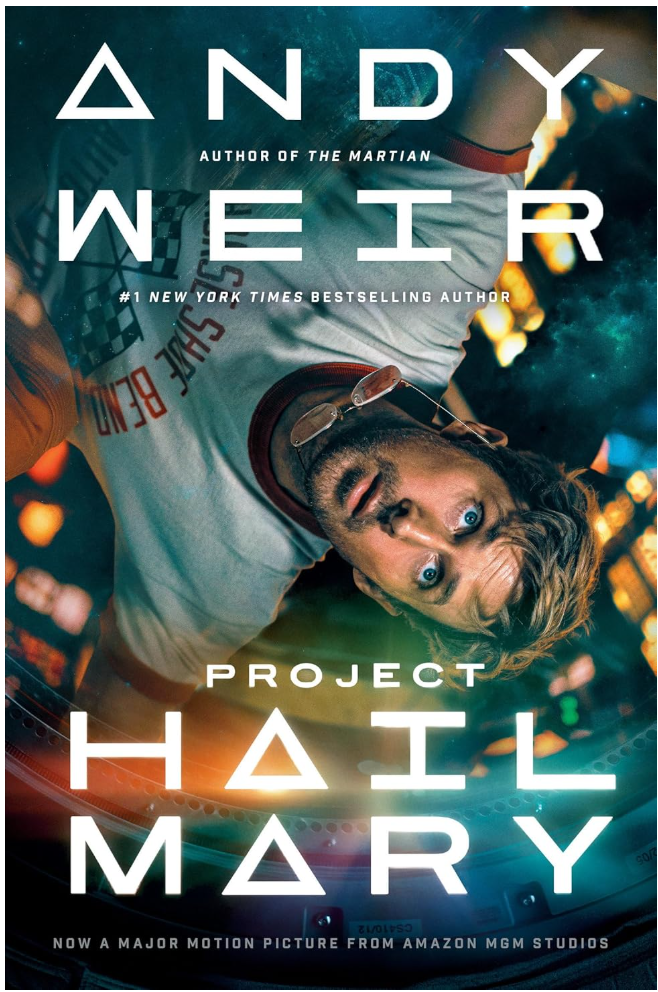
Andy Weir’s Genius in Project Hail Mary

Andy Weir has a rare gift: he writes ordinary people — genuinely, recognizably ordinary — who have a skill that is also recognizable, and then puts them in situations where their one extraordinary competence is the only thing standing between them and death (in the case of Project Hail Mary, the extinction of the Human race.) The heroism is quiet and technical and you could almost believe that you could do that in the right circumstances.

You believe it because he’s made you believe in the person first. I saw the movie. I read the book years ago. Both are excellent, and the movie is one of the most faithful book-to-screen adaptations in recent memory.

Like The Martian before it, the film sticks closely to the book in both thesis and spirit. That fidelity matters: both stories rely on the reader/viewer trusting that the protagonist’s problem-solving is real, not movie-magic. Break that contract and the whole thing collapses. Weir earns it on the page; the filmmakers preserved it on screen.

The one genuine gap between novel and film is interior monologue. Novels handle internal states naturally; movies almost cannot. But Weir constructs scenes that externalize internal conflict visually — and those translate superbly.

A couple of minor side arcs from the book are absent, and I think those were wise cuts. They deepened the protagonist on the page but would have felt excessive at feature length.

One thread that bothered me in the book and still bugs me in the movie: Ryland Grace is pulled into the program because in his post-doctoral research he had proposed that alien life does not require water and carbon — and had defended that position to a career-ending degree. When the AstroPhage is first discovered it appears very alien, so Grace is brought in for initial analysis. He then finds it’s made of the same materials as Earth life — which undercuts his entire reason for being there and threatens to sideline him. That it doesn’t is a good twist; go see the movie or read the book for how it resolves.

Here’s where my engineering brain creates further friction. The AstroPhage’s energy density is extraordinary, and the novel acknowledges this and hand-waves it away. I cannot see how any life form built on biology similar to our own could handle those energy levels — it feels bolted in, even if it probably wasn’t. Similarly, Rocky — the alien Grace meets at the target sun — turns out to be exactly what Grace originally proposed: a non-water/carbon life form, which feels a little convenient in vindicating him.

There are complaints about Rocky delivering a specific thematic point about first contact and communication. My view is the opposite (other than the niggle above) that whole piece is brilliantly on point and there would not have been much of a story without it.

None of that diminishes what Weir achieves. He takes relatable people with very human quirks and puts them in situations where they have to fight to survive — and we root for them completely. And here i put the very alien Rocky in the bucket of people…he is about the best alien I have seen in a move ever. I wish I were half the author he is, and I say that as someone who is trying. Project Hail Mary is the rare book where you finish it and immediately want someone else to read it so you can talk about it. The movie earns the same feeling. Go see it.
Some thoughts on a tangential topic to truth in a ‘Statesman’s’ world

The famous rant by Colonel Jessep (Nicholson) from A Few Good Men:

You can’t handle the truth! Son, we live in a world that has walls, and those walls have to be guarded by men with guns. Who’s gonna do it? You? You, Lt. Weinburg? I have a greater responsibility than you could possibly fathom. You weep for Santiago, and you curse the marines. You have that luxury. You have the luxury of not knowing what I know. That Santiago’s death, while tragic, probably saved lives. And my existence, while grotesque and incomprehensible to you, saves lives. You don’t want the truth because deep down in places you don’t talk about at parties, you want me on that wall, you need me on that wall. We use words like honor, code, loyalty. We use these words as the backbone of a life spent defending something. You use them as a punchline. I have neither the time nor the inclination to explain myself to a man who rises and sleeps under the blanket of the very freedom that I provide, and then questions the manner in which I provide it. I would rather you just said thank you, and went on your way, Otherwise, I suggest you pick up a weapon, and stand a post. Either way, I don’t give a damn what you think you are entitled to.

Nicholson is able project a charismatic mix of steely conviction with righteousness and psychotic tendencies. He’s homely in a rather attractive sense but his rubber play mask of a face often seems on the brink of either maniacal rage or maniacal laughter…with the understanding that the differences are tiny.

That whole movie left me cold, there was something trite about it and the casting of the oh so cute JAG’s and the oh so over wrought marines was perhaps clever, the setting clever, the words….clever, but what was it all about?

It was all about the delivery of that one monologue and its delivery by someone who was clearly, if only slightly, over the edge, in a place that should not exist.

The movie provided depth to the speech that twists the highest meanings of honor and service into dark and dangerous threats curdled in a place and circumstance that are wholly unnecessary.

And this was long before Guantanamo took on its current gray mantle.

This can be seen as the most powerful anti war movie (without any action) that has ever been created because it says that the things a person has to take on to become a combatant are manipulations and most likely the rational behind it is a lie and the urge to protect, more about power and privilege than caring.

And yet…and yet…I came away with the weird sense, I think intentionally  that Jessep was more hero than villain and the JAGs more (minor) villains than heroes though they were heroes and he was a villain who needed stopping.

In ghostly profile behind Jessep, I see Patton, Stonewall Jackson, Sherman and others, who were in their ways just as nuts,  In an alternate to his fictional world Jessep could have been a great hero and the JAGS might have been slimy villains.

Was any of this the original intent?  Probably and if so its probably great art, in the sense of great playwright’s work and great casting, not so much cinematography or  directing or  acting on anyone’s part other than Nicholson’s.

A Few Good Men and the strange mirrors it casts are more apropos today than they could conceivably have been when it was made.  This movie made today, set in Iraq, Afghanistan or any one of a hundred other places, would not work as well and would create a firestorm of debate but then vanish.

It has been left alone because it says more, more subtly the way it is than it could possibly say if redone in a contemporary venue.  And anyone who tried to remake it would be unable to create the remarkably fine balance that it drew between hero and villain on both sides.