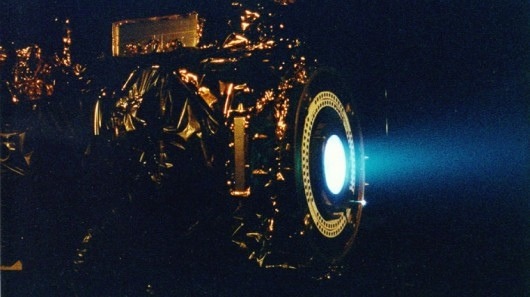
Engage the Ion drive
Reply

3D / Additive Manufacture in Space! Two favorites in one!
And its an SBIR…Small Business Innovative Research, program, how cool is that on top? The SBIR program is a personal favorite of mine. It basically provides entrepreneurs and engineers with ideas with funds to develop a concept and put together a prototype then helps them either commercialize it or work with a big company to bring to the market or to NASA, USAF, Navy, Army, DoE, DoT, DHS etc. When done right which NASA, the Navy and to some extent the AirForce and Army have done this can provide fantastic bang for the buck. Its only downside is that it can be seen as a substitute for bigger development programs and it’s not. SBIR works for initial concepts, for components, basic materials, small-scale projects (App scale maybe) but it’s not enough bucks to do anything major. The only program that does something similar on a larger scale is DARPA, which is also a world leading organization in this area.

On Thursday, NASA announced the selection of 39 proposals for Small Business Innovation Research (SBIR) Phase II awards. …… Made in Space, a Silicon Valley company working on 3-D manufacturing in space.
Made in Space, Inc.
Moffett Field, CA
PROPOSAL TITLE: ISS Additive Manufacturing Facility for On-Demand Fabrication in Space
SUBTOPIC TITLE: ISS Utilization
Estimated Technology Readiness Level (TRL) Begin: 6 End: 8
TECHNICAL ABSTRACT
Made in Space has completed a preliminary design review of the Additive Manufacturing Facility. During the first half of Phase 1, the design went through conceptual development, simulation testing, cost analysis, and comparison testing of which off-the-shelf parts can be used. The deliverables for Phase I include a written report detailing evidence of demonstrated technology (TRL 5) in the laboratory and will outline in detail the path taken toward hardware demonstration for Phase II (TRL 6). The preliminary design is ready to be manufactured as an engineering test unit in Phase II. A feasibility study was created to demonstrate what could be fabricated for the inside of the ISS (parts and spares) and for the outside (possible satellites). It is anticipated that many of the sample uses that the AMF will make possible on-orbit have not yet been envisioned.
Ah sweet progress, not much yesterday (its rolled into today’s count.) I should have gotten more done today but I kept on hitting blocks and getting the urge to get up and go do something else. Hopefully I can get another good stint tomorrow and Sunday, fortunately for NaNoWriMo progress and very unfortunately for my real life the work I am having done on my house is taking longer than expected, this time the coating for the new cork flooring needs to harden for 72 hours before I can start moving furniture in so another damned weekend down the drain!

Better chemistry: To produce drugs in a continuous-manufacturing method, MIT engineers had to develop several new pieces of equipment, including this reactor, which enabled a faster reaction and eliminated the need for a toxic solvent.
This is a big breakthrough, this is part of the maker revolution though a long way from maker bot. In the long run such a system can be miniaturized and stocked with a range of precursors which will allow a single system to produce any number of different drugs on demand. In the early days such systems will be huge and hugely expensive but will make drug exploration exponentially quicker and less expensive. In the long-term the system makes the whole pharmaceutical infrastructure we have today obsolete…except that it will probably increase the need for scientists, physicians specializing in individualized medicine, etc, etc. Old jobs go away new ones come on-line. And the new ones will generally be much more about the outer edges of technology and the connection between people and between people and their machines, instead of embedding people as cogs in the machines.
The article is pretty high level but a good quick read on the topic.
 From the word source section at Dictionary.Com
- c.1300, “an area, extent, expanse, lapse of time,” aphetic of O.Fr. espace, from L. spatium “room, area, distance, stretch of time,” of unknown origin.
- Astronomical sense of “stellar depths” is first recorded 1667 in “Paradise Lost.”
- “Space isn’t remote at all. It’s only an hour’s drive away if your car could go straight upwards.” [Sir Fred Hoyle, “London Observer,” 1979]
- Typographical sense is attested from 1676
- (typewriter space bar is from 1888).
- Space age is attested from 1946;
- spacewalk is from 1965.
Many compounds first appeared in science fiction and speculative writing, e.g.
- spaceship (1894, “Journey in Other Worlds”);
- spacesuit (1920);
- spacecraft (1930, “Scientific American”); space travel (1931);
- space station (1936, “Rockets Through Space”); spaceman (1942, “Thrilling Wonder Stories;”
- earlier it (spaceman) meant “journalist paid by the length of his copy,” 1892).
- Spacious is attested from 1382.
- 1703, “to arrange at set intervals,” from space (n.). Meaning “to be in a state of drug-induced euphoria” is recorded from 1968.
- Space cadet “eccentric person disconnected with reality” (often implying an intimacy with hallucinogenic drugs) is a 1960s phrase, probably traceable
- to 1950s U.S. sci-fi television program “Tom Corbett, Space Cadet,” which was watched by many children who dreamed of growing up to be one and succeeded.
I was born the year and month that Sputnik was blasted into orbit and so I grew up dreaming of the great rockets roaring into space. My dreams died a little with the end of the Apollo era and a little more with every year of the space shuttle and ISS travesties that followed. Not because of the actors in the piece but because of the dead hand of bureaucratic-management-executive risk aversion that could be seen crushing the glory out of the endeavor. It was only the glorious optical archive that is Hubbles legacy that kept a dream alive, a dream rekindled with Faster Better Cheaper and the Mars flurry and then blown to full flame in the last few years with Space X, Virgin Galactic, Bigelow, Orbital, and more.

National Novel Writing Month 2012, Starting November 1, at 00:00:00, a thing to do…
So once again November approaches and new fields of stress and invention await. The Daughter (beloved I assure you) is getting married this November but still seems to think she may actually try to do this (again) and is (kinda) urging me to as well. And maybe I should, a novel about her driving her parents NUTS!!! But besides that it might be an interesting challenge. On top of all the other writing assignments I am getting from work and the attempt to get Elgin finally Finished and into Smashwords Premium Distribution. (Elgin was last year’s NaNoWriMo entry…finished in December but a winner none the less.)
dc grid cuts cost, size of electric propulsion systems
11-Apr-2012 09:32 GMT
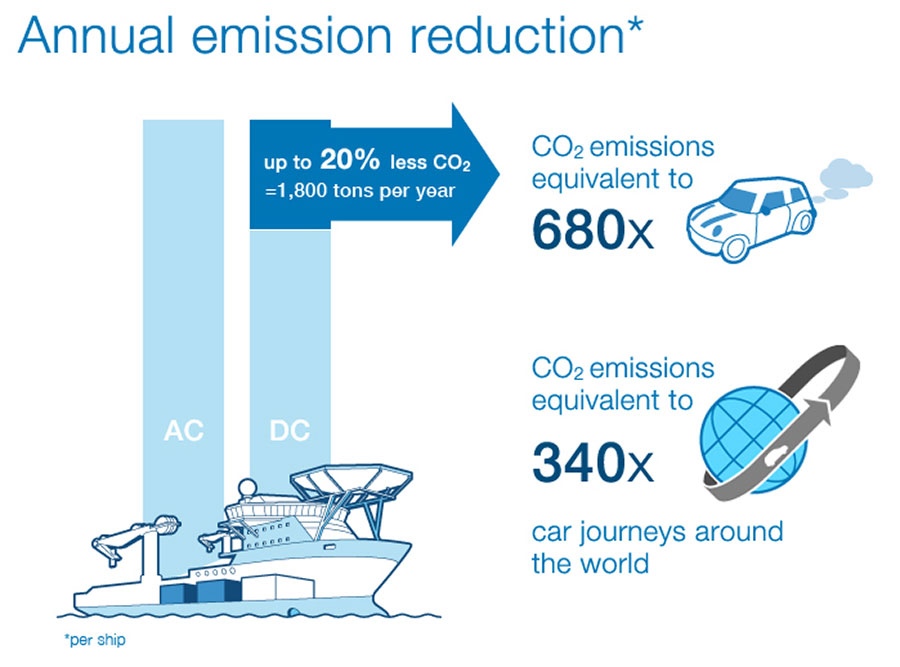
ABB’s dc grid trims the weight and size of the electrical system by nearly a third.
Norwegian ship owner Myklebusthaug Management plans to become the first company to employ a direct current (dc) power grid on board a ship. A 5000-ton (4535-t) offshore platform support vessel will deploy ABB’s Onboard DC Grid, which ABB says will improve efficiency and reduce emissions for ships with electrified propulsion.
In existing electrical propulsion vessels, more than 80% of electrical power consumption goes to thrusters and propulsion drives. They use dc connections derived from an alternating current circuit.
Rather than converting ac to dc, the Onboard DC Grid optimizes propulsion by distributing power through a single dc circuit, according to ABB. ABB predicts that once ship owners see the benefits of electric propulsion, dc grids will see rapid acceptance. Myklebusthaug Management’s 93-m (305-ft) oil field supply and construction vessel is scheduled for delivery in the first quarter of 2013.
“We believe that by 2020, approximately 20% of ships will be electrified, and quite a bit of that will be dc,” said Heikki Soljama, head of ABB’s business unit marine.
One key reason the Onboard DC Grid saves power is that the ship’s engines no longer have to run at a fixed speed. Engine speeds can be adjusted to optimize fuel consumption.
At the same time, bulky transformers and switchboards can be eliminated, reducing the footprint and weight of the electrical system by up to 30%. The main ac switchboards and transformers are no longer needed.
However, ABB’s system extends the many dc-links used in all propulsion and thruster drives. That lets shipbuilders retain the dc generators, inverter modules, ac motors, and other proven products.
The grid can be used for any electrical ship application up to at least 20 MW. It operates at a nominal voltage of 1000-V dc. The power distribution can be arranged with all cabinets in a single lineup using a multidrive approach or it can be distributed throughout the vessel by short-circuit proof dc busbars. That gives designers more freedom for locating electric components, which can result in a more functional vessel layout.
Terry Costlow
Good synopsis of why DC and to some degree why electric…this is the future but as always the path is long and takes odd jaunts that will ‘drive men(proponents) mad.’
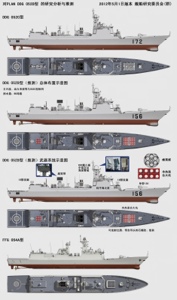
The Chinese Navy ( sometimes still called the PLAN/People’s Liberation Army Navy/) appears to have finished it’s experimentation~development with their premier surface combatant, the medium DDG 052C/D producing a rough equivalent of the western Aegis (at least in their boosters eyes.) the ship very obviously follows western design concepts but appears to be a very competent design, at least from “it’s likely right if it ‘looks’ Good metric,” though the radar and computer part of the system are probably not that good, yet. This good article in the Diplomat discusses this and its implications in some detail.
Private space flight becoming mainstream
Ability for a person of moderate means to buy tools to build almost anything
Quantum effects erase the speed of light barrier
Ability to design materials down to the atomic level
Personal communication between any two people anywhere on earth with minutes if not seconds
What of the above was not science fiction a decade ago…well maybe the last, but it was definitely sci fi twenty years ago.
We live in an age of wonders…we just don’t always appreciate it.

 This World and Others