Image Credit & Copyright: Stephen Leshin
Explanation: Described as a “dusty curtain” or “ghostly apparition”, mysterious reflection nebula VdB 152 really is very faint. Far from your neighborhood on this Halloween Night, the cosmic phantom is nearly 1,400 light-years away. Also catalogued as Ced 201, it lies along the northern Milky Way in the royal constellation Cepheus. Near the edge of a large molecular cloud, pockets of interstellar dust in the region block light from background stars or scatter light from the embedded bright star giving parts of the nebula a characteristic blue color. Ultraviolet light from the star is also thought to cause a dim reddish luminescence in the nebular dust. Though stars do form in molecular clouds, this star seems to have only accidentally wandered into the area, as its measured velocity through space is very different from the cloud’s velocity. This deep telescopic image of the region spans about 7 light-years.
Tag Archives: Space
Space
From the word source section at Dictionary.Com
- c.1300, “an area, extent, expanse, lapse of time,” aphetic of O.Fr. espace, from L. spatium “room, area, distance, stretch of time,” of unknown origin.
- Astronomical sense of “stellar depths” is first recorded 1667 in “Paradise Lost.”
- “Space isn’t remote at all. It’s only an hour’s drive away if your car could go straight upwards.” [Sir Fred Hoyle, “London Observer,” 1979]
- Typographical sense is attested from 1676
- (typewriter space bar is from 1888).
- Space age is attested from 1946;
- spacewalk is from 1965.
Many compounds first appeared in science fiction and speculative writing, e.g.
- spaceship (1894, “Journey in Other Worlds”);
- spacesuit (1920);
- spacecraft (1930, “Scientific American”); space travel (1931);
- space station (1936, “Rockets Through Space”); spaceman (1942, “Thrilling Wonder Stories;”
- earlier it (spaceman) meant “journalist paid by the length of his copy,” 1892).
- Spacious is attested from 1382.
- 1703, “to arrange at set intervals,” from space (n.). Meaning “to be in a state of drug-induced euphoria” is recorded from 1968.
- Space cadet “eccentric person disconnected with reality” (often implying an intimacy with hallucinogenic drugs) is a 1960s phrase, probably traceable
- to 1950s U.S. sci-fi television program “Tom Corbett, Space Cadet,” which was watched by many children who dreamed of growing up to be one and succeeded.
I was born the year and month that Sputnik was blasted into orbit and so I grew up dreaming of the great rockets roaring into space. My dreams died a little with the end of the Apollo era and a little more with every year of the space shuttle and ISS travesties that followed. Not because of the actors in the piece but because of the dead hand of bureaucratic-management-executive risk aversion that could be seen crushing the glory out of the endeavor. It was only the glorious optical archive that is Hubbles legacy that kept a dream alive, a dream rekindled with Faster Better Cheaper and the Mars flurry and then blown to full flame in the last few years with Space X, Virgin Galactic, Bigelow, Orbital, and more.
Not Everything that President Obama has done is wrong…and by the way he hasn’t shut down a lot of things that President Bush started either
There are far too many conservatives of various flavors who seem to have gotten lost in their own narratives. Fortunately we have some smart conservatives watching out for the overspill.
This is an excellent piece by Rand Simberg of Transterrestrial Musings blowing away a rather ignorant rant against NASA’s Space Station Commercial Access plans, which by the way is going well and attracting a huge amount of investment by pure play commercial space entrepreneurs.
I believe that what we are seeing today is what the first generation science fiction writers of the 30’s to 50’s predicted, it’s just taken a whole lot longer because the technology they thought would allow us to blast off (atomic energy) was shut down due to fears, founded and unfounded. It has taken us five decades to develop technologies that enable us to get to space inexpensively (in relative terms) burning tons of liquefied oxygen and kerosene.in what are essentially tightly controlled explosions.
Exotic Contraband – Lost among the stars…now on Smashwords and soon to be at iBooks, Nook Books, and more
Exotic Contraband: Lost among the stars: Aliens are real and they’re here. Unfortunately they aren’t here for intellectual stimulation, they’re here to make cold hard cash. And they aren’t interested in letting the authorities, theirs or ours, in on their racket.
This is the story of survivors lost in a universe that they hadn’t imagined, and the story of their rescue and return.
It’s only 99cents and a steal at many times the price if you enjoy a good read with a mix of hard and space opera sci fi with a little action and romance thrown in. And why is that ship called the Stonewall?
See it all at Smashwords.
USA TODAY update on commercial crew transport program
Article in USA TODAY on the commercial crew access program. A good recap of the politics and status without taking sides at least not overtly.
Space X continues to make progress…
The picture below was part of this article about Space X’s intentions to develop a better launch abort system using the integrated rocket system on the Dragon Capsule.
The cool thing about this is that the old system was horribly wasteful and a danger in itself. This is the old and still standard way (from Wikipedia) a shot of the Apollo system under test, and that was just a larger version of what was on Mercury.
This is called a Tractor system, and it pulls the capsule off the booster in case of disaster. The rocket motor is attached to a shell which attaches to the base of the capsule protecting the capsule in case of rocket ignition. But for a successful, even survivable mission, now you have to discard the abort system during boost. And it’s an expensive and heavy piece of gear tossed in the sea. Even the Orion exploration vehicle, part of the SLS uses the same expensive and wasteful system.
Space X will make the rocket motors part of the Dragon, firing from the skirt area as you can kind of see in the picture at the top. This rocket motor will Push the capsule off the booster. It can also become part of the landing system, the intent is to make the Dragon a mixed mode lander, decelerating using rockets, heat shield, then parachute but finally landing under rocket power, this will allow for pin point landing in some reasonably remote and safe spot on land instead of at sea. In fact the Russians have used a rocket ‘cushion’ system for landing their capsules forever, but the Dragon will be a real landing system, not just a cushion.
Below the Draco Rocket under test, and here the article in Wired that does a good job of explaining what’s going on in the picture. There is also video at Wired so enjoy.
Eyecandy
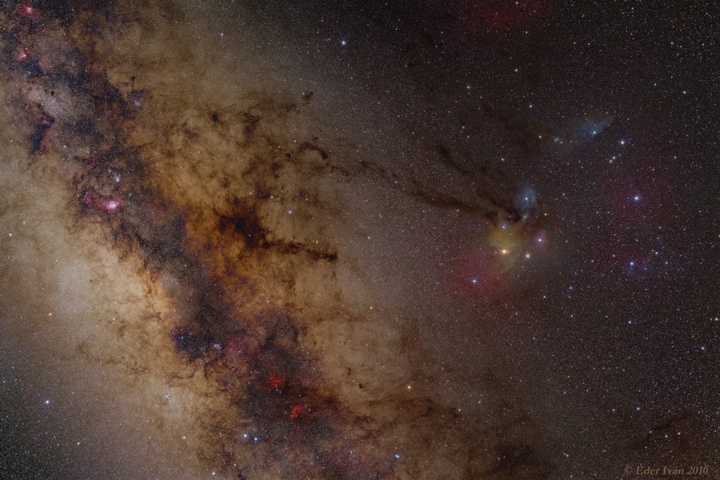
A Wide Field Image of the Galactic Center
Image Credit & Copyright: Ivan Eder
Explanation: From Sagittarius to Scorpius, the central Milky Way is a truly beautiful part of planet Earth’s night sky. The gorgeous region is captured in this wide field image spanning about 30 degrees. The impressive cosmic vista, taken in 2010, shows off intricate dust lanes, bright nebulae, and star clusters scattered through our galaxy’s rich central starfields. Starting on the left, look for the Lagoon and Trifid nebulae, the Cat’s Paw, while on the right lies the Pipe dark nebula, and the colorful clouds of Rho Ophiuchi and Antares (right). The actual center of our Galaxy lies about 26,000 light years away and can be found here.
Comet Lovejoy (hot rock) and ISS
WOW
Comet Lovejoy and the ISS
Image Credit: Left – Carlos Caccia, (Intendente Alvear, Argentina) / Right – Dan Burbank (ISS Expedition 30, NASA)
Explanation: On December 24, Comet Lovejoy rose in dawn’s twilight, arcing above the eastern horizon, its tails swept back by the solar wind and sunlight. Seen on the left is the comet’s early morning appearance alongside the southern Milky Way from the town of Intendente Alvear, La Pampa province, Argentina. The short star trails include bright southern sky stars Alpha and Beta Centauri near the center of the frame, but the long bright streak that crosses the comet tails is a little closer to home. Waiting for the proper moment to start his exposure, the photographer has also caught the International Space Station still glinting in the sunlight as it orbits (top to bottom) above the local horizon. The right panel is the near horizon view of Comet Lovejoy from the space station itself, captured only two days earlier. In fact, Dan Burbank, Expedition 30 commander, recorded Comet Lovejoy rising just before the Sun in a spectacular video (linked here). Even considering the other vistas available from low Earth orbit, Burbank describes the comet as “the most amazing thing I have ever seen in space.”
Dawn’s first low altitude images of Vesta
NASA’s Dawn spacecraft has spiraled closer and closer to the surface of the giant asteroid Vesta. (Credit: NASA/JPL-Caltech/UCLA/MPS/DLR/IDA)
At this detailed resolution, the surface shows abundant small craters, and textures such as small grooves and lineaments that are reminiscent of the structures seen in low-resolution data from the higher-altitude orbits. Also, this fine scale highlights small outcrops of bright and dark material.
Hot Comet puts on another show

Comet Lovejoy after its spectacular close pass around the sun put on a fabulous show for an ISS astronaut. At max it was ~10x the moons apparent diameter.