Comet Lovejoy (hot rock) and ISS

WOW

20120105-120954.jpg

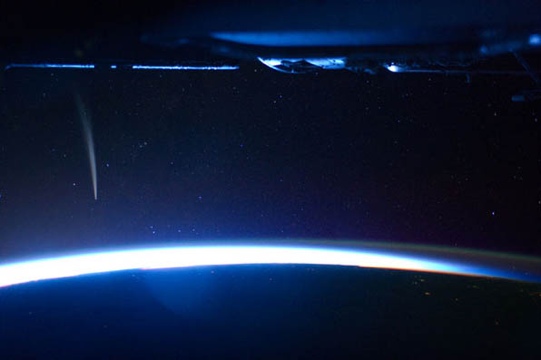
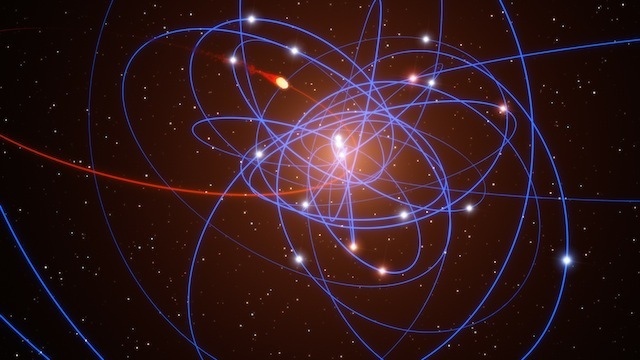
Comet Lovejoy and the ISS

Image Credit: Left – Carlos Caccia, (Intendente Alvear, Argentina) / Right – Dan Burbank (ISS Expedition 30, NASA)

Explanation: On December 24, Comet Lovejoy rose in dawn’s twilight, arcing above the eastern horizon, its tails swept back by the solar wind and sunlight. Seen on the left is the comet’s early morning appearance alongside the southern Milky Way from the town of Intendente Alvear, La Pampa province, Argentina. The short star trails include bright southern sky stars Alpha and Beta Centauri near the center of the frame, but the long bright streak that crosses the comet tails is a little closer to home. Waiting for the proper moment to start his exposure, the photographer has also caught the International Space Station still glinting in the sunlight as it orbits (top to bottom) above the local horizon. The right panel is the near horizon view of Comet Lovejoy from the space station itself, captured only two days earlier. In fact, Dan Burbank, Expedition 30 commander, recorded Comet Lovejoy rising just before the Sun in a spectacular video (linked here). Even considering the other vistas available from low Earth orbit, Burbank describes the comet as “the most amazing thing I have ever seen in space.”

Dawn’s first low altitude images of Vesta

Circling in

NASA’s Dawn spacecraft has spiraled closer and closer to the surface of the giant asteroid Vesta. (Credit: NASA/JPL-Caltech/UCLA/MPS/DLR/IDA)

At this detailed resolution, the surface shows abundant small craters, and textures such as small grooves and lineaments that are reminiscent of the structures seen in low-resolution data from the higher-altitude orbits. Also, this fine scale highlights small outcrops of bright and dark material.

More images at.
20111227-141532.jpg

Earth-size worlds found orbiting another star (bit ‘ot though)

This Spaceflight Now article discusses the Kepler Orbital Observatory’s discovery of two “smallish” worlds (within a few percentage points of Earth) orbiting a star 1000 light years away. This proves that 1) Kepler can ‘see’ worlds of this size and 2) that such worlds are not radically rare since there are two in the first few dozen discovered.  However both orbit too close to their star for us one’s probably got a surface temp of ~1500 the other a relatively ‘cool’ 800.  Other interesting thing is that the other planets spotted (all way to close to the star) are gas ‘pigmy giants.’

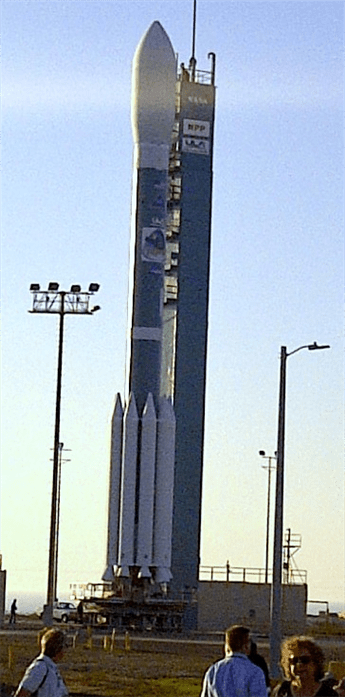
A soaring NASA rocket prompts thoughts of earthly politics a year from 2012 vote by Andrew Malcolm – Investors.com

A soaring NASA rocket prompts thoughts of earthly politics a year from 2012 vote by Andrew Malcolm – Investors.com.

A great reflective article, I have seen 2 launches both in Florida, one an Atlas the other a Delta, both commercial, both with hundreds of others, both indescribably moving because of the awesome symbolism as much as anything else.

Could the Jetsons be Close? This would foment radical change and growth…

20111211-165244.jpg

I had not realized that LENR (low energy nuclear reactions) research had continued. The PPT’s are actually pretty exciting but the proof is in the repeat ability. There does appear to be some developing theory and theory based experimentation, if this work bears fruit it would be a game changer.

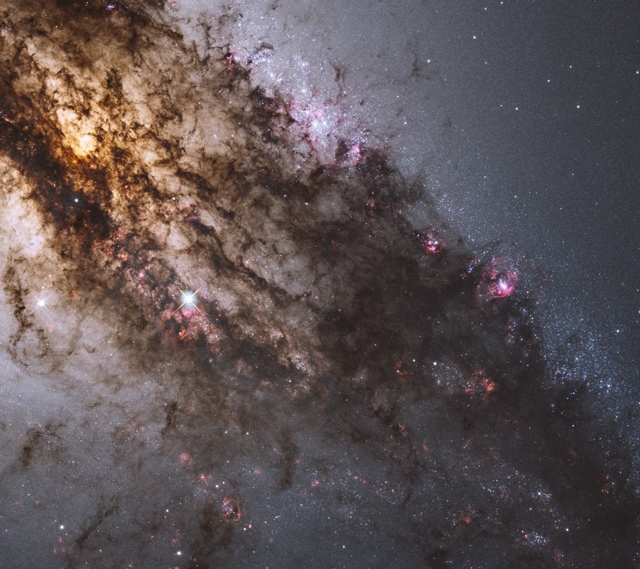
Picture has nothing to do with the article, just APOD ‘eye candy.’

Air Force Mini Shuttle the future Swiss army knife of space

20111206-181440.jpg

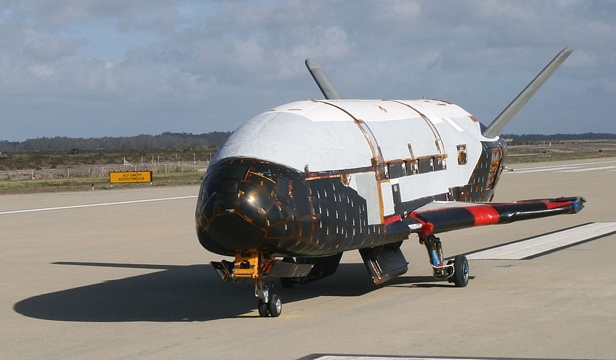
In a testing procedure, the X-37B Orbital Test Vehicle taxis on the flightline in June 2009 at Vandenberg AFB, Calif

The Air Forces X37B autonomous mini shuttle has proven a great success. The first prototype orbiting for 9 months and then returning safely. The second unit is currently at 10+ months. Also the craft have shown that they are very maneuverable in orbit and very hard to keep track of from the ground even by pretty sophisticated observers. Now The AF is talking about an X37C that could carry six passengers. But it would still be autonomous, i.e. the passengers are passengers not pilots. To me that is probably a rather weak cover/secondary use. Most of the craft would spend most of their lives with no passengers, doing an array of important tasks. I think the AF like s the idea of a more ‘drone’ like operating profile, multi use(refuel, recovery, small launch, medium duration observation, etc) able to upgrade, lower orbit so less massive ‘optics’ for any class of objective. This would be the true space fighter, not a combat vehicle, but a platform that can do almost anything almost anywhere (in orbit) on very short notice without giving away the mission just by its shape/launch orbit.

Of course they need to lose the expensive aeroshell, it was necessary I assume to keep from having to do something even more expensive with the Boosters control laws, but it sure looks expensive, and for the six person version would get pretty bulky. Of course a 6 person crew though the same as the shuttle does not mean a shuttle scale vehicle, Shuttle was a mixed cargo freight hauler most of its size was for cargo I don’t the X37C will be much more than 2x maybe 3x the size of the diminutive 29ft X37B.

20111206-183825.jpg

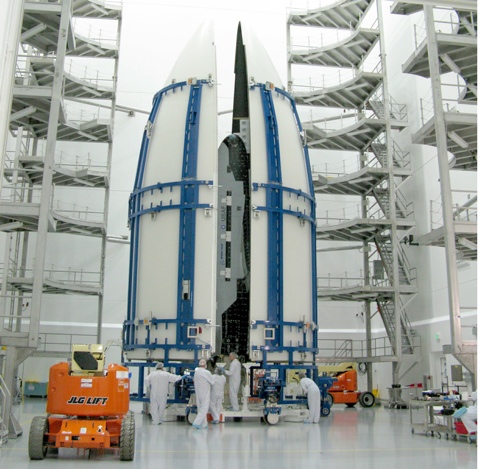
The US Air Force X-37B Orbital Test Vehicle during encapsulation within the United Launch Alliance Atlas V 5-meter fairing Feb. 8, 2011, at Astrotech in Titusville, Fla. The fairing protects and carries the OTV into space.

A bit overweight Goldilocks

This article discussing another good candidate for a relatively Earth like world orbiting a not to distant star.

20111205-234453.jpg

This week astronomers have announced the existence of a planet discovered to be in human livable range of star not unlike our sun, with a size 2.4 times that of our Earth and a temperature of approximately 22 degrees celsius. This is the most recent in a line of possibilities for habitable planets in the realm of possibility as outlined by an international team of scientists in a paper by the name of “A Two-Tiered Approach to Assessing the Habitability of Exoplanets” as found at Mary Ann Libert Inc, publishing — these scientists are not the same group that’ve discovered this newest planet, but they’re sure to add the new finding to their list sooner than later. What we’ve got here is Kepler 22-b, a body that is what the Kepler space telescope team says is the closest we’ve ever gotten to discovering a planet that’s like our own – an “Earth 2.0,” if you will.

G the gravity constant, being a constant would indicate that your average 150lb person (on Earth) is going to tip the scales at 300lbs. This seems in the realm of supportable but it’ll be a chiropractor’s paradise. Also would have to wonder about atmospheric density and depth, seems like there would be all sorts of interesting knock on effects.