DoD Buzz | The Iran problem

DoD Buzz | The Iran problem.

The problem with Iran is that there is nothing we can do about it as the article below points out.  Short of all out war we are not going to make the situation any better proliferation wise and almost any other option at least leaves open the opportunity for long termsolutions.

The article points to a think tank paper arguing (rightly I think) that Deterrence like that used vs. the USSR is the most realistic option but it requires constant vigilance and a very credible threat on our side.  Maintaining such a credible threat is not cheap, has to be part of the grand strategy and force structure of the US.  The issue is, is the current administration up to the job of planning that grand strategy? Is the US up to sustaining another deterrent axis and the costs associated,  the article highlights the (largely artificial) stresses even the limited missile shield for Europe is causing with Russia.

One interesting thing about this is that all the Wests attempts to halt proliferation have in the end come to nought, the worst of the worst are going to get the nuc’s, unless we provide an almost blanket assurance that we will avenge any first use then at least one more tier of nuc powers will emerge.

It’s also of some ironic interest that it was the US’s perfection of smart weapons and limited war tactics that could be seen as driving this nuc arms race.  We should remember that at one time or another we saw nucs as the cheap counter weapon to the Russian horde .  These smallish countries now see nuc’s as the cheap counter to folks with deep pockets and smarter magazines.

Air Force Mini Shuttle the future Swiss army knife of space

20111206-181440.jpg

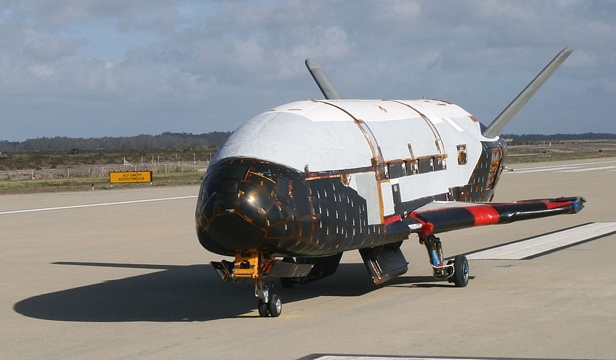
In a testing procedure, the X-37B Orbital Test Vehicle taxis on the flightline in June 2009 at Vandenberg AFB, Calif

The Air Forces X37B autonomous mini shuttle has proven a great success. The first prototype orbiting for 9 months and then returning safely. The second unit is currently at 10+ months. Also the craft have shown that they are very maneuverable in orbit and very hard to keep track of from the ground even by pretty sophisticated observers. Now The AF is talking about an X37C that could carry six passengers. But it would still be autonomous, i.e. the passengers are passengers not pilots. To me that is probably a rather weak cover/secondary use. Most of the craft would spend most of their lives with no passengers, doing an array of important tasks. I think the AF like s the idea of a more ‘drone’ like operating profile, multi use(refuel, recovery, small launch, medium duration observation, etc) able to upgrade, lower orbit so less massive ‘optics’ for any class of objective. This would be the true space fighter, not a combat vehicle, but a platform that can do almost anything almost anywhere (in orbit) on very short notice without giving away the mission just by its shape/launch orbit.

Of course they need to lose the expensive aeroshell, it was necessary I assume to keep from having to do something even more expensive with the Boosters control laws, but it sure looks expensive, and for the six person version would get pretty bulky. Of course a 6 person crew though the same as the shuttle does not mean a shuttle scale vehicle, Shuttle was a mixed cargo freight hauler most of its size was for cargo I don’t the X37C will be much more than 2x maybe 3x the size of the diminutive 29ft X37B.

20111206-183825.jpg

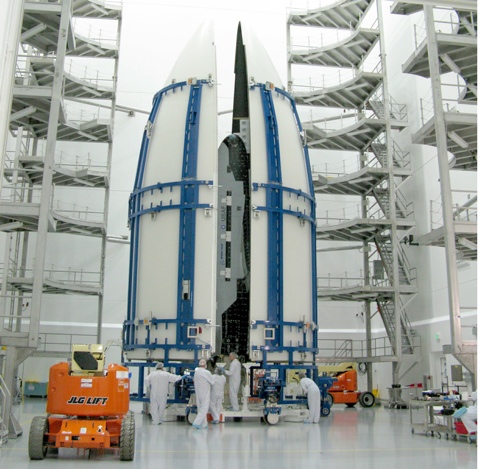
The US Air Force X-37B Orbital Test Vehicle during encapsulation within the United Launch Alliance Atlas V 5-meter fairing Feb. 8, 2011, at Astrotech in Titusville, Fla. The fairing protects and carries the OTV into space.

Space

20111130-230822.jpg

In, Through, and Beyond Saturn’s Rings

Image Credit: Cassini Imaging Team, ISS, JPL, ESA, NASA

Explanation: A fourth moon is visible on the above image if you look hard enough. First — and farthest in the background — is Titan, the largest moon of Saturn and one of the larger moons in the Solar System. The dark feature across the top of this perpetually cloudy world is the north polar hood. The next most obvious moon is bright Dione, visible in the foreground, complete with craters and long ice cliffs. Jutting in from the left are several of Saturn’s expansive rings, including Saturn’s A ring featuring the dark Encke Gap. On the far right, just outside the rings, is Pandora, a moon only 80-kilometers across that helps shepherd Saturn’s F ring. The fourth moon? If you look closely in the Encke Gap you’ll find a speck that is actually Pan. Although one of Saturn’s smallest moons at 35-kilometers across, Pan is massive enough to help keep the Encke gap relatively free of ring particles.

As you’ll note in the side bar one of my favorite sites is APOD Astronomical Picture Of the Day, the above picture from Saturn is from the APOD. the single largest segment of memory on my iPad is devoted to these pictures. I understand that a human’s limited senses would not see these views but they still haunt me with their beauty and inaccesibility. Here is wonder and beauty we cannot destroy.

Have to admit I’m a mite disappointed in humanity right now…hence the mooning over moons. We have a huge amount of capability and mountains of resources at our finger tips but we seem to have lost the magic sauce of leadership. I don’t know if we (humans) are going through a phase change right now or just hitting a rough patch or perhaps we have reached Lemming Stage (too many people period and some deep programming sets us at a metaphorical run towards the nearest metaphorical cliff.) I hope it’s no LS just a rough spot in the singularity….whatever that turns out to be.

Good luck Curiosity, let’s just hope you’re no cat.

20111126-230755.jpg

A United Launch Alliance Atlas V rocket carrying NASA’s Mars Science Laboratory (MSL) Curiosity rover lifts off from Launch Complex 41 at Cape Canaveral Air Force Station in Cape Canaveral, Fla., Saturday, Nov. 26, 2011. The rocket will deliver a science laboratory to Mars to study potential habitable environments on the planet. (AP Photo/Terry Renna)

20111126-231408.jpg

Graphic of the Mars Science Laboratory, an elite six-wheeled vehicle powered by nuclear fuel, is scheduled to launch at 10:02 am (1502 GMT) from Cape Canaveral Air Force Station in Florida atop an Atlas V rocket

The size of a compact car, nuclear powered, autonomous guidance, what’s not to geek love? Of course it’s a full press design very low fault tolerant landing system, albeit really cool, and probably warranted to work for years…exact opposite of the last two plucky cheap little explorers we sent. So I have to hope all goes well. This is not likely to be repeated for a decade if it goes thump.

Good luck Curiosity, let’s just hope you’re no cat.