Rudimentary Liver from Stem Cell, 3D Printed Ear and 3D Printed micro Battery ? What does the future hold

Theres a huge amount of research going on in fields that don’t at first appear to have much to do with each other that could in the next few years to few decades lead to a world where the possibility of building new organs either as replacements or upgrades is possible, even common.

Read more at: MIT TR // A Rudimentary Liver Is Grown from Stem Cells
Read more at: Princeton Nano Letter // 3D Printed Bionic Ears
Read more at: MIT TR // A Battery and a “Bionic” Ear: a Hint of 3-D Printing’s Promise
From ViaMeadia:

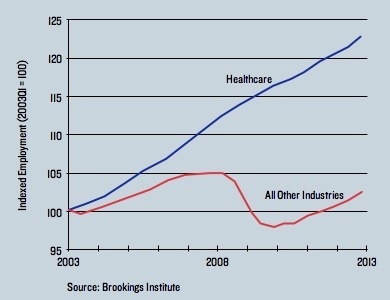
Those worried about the future of employment in America—for themselves or for the country as a whole—should look to this data. As of now, many of the jobs of the future are going to be health care jobs, and that will only become more true if Obamacare stands and the pool of insured patients expands dramatically. To understand what the jobs of the future will be (or to land one), go where the money is: services, and especially, according to this data, health services.
For those unlikely to take up health jobs, this graph might seem discouraging. After all, more doctors and health workers points to more health care costs, in a system that’s already vastly too expensive. As the Atlantic points out on its piece on the graph, “There are a couple stories that branch off from this graph. One is the unchecked growth in health care prices over the last few decades, which has made the medical industry the one truly recession-proof job engine of the economy.”
But there’s also a case of optimism here. The Atlantic notes that the two kinds of health care jobs most likely to grow in coming decades are personal health aides and home health workers. This is good news even on its own; achieving a better balance between hospital care and home care is an important task for health care reformers. Moreover, it means there’s a lot of room for entrepreneurial individualse to come up with new and creative ways to cater to a growing demand for personalized health care.

20130706-133823.jpg
Read more at: Jobs of the Future in One Astounding Graph

Motley Fool // Is Sony the Next Apple?

Is Sony the Next Apple?
By Leo Sun – June 26, 2013

There is a lot of evidence suggesting that Cook doesn’t know where to go from here – Apple’s stock buyback, dividend, and bond sale all indicate that the company could become a slow-growth tech stock like Microsoft and IBM. The iPad Mini and iOS 7 also suggested to investors that the road ahead would be reactionary, rather than revolutionary.

… Sony has expanded into is the phablets category, … a 6.4-inch screen …seriously pushing the acceptable size limit of a smartphone.

Although the Ultra seems like a goofy attempt to capture some of the phablet market from Samsung, I believe that it could gain some serious ground when used in tandem with the SmartWatch 2 and a Bluetooth headset. Many consumers could stow the Ultra in a bag, while using the SmartWatch to check on basic information and tasks while using a Bluetooth headset to make calls or listen to music. To view movies, make video calls or games, the Ultra could be brought out and used like a normal tablet.

I’m no sure Apple has lost it’s mojo but I agree there is evidence of it.

I think that the latest iteration of blue tooth and general tech advances definitely plays to the padPhone+smartWatch+headSet combo and maybe, maybe Apple missed it.

Apple IMO also has missed the stylus revolution, pads of all sizes need sophisticated hand writing, sketch, art input capability to jump another level of ubiquitous usefulness.

I hope Apple is looking at things like 3D Printing, scanning and model manipulation and creation, in the same way they took on the 2D Printing world, there would be a real break out stroke.

Syria, the ugly truth is its not going to get better

Syria (like Egypt) as presently constituted simply is not viable as a country. Iraq might be viable, because it has enough oil to subsidize a largely uneducated, pre-modern population. As an economist and risk analyst (I ran Credit Strategy for Credit Suisse and all fixed income research for Bank of America), I do not believe that there is any way to stabilize either country

Read more @:http://pjmedia.com/spengler/2013/06/05/muslim-civil-wars-stem-from-a-crisis-of-civilization

Entrepreneurial Drought Limiting job and wealth creation

20130604-210243.jpgWhere are the entrepreneurs? More evidence the very heart of the US economy is failing
James Pethokoukis | June 3, 2013

In my opinion the culprits are easy to discern…..

  1. Uncertainty
  2. Regulation
  3. Taxes
  4. intellectual property law breakdown ( too much, too long, too easy)
  5. Healthcare
  6. Retirement
  7. Risk aversion by banks

I am also thinking that:

  1. the informal economy is more active than is accounted for
  2. people who are paid can in fact support more hangers on than one might expect
  3. especially away from the ‘urbs’
  4. significant numbers are hidden on disability of one sort or another

Which may be hiding lots of small scale entrepreneurial efforts.

But in the main what we are seeing is the aggregate effect of the first list which significantly suppresses the urge to grow. Many commentators miss that the way so much regulation is structured once you reach a certain size it suddenly becomes asymptotically more difficult / expensive / stressful to operate. This makes even starting much less attractive. It also means that we are suppressing companies just as they start to kick up into a realm where they could potentially quickly accelerate out of small business land into middle sized and become more consequential.

This is a socio-economic problem that has to be solved on a broad scale:

  1. Lower but still progressive taxes
  2. Brute simple tax code
  3. Individual focused health care
  4. Individual focused retirement
  5. Small business non interference focus in government rules setting
  6. Standards setting and supporting organizations for: health, safety, financial stability, etc, instead of regulatory administrations
  7. Return IP law to its small creator anti monopoly roots
  8. Support a couple of ‘international’ banks but return banking to moderate scale focus
  9. Eliminate subsidies
  10. Continue deep and wide science support with focus on stimulating commercial support like NASA’s ISS assured access program.

Both main parties need to develop their versions of this list, the massive scale, top down, big corporation supporting model both have devolved into has come to the end of its efficacy and we need to go back to our roots. Those roots are individuals acting on, in and through the small scale collective, which both Dem and Rep should be able to support. Of course the downside is that large scale pandering and petty corruption are less hide-able in such a polity.

21st Century Opportunity > Making The New Everything…

MIT Technology Review : Business Report : The Next Wave of Manufacturing

You Must Make the New Machines // Economist Ricardo Hausmann says the U.S. has a chance to invent the manufacturing technology of tomorrow.
From MIT Technology : read more: http://www.technologyreview.com/news/509281/you-must-make-the-new-machines/

The basic knowledge is here, the ideas and innovation, even the entrepreneurial spirit, the problem is have we tied ourselves down with rules regulations taxes monopolies etc?

Walter Russell Mead // jobs jobs jobs

As always lots of great thought at The American Interest read more at: http://blogs.the-american-interest.com/wrm/2013/05/22/jobs-jobs-jobs-2/

First, make hiring easy and cheap.
Second, put the service economy and especially small business and entrepreneurship front and center.
Third, we need to feed the state to the people even as we individualize its services.

That third one had me puzzled till I read the explanation, which is a good description of what the statesmen of the past have done.

A characteristic of American political economy going back to colonial times has been the use of the resources of the state to promote the welfare of what today we would call the middle class. For much of our history we “fed the state to the people” by turning over publicly owned lands at low and ultimately zero cost. The public lands, which once included virtually all of the continental United States, were a possession of almost infinite value, but it seemed wiser (and more politically sustainable) to the leaders of the day to make them cheaply available to the people rather than to hoard them or try to retain a larger share of their value for the public purse.

Ludwig Von Mises Austrian school economics

Was reading some Mises and ran across this very neat aphorismReference
Sane sicut lux se ipsam et tenebras manifestat, sic veritas norma sui et falsi est, (Latin). A dictum of Spinoza (1632-1677). Translation: “Indeed, just as light defines itself and darkness, so truth sets the standard for itself and falsity.”

Spinoza:

Spinoza is one of the most important philosophers—and certainly the most radical—of the early modern period. His thought combines a commitment to a number of Cartesian metaphysical and epistemological principles with elements from ancient Stoicism and medieval Jewish rationalism into a nonetheless highly original system. His extremely naturalistic views on God, the world, the human being and knowledge serve to ground a moral philosophy centered on the control of the passions leading to virtue and happiness. They also lay the foundations for a strongly democratic political thought and a deep critique of the pretensions of Scripture and sectarian religion. Of all the philosophers of the seventeenth-century, perhaps none have more relevance today than Spinoza.

Ludwig von MisesRead more at: http://mises.org/

The Ludwig von Mises Institute was founded in 1982 as the research and educational center of classical liberalism, libertarian political theory, and the Austrian School of economics. It serves as the world’s leading provider of educational materials, conferences, media, and literature in support of the tradition of thought represented by Ludwig von Mises and the school of thought he enlivened and carried forward during the 20th century, which has now blossomed into a massive international movement of students, professors, professionals, and people in all walks of life. It seeks a radical shift in the intellectual climate as the foundation for a renewal of the free and prosperous commonwealth.

Why Tesla thrives while Fisker dives | MIT TR

20130406-093422.jpg

Tesla Model S

Tesla has had it’s ups and downs while Fisker has had it’s blips and boops, but Elon Musk’s (Tesla and SpaceX) has proven to be a serial innovator with a bloodhound nose for the right technical – business mash up. This MIT Technology Review piece comparing these two iconic eCar companies seems right on. And points to the government force fed A123 battery company as a compounding problem.

20130406-093432.jpg

Fisker Karma

Edited the title only…