Green on Blue, Afghan Tribalism and Would Cyberdyne do better? (w/edits)

One of my favorite websites is StrategyPage it has a text only format news wire covering technical, tactical, strategic, operational, social, political aspects of the military.  An ongoing thread has been the Blue on Green attacks (Afghan  police or army members, killing US, NATO and other Afghans) .  One of the basic issues Strat Page point to is that Afghan society is by modern standards pathologically dangerous.  Most Afghans are probably clinically PTSD by our standards, and they few restraints on killing.  Murder rates are vastly higher than in the west, the main reason we never hear about it is that there is no one to keep the statistics.

This should not come as a surprise, it has a lot to do with their culture and their state of development, particularly the latter.  We used to be a lot more like them, except at the time it was bows and swords, not AK47s.   The murder rate in the west has been decreasing  precipitously for centuries. In feudal and pre-modern times, when the village, clan and tribe were the underpinnings of society, life was harsh anyway,  honor was all a man or family had, and the weapons were knives, clubs and fists (which are often more about hurting than killing and death was a random though not infrequent occurrence)  the killing/murder rate was many times what it is today.  The violence in clan and tribal (familial not trust based) cultures is higher than in the nuclear family/trust based cultures.  In fact I would argue that most of the US murder rate happen in sub cultures that never developed from or devolved back to clan / tribal structures.  Murder in the sense of the gentile English tea garden variety is rare and probably getting ever rarer.

This article What the Western media doesn’t say about green on blue attacks in Afghanistan : goes much further and broadens the aperture:

Recalibrating our perspective
The enemy that we’re fighting in Afghanistan is tribal. Their notion of the nation-state is almost abstract and, outside of the major cities of Kabul and Kandahar, essentially irrelevant to the people of the provinces where the tribe has been the principal social unit since before recorded time. The CIA estimates the literacy rate in Afghanistan at a shockingly low 28.1% of the general population.[ii] The tribe doesn’t recognise international borders when its members have familial ties on both sides that go back for millennia. Nation states may come and go but the tribe remains and nowhere is this more apparent than southwest Asia as a region and Afghanistan in particular. Alexander learned this the hard way after three bloody incursions 329 years BCE. So did Genghis Khan in the 13thcentury, Tamerlane in the 14th, and Babur in the 16thcenturies CE

……..

Tribal alignments are socio-politically complex arrangements that are driven by principles of defence and survival. Tribe and democracy are incompatible constructs, a reality the modern Western militaries would do well to accept and build policy around. Tribal leadership and honour is everything; people do as their chiefs direct. They fight with total commitment the enemy they are told to fight, stop fighting when they are told to stop, vote for whom they are told to vote, plant wheat or opium as directed, and demonstrate a degree of social cohesion that is simply unknown to Western cultures. War and conflict are incredibly personal things to tribal culture and the tribal affiliations transcend any external relationships. This may logically explain how 500 Taliban and Haqqani insurgents escaped from the Kandahar prison in early 2011 without a single ANSF casualty; clearly the ANSF didn’t want to challenge the insurgents or were told not to by their superiors.

In this environment fighting a war in the traditional sense is almost pointless unless you have a clear eyed view of the situation and a long term plan to eradicate the problem not by violence alone but by uprooting the social structure. Of course there are many who would see this as abhorrent on its face…though the lives of those affected would be improved it would not be self determination.  It would also require decades and decades of money, toil and blood.  In our 140 character society with its plethora of supposedly quick changes we lack the ability to see that doing a hard thing like this requires incremental change over time, a million little wins not a handful of big ones.  This is the curse of our Big Bang mentality, and the failure of Westerners to understand that people from low development cultures are not  ‘us; waiting to be released from some shell of dung.   It takes decades of work to infuse the ‘memes’ that would underpin an Afghan society with the arrow of development going up rather than spinning down.

I’m not advocating this, I don’t think that humans have the ability to carry through the ‘plan.’  No society could wage peace-war for decade after decade maintaining the high moral and intellectual honesty as well as financial and material outflows that it would require while suffering the casualties and the continuing hatred of the the rest of the world.  See the fate of the British Empire..

We are going to pull out of Afghanistan in the main, given the surrounding hostility we cannot maintain a large force in country without the risk of something bad happening.  In a few years Afghanistan will be a near worthless wilderness patrolled by deadly drones ready to kill anyone who is seen to present a threat.  

And…maybe Cyberdine is the solution. The Terminator…the flying Terminator, the Predator.  With these reapers taking down any would be king Afghanistan might become a new frontier of wild east libertarian-ism. At first a place where the tribes can live if peace, or war, as they feel fit.  But under the unblinking eye will they slowly be brought to heel by the chains of modern life, solar lighting, cell phone commerce, TV, Googlepads, etc.

Maybe this is the plan behind the plan in the Disposition Matrix…..

If you know we’re in trouble but can’t quite figure out why? Adam Garfinkle at American Interest has a key

Great Primer on why bureaucratic / regulatory purgatory has descended on our heads in this blog post at the American Interest site.

America’s political institutions are so fouled up at both the politics/decision-making and the bureaucratic/administrative levels that one can actually make a plausible case that all the variance we are trying to account for lives here. One can make this case regardless of political affinities, too. Liberals argue that our economic situation, touched off by the financial collapse of autumn 2008, is all the fault of anti-government, market-fundamentalist types obsessed with deregulation. Conservatives argue that our economic situation is what it is because we are hopelessly in debt thanks to the futile and counterproductive meliorist entitlement policies of bleeding-heart liberals who invariably care more about intentions than outcomes. Both are partly right, but also partly wrong or, better, incomplete, in their analysis—which brings us to part three, next time.

Couple of updates, Alan’s post really starts here with Section 1 which provides background, that points back to Walter Russell Meade’s The Collapse of the Blue Model series I’ve posted about earlier.  Read it all, Alan says much more clearly and with more background what I have tried to say in various small ways for almost a year now.

The system is systematically broken, it has become so broken that it is self reinforcing and is pointing the nose of the ship of state down, harder and harder as we try to fix it.

Free Syrian Army | Counterpoint

http://www.foreignpolicy.com/articles/2012/10/15/Guerrilla_Country_Syria_Jebel_Zawiya


As a counterpoint to Huriyet Daily’s Point of view this article; Guerrilla Country I linked to in Foreign Policy has a different take.  The article is fascinating in its details but the money item is this:

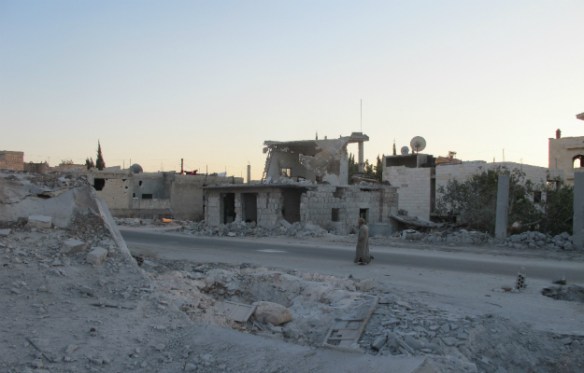
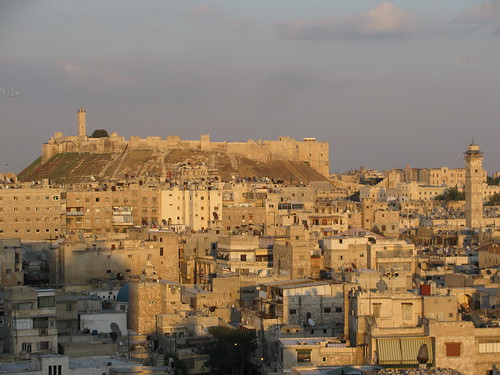
As a no-holds-barred battle rages to the east in the city of Aleppo, the pulse of the Syrian insurrection can be taken in Jabal al-Zawiya. This complex region of hills covered in olive groves and plains entwined with narrow roads of asphalt or dirt is the homeland of Hussein Harmoush, the first officer to publicly defect in 2011, and of Riad al-Asaad, the leading figure of the Free Syrian Army (FSA). Here, the insurrection is deeply rooted in the social fabric: The war these men are waging is always present, and its path is inseparable from their identities.

The FSA’s lack of formal hierarchy appears to be an asset here, as it allows the citizens of the region to organize the insurgency locally and tailor their military response to their environment. Although the rebels in Jabal al-Zawiya recognize a general leadership above them — and though they place themselves under the FSA’s umbrella — these semiautonomous groups of fighters are organized along village and family lines. That gives them several advantages: They have natural intelligence-gathering networks, and they know the terrain like the palms of their hands, having relied on back roads for supplies and secret meetings for many months. These assets, coupled with basic military skills, have allowed them to drive a far superior foe out of the towns.

Now I am far from the sound of guns and have never had the ill luck to be any closer than in an airliner on the original 9/11 but this piece rings true to me.  That is not to say it’s a good thing or bad thing, it is a reasonable facsimile of a fact on the ground.  What it says is that the FSA is probably a lot more effective than numbers and weaponry might indicate.

The FSA does not need to have its boots on the ground everywhere as it has co-opted the local fighting age inhabitants into a cell based ground holding force.  This ground holding force is self-supporting, motivated and dangerous because of its local knowledge and backing.

The FSA assault groups can stay very lean and relatively disbursed and yet have considerable military effect   They can move through the held ground quickly even if on foot because they will have local guides, support and not need a significant logistics tail or carry a lot of food and ammo.  Of course that means they cannot carry out a stand up fight from the move but that should happen rarely since they have eyes everywhere.

That’s not to say the situation sounds good.  The picture and the description are unsettling.  This is a war very much like those in the Balkans during the partisan wars associated with WWI, WWII and the ColdWar.  A war of sects who until the dogs were loosed had lived interlaced with each other for decades if not centuries (not always at peace mind you.) Now with the emperors (dictators) military police no longer suppress all,  distrust and pent-up hate is unleashed and leads down an ever tighter and more destructive spiral.

This is what the US and others should have been trying to prevent, the fragmentation and violation of the populace to a point where their natural distrust of ‘the other’ will make it all but impossible to put a working multi-cultural society back together again.

Lebanon (Syria’s neighbor and sometime satrap) is another multicultural nation in name only, but it has learned to live with its divisions, hopefully it can teach Syrians how to live with theirs when the dogs of war grow sated.

Which Is Worse: To Help the Syrian Rebels or to Do Nothing? | WALTER RUSSELL MEAD

From the Huriyet Daily News:

There are more than 30 different rebel groups, including the most prominent rebel group, the “Free Syrian Army” (FSA), fighting in Syria, according to officials from the most prominent Syrian opposition group, the Syrian National Council (SNC).
The Jihadists, Islamists, pro-al-Qaida and secular groups that are not under the control of the FSA and which are fighting in different areas of Syria against the Syrian regime forces prove how fragmented and disorganized the Syrian rebel groups were in Syria.
According to the SNC media officer, Ahmad al-Halabi, there are more than 30 opposition groups fighting in Syria – of whom only 15 could be identified by Hürriyet Daily News research. “Fifty armed men come together and they form a rebel group. They generally give their groups names from the Quran or the names the towns and areas they are coming from,” Ahmad al-Halabi told the Daily News.
According to SNC officials, there were between 70,000 and 100,000 rebels fighting against the Syrian regime in Syria. The most prominent rebel group, the “Free Syrian Army” (FSA) – who listed its main base as in the southern Turkish city of Hatay on its website – is the best connected with the SNC.

Click to go to PDF of the article (In English)

From WRM’s Via Meadia Post:

Syria is a lot like Lebanon’s bigger, uglier, and meaner brother. The ethnic and religious tensions that produced decades of civil war in Lebanon are also present in Syria. The Assad dictatorship imposed a rigid order on Syria, but as the dictatorship crumbles the divisions are coming back into public view. Unless we were willing to put tens, maybe hundreds of thousands of troops in Syria and keep them there for a long time, often fighting bad guys and getting attacked by suicide bombers, we don’t stand much chance of building and orderly and stable society there, much less an open and free one.

And:

Aiding the less ugly, less bad guys in the Syrian resistance, and even finding a few actual good guys to support, isn’t about installing a pro-American government in post civil war Syria. It’s about minimizing the prospects for a worst-case scenario—by shortening the era of conflict and so, hopefully, reducing the radicalization of the population and limiting the prospects that Syrian society – – – will descend into all-out chaotic massacres and civil conflict.

Understand and agree with this next with a big but…

If the United States hadn’t gotten itself distracted by the ill-considered intervention in Libya, we might have acted in Syria at an earlier stage, when there were some better options on the table. But we are past that now; the White House humanitarians did what humanitarians often do—inadvertently promoting a worse disaster in one place (in this case, Syria) by failing to integrate their humanitarian impulses (in Libya) with strategic reflection. This kind of strategic incompetence is the greatest single flaw in the humanitarian approach to foreign policy. It has led to untold misery in the past and will likely lead to many more bloodbaths in the future. Unfortunately, warm hearted fuzzy brained humanitarianism is one of the world’s greatest killers.

BUT:  There is really no reason we could not have done something earlier and more aggressively in Syria except that it is Silly Time (otherwise known as Presidential Election Quarter) in America.

One hopes that this is not the future for all of Syria, which has already succeeded in bombing its economy and infrastructure back decades.  Somehow when the dogs of war are unleashed the destruction seems immaterial.  Someday the dogs are impounded again and then the red haze recedes leaving behind only tears.

I’m with Ike!!!

File:Dwight D Eisenhower official photograph.jpg

I despise people who go to the gutter on either the right or the left and hurl rocks at those in the center.

And:

We will bankrupt ourselves in the vain search for absolute security.

Also:

The supreme quality for leadership is unquestionably integrity. Without it, no real success is possible, no matter whether it is on a section gang, a football field, in an army, or in an office.

And again:

If you want total security, go to prison. There you’re fed, clothed, given medical care and so on. The only thing lacking… is freedom.

Most Famously…and foresightedly:

In the councils of government, we must guard against the acquisition of unwarranted influence, whether sought or unsought, by the military-industrial complex. The potential for the disastrous rise of misplaced power exists and will persist.

With this as a postscript…from a man who would know:

Every gun that is made, every warship launched, every rocket fired, signifies in the final sense a theft from those who hunger and are not fed, those who are cold and are not clothed.

What we need in a president is someone with these understandings.  And a person who is willing to talk to the people honestly and directly about the decisions being made the trade offs necessary without diving into the cant (dialect) of economics, financiers, government (acronymophilia) or academia (grecoromanobibliophilia.)

The truth is that the president is both the most powerful person in the world and one of the most constrained chief executives in government.  This is a good thing, a different combination would be very frightening.

Our president should have clear moral and ethical lynch pins, but that does not mean that he or she can or should try to enforce those views except as permitted and directed by congress and the courts.   For example the president to represent the Ethics of the people of the United States needs to be anti-abortion (always) but know that in the end it has to be a choice made by the woman with her own conscience, that is the meaning of individualism in politics/society.

Much about taxation and regulation is beyond the direct control of the president but the executive does control implementation.  The number of laws is so huge that there is no way to actually enforce them all.  [A problem congress needs to fix by timing out old laws and replacing them with simpler laws updated every decade or so.]  A president needs to  follow the letter of the law but always push for the most minimal use of resources to enforce them, sometimes (a lot of the time) to the point of ignoring them except as modifiers (adders) if someone is indited for other reasons.  The biggest job an executive has is to ensure that the ‘system’ is not captured by those it is supposed to regulate…or if it is (by law) to ensure that they are self regulating to the advantage of the citizens in general, not their own enrichment or more dangerously their enshrinement.  Far too many of our laws at all levels of government, intended (perhaps) to protect the poor defenseless citizen, are in action a way for a small group to ensure that their way of life (money siphon) is affected (throttled or knocked from their lips), for example:  medical, bar, plumbing, electrician, cosmetician, licensing laws in each state.

What the Hayek?

Economist Philosopher F.Hayek

Economist Philosopher F.Hayek

The Road To Serfdom is often referenced and probably like many such books rarely read.  This link goes to a real life Readers Digest version, that seems to hit hard and capture well his central thesis, at least it seems so from the references to his writing.

Its certainly making me think of buying a version either at Half Price books or more likely for Nook.

From the Post Referenced above a few key pieces:

From the preamble:

At that time it was a political philosophy that stood for progress through preserving the Autonomy of the INDIVIDUAL, and the protection of the INDIVIDUAL’S civil liberty. Oddly enough, today “liberalism” equals “socialism.” Equally as odd, conservatism (and in many instances, libertarianism) champions the independence of the individual.

From the first section:

Yet is there a greater tragedy imaginable than that, in our endeavor consciously to shape our future in accordance with high ideals, we should in fact unwittingly produce the very opposite of what we have been striving for?

Planning and Power

In order to achieve their ends, the planners must create power – power over men wielded by other men – of a magnitude never before known. Democracy is an obstacle to this suppression of freedom which the centralized direction of economic activity requires.

And despite the somewhat old fashioned and formal words this should have striking impact because it tells you exactly what is going on today and why so many fear it.  It does not matter that we voted ‘the planners’ into place or that they are bureaucrats subject to dismissal.  We are providing the keys to power and we are then likely to forget about them until they are far too entrenched to remove easily.

It is only because the control of the means of production is divided among many people acting independently that we as individuals can decide what to do with ourselves. When all the means of production are vested in a single hand, whether it be nominally that of “society” as a whole or that of a dictator, whoever exercises this control has complete power over us.

Now this sounds like Communism, Socialism or Fascism not the American way but the truth is that any major part of the social structure-economy in one groups hands creates a massive center of power, privilege and patronage, the 3P’s of tyranny writ small or large.  The 3Ps lead to lawless, corrupt and ineffective organizations.

Individualism, in contrast to socialism and all other forms of totalitarianism, is based on the respect of Christianity for the individual man and the belief that it is desirable that men should be free to develop their own individual gifts and bents. This philosophy, first fully developed during the Renaissance, grew and spread into what we know as Western civilization. The general direction of social development was one of freeing the individual from the ties which bound him in feudal society.

This is not a theologian’s statement it is a philosopher’s recognition of the Christian-European (unstated but clear) understanding of the centrality of the individual as the basis of societies. That societies are are the emergent organization of many individuals interacting with each other.  And societies that provide ‘room’ for people to find their own level and best place in the social fabric are vastly more fair and kind than ones organized in rigid hierarchies and treat or form the person as an interchangeable cog.

From the post script a quote  from Frédéric Bastiat.:

Individualism, in contrast to socialism and all other forms of totalitarianism, is based on the respect for the individual man and the belief that it is desirable that men should be free to develop their own individual gifts and bents.

Musing during a presidential election year…

Disaster! Panic! Politics! Society! Government! Federal, State and Municipal Finances! Conservatives! Progressives! Libertarians! TeaParty! Occupiers! Obama-Biden! Romney-Ryan!   Truth-subverted!  Facts, obscured!

Its got to be a presidential election year!

Let’s start out with pointing some things out about some definitions:

  • Truth- Is always subjective, tied to the person assessing it and thus subject to that person’s knowledge and understanding of the facts , cultural background, personality, prior experiences, etc.
  • Lie- An untruth and subjective, what is clearly a ‘lie’ to one person may  equally clearly be‘ Truth’ to another.   There is no directionality to the words though it is often assumed, the one promulgating may know it is a lie and the person receiving could receive it as truth, or the opposite.
  • Fact- Is based on the physical world and physical record, is objective and concrete.
  • Fiction is as close as we come to the Lie equivalent to Fact.  But Truth vs Lie is not equivalent to Fact vs Fiction .  Fiction depends on lies (often willingly accepted) whereas Fact does not depend on Truth,  Truth depends on Fact .  Actually a lie can be tied to a fact as easily as truth the only way to distinguish is to analyse other facts about the first one more deeply
  • Accounting- Theoretically the objective, fact based ‘counting’ of sums and valuations.  It can be almost pure arithmetic but when the sums are in computers and the valuations are subjective and relativistic then it becomes something more about Truth than Fact.
  • Finance- Formulating, creating, ‘raising,’ distribution of and ‘payment or rental’ of the discretized units of valuation we call money.
  • Statistics- Numeric / mathematical analysis of distributions and relationships within and between groups of related measurements.

It’s obvious that the past was simpler, in the 19th century even up into the mid 20th century you had a certain number of tons of gold in various repositories around the world.  Finance and accounting were all about arithmetic tied back to those hillocks of gold stashed away under lock and key. We could count the number of ships in our fleets, measure the throw weight of their guns and the length of the coast or sea lane to be protected.  The number of Aristocrats, Plutocrats, Technocrats, Artisans, Storekeepers, Farmers, Workers, Farm Hands, etc and know they would reliably vote one way or another (if there was a vote at all.)   That world was chaotic in the eyes of those who lived in it, to us it looks like a pool of tranquility.

Today we have fiat money (its value is based on the credit of the person, corporation or government issuing it.)  And the money is not in the form of a fixed number of coins or even pieces of paper, its an approximate number based on accounting that is based upon assumptions and approximations of a hundred different variables.   While we know that the US has more firepower than the rest of the world combined we cannot really be sure that provides the level of assurance and protection we need, or if its vastly too much.  The population is far more diverse in what they do and how they perceive themselves in relationship to others now and the fragmentation makes it almost impossible to create a coherent platform for change.

Everything has become political (in the worst sense) because there is no agreed upon foundation of facts and truths.  The only time things get done effectively is when the (till the moment before, unseen) rocks of fact tear the guts out of the ship of state (the municipality goes bankrupt, etc.) So the guys who want to be in charge are always trying to predict the next disaster either to flog their favorite solution or to steer the ship away to keep it going for a few more weeks, months or years.  While most ‘politicians’ are men and women of good faith in their own minds, they also WANT to hear Truth from their own side and Lies from the opposition, and consequently do so.  Most are not able to unravel Facts from Fiction, Truth or Lies because of the complexity, (until the rocks start smashing in the planking.)

So…Panic! Disaster! Despair! Outrage! Fraud! Corruption! Cowardice! On and on, and on…..

So at the end of the day what?  View the recent past in light of what history has to say and pick your poison.  I see that regulation while important cannot run amuck and it is running amuck.  I see that no state can run a deficit forever, and we need to have a long term plan.  I see that there is only so much the state can take out of the pockets of the people and corporations without doing harm (or having to provide a substitute service of some kind) and we are at a decision point, and I do not want a government substitute.  I think that government can only get so large before it distorts the society and market network, and government is definitely at that point and must be reigned in before we become utterly dependent on it.  No government lasts forever, and when it collapses it pulls the society down with it, the US was designed so that ‘the government’ is always in a state of creative destruction, and we – society at large, are able to keep on going.  There are forces (I think emergent from historical and social movement rather than Dr. Big Brain)  at work in the US economy and political class to make the government – more and more rigid, this has to be stopped, and that means less government, less regulation, lighter taxes, and probably more personal risks, and I am ready to accept that trade-off, as are I think most citizens…

And that leads to one last definition:  A citizen is not a legal title in my usage, its an attitude/philosophy.  If you care about the future of the country and want what is best for ‘the country’ and other citizens, understanding that there is no free lunch, no equal outcomes or natural fairness in this world, you are probably a citizen of the US, not just someone who happened to be born lucky.

A world apart

We each live in a world apart from all others with only limited senses, knowledge and above all time, to understand the worlds of others, we tend to associate with those of a similar mindset either on purpose or by happenstance [family, region, career, religion, etc.]  We associate with the similar because its easier and more effective than having to form a common base with someone whose world is very different.

Is the internet while making many things more common on one level, is breaking down some of the commonality that provided the ability to quickly relate to those you meet on a day-to-day basis?

With that rapid assimilation gone do we tend to live in a field of strangers who are getting less familiar all the time.  And does that limit trust, the trust that is so critical to the success of the greater American culture?

The above is just a restatement of concerns expressed many times before.  I guess I just had never thought through the ‘world apart’ metaphor and the reason we are worlds apart, even when we are touching each other.


Key Insight regarding Gov’mt in America

An important, simple point from: Backers of government-run healthcare, including the single-payer concept, think regulation by government and intelligent planning will work better. I think that these people are well-intentioned but wrong. If we follow their suggestions, we are more likely to end up with something like the U.S. Postal Service than a high-tech, streamlined medical system that can work in the future. This is not because governments can never do anything right, but because the American political system works the way it does. Other countries, usually smaller and more homogenous ones, can do these things better. Approaches that might work in Denmark don’t work well here. The messy compromises and one-size-fits-all solutions that usually come out of Washington generally can’t provide the kind of guidance our healthcare system needs.

How can Romney respond to Candidate Obama’s exposure of his underlying socialist mindset?

Respond to what, it was just a misstatement, right?

Wrong!!

if you listen or read more it’s quite obvious he meant it in a deeper sense than a softly communitarian sense, he denigrated the hard work and smarts it takes to build up the smallest or commonest business. Yes you need infrastructure to build on, but it was leaders and tax paying citizens who built that, government is at its best when it’s a framework of self organization not the organizer.

How could Romney respond…by declaring a regulatory holiday, for two years. Also rescinding all new regulations from the last eight years unless the were a relaxation of prior rules or to do with acute toxic threats…and I know that even that would be abused.

During the holiday the US’s regulatory framework would be changed from mostly a matter of sovereign law to contract law. Regulations would be matters of goals and baselines and an standard if unwritten contract line item not a legal straight jacket. Don’t feel the regulation is best for your customers, neighbors, employees etc? Then write it up and submit it as a change to your social contract. Regulatory law is ‘now’ contract law, you pay for your day in court to review your change, if someone protests they have to pay the extra court costs (and by the way court is in your HQ’s state capital or a nearer regulatory court, not in your or their venue of choice.) If you’re sued on a ‘regulatory’ item, first hearing is split if it’s extended the ‘suit filer pays’ unless they can prove that you lied, if it’s a question, you split costs.

Simple minded you say? Good laws are simple and philosophically clear. Applying law to complex and ambiguous reality is what we pay judges and lawyers for.

Such a plan would lay the foundation for a new US boom, it would take the shackles off and let people’s ingenuity and desire to build something for the future blow the roof of the doldrums the regulatory over reach of the last several decades has built over our dreams.