Nuclear, The Story Not Told

Two numbers.

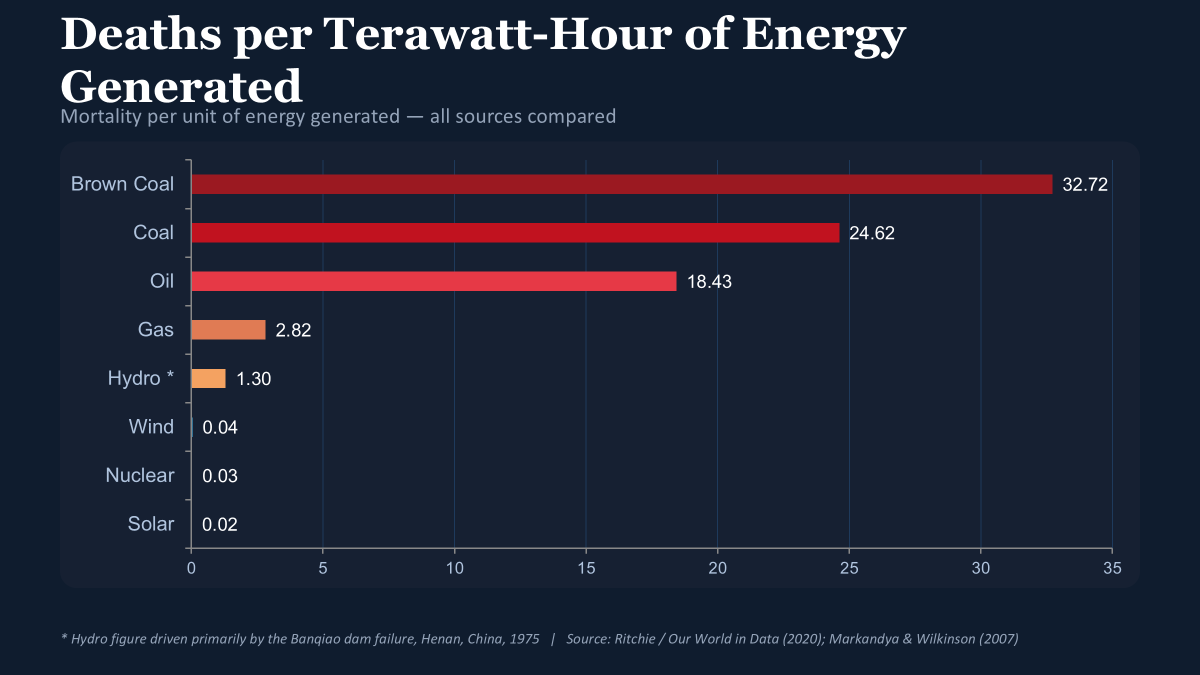
Hydro: 1.30 deaths per terawatt-hour of energy generated.
Nuclear: 0.03.

I spent thirty years in power electronics and systems engineering. I’m used to evaluating risk from data. When I first looked at those two numbers sitting side by side in the same table, I had to read them twice. Then I went looking for where the data came from, who had reviewed it, and whether anyone had poked holes in it. Nobody had. The methodology is consistent across multiple independent sources, and the numbers have held for years.

The question that’s stuck with me since is a simple one: why does one of those numbers drive policy, and the other one barely gets mentioned?

That’s not a rhetorical question. It has an answer. And the answer is worth understanding, because the same mechanism is almost certainly operating right now on something else entirely.


August 1975
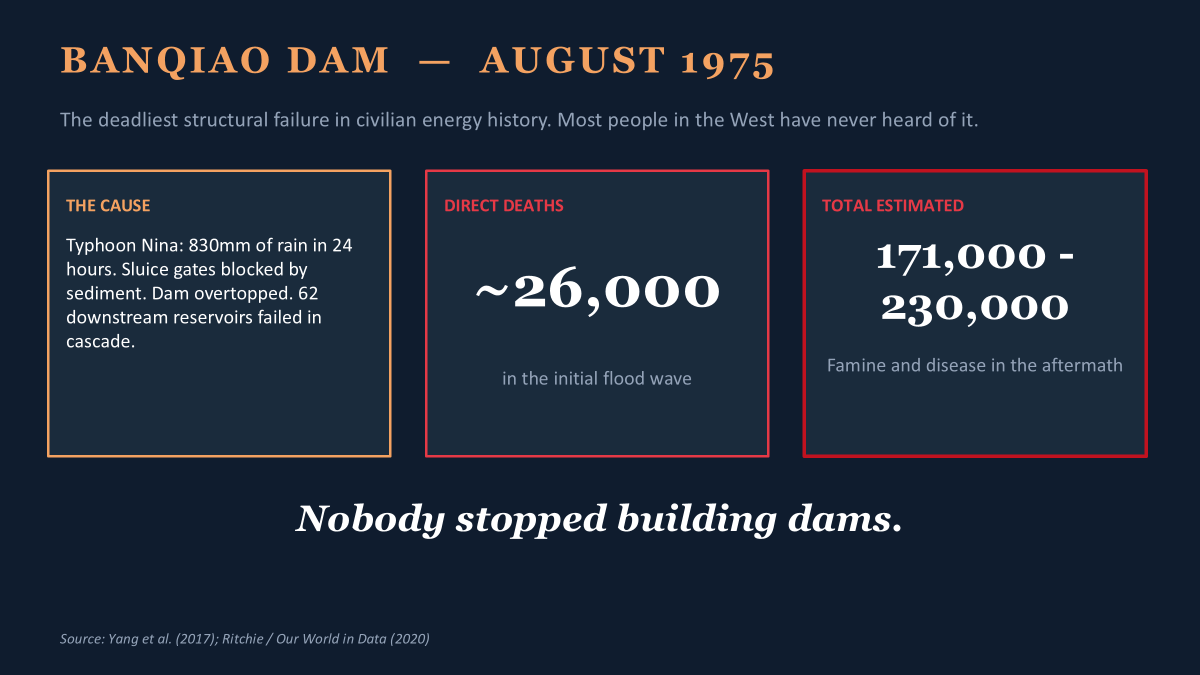
Henan Province, China. Typhoon Nina hits a cold front and drops roughly a year’s worth of rain in 24 hours. The Banqiao dam, built to handle a so-called thousand-year flood, gets overtopped. Sluice gates are partially blocked by sediment. The dam fails. Then 62 downstream reservoirs fail in sequence.

A wall of water six meters high and ten kilometers wide moves down that valley at close to 50 kilometers an hour.

Direct deaths: approximately 26,000. Total deaths, once you account for the famine and disease that followed the destruction of the regional water supply and agricultural system: somewhere between 171,000 and 230,000 people. The Chinese government suppressed the numbers for decades. Most people in the West have never heard of Banqiao.

Nobody stopped building dams.

No global regulatory freeze. No decades-long moratorium on new hydroelectric construction. Banqiao killed more people than every nuclear incident in history combined, and the policy response was essentially nothing.

Hold that thought.


Nuclear’s Actual Record
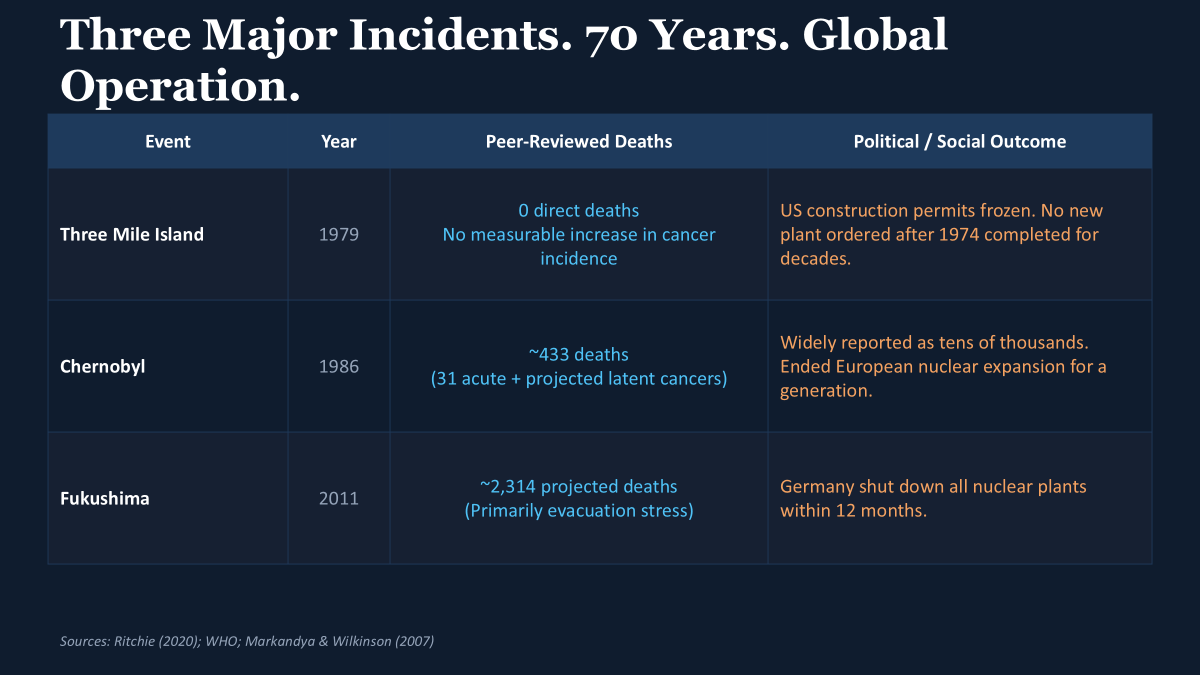
Three events define public perception of nuclear power.

Three Mile Island, 1979. Partial meltdown. Serious incident. Zero direct deaths. Peer-reviewed studies found no measurable increase in cancer incidence in the surrounding population. The containment system worked.

The public response: mass panic. The regulatory response: construction permits frozen across the United States. No new nuclear plant ordered after 1974 was completed for decades.

Chernobyl, 1986. A genuinely catastrophic failure of a reactor design with known safety flaws, operated outside its safety envelope during a test. Peer-reviewed death toll: approximately 433. That number gets reported in popular media as tens of thousands, sometimes hundreds of thousands. The peer-reviewed literature does not support those figures.

Fukushima, 2011. This one needs context. A magnitude 9 earthquake and a 15-meter tsunami killed approximately 20,000 people directly and destroyed the regional infrastructure. The nuclear plant failure was a knock-on of that disaster, not a standalone event. Hospitals were already overwhelmed, supply chains already broken, shelters already strained.

That context matters, and it makes what follows more striking, not less.

Deaths from radiation: zero. UNSCEAR and the WHO both confirm no member of the public or plant worker died from acute radiation exposure.

Deaths from the evacuation: 2,313. Officially certified by the Japanese Reconstruction Agency. Cohort studies compared evacuated groups against matched groups in the same disaster zone who were not subject to the nuclear evacuation order. The excess mortality still tracks to the evacuation specifically, not the general disaster. Patients pulled off ventilators and loaded onto buses. Elderly evacuees in unheated gymnasiums in March without their cardiac medications. Long-term displacement that drove a documented spike in strokes, heart attacks, and suicides.

The evacuation killed 2,313 people. The radiation killed none.

Germany’s response: shut down all nuclear plants within twelve months.


The Thing Nobody Talks About
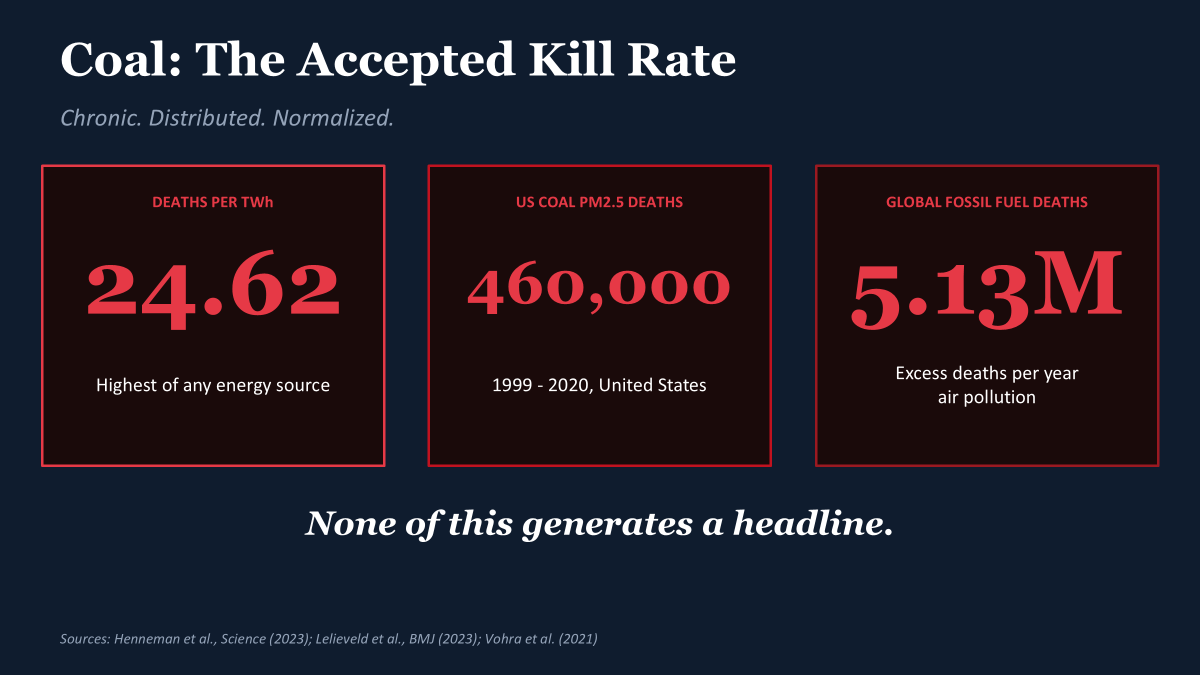
If nuclear is the thing people are afraid of, coal is the thing nobody discusses.

Coal sits at 24.62 deaths per terawatt-hour. That’s not an accident rate. That’s a baseline. It runs every hour the plant is operating, in every community downwind, invisibly.

The mechanism is particulate matter, specifically PM2.5. Fine particles that bypass your lung filtration and enter the bloodstream. They drive ischemic heart disease, stroke, and chronic obstructive pulmonary disease. The people dying from this don’t die in a dramatic event. They die over years, and the death certificate says heart disease, not power plant.

In the United States alone, between 1999 and 2020, 460,000 deaths were directly attributed to coal particulate emissions. That’s a peer-reviewed figure from a study published in Science in 2023, based on Medicare records.

Globally, fossil fuel air pollution causes an estimated 5.13 million excess deaths per year.

No headlines. No evacuation zone. No footage. No panel of experts. It just happens, continuously, and we have decided as a society that this is acceptable.


Why the Data Didn’t Matter

This is the part worth sitting with.

The deaths-per-TWh data has been available and consistent for a long time. The numbers aren’t new. So why did the policy response to nuclear go one way and the response to everything else go another?

The answer isn’t scientific illiteracy, though that plays a part. The answer is how human risk perception actually works, and specifically a category psychologists call dread risk.

Before applying it to nuclear, try it somewhere closer to home.

Roughly 40,000 people die in car accidents in the United States every year. Commercial aviation kills, in a typical year, somewhere between zero and a few dozen. Per mile traveled, you are orders of magnitude more likely to die in a car than on a plane. Most people know this, at least abstractly. And yet a significant portion of the population is afraid to fly and gets in the car without a second thought.

That’s not stupidity. That’s a predictable failure mode of the human nervous system. Dying in a plane crash feels uncontrollable, invisible in its causes, and catastrophic in its image. Dying in a car feels like something that happens to other people who weren’t paying attention. The statistics are not what’s driving the fear response. The characteristics of the event are.

Psychologists have a precise vocabulary for this. The factors that amplify perceived risk include: whether exposure is voluntary or involuntary, whether the mechanism is visible or invisible, whether effects are immediate or delayed, and whether the hazard carries prior cultural associations with catastrophe. Score high on those dimensions and people will treat a low-probability event as an existential threat. Score low, and they’ll accept a high-probability harm without complaint.

Nuclear hits every trigger. Radiation is invisible. Exposure is involuntary. The effects are delayed. And the word “nuclear” has carried the weight of Hiroshima and Nagasaki since 1945. Thirty years of Cold War civil defense films, fallout shelter drills, and duck-and-cover exercises had done their work long before Three Mile Island. The public was primed.

Coal has none of that. It kills more people per unit of energy than any other source in widespread use. It kills them slowly, distributed across populations, through mechanisms that show up on death certificates as heart disease and stroke. There is no “coal incident” that preempts the evening news. So coal never triggered the dread response. It just kept running.

Here’s where it gets interesting from a broader perspective. Once you understand that nuclear had a unique set of psychological vulnerabilities, you also understand that those vulnerabilities were predictable. And predictable vulnerabilities are usable ones.

You didn’t need to fabricate data to keep nuclear from expanding. You didn’t need to lie about the death toll or invent risks that didn’t exist. You just needed to keep the fear operational. Any outcome you wanted from that situation, whether it was energy policy, geopolitical competition, protection of existing energy assets, or genuine environmental concern, ran through the same lever. The mechanism did the work regardless of the motive behind it.

That’s how you get a policy response that froze an industry after an incident with zero deaths, while an energy source that kills hundreds of thousands of people a year kept operating without comment.

The data didn’t change the policy because the data was never the driver of the policy. The fear was the driver, weaponized by a lot of different actors. And fear, once well-established in a culture, doesn’t need new information to sustain itself.


What It Cost
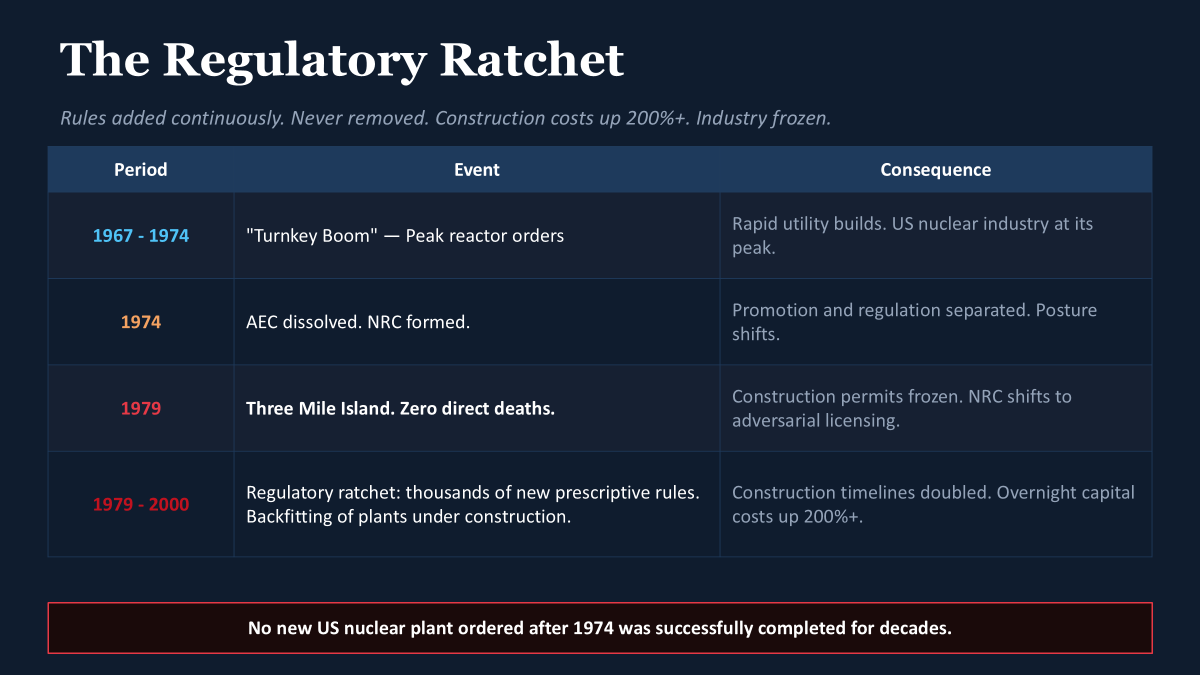
After Three Mile Island, the NRC froze construction permits and shifted to an adversarial licensing posture. Plants that were 80% complete had to be redesigned to meet new rules written after they broke ground. The rules kept changing. Cable separation distances. Concrete specifications. Redundant backup systems. Each rule issued as a response to perceived risk, none ever rolled back.

The industry has a name for it: the regulatory ratchet. Rules only move in one direction.

The result: construction timelines doubled. Overnight capital costs increased by over 200%. An industry that had been commercially viable became financially impossible.

One example makes it concrete.

The Shoreham Nuclear Power Plant on Long Island, New York. Construction started in 1973. The original cost estimate was $75 million. The plant was completed in 1984 at a final cost of $6 billion. The regulatory environment had changed so many times during construction that the finished plant was essentially built twice. After completion, the plant ran a single low-power test. It never delivered commercial electricity to a single home. In 1989, Long Island Lighting Company transferred ownership to New York State for one dollar. The plant was decommissioned.

Zero deaths at Three Mile Island. The containment worked. The response was to make nuclear power economically unbuildable for the next forty years, and to leave a completed $6 billion power plant sitting idle until it could be taken apart.


The Question the Data Left Open

The engineering question was answered a long time ago. Deaths per terawatt-hour is a clean metric. The data is consistent across multiple independent methodologies. Nuclear kills fewer people per unit of energy than any fossil fuel, and roughly the same as wind and solar. Hydro sits at 1.30, driven almost entirely by a single dam failure in 1975 that most people in the West have never heard of.

The question the data leaves open is not whether nuclear is dangerous. The data settled that. The question is why the data didn’t matter, what it cost us that it didn’t, and whether you can now look at any other technology or industry and spot the same pattern running.

Find something that scores high on the dread risk dimensions. Invisible mechanism. Involuntary exposure. Delayed effects. Prior cultural associations with catastrophe. Then look at what the data actually says about it versus what the policy response has been.

The mechanism is still running. The only variable is what it’s pointed at today.

Here is the file


M.A. Harris is a systems and mechanical engineer with 30 years in power electronics and a particular interest in how engineering data interacts with public policy. He writes hard science fiction as M.A. Harris and runs The Unretired Engineer on YouTube.

📺 YouTube: https://www.youtube.com/@Scifiengineer-09
🔗 LinkedIn: https://www.linkedin.com/in/mark-a-harris
📚 Published works (M.A. Harris): https://www.amazon.com/author/m-a-harris

Grumpy elders…

Not much more to say there. Other than everything I hear about what Elizabeth II has indicated publicly, is what I would expect from the grandest of ladies, polite and deflecting rather than the hard right to the chops the little bitches both deserve.

My personal weekend grumpy gripe is the shit show from the idioechelon’s of the DoD about mean things that Tucker Carlson says.

The operational uniformed men and women in the services and the working level folks in the DoD are 99.999% good folks. But unfortunately in this day and age the fraction that works its way to the top is the dregs not the cream.

Do Not Trust DoD! DoD is Asshole!

And

I worked in one of the Navy Industrially Funded Facilities for 15+ years before the assholes in industry finally paid congress enough to get them to shut down those generators of expertise and providers of reasonable cost special projects. I got a PhD level training in technology and the management of technology working on electronics and packaging at NAC, the Naval Avionics Facility, of fond memory.

Do not trust Congress! Congress is Asshole!

What is Propaganda…is it different from Fake News?…and when is it good?

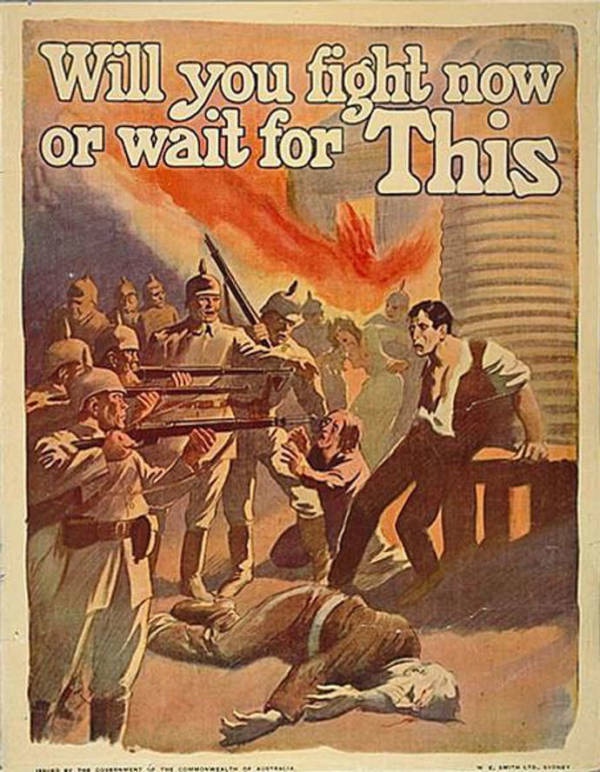
World War I Posters That Reveal The Roots Of Modern Propaganda
By All That’s Interesting
Published December 26, 2016
Updated July 10, 2019
These World War 1 propaganda posters courtesy of the U.S. government provide a fascinating look at the America of a century ago in the midst of the Great War.

Propaganda is the more or less systematic effort to manipulate other people’s beliefs, attitudes, or actions by means of symbols (words, gestures, banners, monuments, music, clothing, insignia, hairstyles, designs on coins and postage stamps, and so forth). Deliberateness and a relatively heavy emphasis on manipulation distinguish propaganda from casual conversation or the free and easy exchange of ideas. Propagandists have a specified goal or set of goals. To achieve these, they deliberately select facts, arguments, and displays of symbols and present them in ways they think will have the most effect. To maximize effect, they may omit or distort pertinent facts or simply lie, and they may try to divert the attention of the reactors (the people they are trying to sway) from everything but their own propaganda

Britannica.Com on propoganda

If you spend a little time absorbing this definition, which I have no quarrels with, you realize that what has been called Fake News IS largely propaganda. And it IS what the US main ‘news’ channels have been practicing either somewhat accidentally or wholly on purpose for the last four + years. They have been sliding this way for decades, but it has slid down the slippery slope to this end state quickly over the last few. (Read my post on the Slippery Slope…Looking at this topic I realize this fits into that type of situation where the Slippery Slope IS real, all of the actors are in the game and the rational observers have no impact on the discussion AT ALL.)

Is propaganda ever appropriate? I can’t tell. I want to say NO not just ‘no’ but HELL NO. But I also see how difficult it is to get everyone on the same page and can see that in general if there is a societal good that can be defined as good then making sure everyone is on board is also Good.

But….a big one.

I think that with the internet and the explosion of ‘near news’ outlets propaganda and its bastard child fake news, become a very bad thing, an evil. Everyone learns about propaganda and they get a sense that in the right hands it is good, in the wrong hands evil. So it becomes something of a standard tool, because most of us sees ourselves as ‘one of the goodies.’

The problem is that all sides of an argument get a say. And the general populace do not have any deep sense of the reality of the situation, the nuances etc. If you are generally democrat you see mostly democratic outlets. If Republican, only that line. While some resources have centrist voices, they always shade one way or the other, and many outlets are purposefully hard over. One sides group gets propagandized into believing their trope. The other side…the other trope.

So as Scott Adams points out you get two radically different views of the same events. To the point that the objective reality is not even in view of those Propagandized. Take the Capital Intrusion, one side, clearly nonviolent non threatening, good people protesting an at least murky election. Other side clearly violent, threatening, evil people trying to overturn a fair election.

In this war of propaganda the sides are purposefully pushed apart because the two sides cannot allow ‘their’ segment to wander. They rationalize deleting and spinning evidence because it is not important and muddles the message.

But…but…but…Journalism!

Journalism has always had an element of propaganda. Yes there was a period when it was portrayed as noble to present just the facts but the reality was this was at best a hope and and worst cover. The same schools essentially TEACH propaganda methodology as part of the general curriculum. Again in one view to inoculate the innocent learner against it, in the alternate view because there are a lot of jobs in public relations and advertising (commercial propaganda) as well as in government (propaganda straight up though usually for neutral topics.)

And….”If it bleeds it leads”…news of any kind is a business. Yes you can point to billionaire liberals propping up various operations. But at the end of the day news is a good way of turning a billionaire into a millionaire over time. The operation has to support itself or it cannot last long. What Fox showed was that you could get an audience by bending the news in a certain way and feeding them ‘red meat.’ They tried (mostly succeeded) in a combination of pretty clearly factual reporting and pretty clearly politicized editorial content though you were left to guess which was which. What a lot of the other operations couldn’t really afford to do was the factual reporting. Editorializing everything with a left bend…but left the audience to believe they were giving ‘just the facts.’ And probably excusing themselves by closing their senses to the much more complex nuanced reality…Though it is not clear most of those smiles even have a clue that such a thing exists.

Sigh…and so it goes…have not watched TV/Video news in years, probably never will again, despise its superficiality and bias. Even the talk shows are uselessly one sided these days, making the whole realm a danger to the Republic rather than the safety valve it was supposed to be.

Presidents

A comment – link at Maggiesfarm

Here is an off the cuff list of the best: George Washington, Abraham Lincoln, Grant, Theodore Rosevelt, Coolidge, The war FDR, Eisenhaure, Maybe Reagan, Clinton, Trump.

It is not the man so much as a mix of philosophy, administration and legacy.

To me Lincoln seems like the greatest but at the time he was hated by as many or probably more, than he was loved.

I believe Trump the president was also great.

Trump the man as president…not so much. But it is not clear to me that Trump would have been as successful as he was any other way than the way he was.

That left the opening for a lot of very rapid damage to be done by the following administration when he became a one term president due the to the machinations of the machine.

Why is he hated so much when once he was beloved of the very elites that rabidly snarl at his ankles today? Because he stayed true to himself , he is not, never was, a conservative, he’s an updated 1950’s Anti Communist Centrist Liberal.

He is, as were they in some significant sense, populist and anti elite while connecting to the elite, and he got down and did real work for most of his life. OK executive and then star work, but work of a significant type for many years.

That may be the biggest difference between liberalism of early twentieth century and today…those liberals (even anti communists) were populists of a rather socialist bent who got down and got working guy grubby (which made a lot of those earlier left liberals much more attractive than the modern soy boy type.)

Of ratchets and slopes, slippery or otherwise

Crossbow and the crank/ratchet for cocking it medieval period, WikiCommons

As commented on before I pay attention to Scott Adams of Dilbert fame as an interesting thinker with a fairly well defined but undefinable political gestalt. Uber liberal realist Trump supporter is maybe the best description.

One of his mantra’s is that Slippery Slopes are Not a Thing.

The following is my interpretation of his position.

A point of view/policy item with a broad ‘option space’ and supporters on both ends, say like gun control, will slide in a direction that is acceptable to the general polity (something like the Overton Window) until some point it will no longer be acceptable. Those who wish to push the policy towards one end or the other will eventually meet resistance and be unable to move the policy further ‘their way’ until some change occurs. That change may move the policy ‘back’ or ‘forward’ but it is acceptability that controls. This says that the idea of a ‘slippery slope ‘with its imagery of reaching a point where you lose control and slide to some end point it false on its face.

Having thought about this I agree with the premise in a general sense.

Two, I think important, quibbles:

1) That in a highly emotional and very dynamic situation such as one might have in the ancient Demos of Greece, or say a Constitutional Congress, a French State Committee…, the slippery slope appears to me to be a real threat. The whole of the polity is in the fight as it were and there is no stable base of opinion to dampen high flights of rhetoric and emotion. In such situations you have a tendency to move to the end state without the intermediary and if this is then enforced on the outside world the results are likely to be calamitous if the topic is one with a high degree of emotional attachment with the broader public. The Demos were tiny isolated city states and they killed a few important people and destroyed themselves but it was in the end fairly evolutionary. The US constitution was very conservative in its basis and while the result was ‘liberal’ it was not that crazy and was in line with most of the populous, plus it was a huge area with a tiny population, where malcontents could often go west if they wanted. The French Revolution was a bloody multi decadal disaster because it didn’t have any other damper than time and blood….To a large degree I don’t see this as that active other than in a Social Network Today…to some degree it explains some of the crap that goes on in odd corners of the web.

2) More important than 1) is the fact that the ratchet is IMO real. That once a law or regulation is in place it tends to create a new baseline and constituency. If the issue is fairly hot there will be pushback but in general people are for stability and a law or regulation will become entrenched. It only takes time for that to then be the jumping off point for a new effort to extend whatever policy. This may not be very logical on its face but it is a reality and is one of the reasons that any human system tends to atrophy with time. So the party who tends to desire more law and regulation have a tendency to have the edge here and they will turn the crank on the ratchet whenever they get the chance.

While England is not the US in any sense one should look at it as a bit of a case study, though the lack of the 2nd Amendment is a huge factor. A century ago guns were rare more because of their cost than anything else. Then regulation started to build up. Because of no 2A and it was very gradual there was not much push back. Today not only is any kind of firearm in private possession effectively illegal so are any edged/pointed device inclusive of scissors. The ratchet is real…the slippery slope is a thing only in very constrained cases.

Deep Funk

Gallup Pole, Deepest dive ever recorded.

Makes one wonder, no proof that the election was stolen or that there was massive irregularities. Also not really proof that Big Business and Big Labor agreed to suppress any push back on the result. And maybe that is all right. Is it possible that Orange Man Bad helped defeat himself? That he was both so toxic to the pretty elite and beloved by the deplorable that a large number of people who supported the Trump administration but deplored the man voted Blue in the conviction that Orange Man Bad would win anyway. Convinced he would win they were fairly positive about the future….now…deep funk.

Just sayin… as the niece has said.

A little air, a bit of heat, some light

What Global Warming? 148 New (2020) Scientific Papers Affirm Recent Non-Warming, A Degrees-Warmer Past at WattsUpWithThat

Climate Change Horror Porn is another tool of the apparat to frighten us. In realty there is an objective truth out there…none of us know it. Two sides largely aligned Left and Right though not precisely have taken sides and because the liberal left is ascendant and deeply intwined in academia and the media they are trying to ‘scare us straight.’ It might be well intentioned in many cases, but ideologues, abusers, users and grifters have gathered around a powerful ideological tool that can be used to manipulate the population.

  • The science such as it is….which is a lot…but not what you are told it is by the media and the ideologues who want to use it.
    • Climate science
      • What climate was/is/will be:
        • Is based on models of how the whole atmosphere, hydrosphere and lithosphere work.
          • Early simple models were very illuminating.
          • Complex models are horribly sensitive to incorrect knowledge and unknowns.
        • A lot of it is based on prior history comparing things like plant and sea life growth vs temperature, CO2 etc.
          • But most of this knowledge is based on proxies up until a decade or at most two ago.
          • Plus sparse and non technical accounts up until the modern era
          • Has a sparse and erratic technical record from about a century and a half.
          • Decent deep record for a couple of decades.
          • Can see what it is today in fair but not omniscient detail.
        • We model the future based on models that we ‘test’ against the past. Like the stock market sometimes these models can do an ok job. But that is only because of parameter fiddling to ‘match the curves.’ The models are by necessity highly simplified and often just plain wrong. For example:
          • recent discovery that cloud impact on surface temperature can increase not decrease surface temperature. And that it may depend on where you are in the world.
          • Recent discovery that CO2 concentration’s affect on green house is not linear and tapers quickly at higher concentrations.
          • That the planetary heat balance is highly affected by cooling at the poles, and that the magnetosphere/sun link into the climate also is highly linked at the poles.
          • Etc.
        • While the first climate models that brilliant men and women came up with less than a century ago have been proven to be largely correct, the details are practically, hardly better modeled today than they were in the 1950’s.
        • Today there are literally hundreds of complex computer models and that are run many times with many different start parameters. They generate families of predictions, effectively at random. Those predictions are never even close to right at a rate greater than chance.
Continue reading

The Woke Purge is Beginning

From Maggies Farm: The Woke Purge is Beginning in total because it’s short and very clear:

“ Parler being dumped by Amazon Web Services wasn’t the first shot. Gab was in 2018. Gab is still around, though it is private now and subscription only. That may be the future for Parler and others like it which fill a need.

But going private isn’t the only solution, there are other solutions. But private is probably bes. However, being aware and adept at meeting the Progressive/Leftist challenges to free speech is essential. I am particularly fond of The Mises Institute’s approach.

This is a space in which I’m uniquely informed and aware. I’ve been seeing this slowly developing for years, and it’s been a growing concern. I’ve been told for years “oh it will never get that bad” and now it really is that bad. Many said Net Neutrality was necessary because the provider of the pipes would throttle, reduce and limit ability for sites and apps to work. Ironically, the purported supporters of Net Neutrality are the very same businesses who are throttling free speech – you know, the free speech they felt Net Neutrality was required to prevent OTHERS FROM THROTTLING THEM. Except, they will argue, ‘this is different’. It’s not. And Net Neutrality would have given these tech oligarchs more power to do this very kind of thing.

That said, because all this has happened slowly at first, then suddenly (due to the Capitol incident), Hemingway’s description of bankruptcy fits these moves restricting the freedoms on speech very well. When it’s taken, unlike bankruptcy – which is usually noticeable, this is going largely unnoticed and unmentioned. Or, at least, it’s being done in a manner many consider ‘acceptable’. Because the main beneficiaries are the very groups doing damage to free speech – the tech oligopolists. Who know ‘better than you’ about how things should be done, how you should live your life, and what you can or should say.

Don’t get me wrong. Tech in’t bad. Social media isn’t bad. It’s not inherently evil. It is ambivalent to morality. But individuals themselves can be good or bad, and as a result can have overbearing and long-lasting impacts on our realities. I’m sure Gutenberg was not loved by leaders of the day and “War of the Worlds” certainly sent many scurrying to talk of the damage radio can do. TV was described as a “vast wasteland” and Bill Gates felt there was little commercial value to the internet.

What is happening now requires individual awareness and action. It does NOT require fighting or violence. Just intelligence and smart, cordial and meaningful action. The Progessives are just starting, in my view. I don’t believe violence will help solve issues – it will be used to justify positions. But being louder, smarter and more aware will make a difference.Posted by Bulldog in Hot News & Misc. Short Subjects at 17:06 | Comments (10) | Trackbacks (0)
. “