Did the ancient Myan’s predict the collapse of human civilization in 2012?

There have been a series of Cassandra video’s floating around this year, actually pretty much from the beginning of the internet.  I think the latest one I keep hearing glancing past is Post America or some such.  Ed Driscoll has a piece on the free fall of California that takes a lot of its material from this piece by Victor Davis Hanson then mentions the book After America from which the following comes:

 In ten years’ time, there will be no American Dream, any more than there’s a Greek or Portuguese Dream. In twenty, you’ll be living the American Nightmare, with large tracts of the country reduced to the favelas of Latin America, the rich fleeing for Bermuda or New Zealand or wherever on the planet they can buy a little time, and the rest trapped in the impoverished, violent, diseased ruins of utopian vanity.

“After America”? Yes. It will linger awhile in a twilight existence, arthritic and ineffectual, declining into a kind of societal dementia, unable to keep pace with what’s happening and with an ever more tenuous grip on its own past. For a while, there may still be an entity called the “United States,” but it will have fewer stars in the flag, there will be nothing to “unite” it, and it will bear no relation to the republic of limited government the first generation of Americans fought for. And life, liberty, and the pursuit of happiness will be conspicuous by their absence.

I agree that things are ugly for certain segments and geographical subsets of the middle class.  But I do not see a wholesale breakdown of the American dream.  On one side the American Dream has always been time and place focused, on the other I see almost as many positive signs as negative if you look at things from a broader perspective.  Conservatives are always going to lament most changes they see around them and conservatives living hyper conservative lifestyles, (i.e. farmers, lawyers, police, military)  are going to see things going to hell with more poignancy. 

The way I see it we got here because of the sequence of bubbles we have lived through, from the Post Cold War Bubble, Tech Bubble, Internet Bubble, a General Bubble (up to 9/11/01) then the Housing Bubble.  All of this essentially enabled the following: 

  • Pandering to gov’t worker unions
  • venal politicians promising money they had no way of knowing would be there
  • Bankers divorced from personal financial risk taking too many risks
  • Stock investors who should know better always expecting smooth growth
  • Managers looking six months ahead instead of six years ahead
  • Apathetic voters:
    • Voters who vote for the guy who ‘looks’ the best
    • Voters who vote for the guy who promises the most
    • Young folks not voting because they’re working 60hours and playing 40.
    • Middle career folks voting on visceral because their working 60hours and then coming home to another 40 of honey dos
  • One issue voters
    • Old folks voting for their pensions with scant consideration for other issues
    • Gov’t workers voting their pocket book  with scant consideration for other issues.
    • Bee in their bonnet rich folks using referendum to drive through special initiatives with no concern for unintended consequences.
    • Bee in their bonnet single issue political movements who vote gut level issues like abortion or church state separation, lower taxes butleave no room for compromise even when most of the realize that compromise is the only way anything will ever really be done
    • Politicians who gutlessly sign pledges that lock out the possibility of compromise, which was the basis on which the US was established.
  • Etcetera, etcetera, etcetera, as the king of Siam famously said

So…what am I saying?

That while I agree with the Cassandra’s that things look very bad this too shall pass, though sadly it’s not certain it will not pass without disorder and death, I expect that the United States will continue to exist for a few more centuries.  The majority of the country understands the general direction we need to go.  This majority does not include the rabid left or the zombie right but it does include many on both sides as well as the middle.

    • A retirement safety net that is much more focused on those in real need at a fraction of the current cost (means tested and not generally available till 75.)
    • A universal retirement savings system that is portable and personally monitored and focused on retiring at 70 only earlier if you have the funds or a real need due to disability.
    • A disability safety net that is probably little changed from today. but any federal mandate has to be funded by block grants from the federal gov’t .
    • Out of work benefits, system probably little changed from today but any federal mandate has to be funded by block grants from the federal govt’
    • Health Coverage:
      • A health insurance safety net focused on kids to 18
      • Universal Health Savings account (not mandatory you use it, not taxed), portable and personally controlled
      • Health insurance available, Insurance companies have to take new people, they can establish different price for different age groups (5 year min span.)  If you sign up as an adult with no prior insurance you will pay a reasonable premium for the first two years (25%)
      • Health cost published by all practitioners on their web pages, visits, shots, etc etc. 
      • Health practitioners are not allowed to charge different groups different prices for the same services.
      • People will pay their own health bills via a Pay Pal or equivalent system.
    • A simple but graduated income tax system without the bands.  I’d propose  simple linear progression from 0% at 10,000 to 20% at  $1 Million. Above $1M ‘income’ is considered capital gains and flat taxed
      • Capital Gains 25%.
      • No exemptions period end of sentence.
      • Special tax deals are special contracts with Department of Treasury / Inland Revenue, which Congress has to sign off on. 
      •  No tax deal can reduce expected tax rate below 10% ever.
    • Restrict the volume of regulations and laws.
      • A whole bunch of restrictions on length and length of effect.
      • You cannot make a regulation ex post facto (after the fact) just like no ex post facto laws restriction in the Constitution.
    • Anti Corruption
      • Congressmen have to put their money in a blind trusts.  No insider trading
      • All donations to all elected officials have to be public record, no restriction on the amount. No privacty for political acts.
      • Special interest groups who target politicians with adds, have to publish their financials and who provided the funds. No privacy rights for political acts.
    • Secrecy Restrictions
      • Debates on laws can be held behind closed doors but a proposed law has to be published on the internet at least ten days before the final vote and no special access for lobbyists etc.
      • Nothing can be held secret for more the 5 years without special and specific reasons agreed to by a committee of the senate and the maximum is 50 years.

  • No program / group above a certain size (10 people, $10 million) can be completely black, it has to have a public face and a public (and honest) reason for existence and its top level budget and basic structure must be public.

    • 5 and only 5 Departments of Executive Gov’t
      • Department of Treasury
      • Department of Defense
      • Department of State
      • Department of the Interior
      • Department of Commerce
      • All other departments shuttered and any necessary functions put in one of the others:
      • All current agencies would fall under one of these departments.  No independent Agencies of Gov’t. But can have an independent board of directors who can act as buffers…&seperate budget line item.
    • Recognize that blanket prohibition never works and establish a new regime for bad drugs including tobacco and alcohol.
    • Get Gov’t out of the marriage business.  Gov’t does care about stable committed partnerships for clear socio-economic reasons but should see it as a contractual issue.  Contract of Family Partnership to replace Marriage License.  Marriages are religious and can be restricted as the religious group sees fit. 

    So OK I got carried away, I’ve cut this list down several times then rebuilt it.  Not sure it’s really coherent but it does reflect my opinion on a number of topics.  I also think it reasonably represents the views of a lot of moderated, be they Republicans, Democrats, Liberals, Conservatives, Libertarians, Progressives….I think.  I may find out I am absolutely wrong….but then that would require folks to read this…..sigh.

    Cheers

    Study of the Syrian Rebellion–update and some broader context

    This is an update of the earlier Syrian post. I think these two pieces supplement and bring up to date the ISW paper. First an article on the violence in Syria, which if compared to the white paper seems to show a continuing not accelerating level of violence. The bombings in Damascus would also appear to be part of a continuous ark rather than some large step, though I remain skeptical about who bears responsibility. The other Strapage article is a short discussion about the dueling use of orphans in sectarian violence, these boys and men grew up under awful circumstances and they tend to be easily turned into ruthless fighters. Another article the other day referenced the same socio-economic background for the Iranian Baij irregulars.

    The Struggle for Syria in 2011 | Institute for the Study of War.

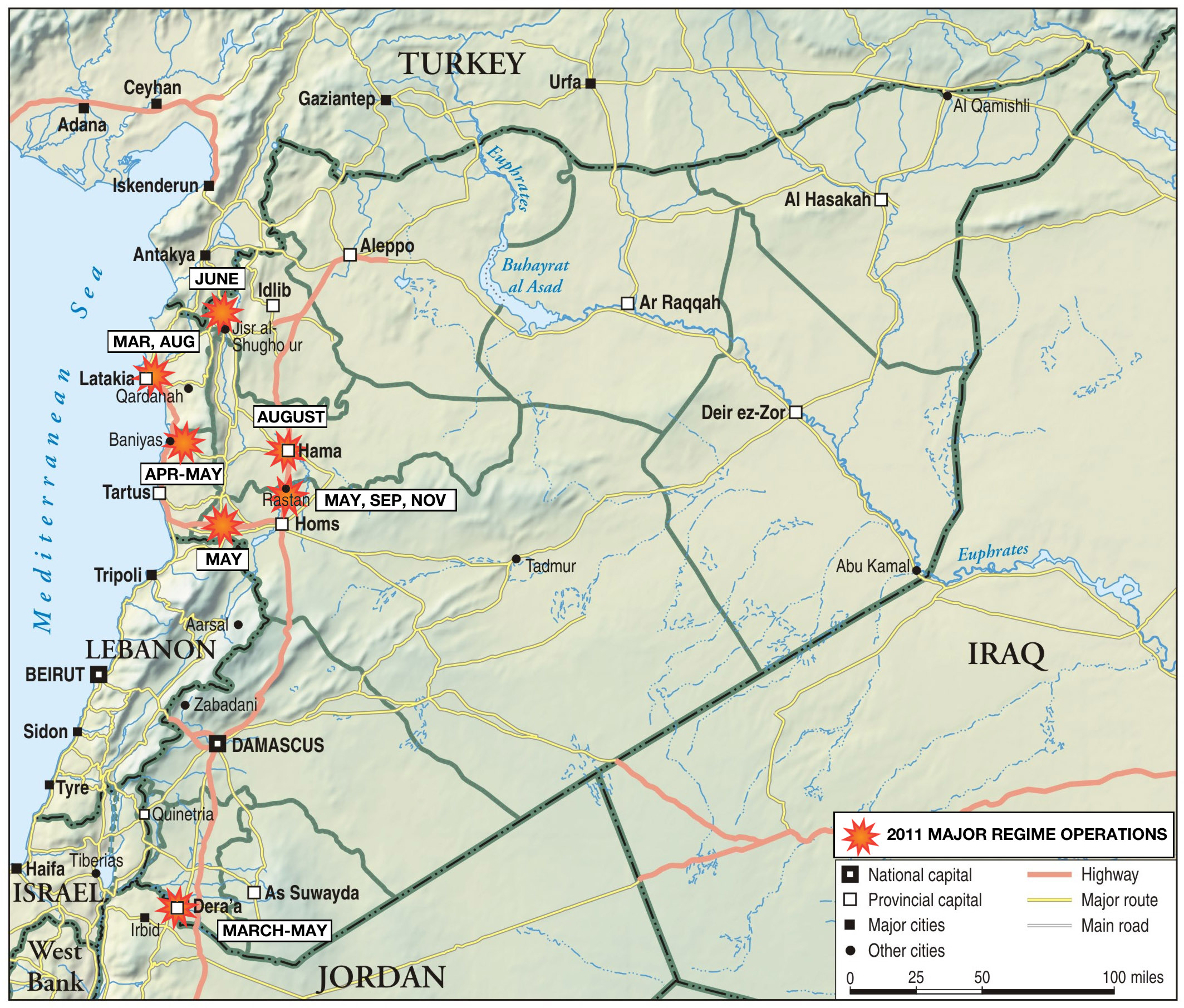
    The scale of unrest in Syria has made it impossible for the regime’s security forces to simultaneously garrison all of the country’s key terrain. The regime has maintained control over Syria’s armed forces, despite limited defections. Therefore, the regime’s strategy has been to maneuver elite forces to key centers of unrest and conduct large clearance operations, using selective brutality in an effort to end the crisis.

    The regime successfully suppressed demonstrations in Dera’a, where the protests began in March 2011, by conducting aggressive clearance operations. This allowed the regime to focus resources elsewhere as the conflict progressed.

    Homs has become the conflict’s center of gravity because of its strategic location and its frequent sectarian violence. The regime attempted to quash Homs’ dissent in May, but emergencies elsewhere in Syria diverted attention and resources. By the time the security forces refocused on Homs in September, peaceful demonstrations had given way to armed resistance.

    Despite large demonstrations in Damascus’ northeast and southwest suburbs, the regime’s security presence and targeting campaign has successfully prevented demonstrations from overrunning downtown Damascus. The size of the pro-regime population in Damascus has also contributed to dampening unrest in the capital. From the beginning of the uprising, the regime has deliberately consolidated its control over the Alawite homeland of Syria’s coastal region. Clearance operations in Latakia, Baniyas, and Tel Kalakh targeted Sunni enclaves and shored up regime lines of communication

    From the Paper, a breakdown of the ethno religious makeup of the Syrian Populaion
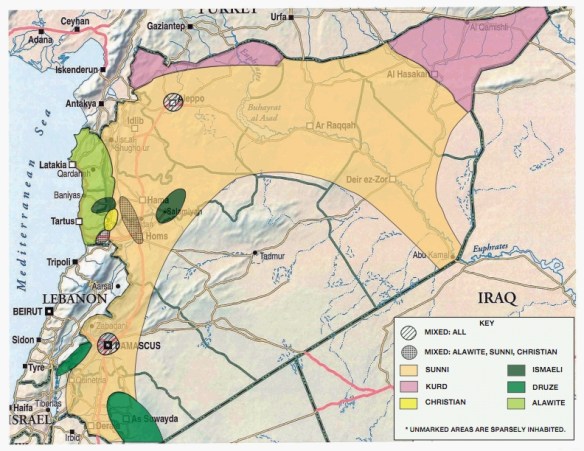
    From the Paper, the distribution of the ethno religious groups in Syria
    From ArticleFrom the Paper, Gov’t Operations this year

    Richard Fernandez at the Belmont Club pointed out this paper and has a very good analysis of it and some other bits, such as this, 58 Foreign Policy Analysts are urging Obama to act regarding Syria. And the article has an interesting lead in picture…

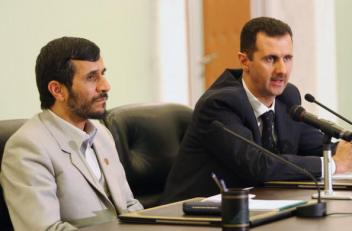
    Our Favorite Middle Eastern Leaders

    Getty Image/ Our Favorite Middle Eastern Leaders

    Now the problem is, which is more important for us to do keep our powder dry ready to deal with Iran, Ahmadinejad (in gray) or do we use assets and energy on Syria, Assad (dark blue) which is the more important world issue? Hands down, right now it would seem that Iran’s nuclear weapons and delivery system development is. Whereas sad Syria is suffering the agonies of realizing that the Dear Leader, is wasting the majority of its subjects potential and that the only way to change that is to change the leadership.

    Now some are asking why can’t we ‘do a Libia’ and I think the argument is that both the socio/economic and military situations are far more complex in Syria, the bad guy and his military are not utterly incompetent and the rebels are dispersed and often ambivalent about the use of violence. I think that the maps and the text show that the majority of the Military Potential of the Anti Assad camp have not become engaged.

    • What happens if Iraq blows up as we go in and blow up Syria, and then we really do have to do something about Iran.
    • Is it possible the Kurd, Shia, Sunni ethno religious cocktail goes cablooey.
    • What if the Kurds get the bit in their tenth regarding a Kurdistan stretching across their ethnic foot print (Turkey, Syria, Iraq and I think Iran)Do the Shia try for Shiastan…and that means bits of Shiadom on the other side of the Sunni Crescent in Iraq and Syria.
    • Do the Sunni go for an Emirate partnered with Saudi Arabia et.al.

    Things could really go to hell…and they may be on their way already regardless of what we or the west in general want.

    This can be interpreted as negative, but is it? And are there other factors?

    Plant Power alone sucks up $$$

    From Technology Can We Build Tomorrow’s Breakthroughs? I think the answer is a resounding yes though I agree there is reason to be cautious.

    Charts discussing manufacturing in the US
    Does this represent net loss or just change?

    As I have discussed before there is at least reasonable evidence that manufacturing in the US is on the upswing and while the charts paint a disappointing picture one has to be a bit careful about what is being measured. If mass production were giving way to boutique build +value add, might one miss it because we are importing what are essentially the bricks and mortar (which we by the way mostly designed or own a big part of) and the customization and final build (with their higher margins and more creative content) is done here?

    There is an interesting section in here dealing with the founder of A123 and then with a couple of solar cell manufacturers.  And the author makes some very telling points.  I think they should be emphasized:

    1. Unless there is a very fundamental change in a product, improving process technology to produce a that product will not start out producing a cheaper product and unless you can get over the hump of higher cost and lower sales the guy with the bog standard product and highly refined standard process will eat you alive.
    2. Controlling one (however important) process or input material does not mean you control the market, a sudden change in market dynamics, possibly one you created, can suddenly pull the prop out from under you and if you only have one prop you are finished.
    3. Getting from prototype to production is horribly expensive especially in a mass market (which are almost by definition price sensitive and commoditzed ones) A first article will cost you K, getting that product in front of customers is likely to cost you 2 time K and getting into production 5 times to 10 times as much again, sometimes many times more. 
      1. Why you Ask? Because you can do a lot of research for say $1M, that’s enough to support three or four researchers for a year.  But once you have to show it to a customer you have to be able to replicate the work and make either a full scale device and or prove you can do so repetitively or have a process that scales from desktop to garage at least and that usually takes 2 or 3 years or 2 or 3 times as much effort and expense.  The when you go to production you now have to build a factory staff it, train the staff, fill out all the paperwork, pay the lawyers to make sure you’re not doing anything illegal etc, etc.  And you then have to make enough of your product to put on the shelf and most of the time you have to price it at well below cost because the first batches and the smaller batches are much, much, MUCH more expensive than the run of the lot will be later and you cannot charge 10x the expected price.  Selling the first  ???  units at an average of 1/?? their actual cost can eat up a huge amount of money.

    The first comment after the article makes the point that established companies have in my way of thinking ‘normalized and processed’ innovation out of their main line business because of the costs.  It is easy to project cost and risk with incremental improvements.   The costs and risks of really new products/processes (disruptive ones) are much more uncertain, and few managers are allowed the latitude to innovate in big, risky ways. 

    But this circles back around, does this in fact facilitate the creative destruction that the US industrial base has depended on.  Once large corporations run by bull-headed industrialists did the risky stuff.  When that generation was replaced by the MBA brigade they froze up.  Then the innovations erupted in a series of mid rankers with mavericks at their head or in a series of entrepreneurial start-ups who then took down many of the old guard.  Are we seeing the wake of another change of phase…

    Anyway a good article but don’t take it as gloom and doom, its pretty evenly pro as well as con.

    9 Chickweed Lane is sublime

    20111219-214956.jpg
    todays strip

    A rarity in the comics, 9 Chickweed Lane spotlights music and dance with superb artistry that complements Brooke McEldowney’s strong-minded characters. A popular comic strip about three generations of family, 9 Chickweed Lane features strong characters, flights of fancy and an intuitive grasp of all kinds of relationships. The strip was recognized in 2006 for its brilliant artistry and intellectual humor when it was named Best Newspaper Comic Strip by the National Cartoonists Society. The strip appears in 60 newspapers worldwide, including the Los Angeles Times, Houston Chronicle, Calgary Sun and Columbus Dispatch. Central character Edda Burber is dancing to the beat of a different drummer these days as McEldowney focuses 9 Chickweed Lane more on the story of a young woman who moves away from home to perform with a prestigious metropolitan ballet company in New York City. Although it may seem like a completely new strip, 9 Chickweed Lane is peopled with very familiar friends, like furry feline Solange, and Edda’s childhood friend and recent love interest, Amos.

    I have browsed far into the archives, I adore this comic strip!

    Manufacturing in the US

    US manufacturing has always been in a state of transition rather than straight decline, just like agriculture it has become brain rather than labor intensive though in both cases there is a need for a certain degree of physical toughness, or aptitude, as well. With the easy low cost labor sources ‘tapped out’ and US energy ‘issues’ reduced by the Natural Gas boom, US manufacturing is on a growth trajectory.

    Commercial Crew Launch funding issues cause concerns

    Spaceflight Now | Breaking News | NASA decision increases risk in commercial crew program.

    Congress short funded the commercial ISS crew/cargo program (by 1/2!!!!) the only good result being the continued use of cooperative agreement funding tools rather than the (potentially) more controlling fixed price contracts. Some concerns about delays and risks are very appropriate but it’s possible this not all bad. One of the comments pointed out that the senatorial launch system got funded as well and suggests a great solution, take some of the SLS money for CCL and then offer the big launcher requirement up to the eSpace competitors for solution on a commercial basis.

    Some very blunt advice…

    This article from the Cato Institute is very hard for me to argue with. Essentially the only parts of gov’t that matter when talking about deficits are (drum roll please) Medicare, Medicaid, Social Security and the Defense department. And even the DoD is relatively small beer, it’s a traditional bee in the bonnet of Libertarian/Cato types (with some reason.) Mr. Bandow points out that all of these programs have to become purely means tested, I think the age has to move up into the mid seventies and should start doing so essentially on a year every year basis ASAP and that anyone ten years or more from ‘retirement’ would be affected, ten years is a huge time horizon to deal with the change.

    Anyway read the article it’s timely and prescribes the sort of major overhaul we need.

    Space and entropy

    Hubble Photo

    A Hubble picture I think its looking into the hot hydrogen spectrum

    Just some writing therapy other than Elgin, struggling a bit with Elgin in New York. I think having that deadline in front of me was effective even after I’d gotten over the base line. But that’s the way it is.

    Spent too much time today reading articles and blogs on the current state of the world. Things are starting to look up in the US and yet most of the pundits are saying it’s going to be a flash in the pan, especially if the Euro resumes its crash into the toilet. And Oh, even if the Europeans pull it out, the Chinese are probably going to implode. And if the Chinese don’t implode then we need start worrying about their hegemonic intentions in the far east.

    And then you have the Arab spring, all of which are now turning out to be pro Islamists of one stripe or another….well duh! Of course they are, the secular piece of the population almost has to be small be definition and they were rebelling against various levels of despotism that was supported at least partly by secular and pro-Israel US/Europe. The reaction is going to blow back. One just has to hope that the more liberal (reasonable set of rights and open economy) arms of the Islamists remain in control because the majority realize that the hardliner conservatives will keep them in at least a deep a hole as they have been for the last fifty years.

    As to space and entropy…

    space

    1. the unlimited or incalculably great three-dimensional realm or expanse in which all material objects are located and all events occur.
    2. the portion or extent of this in a given instance; extent or room in three dimensions: the space occupied by a body.
    3. extent or area in two dimensions; a particular extent of surface: to fill out blank spaces in a document.
    4. Fine Arts
    a. the designed and structured surface of a picture: In Mondrian’s later work he organized space in highly complex rhythms.
    b. the illusion of depth on a two-dimensional surface.
    5. outer space

    en·tro·py

    1.Thermodynamics .
    a. (on a macroscopic scale) a function of thermodynamic variables, as temperature, pressure, or composition, that is a measure of the energy that is not available for work during a thermodynamic process. A closed system evolves toward a state of maximum entropy.
    b. (in statistical mechanics) a measure of the randomness of the microscopic constituents of a thermodynamic system.
    2. (in data transmission and information theory) a measure of the loss of information in a transmitted signal or message.
    3. (in cosmology) a hypothetical tendency for the universe to attain a state of maximum homogeneity in which all matter is at a uniform temperature (heat death).
    4. a doctrine of inevitable social decline and degeneration.