
Read more at: http://phys.org/news/2013-04-astrophysicists-five-planet-earth-like-exoplanet.html#jCp
Five worlds, some almost right…
Reply


File photo of the NK-33 engine firing on a test stand. Credit: Aerojet
From space flight now an article on Orbital Science’s Anteres launcher, specifically the rocket engines. It’s interesting that the Soviets were so good at some things and awful at others.
But then engineering is a very neutral endeavor and one that can adsorb your passion and develop your stoic nature…very good things in Stalinist Russia.
One should also remember that while ‘the west’ got the ‘brains’ of the Nazi German Rocket cadre (like Werner vonBraun) the Russian’s got the great majority, the working engineer types, who in the end have to slog through the agony of turning strokes of genius into real hardware, and it’s the slog that gets you deep capability not the strokes.

ars technica article on the F1B engine the derivative of the Saturn 5 main engines competing for the strap on for the Senatorial Launch System… I don’t love the SLS but the F1B is exciting and worthy, I just wish it were part of a more commercially driven program.
2nd page has a great explanation of the difference between kerosene and liquid hydrogen as a fuel for first stage engines, fun for the rocket scientist in all of us…or at least me.


Xaero B vertical landing rocket demonstrator completed first hot fire tests at Mojave, Calif, on April 9.
From AWST space blog this picture and a short piece on Masten Space Systems Xaero B vertical landing rocket demonstrator
The Xaero is a re-configured, more powerful, higher-altitude version of Masten’s Xombie which has been demonstrating precision flight control and landing. This craft should be capable of 6km hops, an even larger upgrade could do 200 km! They will carry various NASA sponsored payloads.
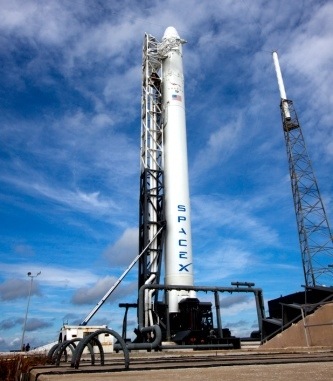
Xombie has demonstrated cm accuracy at touchdown, there is discussion of doing away with the landing legs and coming down into a landing cradle! That would be a big weight savings. If proven here then it would be viable for all of the V-V (Vertical take off Vertical landing) programs such as Blue Origin, SpaceXs fly back Falcons…
What I find interesting is this progress juxtaposed with a piece regarding the AF reusable Booster program, canceled last year. Of course the demo program was ambitious, leap ahead and risky + expensive. Perhaps it shows that the more incremental commercial approach is superior; more robust, affordable and supportable especially with todays design, analysis and fabrication technology.

Orbitec vortex motor launching a heavy sounding rocket.
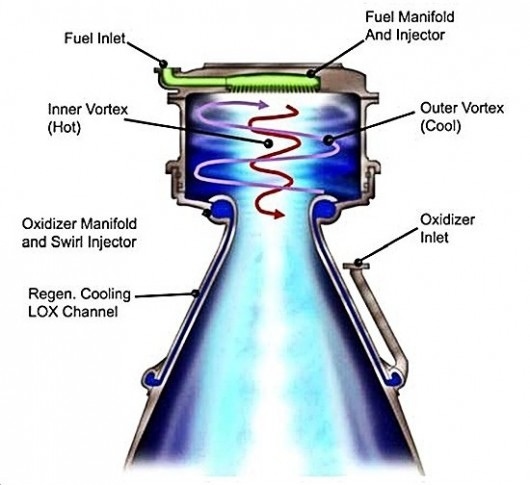
Simple, so very simple and so very elegant.
This was the sort of thing sci fi writers were dreaming about decades ago. It would be a miracle indeed if it became reality in this century. When I first saw this I suspected a rather dry April Fools joke, I hope the joke was on me.

The plasma (blue) is injected into the rocket nozzle. Lithium metal rings (red) then collapse at great force around the plasma, compressing it to fusion conditions. The sudden release of fusion energy vaporizes and ionizes the lithium in the magnetic nozzle, causing it to eject and power the rocket forward. Credit: University of Washington, MSNW
Read more at: http://phys.org/news/2013-04-rocket-powered-nuclear-fusion-humans.html
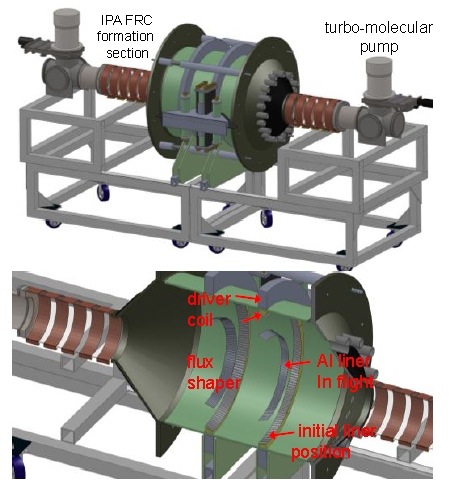

This is the fusion-driven rocket test chamber at the University of Washington’s Plasma Dynamics Lab in Redmond, Wash. The green vacuum chamber is surrounded by two large, high-strength aluminum magnets. These magnets are powered by energy-storage capacitors through the many cables connected to them. These coils are used to drive the collapse of metal rings placed on the inside wall of the vacuum chamber. Credit: University of Washington, MSNW
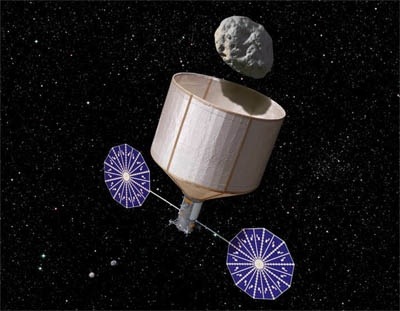
Illustration of an asteroid retrieval spacecraft in the process of capturing a 7-meter, 500-ton asteroid. Credit: Rick Sternbach / Keck Institute for Space Studies
Does this support the the eSpace thrusts towards space resource capture? I think so and as such if done right with partnership with eSpace entrepreneurs it’s the right thing to do.
Had not realized this was progressing as fast as it appears to be, still it is years not months, but neither is it decades.
Short Wired piece with a fantastic video of a precision take off flight and landing of the Xombie test vehicle.


 This World and Others