Aviation Week & Space Technology Ares Blog discussion on new space access company.





Wired | The Common Space Fleet (1968) BY DAVID S. F. PORTREE 12.26.12 7:50 AM
Even as the moon landing was approaching futurists were looking to what should follow. They were looking at manned multi year missions based on the technology they had, reuse and incremental development of Apollo – Saturn technology. Just reading this article sent me of into a dream of what could have been. Just thinking about it made me sad, mad, glad: sad for what might have been, mad at those who sidelined the dream because of shortsightedness, glad that at least some had the sense to think-dream based on common sense.
Today Elon Musk and a few others are dreaming similar dreams maybe having read a few of the NASA documents though the basics are so common sense they do not have to have.
3D / Additive Manufacture in Space! Two favorites in one!
And its an SBIR…Small Business Innovative Research, program, how cool is that on top? The SBIR program is a personal favorite of mine. It basically provides entrepreneurs and engineers with ideas with funds to develop a concept and put together a prototype then helps them either commercialize it or work with a big company to bring to the market or to NASA, USAF, Navy, Army, DoE, DoT, DHS etc. When done right which NASA, the Navy and to some extent the AirForce and Army have done this can provide fantastic bang for the buck. Its only downside is that it can be seen as a substitute for bigger development programs and it’s not. SBIR works for initial concepts, for components, basic materials, small-scale projects (App scale maybe) but it’s not enough bucks to do anything major. The only program that does something similar on a larger scale is DARPA, which is also a world leading organization in this area.

On Thursday, NASA announced the selection of 39 proposals for Small Business Innovation Research (SBIR) Phase II awards. …… Made in Space, a Silicon Valley company working on 3-D manufacturing in space.
Made in Space, Inc.
Moffett Field, CA
PROPOSAL TITLE: ISS Additive Manufacturing Facility for On-Demand Fabrication in Space
SUBTOPIC TITLE: ISS Utilization
Estimated Technology Readiness Level (TRL) Begin: 6 End: 8
TECHNICAL ABSTRACT
Made in Space has completed a preliminary design review of the Additive Manufacturing Facility. During the first half of Phase 1, the design went through conceptual development, simulation testing, cost analysis, and comparison testing of which off-the-shelf parts can be used. The deliverables for Phase I include a written report detailing evidence of demonstrated technology (TRL 5) in the laboratory and will outline in detail the path taken toward hardware demonstration for Phase II (TRL 6). The preliminary design is ready to be manufactured as an engineering test unit in Phase II. A feasibility study was created to demonstrate what could be fabricated for the inside of the ISS (parts and spares) and for the outside (possible satellites). It is anticipated that many of the sample uses that the AMF will make possible on-orbit have not yet been envisioned.

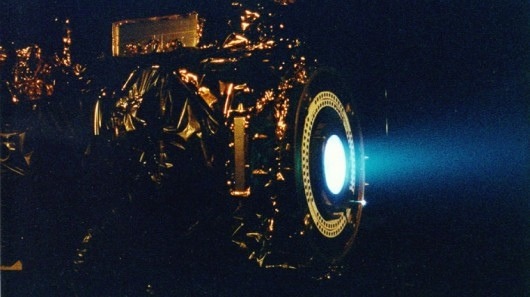
From Phys.org website a Kickstarter project for a scaleable pulsed plasma propulsion system. How hot is that?
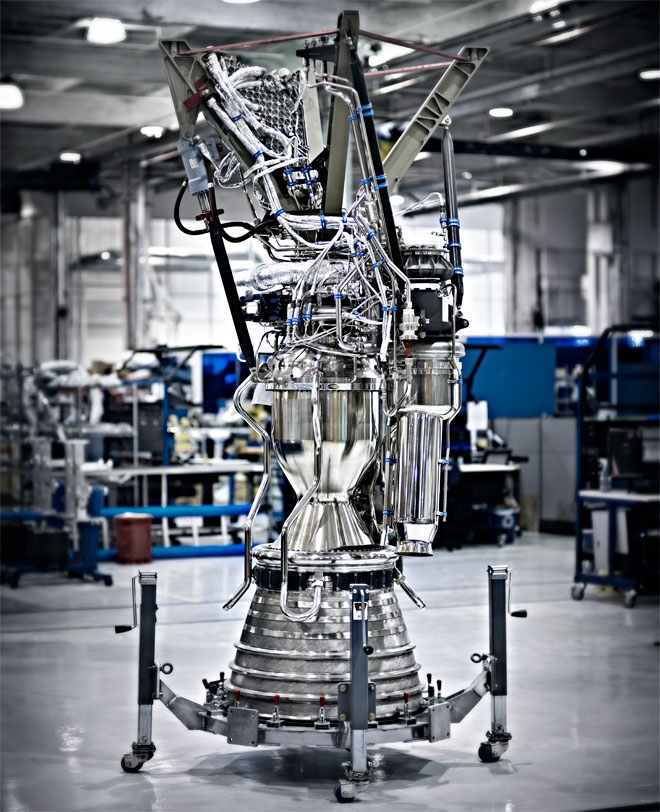
A Merlin engine
Photo: Art Streiber
Wired

VdB 152: A Ghost in Cepheus
Image Credit & Copyright: Stephen Leshin
Explanation: Described as a “dusty curtain” or “ghostly apparition”, mysterious reflection nebula VdB 152 really is very faint. Far from your neighborhood on this Halloween Night, the cosmic phantom is nearly 1,400 light-years away. Also catalogued as Ced 201, it lies along the northern Milky Way in the royal constellation Cepheus. Near the edge of a large molecular cloud, pockets of interstellar dust in the region block light from background stars or scatter light from the embedded bright star giving parts of the nebula a characteristic blue color. Ultraviolet light from the star is also thought to cause a dim reddish luminescence in the nebular dust. Though stars do form in molecular clouds, this star seems to have only accidentally wandered into the area, as its measured velocity through space is very different from the cloud’s velocity. This deep telescopic image of the region spans about 7 light-years.

The smaller of the two planets, dubbed Kepler-20 e, is about the size of Venus, with a radius 0.87 times that of Earth. It orbits its star every 6 Earth days and sits at a temperature of 1,040 Kelvin — hot enough to vaporize any atmosphere and leave a solid hunk of silica- and iron-rich rock.
Kepler-20 f, the larger planet with a radius 1.03 times that of Earth, has a 20-day orbit. As a result, it is a bit less scorching, at 705 Kelvin. At that temperature, says Fressin, hydrogen and helium wouldn’t survive in the atmosphere, but a shroud of water vapour might.
Then there is this planet Alpha Centauri Bb

This planet orbits very close to its star, like Kepler-20 e, in fact its close enough that its surface is most likely molten. But its only 4 light years away and generally where there is one planet there are likely others. This planet was not discovered by the Kepler observatory and there is some discussion as to the data set used to derive its existence…but it seems likely that its there and it’s certainly cool….

A rich collection of colourful astronomical objects is revealed in this picturesque image of the Rho Ophiuchi cloud complex from NASA’s Wide-field Infrared Explorer, or WISE. The Rho Ophiuchi cloud (pronounced ‘oh-fee-yoo-ki’ and named after a bright star in the region) is found rising above the plane of the Milky Way in the night sky, bordering the constellations Ophiuchus and Scorpius. It’s one of the nearest star-forming regions to Earth, allowing us to resolve much more detail than in more distant similar regions, like the Orion nebula.
The amazing variety of different colours seen in this image represents different wavelengths of infrared light. The bright white nebula in the centre of the image is glowing due to heating from nearby stars, resulting in what is called an emission nebula. The same is true for most of the multi-hued gas prevalent throughout the entire image, including the bluish bow-shaped feature near the bottom right. The bright red area in the bottom right is light from the star in the centre – Sigma Scorpii – that is reflected off of the dust surrounding it, creating what is called a reflection nebula. And the much darker areas scattered throughout the image are pockets of cool dense gas that block out the background light, resulting in absorption (or ‘dark’) nebulae. WISE’s longer wavelength detectors can typically see through dark nebulae, but these are exceptionally opaque.
The bright pink objects just left of centre are young stellar objects (YSOs). These baby stars are just now forming; many of them are still enveloped in their own tiny compact nebulae. In visible light, these YSOs are completely hidden in the dark nebula that surrounds them, which is sometimes referred to as their baby blanket. We can also see some of the oldest stars in our Milky Way Galaxy in this image, found in two separate (and much more distant) globular clusters. The first cluster, M80, is on the far right edge of the image towards the top. The second, NGC 6144, is found close to the bottom edge near the centre. They both appear as small densely compacted groups of blue stars. Globular clusters such as these typically harbour some of the oldest stars known, some as old as 13 billion years, born soon after the Universe formed.
There are two other items of interest in this image as well. At the 3 o’clock position, relative to the bright central region, and about two-thirds of the way from the centre to the edge, there is a small faint red dot. That dot is an entire galaxy far, far away known as PGC 090239. And, at the bottom left of the image, there are two lines emerging from the edge. These were not created by foreground satellites; they are diffraction spikes (optical artefacts from the space telescope) from the bright star Antares that is just out of the field of view.
 This World and Others