AWST | Electric Propulsion for Airliners

Green Operations

Taxi Electric

Powered wheel-drive systems promise to save fuel and reduce emissions at airports
Graham Warwick/Washington

Taxiing to and from the runway on engine power may soon be a thing of the past as development of electric wheel-drive systems progresses, with the promise of reducing fuel consumption, emissions and noise—and potentially increasing airport capacity.

EasyJet will be the first airline to test an electric taxiing system being developed by Honeywell and Safran. Operational trials on the Airbus A320 are expected to begin in 2013. Lufthansa and L-3 Communications tested an electric-taxi technology demonstrator on an A320 at Frankfurt in December. WheelTug plans to demonstrate a system on a Boeing 737-800 in May, “almost certainly in North America,” the start-up says.

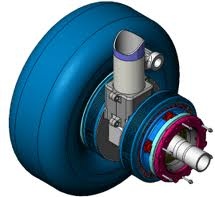
The Honeywell/Safran electric green taxiing system (EGTS) uses electric motors on the main landing-gear wheels, powered by the aircraft’s auxiliary power unit (APU). L-3’s GreenTaxi system also powers the main wheels, but WheelTug’s approach is to drive the nosewheels. German aerospace center DLR demonstrated a powered nosegear on an A320 at Hamburg in June 2011, with the electrical power coming from a fuel cell.

WheelTug is testing its motors in the laboratory and expects to begin tests of the complete wheel package in March, says CEO Isaiah Cox. Details of the May demo have yet to be announced. WheelTug is on track for certification and first deliveries for the Boeing 737NG in mid-2013, he says, and talks have begun with A320 operators. Israel airline El Al has signed a memorandum of understanding, and Cox expects to have “1,000 aircraft in backlog” by late this year.

The Honeywell/Safran partnership has acquired an A320, based at Montpelier, France, which it is using to understand loads and deflections on the landing gear. This aircraft will be used for tests of the EGTS beginning this year, says Brian Wenig, vice president of business development at Honeywell Aerospace. Certification of the system for retrofit and forward fit is targeted for 2016.

Lufthansa Technik and teammates L-3, Airbus, Lufthansa and Frankfurt Airport operator Fraport are scrutinizing data from 14 hr. of taxi trials and will complete an economic benefit analysis in March before deciding whether to proceed to a prototype system, says Christian Mutz, project manager of innovation for Lufthansa Technik.

The GreenTaxi demonstrator used off-the-shelf vehicle motors from German subsidiary L-3 Magnet-Motor. Installation required removal of the brakes from the outer wheel on each pair. A container in the cargo bay provided power conditioning and liquid cooling, which Mutz says proved not to be needed, as the motors stayed cooler than the brakes.

Weight is critical, and the Lufthansa team is looking at a lighter pushback-only system as an alternative to the full capability, as well as a hybrid of the two. A pushback-only system would propel the aircraft at 3 mph, compared with a full system that would be capable of taxiing the aircraft at 30-40 mph, Mutz says.

Able to propel the aircraft at up to 28 mph, WheelTug weighs 300 lb. but is “flight weight”-neutral, as less fuel is required for taxiing, the company says. Minimum fuel burn for a 737 taxiing on one engine averages 15 lb./min., and crews typically add 30 min. of fuel weighing 450 lb. for contingencies. Powering the wheels from the APU cuts taxi fuel burn by up to 85%. “Instead of over 200 kg [440 lb.] of taxi contingency fuel, I can load 60 kg, and have the same operational flexibility,” says Chief Pilot Joseph Goldman.

WheelTug’s business plan is to supply systems and spares free to airlines and share the demonstrated savings. “We can show savings to airlines of $600,000-800,000 a year,” says Cox. “That compares with $1.5-2 million a year for reengining.” Honeywell “conservatively estimates” that the EGTS will save an average $160 per segment, and 130 tons of fuel per year per aircraft, for an A320 or 737 operator, says Wenig.

There is still debate over the right approach. Honeywell/Safran and L-3/Lufthansa say the capability to taxi in all conditions can only be provided by powering the main wheels, as there is not enough weight on the nosewheels to provide the required traction. “We have done tests, and demonstrated operation in ice and snow,” counters Cox.

Other potential benefits of electric taxiing include shorter turnaround times and the ability to position aircraft on the runway at noise-constrained airports so takeoffs can begin as soon as the curfew is lifted, generating more slots. But engine makers are concerned about the lack of warm-up time that could result.
20120221-224508.jpg
A picture from Chorus Motors, who owns WheelTug, the motors are in the nose wheel which has no braking system so has lots of room for the motors (don’t get me wrong these are powerful motors for their size weight.)

The issue mentioned above and main reason that this is starting on the 737 and A319 is that these are both big and small at the same time.

Compare the landing gear in the pictures below one of a 737 the other of its biiiiig brother the 777.

20120221-225832.jpg

20120221-225921.jpg

There is much more, % wise, weight on little bro’s front wheel. With friction etc you have a practical propulsion system even in crappy frigid/icy weather, after the planes been sitting for a long time, and the tires have flat spots where they contact the ground. With the 777 there is no way that the front wheel can haul that big boy around.

The article discusses work on main gear but here you have to integrate around the brakes. Now there are reasons this would be good beyond taxing but the brakes are hot and dirty, a much tougher environment and for a big boy you would need a lot more than two driven wheels which makes cabling and drives even more of an issue. But at the end of the day this is probably the way aircraft will move on the ground in twenty some years and those future versions of us will wonder why it took so long.

20120221-231528.jpg
Testing out a main gear electric taxi concept, L3/MagnetMotor and Lufthansa.

Ferret under the cars, the tables, the … Uh shouldn’t go there…

20120218-221136.jpg

Another use for a robot, inspecting for bombs etc, this is the general-robotics Ferret. I find the name of the company interesting it’s turned up in SciFi forever, following General Electric, General Motors, General Mills, General Atomic, etc, etc, it became a claim on greatness then a cliche. The parent company is in electrooptics and it’s influence can be seen in the video glasses. Does not take away from a great idea. I wonder if the inventor was watching his Rumba vacuum under the couch when he had the flash?

From Defense Tech

20120218-215324.jpg
This reminder of fun times past, though one wonders about the prayers of the C5 pilot prior to ignition. I remember seeing this as one of the options explored for the Peacekeeper ICBM follow on to The Minuteman. Must admit that it seems pretty crazy cost wise and if you kept them on the ground most of the time little different from the bomber force. Maybe it made some sense, fly as close to the border as you want then toss in at a shallow angle, mixing up the attack as it were. Of course by the time this was really feasible, there was no point…and history seems to say that much of this kind of thinking was wasted time and energy, the BOOGEYMAN, was only ever a boogeyman, and probably more worried about what we might do to him than what he could do to us.

3D printer builds a Lower Jawbone Replacement

This piece of news popped up all over earlier this week, but the Technology Review piece though short gives it some context.  The rapid advances in imaging, tissue creation, stem cell technology, bio compatible materials, low impact surgery and 3D fabrication are being brought together to make things possible that were once fantasy and to eventually overtake transplants in the traditional sense.

While this is fascinating from a sci-fi writer’s viewpoint, the reality is something close to awe-inspiring.

A few chemicals and a microwave and see what you get

Zapping raw materials in a microwave oven and drying the resulting solution produces a black powder (top) made of hexagonal bismuth telluride nanoplates (bottom).

High-efficiency thermoelectric materials could lead to new types of cooling systems, and new ways to scavenge waste heat for electricity. Researchers at Rensselaer Polytechnic Institute in Troy, New York, have now developed an easy, inexpensive process to make such materials.

The materials made by the RPI team already perform as well as those on the market, and the new process, which involves zapping chemicals in a microwave oven, offers room for improvement. “We haven’t even optimized the process yet,” says Ganpati Ramanath, a materials science and engineering professor at RPI. “We’re confident that we can increase the efficiency further.”

What caught my eye here is that the material is a form of nano particulate, its produced in an evidently very simple process and it has a very high efficiency.  This type of technology as the article notes could have a great number of applications.  In a car one could conceive of replacing the mechanically driven alternator with something like this or supplementing it, this would essentially be using waste heat to provide electricity and would increase gas mileage.  There are many other places where heat scavenging would make sense and have an impact if the materials and system were cheap enough.  This goes back to a fundamental issue, energy efficiency costs money and if the cost of burning a tiny fraction more fuel over the life of the system (which can add up to biggish $) is less than the energy scavenging equipment then the equipment will not be installed unless the added cost is passed on to someone. 


Algae to the rescue

Green tea: Joule Energy's SolarConverter turns carbon dioxide and sunlight into ethanol fuel at a pilot plant in Leander, Texas.

 Technology Review| Photosynthesis Fuel Company Gets a Large Investment:  Joule Unlimited will build a production plant for turning sunlight and CO2 into liquid fuels.

The company is combining many technologies to move to direct creation of biofuel precursor liquids.  The algae is similar to that others are experimenting with but excrete the molecules into the water instead of retaining inside the cells.  This way the harvesting ‘only’ entails fractionating the liquid from the flow.  The bioreactors are essentially double panel windows with the algae filled liquid flowing inside.  The water gets CO2 from a power plant which scrubs it out of the plant effluents and one guesses that in cooler climates the water could be warmed in the cooling cycle of the same power plant so the system could operate year round.

The company calculates that their system can produce a great deal more, more easily refined biofuel precursor liquids than the alternates. Which mostly involve growing various kinds of plants and then converting them to biofuels in either chemical or bio reactors.

Skynet it’s not yet, but one has to wonder…

Police Drone...
Skynet’s distant ancestor

The fact of the matter is that this, like so many other things, is coming.  I used to laugh at some ‘SciFi-ish’ cartoons for their depiction of flying drone/droid/robo cops, but then I’ve never been any better at predicting the future than most other engineers, we always dive way too deep into the details far too quickly unless we have something keeping our head out of the water long enough to figure out if we are in the ocean, sea, lake, pond, swamp or whirlpool. 

But there is the issue of privacy and the increasing ability of ‘the system’ to keep track of citizens 24/7/365.  Save a few puppies and a kid or so and we’re all for giving up a little bit of something for increased safety.  But at what cost, and have ‘we’ ever considered that we may be being manipulated?…..Anyway….

This post by Babbage at the Economist covers the ground pretty thoroughly, at least for the near term.  I think the killer app here is the comment about replacing choppers which cost a couple of million up to operate along with expensive maintenance and aircrew tails. Smaller police forces will be able to have an air contingent and big forces will have a lot of these things (hopefully replacing most if not all the choppers, which are IMO a waste of taxpayer money.)
 
UAV’s , particularly like the one in the picture have a lot of advantages they :
  • can fly in a wider weather window than crewed craft.
  • are harder to see and hear
  • can land and sit/monitor for long periods
  • could operate 24 hours with rotating crews or units
  • can travel ‘as the crow flies’ instead of around buildings, fences, traffic etc
That’s in the near term, 2-3 years, what about the middle Future (4-7 years)?:
  • Wide area surveillance from solar powered (maybe a SolarSaurs?) high altitude platforms.
  • Add ‘Gorgon’s Stare’ technology, constant surveilance with roll back capability.
  • UAV’s the size of a bird it could follow a perp under cover.
  • UAV’s that can launch a smaller pursuit drone with a TAZER ?…a bit like this
  • What about a humingbird UAV?

And as you add those capabilities my libertarian hackles go up more and more.  None of the above should be given by a free citizenry to a gov’t that is actively growing and actively misusing its powers or taking advantage of congressional stupidity.

…Maybe I’d be happier if…..I had the right to pot one of the little puckers if it was over my property without my permission?  Hey it would create a new market, for home ultra short range anti aircraft systems!  Maybe these guys would have a head start?