Another reason to buy the new iPad

Ten One Design is working on the next definitive iPad Stylus, the Bluetiger, using Bluetooth 4 it allows proper writing sketching etc on the iPad. I use a Wacom Bamboo stylus for notes and art but have pined for the capabilities Ten One Design is touting, call your favourite developer today and have them get on the Bluetiger.

Another Celebrity Seeker…and the Apple Culture

As far as I can see the whole mess with Mike Daisey is the common American confusion between celebrity and profundity.  The Wikipedia entry above starts out :

“Mike Daisey (born 1976) is an American monologist, author, and actor best known for his full-length extemporaneous monologues…”

And that sums it up, he’s not a reporter, does not purport to be one and yet his monologuing is taken as a serious expose of Apple’s factories in China.  The whole problem is that NPR got confused about what they had, it was in some ways not even Daisey’s fault…until he denied any fault as with so many things today, “..it wasn’t the break in it was the coverup…” inept spinning.

Now Apple knows that its old core and even its younger adherents are biased to the progressive/lefty “down with capitalism” side.  Apple is also forced to build their products in China these days, they could not keep their products in the painfully but not prohibitively expensive category otherwise.  They will not purposely turn a blind eye to abuses at their Chinese factories, especially as they know that they are likely to depend on Chinese customers for a lot of growth in the not too distant future.  

Victor Russell Mead at Via Media has the best overall take on the Daisey mess, I won’t go into it any more.

However thinking about Apple and China does bring up other issues about manufacturing and the outsourcing of said.  Two Questions of Apple: 

  1. The iPad, iPhone, iPod are all flat, sandwich build products, why not automate the production and do it in the US?
  2. Aren’t you  afraid of giving your products intellectual property to the Chinese, who have quite blatantly set about appropriating everything they can from anyone with good ideas?

And the answer is the same in both case.  Apple has an extremely short product cycle most of the time and tries to keep their products under wraps until the last second. They use a very deep supplier base on the Asian shore to the fullest extent, the parts are cheaper and more available there, and Apple parcels the parts out so its hard for their competitors to figure out what’s coming until the last month or so before introduction.  Final assembly of many gadgets is the most labor intensive part of the process and the hardest to automate, it can be done but if you are only going to build the product for a couple of years then completely rejigger why put the capital into a fixed site?  And its the Social IP of how you design and proof out a product like the iPad in a very short time that is the secret sauce as much as anything else.  And that IP the IP of the Apple way, the Apple Corporate Society, that gives them the edge, and its not one that anyone can copy easily.  The whole infrastructure of design spin, parting out, having multiple products at various levels of development at one time, and staying mum, that keeps Apple ahead, their competitor’s head’s spinning and the Apple paparazzi merrily dancing in trail.

DefenseTech calls it a Bomb Truck

20120311-204543.jpg
DefenseTech has some Chinese eye candy regarding the large and apparently powerful J-20 in development / trials. They call the aircraft a bomb truck and that seems likely, the analogy to th 70’s vintage FB-111 seems apt.

20120311-205744.jpg
These aircraft are the conceptual descendants of WWII aircraft like the Mosquito.

20120311-205757.jpg
The thing I find peculiar is how open the Chinese are about the testing of the J-20 it’s like a reality TV show. One part of me wants to say the Chinese know everyone will be spying anyway, to reduce the tension, just go ahead and let the pictures be taken, bask in the glow of self righteousness, and the fact you’re saving money. And at the end of the day why does one care, the real secret sauce is deeply buried in the materials and internal details and is not readily apparent on the surface anyway…The other part wonders what’s really going on in some distant corner of the country.

The Army really needs to ‘cool it’s jets'(calm down in the lingo of the ‘Gray Lensman’)

In the NDIA’s National Defense magazine’s blog there is a post: Don’t Rush to Buy New Vehicles, Army and Marine Corps Warned

The traditional approach to updating U.S. military hardware — spending years and billions of dollars on next-generation designs — is no longer working for the Army and the Marine Corps as they seek replacements for their combat vehicles.

——

One reason for the military to hold off on buying new vehicles is that there are no technological silver bullets to make military trucks, tanks and personnel carriers less vulnerable to enemy weapons, …. Adversaries can acquire and deploy antitank weapons and roadside bombs much faster and at far less cost than the U.S. military can build countermeasures and survivable vehicles,

——

It’s not clear that the Army or the Marine Corps can “get out of this box,” Outspending the enemy in this case is a losing battle. … “Adversaries’ use of guided weapons, relatively cheap and rapidly fielded anti-armor weapons … threatens to increase significantly the costs incurred by U.S. ground troops in accomplishing their assigned missions,”

——

The Army’s procurement bureaucracy is still reeling from the failure of its $200 Future Combat Systems. Although the follow-on program, the Ground Combat Vehicle, is far more modest, it is not clear that it (will) offer a substantial technological boost compared to existing vehicles

——-

Army buyers might still be somewhat (IMO are totally) deluded by the thinking that doomed the Future Combat Systems. At the time, FCS officials touted the program for its advanced information network, which would give commanders an instant view of the battlefield and allow them to see the enemy without being detected.

After the termination of FCS, the Army continued the push for an advanced communications network, which is now billed as the services number-one modernization priority. The problem, … is that the Army still assumes it can deploy a network at will. “The assumption is that we are operating in a permissive environment … that once we set up the network, nobody is going to tear it down,”

——
We have operated in a permissive environment, electronically and even threat wise for the past decade at least. We have also operated in a nation building civil war environment in urban, suburban environment. Even in the ‘Stan the military faces an enemy with limited access to weapons beyond RPGs and IEDs but these have proven the Bradley is no longer viable and driven us to develop armored modestly off road vehicles like the Stryker DVH, MATV, and MAXPRO MRAP.

These vehicles use existing technology and are enough over designed to allow for evolution. They are too heavy for the Army and USMC but the effort put into the ‘light weight’ replacement the JLTV Family has already cost huge amounts and the only way the Army/USMC kept the program was mandating a weight(26,000lb), cost ($250,000 ea) and protection (MAXPRO equivalent) and letting everything else float or be a special kit. The program has been a feeding trough for the Mil-Ind-Bandit-complex for several years not for truck builders supported by the Army funding some high end components. In fact the truck builders and high end suppliers have been funding their own pragmatic tech programs based on industrial/commercial insights that in the end the Army and USMC have bought.

Recently a couple of high ups in the acquisition corps said they’ve been meeting the soldiers needs and all the grief about Comanche, Crusader, JLTV EDM, EFV, FCS, etc is all noise. Bull-crap!

Once it might have had some truth, the Army/USMC did projects to build tech and keep design experience honed. Much of the money went to top grade suppliers of engines, suspensions, transmissions, the primes never intended the vehicles to go to production, everyone learnt and had tech on the shelf. Those days are gone.

These days the programs are too tightly focused and the programs are ‘mapped’ to lead to production. So the top tier suppliers go for them, often get more than one ‘team’ funded and develop futuristic Advanced Development Models, designed to highly refined specs that require essentially custom components. To keep their engineering teams fed they keep most of the work in house and over-ride input from the lower tier suppliers they do use. The specifications are too specific and often contradictory, open to interpretation, and all too often evolving. Money swirls down the toilet by the bushel. New management comes in, new ‘baselines’ established more money flushed and eventually the program collapses. Little of the technology is of use elsewhere.

The world class suppliers all largely ignore Army programs because they have spent too much money on programs that are ill conceived and almost bound to fail. Where the automotive industry does work on gov’t programs they try to focus on programs with clear near term needs, like the highly successful, Stryker, MATV, and later MRAPS.

At the end of the day we’ll be better off letting things settle out while we fund evolutionary and component technologies. The thousands of bright young officers coming back from Iraq and the ‘Stan need to settle in, study the world, history and the potential for tightly-constrained battlespaces, they’ll be the ones to figure out what comes next, not the old guard who claim they’re ‘just fine…’

“Quantum Biology and the Puzzle…” quantum WHAT?

More fascinating stuff from Technology Review | Quantum Biology and the Puzzle of Coherence

Quantum processes shouldn’t survive in hot, wet biological systems and yet a growing body of evidence suggests they do. Now physicists think they know how

This is mind blowing, I’ve thought for some time that quantum effects play a role in life but this says that they are pervasive, and possibly usable in the engineering sense, if so this could well open up another road forward in a vast array of fields of development. very cool, very exciting!

At the end of the day it seems to me that a majority of the human race could be set to work investigating and developing useful ways of using the science we are opening up without making a dent in the amount of such work for the foreseeable future. What we lack is enough trained and willing minds to address the world not opportunities to exploit. The problem is that a vast majority of the human race are not a whole lot better educated / socialized (this is as true of at least a significant number of americans as it is of chinese far workers) than a late medieval peasant and the infrastructure of the world is in the same sad state. I can only hope that the great uplifting that has been going on since the beginning of the British Industrial Revolution continues long enough to get us through the coming knot hole.

20120306-202829.jpg

Dual use technology MOPs up?

20120304-200859.jpg

A DUAL-USE technology is one that has both civilian and military applications. Enriching uranium is a good example. A country may legitimately do so to fuel power stations. Or it may do so illegitimately to arm undeclared nuclear weapons. Few, however, would think of concrete as a dual-use technology. But it can be. And one country—as it happens, one that is very interested in enriching uranium—is also good at making what is known as “ultra-high performance concrete” (UHPC).
Iran is an earthquake zone, so its engineers have developed some of the toughest building materials in the world. Such materials could also be used to protect hidden nuclear installations from the artificial equivalent of small earthquakes, namely bunker-busting bombs.

The above quote is from this wonderful Economist article, read it, as always clear prose, useful info well presented and minimal spin (&despite what some say that’s about as good as it gets spin wise if you want to explain/make a point.). It’s actually of general interest if you are interested in Civil Engineering or modern buildings and structures.
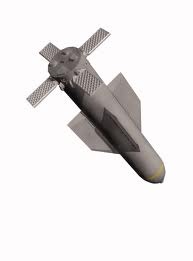
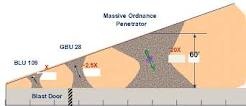
The point is that the US and others have been working on bunker busting for decades. The Massive Ordinance Penetrator shown dropping from a B52 above and in more detail below are the king of the hill right now.

20120304-202352.jpg

20120304-202404.jpg
Their reason for existence right now is to hold Iran’s nuclear bunkers at risk. The MOP is supposed to penetrate up to 200 ft of concrete:

20120304-202951.jpg
The problem is that the work of Iranian engineers on tough concrete could mop up the MOP. The Iranians have added metal nano fibers and particles as well as fairly ordinary metallic, plastic and ceramic, whiskers, flakes etc to the mix to toughen the concrete in various ways. This work is being done to save lives world wide, including the US since it’s focus is on Earthquake damage reduction. But this is a wonderful example of dual use since exactly the same technology could make future bunkers all but impregnable to conventional weapons, which big as it is the MOP still is.
Bottom line if the best of the best tech were used they might get 6 or more times the strength and testing has shown just doubling concrete strength reduces penetration by more than half!
This is not good news and probably explains this:
Congress ‘Urgently’ Approves $82 Million To Improve Its Biggest Bunker-Buster
Despite this:
The 30,000-lb Massive Ordnance Penetrator Bomb Works So Well It Earned A Rare Honor
It would seem we may soon get a chance to see if the Iranians were smart enough to use the super concrete vs if our super bunker busters can slam, blast, burrow their way in. There is also the question of corruption, in a vastly corrupt civil society using expensive concrete which probably looks like any other concrete is an invitation for shaving. Many is the time when a fortress has fallen because of under spec materials. Also you have the long term espionage and internal strife driven sabotage the story is that bunkers for Nazi super Vengeance weapons were sabotaged by the addition of small amounts of sugar to the mix drastically weakening it.
This would all be a wonderful background for a comedic farce, if so many people’s lives were not at risk.

Enough said….

20120304-210218.jpg

Jaja: Worlds first pressure sensitive iPad Stylus

This project to develop a better iPad Stylus is a Kickstarter, crowd sourced project, i.e. the project is funded by putting the prospectus on the website and asking for a set amount of funding to get to the next level.  This is an approach to funding that is taking off big for many types of effort and holds a great deal of promise for W.R.Mead’s Post Blue Model (on which more later.)

The project itself looks reasonably conceived and has what in some circles is called off ramps, that is pieces of the technology that may be of value in their own right. 

jaja cutaway

jaja cutaway

I do have to say that eventually I think a non-capacitive system, maybe even an old style optical dig pen will be needed in addition to the capacitive if the iPad is to reach its peak functionality.  Which is what this Technology Review blog post, Will Designers Take to the iPad3? talks about.  The answer in my opinion is no, I am not a professional but am somewhat ProAm and I find that while the iPad has its liberating effect (frothed about elsewhere) it still has some irritating downsides at times.

Nano Robots Move Out


Mothership?

A fascinating set of articles came out recently discussing the progress in micro and nano robotic techniques above. Is the picture from a short piece in IEEE Spectrum discussing the work of Dr. Ada Poon at the Standford Poon Group who are working on medical applications of beamed power. 

Poon Group Tech Map

Poon Group Tech Map

The basis is this technical paper (PDF).  Which talks about the chip, it essentially couples the beamed energy with a tiny antenna and converts the energy to a form needed to drive the chip using a electromagnetic propulsion fabricated on chip.  Very cool.  I will also point out that the Poon Group appears to be reasonably focused, some similar organizations I have run across or worked with have gotten way too diffuse and seem to wander off topic all the time.  Dr. Poon is doing a good job focusing on some key enabling technologies in the field.

So every battle platform needs its weapons, and what do you know these guys seem to have just the ticket.

Researchers at the Wyss Institute for Biologically Inspired Engineering at Harvard University have developed a robotic device made from DNA that could potentially seek out specific cell targets.

DNA Nanobot Shell

DNA Nanobot Shell

Obviously they are looking to ways to use this in the form of a more traditional delivery system, say a shot, but the Dreadnought could also use these for delivering deadly loads into exactly the right spot possibly repeatedly over time without repeated shots etc.

On its own very cool, in combination with everything else going on, mind-blowing!!

And yet we also complain about the costs of medicine.  The reason that money is put into these efforts is both altruistic and profit driven:

  • Medicine is after all about making life better for human beings
  • These techniques promise profound effects with minimal collateral damage
  • These devices can be fabricated in their thousands using ultra clean and precise techniques that will both lower cost and improve performance.
  • The price performance should move towards a Moore’s Rule like model of decreasing price AND increasing performance on a steep slope.
  • Conditions untreatable today will be treatable
  • People who would have died will live…some with health issues that will make them a drain on the economy.
  • Early clinical trials and during ramp up and cost recoupment the prices will be high because of limited supply and price controls…and people will complain about the cost of medicine.

And so the cycle will go on.  Do not take my screeds against Health Care costs and the Medical Establishment as any kind of Luddism, I want more technology more quickly, its the only path to better human lives.  What I hate is the almost Medieval Economic model of the existing ME in the US.