
Dream Chaser in a captive carry flight over the Mojave. (Credit: Sierra Nevada Corporation

Dream Chaser in a captive carry flight over the Mojave. (Credit: Sierra Nevada Corporation

Artist’s rendering of Solara 50 at high altitude.
Titan Aerospace

The coverage area of a Solara 50, superimposed over New York.
From ars technica:
Almost orbital
Titan’s aircraft plans are … modest and … ambitious at the same time. Solara 50 will have a payload of just 70 pounds—though depending on the time of year and location of the flight, longer daylight hours could sustain flights with heavier payloads. The next design, the Solara 60, will carry up to 250 pounds. Instead of using hydrogen fuel cells, the Solara aircraft use batteries charged from solar panels to power flight at night and provide about 100 watts of power to the aircraft’s payload, as well.The Solara 50 has a 50 m (164 feet) wingspan. The upper surfaces of its wings and tail are packed with over 3,000 photovoltaic cells capable of generating up to 7 kilowatts. It is launched by catapult and can land (when it has to) by skidding on its Kevlar-coated underside. Unlike the giant flying-wing configurations of the Helios and Zephyr, which had large numbers of propellers, the Solara has a single, high-efficiency motor.
In theory, a solar-powered drone capable of withstanding long flights at high altitude—in what Titan executives call the “sweet spot” in the Earth’s atmosphere between 60,000 and 70,000 feet, above nearly all weather patterns in a zone where winds are typically less than 5 knots (5.75 miles/hour)—would be able to perform tasks usually reserved for satellites at a much lower cost.
Several orders on the books, reasonable objectives, good idea, what’s not to like?

Gartner’s 2013 Hype Cycle for Emerging Technologies features Humans and Machines
The cycle is one of those eye opening ideas, a meme that explains while also laying out a way to look forward. Like disruptive vs evolutionary technology, the 80/20 rule and others.
3ders noted it because several things on it this year that are near and dear to their hearts. Personally Gartner’s timeline for consumer 3d printing, from the peak of hype (this years tip) to the plateau of acceptance is to conservative (5-10years). I think more like 3 to 5 years, but we shall just have to wait and see.
AWST Ares Blog: New Ways To Fly by Bill Sweetman

New at AUVSI was a variation on the quadcopter from Latitude Engineering of Tucson – the hybrid quadrotor, or possibly octorotor. A piston engine drives a generator, turning four electrically powered rotors (on the prototype). The next generation vehicle, weighing 60 lb, will have eight lift rotors installed in pairs, above and below the booms. Latitude says that three of the latter vehicles have been ordered by Naval Air Systems Command for a test program.
Tech Radar UK blog/magazine: The future of touchscreens revealed: bigger, cheaper, bendier
IN DEPTH Silver is becoming the gold standard for touchscreen technology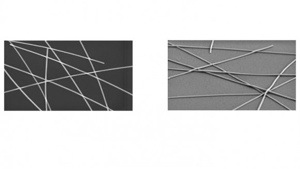
The mesh of tiny silver nanowires, head on and at an angle (very much magnified)
Because it’s flexible it can be roll to roll printed and the silver nanowire ink can be printed to final patern which will enable rapid cost reduction and new options. Cool stuff.
After the plastic has been sprayed with the nanowires and dried in an oven, the machine rolls it up again
When you think about it we’re built up from billions of smaller common modules with a lot of minor variations, why shouldn’t our infrastructure be the same?
MIT researchers have developed a lightweight structure whose tiny blocks can be snapped together much like the bricks of a child’s construction toy. The new material, the researchers say, could revolutionize the assembly of airplanes, spacecraft, and even larger structures, such as dikes and levees.
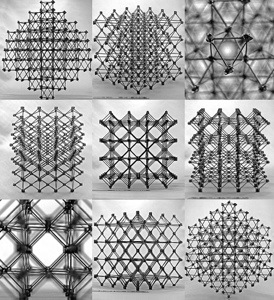
Assemblies of the cellular composite material are seen from different perspectives, showing the repeating “cuboct” lattice structure, made from many identical flat cross-shaped pieces.
PHOTO COURTESY OF KENNETH CHEUNG

Credit: © CC-BY-NC-SA Kenneth C. Cheung
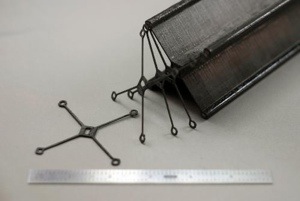
Part production for reversibly-assembled cellular composite materials, slicing from stock produced by a multiplexed fiber winding method. Credit: CC-BY-NC-SA Kenneth C. Cheung
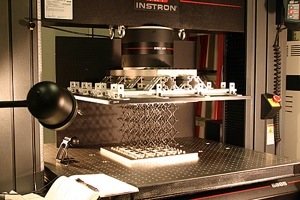
Test apparatus with reversibly-assembled cellular composite materials. Credit: © CC-BY-NC-SA Kenneth C. Cheung
If you can’t tell that last picture is a load cell, an instrument for applying precisely controlled loads to CRUSH YOUR ENEM…. uh, I mean… test the strength of a part or structure.
Read more at:MIT
or at:PhysOrg
or at: 3Ders
Obviously the MIT press piece is the base, but the others each have a little different insight.
Slashgear.com : SpaceX Rasshopper aces side tracking reusable rocket test go check out the video at the link way cool as always! Even more exciting, there’s some more details on the next steps!
Of course, the system will have to go significantly higher if it’s to be of use to NASA. SpaceX plans to introduce a second version of Grasshopper – known as v1.1 – sometime after October 2013, which will stand 160 feet tall and use nine of the engines from the Falcon 9-R rocket, rather than Grasshopper v.1′s single engine.
When testing begins, Grasshopper v1.1 is expected to eventually fly to heights of 300,000 feet, launching from a specially constructed pad at Spaceport America, New Mexico.
Two pieces, on Japanese one Chinese on Orthopedic uses of 3D Printed parts. Like the rocket engine parts mentioned earlier these parts are laser sintered Titanium.
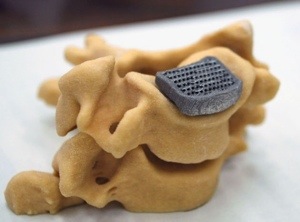 Japanese patients successfully received 3D printed bone transplants
 Chinese hospital uses 3D printed orthopedic implants
Welcome to the future: New Zealand approves permit for jet pack
“It’s essentially a motorbike in the sky, so I imagine anyone who has a snowmobile or a jet ski, this is going to be something they’re going to want in their garage,” CEO Peter Coker told the New Zealand Herald.
. Well… Maybe…
Dynetics reporting “outstanding” progress on F-1B rocket engine
The prototype components were constructed not with welding and casting, but rather with selective laser melting—a 3D printing technique that uses hot lasers to fuse metal powder into complex shapes. Dynetics and Pratt Whitney Rocketdyne hope to lean heavily on advanced manufacturing techniques like this in order to massively reduce the part count—and hence cost—of the F-1B engine compared to its F-1 predecessor. Current estimates call for a reduction in the combustion chamber from more than 5,000 parts in the F-1 to fewer than 100 parts in the F-1B.
OK I loathe the senate taxripoff system (STS), otherwise known as the space transportation system, but this is absolutely cool. I have to say NASA engineers and scientists have done a lot of really great and innovative stuff, even in these tough times, but as an exploratory risk taking organization…..well they’re a bunch of engineers and scientists lead by bureaucrats and directed by politicians . . . what more is there to say?
 This World and Others