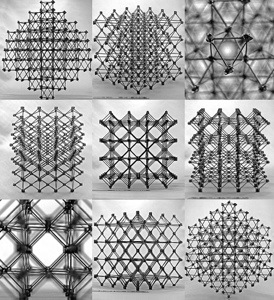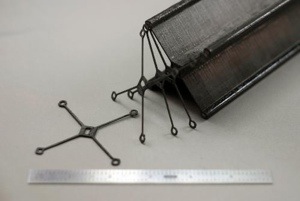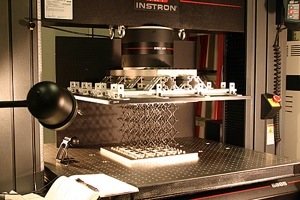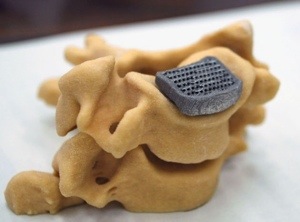
Two pieces, on Japanese one Chinese on Orthopedic uses of 3D Printed parts. Like the rocket engine parts mentioned earlier these parts are laser sintered Titanium.
Japanese patients successfully received 3D printed bone transplants
Chinese hospital uses 3D printed orthopedic implants
Category Archives: Technology
Motorbike, jet ski, snowmobile, jet pack…
Welcome to the future: New Zealand approves permit for jet pack
“It’s essentially a motorbike in the sky, so I imagine anyone who has a snowmobile or a jet ski, this is going to be something they’re going to want in their garage,” CEO Peter Coker told the New Zealand Herald.
. Well… Maybe…
3D printed parts resurrect Saturn V’s ferocious F1 first stage engines
Dynetics reporting “outstanding” progress on F-1B rocket engine
The prototype components were constructed not with welding and casting, but rather with selective laser melting—a 3D printing technique that uses hot lasers to fuse metal powder into complex shapes. Dynetics and Pratt Whitney Rocketdyne hope to lean heavily on advanced manufacturing techniques like this in order to massively reduce the part count—and hence cost—of the F-1B engine compared to its F-1 predecessor. Current estimates call for a reduction in the combustion chamber from more than 5,000 parts in the F-1 to fewer than 100 parts in the F-1B.
OK I loathe the senate taxripoff system (STS), otherwise known as the space transportation system, but this is absolutely cool. I have to say NASA engineers and scientists have done a lot of really great and innovative stuff, even in these tough times, but as an exploratory risk taking organization…..well they’re a bunch of engineers and scientists lead by bureaucrats and directed by politicians . . . what more is there to say?
NYT// Micro (observation) Satellites, new niche, new snitch?
Microsatellites: What Big Eyes They Have
By ANNE EISENBERG
Published: August 10, 2013
Kelley Alwood, project manager, worked on the SkySat-1 satellite in Skybox Imaging’s clean room. Matt McDonald
Your .50 cal rifle not ‘doing it’ for you any longer, what about .905?
Gun company displays largest-caliber rifle ever created with bullets that cost $40 a piece
- The .905-caliber rifle fires rounds about 2,100 feet per second
- The gun also has 2,777 foot-pounds of recoil energy, which essentially makes it as powerful – and gives it about as much ‘kick’ – as firing 10 .30-6 rifles at the same time.
- The company has only produced three of the uber-powerful rifles

Read more at the Daily Mail, UK, http://www.dailymail.co.uk/news/article-2383113/Gun-company-displays-largest-caliber-rifle-created-bullets-cost-40-piece.html the American gun culture is a continuing horror show for many in the UK, as our home invasion and violent crime rates go down and theirs goes up.
Wired || $40K Electric sports plane
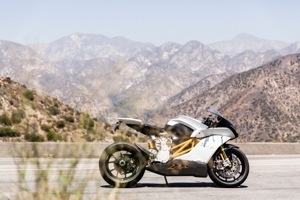
Wired || Two-Wheeled Tesla
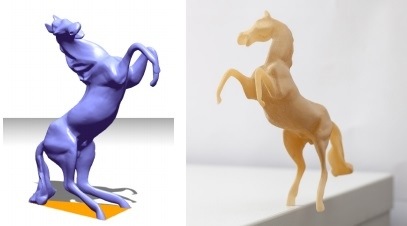
3Ders.org | Make It Stand: balancing shapes for 3D printing
(left) The original horse model does not stand on its hind legs and requires using the tail as a third support. (right) The optimizer deforms the horse to make it stand on a single hind leg.
Read more at | Make It Stand: balancing shapes for 3D printing
Neat tool for helping you creat your own cool artworks.
PopSci | Comfortable Light Weight Space Suit for Commercial Space Travel
Private space company Final Frontier Design shows off the latest orbital fashion.
Read more at: PopSci : New for Space Tourists: A Light Comfy Space Suit
Wired : Space photo of the day
This image emphasizes the beautiful rays of Qi Baishi, in the top of the image. The crater was named for the Chinese painter, Qi Baishi, known for his whimsical watercolors. The extensive rays of the crater mimic such whimsicality, extending far from the impact, exposing new material across the scene. The bright ray system indicates that Qi Baishi is relatively young, compared to other visible features. Notice the lack of rays extending from the west of the crater. This asymmetry indicates that the impactor struck at a relatively low incidence angle from the west.
This image was acquired as a targeted high-resolution 11-color image set. Acquiring 11-color targets is a new campaign that began in March 2013 and that utilizes all of the WAC’s 11 narrow-band color filters. Because of the large data volume involved, only features of special scientific interest are targeted for imaging in all 11 colors.
More at: Wired : Colorful Mercury Rays