RADICAL SCIENCE | GETMYO.COM | motion interpretation by reading muscle signaling and position

Cool stuff

20130428-141503.jpg
(Phys.org) —”Wave goodbye to camera-based gesture control.” That is the confident directive coming from a one-year-old Waterloo, Ontario, startup called Thalmic Labs. The company is prepared to ship its next batch of wearable-computing armbands for device controls early next year. The $149 armbands called MYO do not require cameras in order to track hand or arm movements. The armbands can wirelessly control and interact with computers and other digital consumer products by recognizing the electric impulses in users’ muscles.
Read more at: http://phys.org/news/2013-04-myo-armband-muscle-video.html#jCp
Using groundbreaking technology, MYO is able to measure electrical activity in your muscles instantly. The result is a seamless way to interact with computers, and a truly magical sense of control.
Read more at: https://getmyo.com/

20130428-141510.jpg

Printing tactile images for the blind

3D Printer | Exploring the world of 3D printing | Printing tactile images for the blind
by Cameron Naramore on April 25, 2013
20130425-190348.jpg

A “relief” is an example of what a 3D printed picture could look like.


Etchings, reliefs, contoured renderings of images. But what would a blind Rembrandt create with the right tools, ways for the sighted to gain concept for the inner perceptions of the blind? In the end this will become a new art form.

Zero DS || Wired

20130422-091351.jpg
Article:Alexander George, Photo: Alex Washburn/Wired

When the light turns green and the two-lane road begins an ess turn, it’s clear the Zero DS is a true motorcycle, not just a scooter with sport bike pretensions. This is an electric hoon machine that will put you ahead of almost anything on four wheels. Going from a standstill to 60 mph takes a tick over five seconds, and high-end torque slings the bike through on-ramps with aplomb. The Zero has the power to inspire that smirk of speed euphoria I crave from a bike — something that hasn’t been lost with the removal of a traditional internal combustion engine.

20130422-091619.jpg

As a two-wheeled electric vehicle, the Zero DS is perfect. The engineering has accounted for everything important in a transportation vehicle. Riding the Zero, you think, this is how a civilized society should move about. This is a lithe and efficient vehicle, and an exemplar of what motorized travel should be: four-hundred pounds of weight moving between destinations silently, parking unobtrusively, and most of all, forcing the rider to be deliberate and unwasteful. Take only what can fit in the storage space and travel knowing that you have a finite range and must act resourcefully. Those restrictions, again, keep the Zero from being a true all-around motorcycle, but I like the idea of noble asceticism so long as the thrill of speed remains.

Wind vs. Solar … Advantage … Solar

To me it looks like wind power is a long term loser, I think the capital intensive and land intensive technology may be overtaken by solar…partly because solar seems much more amenable to new nanotechnology ‘helpers’ in comparison to the relatively old school large scale engineering materials tech that dominate wind … And it seems like their are many more complex scaling issues with wind in comparison to solar.20130420-131727.jpg

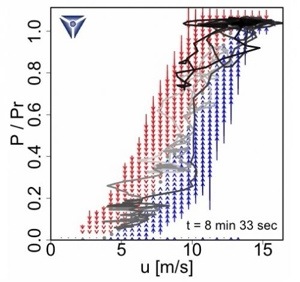
Screenshot … showing the power output vs. wind speed signals for a wind turbine. Credit: Patrick Milan, et al. ©2013 American Physical Society

20130420-132025.jpg

Shifting winds: A simulation shows the effects of turbulent wakes on downstream wind turbines. The turbulence affects air as high as a kilometer above the ground.

20130420-132339.jpg

University of Chicago researchers have created a synthetic compound that mimics the complex quantum dynamics observed in photosynthesis. The compound may enable fundamentally new routes to creative solar light harvesting technologies. Credit: Graham Griffin

20130420-132625.jpg

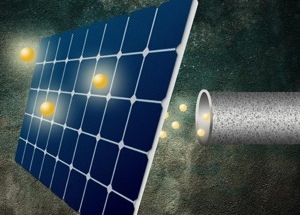
In a standard photovoltaic (PV) cell, each photon knocks loose exactly one electron inside the PV material. That loose electron then can be harnessed through wires to provide an electrical current. But in the new technique, each photon can instead knock two electrons loose. This makes the process much more efficient: In a standard cell, any excess energy carried by a photon is wasted as heat, whereas in the new system the extra energy goes into producing two electrons instead of one.

20130420-132902.jpg

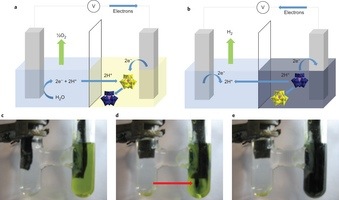
Schematic of the ECPB-based approach to water splitting. Credit: Nature Chemistry.
The process by which plants convert energy from the sun’s rays into chemical ‘fuel’ has inspired a new way of generating clean, cheap, renewable hydrogen
20130420-133252.jpg

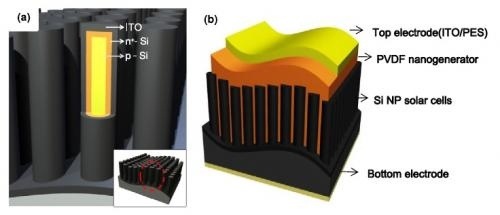
(a) Diagram of the silicon nanopillar solar cell. (b) Diagram of the hybrid energy harvester consisting of a piezoelectric nanogenerator integrated on to of a silicon nanopillar solar cell. Credit: Dae-Yeong Lee, et al. ©2013 IOP Publishing Ltd
20130420-133719.jpg

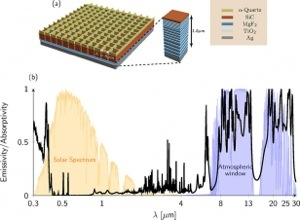
Stanford researchers are developing rooftop panels that cool buildings by sending heat back into space, a technique that could be more efficient than running an air conditioner from solar panels.

And if you look you will find much more of the same…in some areas of the world Solar is more cost effective than other albeit expensive sources and the tech tends to be small scale he scale-able and independent of higher level infrastructure, be it a national grid link or capital level finance, and it tends towards robust systems with local failures isolated … It seems likely this is the future and wind will be relegated to niche plays. Which could still be important…. 20130420-134815.jpg

Batteries: Cheapest Form of Grid Power? Using a wind energy and expensive lithium-ion batteries, AES Energy Storage is making money by stabilizing the grid.

Optical Research equipment via 3D Printing, signs of things to come.

20130409-212711.jpg
Perhaps not sexy but Right On! Article discusses the huge reduction in cost enabled by fabbing ones own optical components. Once scientists were the smart and the curious exploring the world with tools they made themselves. The wave of design software and fabrication tools, much like the wave of page design software and color printers of two decades ago, presage an utter change in the ability of the Everyman ( either, any sex, age) to explore to build/create and add to the sum of Mankind’s repository of knowledge / value.