A few chemicals and a microwave and see what you get

Zapping raw materials in a microwave oven and drying the resulting solution produces a black powder (top) made of hexagonal bismuth telluride nanoplates (bottom).

High-efficiency thermoelectric materials could lead to new types of cooling systems, and new ways to scavenge waste heat for electricity. Researchers at Rensselaer Polytechnic Institute in Troy, New York, have now developed an easy, inexpensive process to make such materials.

The materials made by the RPI team already perform as well as those on the market, and the new process, which involves zapping chemicals in a microwave oven, offers room for improvement. “We haven’t even optimized the process yet,” says Ganpati Ramanath, a materials science and engineering professor at RPI. “We’re confident that we can increase the efficiency further.”

What caught my eye here is that the material is a form of nano particulate, its produced in an evidently very simple process and it has a very high efficiency.  This type of technology as the article notes could have a great number of applications.  In a car one could conceive of replacing the mechanically driven alternator with something like this or supplementing it, this would essentially be using waste heat to provide electricity and would increase gas mileage.  There are many other places where heat scavenging would make sense and have an impact if the materials and system were cheap enough.  This goes back to a fundamental issue, energy efficiency costs money and if the cost of burning a tiny fraction more fuel over the life of the system (which can add up to biggish $) is less than the energy scavenging equipment then the equipment will not be installed unless the added cost is passed on to someone. 


Algae to the rescue

Green tea: Joule Energy's SolarConverter turns carbon dioxide and sunlight into ethanol fuel at a pilot plant in Leander, Texas.

 Technology Review| Photosynthesis Fuel Company Gets a Large Investment:  Joule Unlimited will build a production plant for turning sunlight and CO2 into liquid fuels.

The company is combining many technologies to move to direct creation of biofuel precursor liquids.  The algae is similar to that others are experimenting with but excrete the molecules into the water instead of retaining inside the cells.  This way the harvesting ‘only’ entails fractionating the liquid from the flow.  The bioreactors are essentially double panel windows with the algae filled liquid flowing inside.  The water gets CO2 from a power plant which scrubs it out of the plant effluents and one guesses that in cooler climates the water could be warmed in the cooling cycle of the same power plant so the system could operate year round.

The company calculates that their system can produce a great deal more, more easily refined biofuel precursor liquids than the alternates. Which mostly involve growing various kinds of plants and then converting them to biofuels in either chemical or bio reactors.

Aerovironment micro UAV

20120116-223425.jpg

AeroVironment’s Hummingbird NAV shown in the palm of a hand to give it scale. The company has been able to fly the NAV (nano air vehicle) indoors and outside, including flying it through doors and down corridors into a workshop and office environment.

From the SAE aeronautics eNote. Not new news but best picture and ‘technical’ description yet.

AeroVironment has captured the imagination of a worldwide audience with news of a major extension of its activities into nano air vehicles (NAVs). Ever since human beings first discovered the basic principles of lift and the importance of wing shapes, the necessary muscle power and control movements of birds defeated all attempts to emulate the mechanical process of using wing flapping to beat gravity. The hummingbird’s amazing ability to conduct a perfectly stable hover has long fascinated students of aerodynamics, especially when slow-motion film footage displays the complexity and perfection of its ultrahigh-speed wing flapping movements.

Elgin First Draft is Done and Posted

Cover

The wait is over, at least for the unedited version.  So when the 24th of Nov hit it was 58K words.  It is now 122K and you may not believe this but it’s the shortest book and by far the shortest draft I’ve ever managed.  I think it works, I hope you like Elgin and his world.  It’s probably not everyone’s cup of tea, it rises through a series of peaks to a crescendo then slips into the end.  

Download, enjoy, especially if you’ve downloaded, read and enjoyed the first parts.

And remember that the finished Moon Dreams and Under Siege are available.

Skynet it’s not yet, but one has to wonder…

Police Drone...
Skynet’s distant ancestor

The fact of the matter is that this, like so many other things, is coming.  I used to laugh at some ‘SciFi-ish’ cartoons for their depiction of flying drone/droid/robo cops, but then I’ve never been any better at predicting the future than most other engineers, we always dive way too deep into the details far too quickly unless we have something keeping our head out of the water long enough to figure out if we are in the ocean, sea, lake, pond, swamp or whirlpool. 

But there is the issue of privacy and the increasing ability of ‘the system’ to keep track of citizens 24/7/365.  Save a few puppies and a kid or so and we’re all for giving up a little bit of something for increased safety.  But at what cost, and have ‘we’ ever considered that we may be being manipulated?…..Anyway….

This post by Babbage at the Economist covers the ground pretty thoroughly, at least for the near term.  I think the killer app here is the comment about replacing choppers which cost a couple of million up to operate along with expensive maintenance and aircrew tails. Smaller police forces will be able to have an air contingent and big forces will have a lot of these things (hopefully replacing most if not all the choppers, which are IMO a waste of taxpayer money.)
 
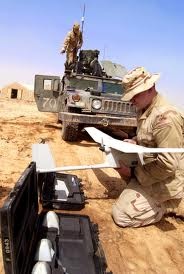
UAV’s , particularly like the one in the picture have a lot of advantages they :
  • can fly in a wider weather window than crewed craft.
  • are harder to see and hear
  • can land and sit/monitor for long periods
  • could operate 24 hours with rotating crews or units
  • can travel ‘as the crow flies’ instead of around buildings, fences, traffic etc
That’s in the near term, 2-3 years, what about the middle Future (4-7 years)?:
  • Wide area surveillance from solar powered (maybe a SolarSaurs?) high altitude platforms.
  • Add ‘Gorgon’s Stare’ technology, constant surveilance with roll back capability.
  • UAV’s the size of a bird it could follow a perp under cover.
  • UAV’s that can launch a smaller pursuit drone with a TAZER ?…a bit like this
  • What about a humingbird UAV?

And as you add those capabilities my libertarian hackles go up more and more.  None of the above should be given by a free citizenry to a gov’t that is actively growing and actively misusing its powers or taking advantage of congressional stupidity.

…Maybe I’d be happier if…..I had the right to pot one of the little puckers if it was over my property without my permission?  Hey it would create a new market, for home ultra short range anti aircraft systems!  Maybe these guys would have a head start?

The old New VW bug, a VW through and through

I’ve owned more VW’s than any other make of vehicle and I have always enjoyed them. I bought a bright yellow new Beetle as a commuter car in 1999, a safe but fun vehicle with some class. And it remains all of those things. It has been abused one way and another and its stayed good looking, solid feeling and fun to drive.
It now looks like I am about to replace the third battery which is supposedly good though I find it odd since its the only vehicle I’ve ever had to replace a battery more than once. I’ve had the fuel gauge stick once and strand me on the road….out of gas and absolutely clueless as to why the car had stopped running. The passenger side window motor blew in the middle of a Commute around Boston in the middle of a Noreaster once, which was bloody interesting….

Which brings me to my only beef really, they are expensive to have work done on and they are almost impossible to work on yourself these days.  The old New Beetle, is, was, a Rabbit (sorry a Golf) with a swoopy outline, making it hard to work on. I’ve had to replace the headlamps and that’s expensive since you have to take it in to the dealer, there is no what to get at them without removing something  important.  So the shape compounds the problem with upkeep cost.

But on the whole I have no regrets and I notice a lot of ‘bugs’ around these days.  They maintain their ‘fun’ a lot longer than other cars and they really are good commuter cars and a fun but safe first cars for the kids (having a certain panzerlike ruggedness.)


Snipers Rule the Modern Battlfield

SR 25 Stoner Sniper Rifle

On the Strategy Page, I read another of their excellent pieces recently, oddly enough called Snipers Rule:

Currently, about ten percent of American infantry are trained and equipped as snipers. Commanders have found that filling the battlefield with two man (spotter and shooter) sniper teams not only provides more intelligence, but also a lot of precision firepower. Snipers are better at finding the enemy, and killing them with a minimum of noise and fuss. New rifle sights (both day and night types) have made all infantry capable of accurate, single shot, fire. With the emphasis on keeping civilian casualties down, and the tendency of the enemy to use civilians as human shields, lots of snipers, or infantrymen who can take an accurate shot at typical battle ranges (under 100 meters), are the best way to win without killing a lot of civilians.

New sniper equipment has made a big difference. During the last decade the U.S. Army has issued several new sniper rifles. The M110 SASS (Semi-Automatic Sniper System) was delivered to troops in Iraq and Afghanistan four years ago. This weapon is not a big technological breakthrough. It is based on the older AR-10 rifle. The U.S. Navy had already been buying a similar weapon, the SR25 since the early 1990s. The SR25 was also known as the Mk11 Sniper Rifle System (SRS). These new semi-automatic sniper rifles are 7.62mm weapons based on the M-16 design elements. The basis for the M-16 was the AR-15, and a 7.62mm version of that weapon was called the AR-10. About half the parts in the SR25 are interchangeable with those in the M-16.

 Read the whole thing if you are interested in modern warfare and the American way of war.  One should put this in context of smart bombs and drone assassins, the fact is that it takes very few modern US warriors to take down a lot of bad guys, without the massive ‘collateral damage’ that our fires centric way of war used to mean (not that any of the others were better, we were just more worried about it.)

Realizing that this going to put me in the ‘gun nut’ category I always get a grin out of the fact tha the iconic US rifle of the Vietnam war and ever since, the M16, was designed in the stoner decade by a guy called Stoner.  It’s also so interesting that the M16 had a horrid reputation and yet has remained the basis of our main fire arm ever since.  In the early days they were prone to jam and some of the early units (If I remember correctly built by Mattel…yes THAT Mattel) were for crap, but with time, training it has shown itself to be the best compromise available for a long time. 

And it’s that word compromise, that used to be an US an American strength.  We and our tools were rarely the very best, at least for argument’s sake, but they almost always had good combinations of attributes available at the right price in the right amounts at the right time, they were compromises, we were good at making very good compromises.  In some ways I fear for a country that has lost its ability to understand that perfection or pure solutions are impossible and that a good compromise is always a better solution anyway because it trades off many factors and allows many to say they had a part in it, even if they also say: “…jeeze why the XXXX team  make THAT decision???”

Eyecandy

20120111-230942.jpg

A Wide Field Image of the Galactic Center

Image Credit & Copyright: Ivan Eder

Explanation: From Sagittarius to Scorpius, the central Milky Way is a truly beautiful part of planet Earth’s night sky. The gorgeous region is captured in this wide field image spanning about 30 degrees. The impressive cosmic vista, taken in 2010, shows off intricate dust lanes, bright nebulae, and star clusters scattered through our galaxy’s rich central starfields. Starting on the left, look for the Lagoon and Trifid nebulae, the Cat’s Paw, while on the right lies the Pipe dark nebula, and the colorful clouds of Rho Ophiuchi and Antares (right). The actual center of our Galaxy lies about 26,000 light years away and can be found here.

Creative destruction in it’s meme’s

20120110-232657.jpg Steve Jobs, our Guttenburg, RIP

VodkaPundit, via Instapundit, has a very good point to bear in mind in this the season of CES(RIP?)

When jobs came back to Apple he brought a self operational version of Creative Destruction, the dynamic heart of real capitalism we saw at work in the late eighties to early oughts, the idea that products, product lines even companies do not, should not, live forever but be overtaken by better solutions.

The iPhones 5 years old, it seems reasonable to think there is something next and no reason for it not to be targeted at eventually gobbling the iPhone as we know it.

What set of features would you build into a new personal product that might change the world?