Democracy is an Outcome not an Input….

In this months The American Interest is a fascinating perspective article that like any profoundly effective piece opens ones mind to a better way of thinking about a topic, in this case democracy and the ‘liberal societies.’   The Cultural Contradictions of Democracy    The main threats to democracy lie within liberal societies themselves. by Vladislav Inozemtsev

Its more of a monograph than an article, it’s talking to the reader about taking a different perspective on a whole classes of issues. In short as my title says Democracy historically emerges after life, liberty and the pursuit of happiness have already emerged within a society not before.  Also he points out that liberal (in the old sense of societal and economic freedoms) societies emerged in homogenous and élite societies and then democracy was implemented to create a stable and responsive gov’t that would last.  Only later as the rule of law, freedom of speech and assembly, equality before the law, became ingrained, and the polis became generally literate and self-reliant did the right to vote become general.

But as the right to vote became general its strength became debased.  As the right to vote was given to many without a strong tie to the society it became more and more populist and a tool of those able to manipulate it.  

Some societies have developed that are quite ‘liberal’ in the old and robust meaning of the world without democracy (Singapore is one example.)

Many societies have developed democratic trappings but they are not at all liberal (Russia is one example)

Some societies have had democratic trappings dropped on them and then have started to tear themselves apart because there is no homogenous polis, (Iraq, many of the African states)

If you are at all interested in the topic read the article, its one of those pieces that opens the mind to a better perspective that might lead to insights of importance.  unfortunately its all too likely that the right people won’t get the message…


Historical Perspective and Narrative

20120221-220832.jpg

Walter Russell Mead’s blog serial Beyond Blue, currently at #5, Jobs, Jobs, Jobs (from which the pictures in this piece come) is a fascinating monograph putting the changes our society/economy is going through into perspective. Dr. Mead’s explanation goes back to the 19th century:

In the 19th century, government promoted the rise of the family farm, selling cheaply and ultimately giving away millions of acres of farmland, and promoting the rise of railroads (which could carry the produce of western farms to world markets). In the 20th century the government promoted the rise of large, stable corporate employers that offered armies of white and blue collar employees lifetime employment and a bevy of benefits.

And later this:

Currently, the American legal and regulatory system is set up to bind as many people to employers as possible. The government wants you to be a wage slave and sets up a regulatory framework that keeps as many of us as possible yoked to bosses and management. The IRS doesn’t like the self-employed, fearing they many conceal income. Banks and credit card companies view such people with suspicion, and it is notoriously difficult for start ups and part time enterprises to have access to formal finance. Many services are hard for the self-employed to get on terms like those made available to employees of large corporations: from health insurance to retirement planning, many things are harder and more expensive for the self-employed. The payroll tax system is brutal: the self-employed pay both the employer and employee halves of Social Security and Medicare taxes, almost 20 percent of income and likely to go higher. Many cities will tack on unincorporated business taxes, mass transit taxes, and other interesting feudal exactions and dues.

The gov’t used(s) the current ‘Blue Model’ in some senses as a social damping mechanism because it provides for a more hierarchical top down command system (of interest in the Cold War climate of the 50’s to80’s) while also providing a relatively efficient economy and outlets for frustration from the masses. This model has worked since the collapse of the 19th century model….the great depression…but itself is now becoming unstable/unaffordable in its turn because it requires too much command and control.

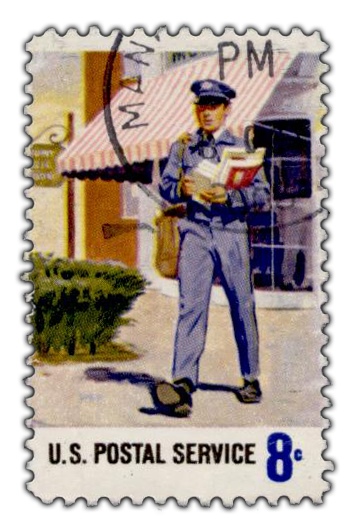
Too much how? Well now that a high percentage (all high value) workers have been amplified by basic literacy, information systems and other technology, they are capable of much more than the drudge work they used to perform at the command of a ‘supervisor’ and demand / need more autonomy. Many organizations accommodate and move on and up. Others keep the older structure or some bastardized version and sink into the muck. Companies that almost have to operate in the old mode because they deliver one sort of highly regulated good or another, get radically more expensive compared to near peers operating outside the penumbra of regulation and lose relevance and competitiveness at a steadily increasing speed. Look at the post office, once the epitome of efficiency.

What a New Model education would Disrupt

Megan McArdle’s take on change in higher Ed. Ms McArdle blogs and writes for ForbesThe Atlantic and has a lot of interesting insights on economics, politics and societal change, more libertarian than conservative her opinions are well reasoned with a dash of humility.

(corrected don’t know what I was thinking. Ms McArdle is at The Atlantic not Forbes, sorry about that)

The Decline of Violence

From Reason Magazine, I hope this is beginning to percolate, it’s actually a perception I’ve had for a long time, that violence of all sorts is declining not increasing.  The perception of greater danger is completely due to the news cycle and our reduced tolerance to violence of all sorts because it is so much less common today than it was even when I was young (and as ancient as I feel I am not THAT old.)

The article is an interview with  Harvard University cognitive neuroscientist Steven Pinker in his new book The Better Angels of our Nature: Why Violence has Declined, where he claims that “You are less likely to die a violent death today than at any other time in human history. In fact, violence has been declining for centuries.”  

The Better Angels of Our Nature: Why Violence Has Declined

Read the book I have not yet so this is not a review, just a commentary on my own observations and thoughts.

A couple of anecdotes:  Growing up I heard repeated references to kids fighting, but mostly it was reference to the generations before me. I never got into a fight (I was a big geek living in the suburbs so maybe not representative) I was only struck twice by other kids in my whole school career, both events were unprovoked single ‘hits’ due to me being the wrong person in the wrong place at the wrong time.

In my family’s early days in the US (mid late 60’s) I distinctly remember my father driving us down a country road someplace in southern Indian and seeing two large farm hand types going at each other with bare knuckles with a ring of what looked like relatives and friends surrounding them. This had been typical in the generations before mine but is rare today. Where it exists it is professionalized and as such the repercussions of the violence are ameliorated and diffused (nothing personal about this beating I’m giving you hey mate?)

I hate to say this but all evidence indicates that in our natural state we’re not peaceful types (despite what fringe utopian greens think.) Hunter gatherer clan life was one of constant warfare with nature and other clans (this can be seen even today in the few places where this life style still exists.)  As we moved to more sedentary life violence was reduced.  Again this can be seen, there was and is a distinct difference in the violence levels of farmers vs herders.  As states developed they tended to damp violence, a dead serf is an unproductive serf, also the ‘justice’ of a third-party tended to defuse feuds and vendettas, which had remained very prevalent (and still survive.) Then the violence of the hierarchical despotic governments was gradually ameliorated by various forms of government based on order and not raw power, again a dead serf is not very productive.  Psychologically we began to be able to perceive others points of view as literacy gave us limited insight into the ways others thought and perceived the world.  As mercantilism developed there was more reason to see ‘the other’ as a possible source of value and not a threat, defusing a great deal of hostility.   Then the enlightenment came with the spread of various forms of representative government and a sense of people at all levels of society having worth. Violence of all sorts began to be seen as an evil in and of itself.   Today we are the beneficiaries of a virtuous circle that this long chain of change has wrought, where the less violence we experience the less tolerant we are of the behaviours leading to violence, and so on.

Of course there may be dangers to this: 

  1. We could become so intolerant of behaviours that we begin to make intolerant and anti liberal laws.
  2. In the land of the disarmed lotus eaters the thug with the shiv rules.
  3. Not all places will experience the same cycle or at least not at the same rate and time.  Are we seeing this with Europe vs MidEast, is it a threat  because it leads to self disarmament and then scenario 2 on a large-scale.
  4. People become disinclined to stand up for their rights because all those around them see ‘standing up for something’ as code for unacceptable pre violence behaviour.

But on the whole I like where we are today.  The only real problem I see is that many of us do not take advantage of the opportunities because A) we perceive violence as increasing not decreasing B) lack of self-confidence in one’s ability to deal with violence.  

Now a curious though (stream of consciousness being what it is) do A and B in conjunction with the very real decrease in average violence explain the increasing prevalence of concealed carry laws?   Given the decrease in violence in general does it make perfect sense to have armed citizens able to provide deterrence pressure on the remaining ‘thugs for life’ in society?   It could be argued either way but I think that it is a sensible question to ask.

Charge Your Phone (and Your Car) from Afar

Charge Your Phone (and Your Car) from Afar – Technology Review.

This has been coming for some time but as the tag line says at the end, “…It’s going to catch on superfast…”  This may well be the technology that electric cars were looking for. Think about it coils at stop signs and stop lights, etc, or even in charging lanes.  With the technology of the battery and electric propulsion at its current level this should make the electric car a reasonable investment.  The problem is the deployment, investment, but spread out over time and geography and with the expectation that you’re going to have diesel, gas and LNG vehicles around for a long time I think you can see a realistic road to electric nirvanah.

In the Developing World, Solar Is Cheaper than Fossil Fuels – Technology Review

In the Developing World, Solar Is Cheaper than Fossil Fuels – Technology Review.

          The sudden interest is fueled by the advent of relatively low-cost LEDs, …., powering lightbulbs required a solar panel that could generate 20 to 30 watts, …. LEDs are far more efficient. Now people can have bright lighting using a panel that only generates a couple of watts of power…  

         But such technological improvements aren’t quite enough to open up the market. High-quality LED systems, with a pair of lamps and enough battery storage for several hours of lighting, cost less than $50. The systems can pay for themselves in less than two years, but the upfront cost is still too steep for many people. 

         Eight19, a company based in Cambridge, U.K., is one of several companies offering some type of payment plan to make the systems affordable. Customers pay $10 for the solar lighting system,….Then they pay a weekly fee for the power it generates.

It is a truism that new technology often needs a new business model to make it really pratctical.   This is an interesting and promising approach. 


The Instant Mall of the Future….an interesting idea

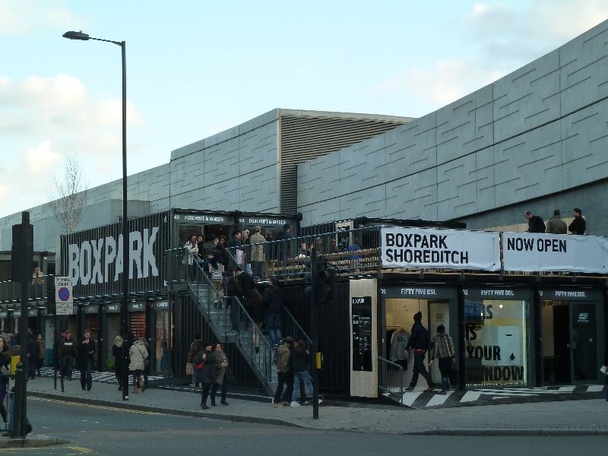
London’s new Containerized Mall

This  article A Walk Through London’s Boxpark, the Temporary Mall That’s Probably Coming Soon to a City Near You in the The Atlantic magazines Cities section talks about Boxpark, a containerized mall in london.  The structure are modified shipping containers with added insulation and fittings to make them into stores.  The whole thing was assembled on an empty lot in a few days and will be removed when construction starts on the building that’s going to go there permanently, in 5 years.  This is the next phase of the pop up store phenomenon, a pop up mall and there no longer needs to be an empty storefront available.  Also this would work to experiment with new store concepts, new locations, and even just to ‘freshen up’ or ‘change up’ a stale section of real estate. 

Also a dig for the Atlantic, which can be cranky liberal but is generally pretty even-handed and has some very good articles.  Their web page is pretty darn good and the Cities section has some fascinating off the beaten track articles.

Mark Twain and a thought or two about change

Twain in ~ 1890
Twain in ~ 1890

A picture from the Wikimedia archive of photos, which cover his adult life pretty thorouhgly.  this is a fantastic source of images.

Before I had chance in another war, the desire to kill people to whom I had not been introduced had passed away.
Autobiography of Mark Twain

Change is the handmaiden Nature requires to do her miracles with.
Roughing It

Strangely enough I have only read a little of Mark Twain’s work, I like reading about him and I like his humor and his philosophy but his classic novels don’t interest me.  Not sure if it was Junior High, High School readings that did it to me or if I’m just not  up for the experience.

I find the times in which he lived fascinating, in some ways we should be ashamed of ourselves for complaining about the rate of change today.  The rate of change during the Victorian era, or the Twain era (which overlap a great deal,) was simply incredible.  The biggest difference is that the impact was probably less personal than the changes today, but they were more physical.  The Transition from horse carriage and canal to train, the telegraph, the steam ship, the spread of parliamentary gov’t and limited monarchy, the explosion of broadsheet papers and journalism, the beginnings of scientific medicine etc.

By the time Twain died the world he had been born into would be almost unrecognizable.  The world you and I were born into are recognizably precursors to our life today.  However the differences in mental attitude and knowledge etc, are many orders of magnitudes greater than the same types of changes that happened across Twain’s life.

The intellectual changes that lead to the Victorian/Twain era explosion, happened in  the decades and years leading up to the years of greatest change.  Is that what we are seeing now, the build up of an underpinning that will enable quantum leaps in the physical characteristics of our lives like those that occurred from ~1840-1900?

Just a thought …

Did the ancient Myan’s predict the collapse of human civilization in 2012?

There have been a series of Cassandra video’s floating around this year, actually pretty much from the beginning of the internet.  I think the latest one I keep hearing glancing past is Post America or some such.  Ed Driscoll has a piece on the free fall of California that takes a lot of its material from this piece by Victor Davis Hanson then mentions the book After America from which the following comes:

 In ten years’ time, there will be no American Dream, any more than there’s a Greek or Portuguese Dream. In twenty, you’ll be living the American Nightmare, with large tracts of the country reduced to the favelas of Latin America, the rich fleeing for Bermuda or New Zealand or wherever on the planet they can buy a little time, and the rest trapped in the impoverished, violent, diseased ruins of utopian vanity.

“After America”? Yes. It will linger awhile in a twilight existence, arthritic and ineffectual, declining into a kind of societal dementia, unable to keep pace with what’s happening and with an ever more tenuous grip on its own past. For a while, there may still be an entity called the “United States,” but it will have fewer stars in the flag, there will be nothing to “unite” it, and it will bear no relation to the republic of limited government the first generation of Americans fought for. And life, liberty, and the pursuit of happiness will be conspicuous by their absence.

I agree that things are ugly for certain segments and geographical subsets of the middle class.  But I do not see a wholesale breakdown of the American dream.  On one side the American Dream has always been time and place focused, on the other I see almost as many positive signs as negative if you look at things from a broader perspective.  Conservatives are always going to lament most changes they see around them and conservatives living hyper conservative lifestyles, (i.e. farmers, lawyers, police, military)  are going to see things going to hell with more poignancy. 

The way I see it we got here because of the sequence of bubbles we have lived through, from the Post Cold War Bubble, Tech Bubble, Internet Bubble, a General Bubble (up to 9/11/01) then the Housing Bubble.  All of this essentially enabled the following: 

  • Pandering to gov’t worker unions
  • venal politicians promising money they had no way of knowing would be there
  • Bankers divorced from personal financial risk taking too many risks
  • Stock investors who should know better always expecting smooth growth
  • Managers looking six months ahead instead of six years ahead
  • Apathetic voters:
    • Voters who vote for the guy who ‘looks’ the best
    • Voters who vote for the guy who promises the most
    • Young folks not voting because they’re working 60hours and playing 40.
    • Middle career folks voting on visceral because their working 60hours and then coming home to another 40 of honey dos
  • One issue voters
    • Old folks voting for their pensions with scant consideration for other issues
    • Gov’t workers voting their pocket book  with scant consideration for other issues.
    • Bee in their bonnet rich folks using referendum to drive through special initiatives with no concern for unintended consequences.
    • Bee in their bonnet single issue political movements who vote gut level issues like abortion or church state separation, lower taxes butleave no room for compromise even when most of the realize that compromise is the only way anything will ever really be done
    • Politicians who gutlessly sign pledges that lock out the possibility of compromise, which was the basis on which the US was established.
  • Etcetera, etcetera, etcetera, as the king of Siam famously said

So…what am I saying?

That while I agree with the Cassandra’s that things look very bad this too shall pass, though sadly it’s not certain it will not pass without disorder and death, I expect that the United States will continue to exist for a few more centuries.  The majority of the country understands the general direction we need to go.  This majority does not include the rabid left or the zombie right but it does include many on both sides as well as the middle.

    • A retirement safety net that is much more focused on those in real need at a fraction of the current cost (means tested and not generally available till 75.)
    • A universal retirement savings system that is portable and personally monitored and focused on retiring at 70 only earlier if you have the funds or a real need due to disability.
    • A disability safety net that is probably little changed from today. but any federal mandate has to be funded by block grants from the federal gov’t .
    • Out of work benefits, system probably little changed from today but any federal mandate has to be funded by block grants from the federal govt’
    • Health Coverage:
      • A health insurance safety net focused on kids to 18
      • Universal Health Savings account (not mandatory you use it, not taxed), portable and personally controlled
      • Health insurance available, Insurance companies have to take new people, they can establish different price for different age groups (5 year min span.)  If you sign up as an adult with no prior insurance you will pay a reasonable premium for the first two years (25%)
      • Health cost published by all practitioners on their web pages, visits, shots, etc etc. 
      • Health practitioners are not allowed to charge different groups different prices for the same services.
      • People will pay their own health bills via a Pay Pal or equivalent system.
    • A simple but graduated income tax system without the bands.  I’d propose  simple linear progression from 0% at 10,000 to 20% at  $1 Million. Above $1M ‘income’ is considered capital gains and flat taxed
      • Capital Gains 25%.
      • No exemptions period end of sentence.
      • Special tax deals are special contracts with Department of Treasury / Inland Revenue, which Congress has to sign off on. 
      •  No tax deal can reduce expected tax rate below 10% ever.
    • Restrict the volume of regulations and laws.
      • A whole bunch of restrictions on length and length of effect.
      • You cannot make a regulation ex post facto (after the fact) just like no ex post facto laws restriction in the Constitution.
    • Anti Corruption
      • Congressmen have to put their money in a blind trusts.  No insider trading
      • All donations to all elected officials have to be public record, no restriction on the amount. No privacty for political acts.
      • Special interest groups who target politicians with adds, have to publish their financials and who provided the funds. No privacy rights for political acts.
    • Secrecy Restrictions
      • Debates on laws can be held behind closed doors but a proposed law has to be published on the internet at least ten days before the final vote and no special access for lobbyists etc.
      • Nothing can be held secret for more the 5 years without special and specific reasons agreed to by a committee of the senate and the maximum is 50 years.

  • No program / group above a certain size (10 people, $10 million) can be completely black, it has to have a public face and a public (and honest) reason for existence and its top level budget and basic structure must be public.

    • 5 and only 5 Departments of Executive Gov’t
      • Department of Treasury
      • Department of Defense
      • Department of State
      • Department of the Interior
      • Department of Commerce
      • All other departments shuttered and any necessary functions put in one of the others:
      • All current agencies would fall under one of these departments.  No independent Agencies of Gov’t. But can have an independent board of directors who can act as buffers…&seperate budget line item.
    • Recognize that blanket prohibition never works and establish a new regime for bad drugs including tobacco and alcohol.
    • Get Gov’t out of the marriage business.  Gov’t does care about stable committed partnerships for clear socio-economic reasons but should see it as a contractual issue.  Contract of Family Partnership to replace Marriage License.  Marriages are religious and can be restricted as the religious group sees fit. 

    So OK I got carried away, I’ve cut this list down several times then rebuilt it.  Not sure it’s really coherent but it does reflect my opinion on a number of topics.  I also think it reasonably represents the views of a lot of moderated, be they Republicans, Democrats, Liberals, Conservatives, Libertarians, Progressives….I think.  I may find out I am absolutely wrong….but then that would require folks to read this…..sigh.

    Cheers

    Is Petabyte Storage and the supercomputer going to create the ultimate totalitarian state.

    FuturePundit: Government Total Recall On Past Communications.

    Is Petabyte Storage and the supercomputer going to create the ultimate totalitarian state?  There is some discussion that Syria and Iran already do this….as does the US.  The NSA theoretically only trolls outside the ‘Homeland’ but how can you be sure…isn’t this a bit like th False in one, False in all assumption, Roman lawyers pulled out of their butts a couple of millennia ago.