
Study of the Syrian Rebellion–update and some broader context

This is an update of the earlier Syrian post. I think these two pieces supplement and bring up to date the ISW paper. First an article on the violence in Syria, which if compared to the white paper seems to show a continuing not accelerating level of violence. The bombings in Damascus would also appear to be part of a continuous ark rather than some large step, though I remain skeptical about who bears responsibility. The other Strapage article is a short discussion about the dueling use of orphans in sectarian violence, these boys and men grew up under awful circumstances and they tend to be easily turned into ruthless fighters. Another article the other day referenced the same socio-economic background for the Iranian Baij irregulars.

The Struggle for Syria in 2011 | Institute for the Study of War.

The scale of unrest in Syria has made it impossible for the regime’s security forces to simultaneously garrison all of the country’s key terrain. The regime has maintained control over Syria’s armed forces, despite limited defections. Therefore, the regime’s strategy has been to maneuver elite forces to key centers of unrest and conduct large clearance operations, using selective brutality in an effort to end the crisis.

The regime successfully suppressed demonstrations in Dera’a, where the protests began in March 2011, by conducting aggressive clearance operations. This allowed the regime to focus resources elsewhere as the conflict progressed.

Homs has become the conflict’s center of gravity because of its strategic location and its frequent sectarian violence. The regime attempted to quash Homs’ dissent in May, but emergencies elsewhere in Syria diverted attention and resources. By the time the security forces refocused on Homs in September, peaceful demonstrations had given way to armed resistance.

Despite large demonstrations in Damascus’ northeast and southwest suburbs, the regime’s security presence and targeting campaign has successfully prevented demonstrations from overrunning downtown Damascus. The size of the pro-regime population in Damascus has also contributed to dampening unrest in the capital. From the beginning of the uprising, the regime has deliberately consolidated its control over the Alawite homeland of Syria’s coastal region. Clearance operations in Latakia, Baniyas, and Tel Kalakh targeted Sunni enclaves and shored up regime lines of communication

From the Paper, a breakdown of the ethno religious makeup of the Syrian Populaion

From the Paper, the distribution of the ethno religious groups in Syria
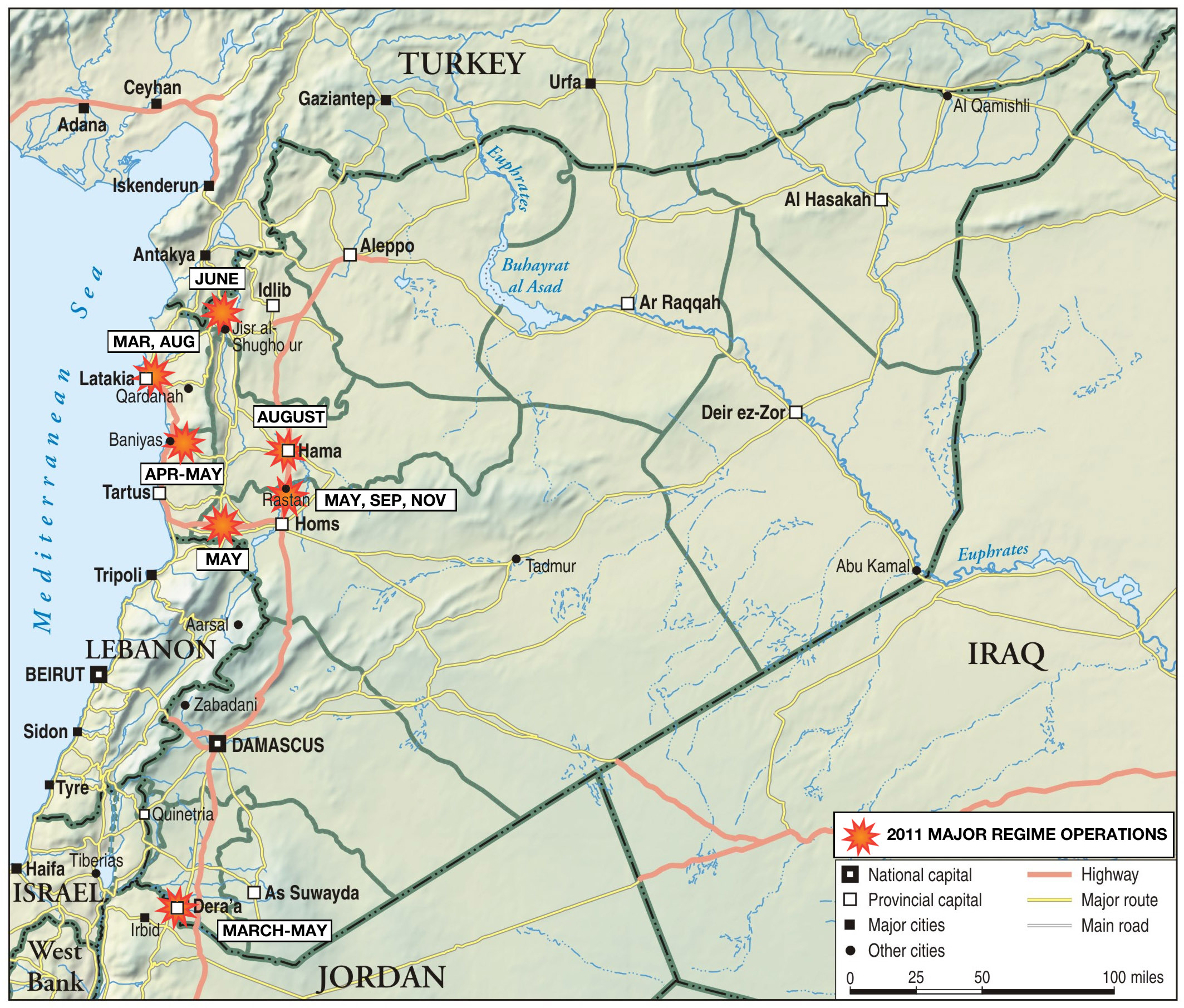
From ArticleFrom the Paper, Gov’t Operations this year

Richard Fernandez at the Belmont Club pointed out this paper and has a very good analysis of it and some other bits, such as this, 58 Foreign Policy Analysts are urging Obama to act regarding Syria. And the article has an interesting lead in picture…

Our Favorite Middle Eastern Leaders

Getty Image/ Our Favorite Middle Eastern Leaders

Now the problem is, which is more important for us to do keep our powder dry ready to deal with Iran, Ahmadinejad (in gray) or do we use assets and energy on Syria, Assad (dark blue) which is the more important world issue? Hands down, right now it would seem that Iran’s nuclear weapons and delivery system development is. Whereas sad Syria is suffering the agonies of realizing that the Dear Leader, is wasting the majority of its subjects potential and that the only way to change that is to change the leadership.

Now some are asking why can’t we ‘do a Libia’ and I think the argument is that both the socio/economic and military situations are far more complex in Syria, the bad guy and his military are not utterly incompetent and the rebels are dispersed and often ambivalent about the use of violence. I think that the maps and the text show that the majority of the Military Potential of the Anti Assad camp have not become engaged.

  • What happens if Iraq blows up as we go in and blow up Syria, and then we really do have to do something about Iran.
  • Is it possible the Kurd, Shia, Sunni ethno religious cocktail goes cablooey.
  • What if the Kurds get the bit in their tenth regarding a Kurdistan stretching across their ethnic foot print (Turkey, Syria, Iraq and I think Iran)Do the Shia try for Shiastan…and that means bits of Shiadom on the other side of the Sunni Crescent in Iraq and Syria.
  • Do the Sunni go for an Emirate partnered with Saudi Arabia et.al.

Things could really go to hell…and they may be on their way already regardless of what we or the west in general want.

This can be interpreted as negative, but is it? And are there other factors?

Plant Power alone sucks up $$$

From Technology Can We Build Tomorrow’s Breakthroughs? I think the answer is a resounding yes though I agree there is reason to be cautious.

Charts discussing manufacturing in the US
Does this represent net loss or just change?

As I have discussed before there is at least reasonable evidence that manufacturing in the US is on the upswing and while the charts paint a disappointing picture one has to be a bit careful about what is being measured. If mass production were giving way to boutique build +value add, might one miss it because we are importing what are essentially the bricks and mortar (which we by the way mostly designed or own a big part of) and the customization and final build (with their higher margins and more creative content) is done here?

There is an interesting section in here dealing with the founder of A123 and then with a couple of solar cell manufacturers.  And the author makes some very telling points.  I think they should be emphasized:

  1. Unless there is a very fundamental change in a product, improving process technology to produce a that product will not start out producing a cheaper product and unless you can get over the hump of higher cost and lower sales the guy with the bog standard product and highly refined standard process will eat you alive.
  2. Controlling one (however important) process or input material does not mean you control the market, a sudden change in market dynamics, possibly one you created, can suddenly pull the prop out from under you and if you only have one prop you are finished.
  3. Getting from prototype to production is horribly expensive especially in a mass market (which are almost by definition price sensitive and commoditzed ones) A first article will cost you K, getting that product in front of customers is likely to cost you 2 time K and getting into production 5 times to 10 times as much again, sometimes many times more. 
    1. Why you Ask? Because you can do a lot of research for say $1M, that’s enough to support three or four researchers for a year.  But once you have to show it to a customer you have to be able to replicate the work and make either a full scale device and or prove you can do so repetitively or have a process that scales from desktop to garage at least and that usually takes 2 or 3 years or 2 or 3 times as much effort and expense.  The when you go to production you now have to build a factory staff it, train the staff, fill out all the paperwork, pay the lawyers to make sure you’re not doing anything illegal etc, etc.  And you then have to make enough of your product to put on the shelf and most of the time you have to price it at well below cost because the first batches and the smaller batches are much, much, MUCH more expensive than the run of the lot will be later and you cannot charge 10x the expected price.  Selling the first  ???  units at an average of 1/?? their actual cost can eat up a huge amount of money.

The first comment after the article makes the point that established companies have in my way of thinking ‘normalized and processed’ innovation out of their main line business because of the costs.  It is easy to project cost and risk with incremental improvements.   The costs and risks of really new products/processes (disruptive ones) are much more uncertain, and few managers are allowed the latitude to innovate in big, risky ways. 

But this circles back around, does this in fact facilitate the creative destruction that the US industrial base has depended on.  Once large corporations run by bull-headed industrialists did the risky stuff.  When that generation was replaced by the MBA brigade they froze up.  Then the innovations erupted in a series of mid rankers with mavericks at their head or in a series of entrepreneurial start-ups who then took down many of the old guard.  Are we seeing the wake of another change of phase…

Anyway a good article but don’t take it as gloom and doom, its pretty evenly pro as well as con.

Some very blunt advice…

This article from the Cato Institute is very hard for me to argue with. Essentially the only parts of gov’t that matter when talking about deficits are (drum roll please) Medicare, Medicaid, Social Security and the Defense department. And even the DoD is relatively small beer, it’s a traditional bee in the bonnet of Libertarian/Cato types (with some reason.) Mr. Bandow points out that all of these programs have to become purely means tested, I think the age has to move up into the mid seventies and should start doing so essentially on a year every year basis ASAP and that anyone ten years or more from ‘retirement’ would be affected, ten years is a huge time horizon to deal with the change.

Anyway read the article it’s timely and prescribes the sort of major overhaul we need.

E-Reader Display Shows Vibrant Color Video – Technology Review

E-Reader Display Shows Vibrant Color Video – Technology Review.

“The device seen by Technology Review was made in a pilot factory in Taiwan that has mostly produced sample displays distributed to potential partners and customers, although a relatively small number of commerical displays will be made there. Chui says that a second, larger factory in Taiwan, big enough for production at a very large scale, is under construction and will come online in mid-2012. With the larger factory incomplete, truly mass-market devices with Mirasol displays can only appear in the second half of next year. Qualcomm is planning to invest up to $975 million in the new factory.”

Next year, color video on a small reader full sunlight and several times LCD’s life per charge.    Faster Please….and get it on the iPad…

Complexity and Size…the silent killer of Progressive dreams

I don’t want to crow that I have pondered these things for some time but I have recently seen a couple of posts on some sites where people are beginning to wonder about the problems of size and complexity and interconnectedness that are at least a chunk of the problems bringing the Euro down and that I also think had.   I think that its still a nascent thought but R. Fernandez had a pretty good post here that tied this together

I think some of this is in response to the Rauche Book Demosclerosis The Silent Killer of American Government, (which is mentioned in the Belmont Club piece) but I think that this is just one part of the overall puzzle.

demosclerosis…. which Jonathan Rauch defines as “government’s progressive loss of the ability to adapt” as a side-effect of the postwar style of politics that emphasizes interest-group activism and redistributive programs.”   In Phillip Longman’s book review of Rauch’s  Demosclerosis: The Silent Killer of American Government. – “Rauch rightly asserts that the “American system of governance today is much less at the mercy of any narrow manipulative few than at any time in the past.” The era of back room bosses who called the shots in service of rich patrons is long gone. But that has hardly brought about a more effective, or even more equitable, government, Rauch observes, because it has been replaced by a coalition representing virtually everyone. “We have met the special interests and they are us,” Rauch writes. “Much as mutual funds have offered ordinary people the access to almost every type of productive investment, so interest groups have offered ordinary people access to almost every kind of redistributive investment.””

Be Here Now

How did we get here? Why is this happening now?

The Here and Now is a phonograph needle tracking the wobbles in the groove that all our yesterdays laid down.

 Is there a way out?

There is only foreward there is no going back.

 There is a Destiny which has the control of our actions, not to be resisted by the strongest efforts of Human Nature.   (From)

GEORGE WASHINGTON, letter to Mrs. George William Fairfax, Sep. 12, 1758


Not sure I agree at an individual level all the time, but on the aggregate in the immediate time frame I would.   Perhaps its like this: Science tells me that most of my actions are planned a significant fraction of a second ahead of my consciousness recognizing what is going on.  It is impossible to change what you do not know is coming but if you plan ahead you can control what happens at a future point in time and space.

And what we do individually and locally does matter nationally and globally, at least a little and if not now then sometime in the future. 

Does that mean I demand “Word Gov’t Now!” how stupid do you think I am? 

We need more self-control, personal control, local control and less regional control, national control and global control.  We do need norms and some way of enforcing them for such things as : life, liberty and the pursuit of happiness, and such easily debased things as contract enforcement, property rights, ecological cost accounting, financial cost accounting…a few others…maybe

But….the old bureaucratic model, relying on a plethora of relatively well paid trustworthy functionaries to enforce norms is becoming unaffordable.

Laissez-Faire – let it be – management doesn’t work, it doesn’t work in regulation either.

Why has the US Constitution remained important for more than 200 years?  Because its simple, basic, lays out fundamentals and leaves the rest for interpretation but by being fairly simple, constrained and pragmatic it is actually possible to interpret it to cover very large sets of cases. 

We have to get over the belief that you can make life perfect if you can just tune your laws/regulations/rules just right and get the humans out-of-the-way.  We used to know better, I think that most scholars know better.  But somehow many folks have come to believe that if not all, then the one specific law they care about can be perfected, and since they care about it passionately they push it forward, usually through a system that has no time to really understand the consequences of this law when combined with that law and this social reality, etc.  And with each law becoming more complex because of fiddling to tune it to perfection, the way they interact becomes utterly unknowable. And the law becomes harder to obey and easier for smart lawyers to subvert.

So….

So where do we go from here? 

Start to build down the complexity we have built up at every level, what about:

  • For every new rule, two old ones have to be eliminated and no double dipping?
  • Limit the length of any law/rule/regulation to two double-sided 8 1/2 by 11 sheets one inch margins typed in 11 point Times New Roman with the option of an extra sheet of readable graphics?
  • Eliminate mandatory this, no tolerance that, rules that have become a pox on our society?
  • Make Judges accountable to other Judges and the Bar with impeachment by the people an option?

You can think of more, I know you can!

 Cheers

Work a day World….which will come

Another article about the end of work as we know it and I have to agree that this is the ‘feeling’ i get when looking and listening to the world at large. My jobs over the years have taken me to many companies, many new, some middle aged, a fair number ‘old line industrial.’ And the way I see it now is that we’ve been overlooking profound changes that were happening without causing much of direct stir while looking in the wrong direction and perhaps (probably) pursuing the wrong ‘solutions’ to what may not be real problems.

The story I would tell is this, that the heyday of the giant integrated conglomerate as a generic solution in the technology arena was probably sometime around the middle of the twentieth century. Not that anyone realized it or noted it, but after that smaller companies were often able to outmaneuver the big guys and started carving away chunks, not directly but by making managers/owners make decisions that marginalized pieces of their business. These middle sized companies started small and sometimes grew big and became conglomerates but on average the company size got smaller and more focused.

Many of the companies I visit have huge factories built in the heyday of mass production. Today these factories instead of producing just one product, produce several, or dozens and the people who service the machines are a fraction of the ‘old’ work force, or much of the facility stands vacant while the still sell just as much in raw value as they did when they had hundreds if not thousands of workers. Many stay in these old factories, because they’re essentially free and/or tearing it down would open them up for problems with the EPA re ‘Brown Field Remediation’ etc.

What happened to all those workers? We’ve heard about the hollowing out of our manufacturing for a long time but the pain was ‘mostly’ pretty low level, why? Because for the first forty years most of the the effects were hidden. Those smaller, mid sized companies were usually, less automated and less efficient but less expensive in terms of human driven overheads (generally younger staff, lower wages, small efficient shops, small effective teams, managerially efficient), and they sopped up, the workers no longer needed by the ‘mainline’ shops.

So why the agony now? I think that the internet bubble then the financial bubble hid the tailing off of the gentle transition, or maybe it kept more of the old line industries / jobs in play and then dropped them on the floor in one steaming pile. And suddenly the staid old like companies appear to have vanished, and the jobs appear to have vanished, but they had mostly vanished a decade and more ago, the rest was financial illusion.

If there had been no 911 and a need to hide the cost of the wars it sparked and a Ranch and Cancun Vacation (instead of bread and circuses) program put on to distract our attention, we would probably have seen the pain earlier and I think less severely. Now we probably are going to undergo a painful decade of recession, maybe more until we understand that the world has changed and work and the economy have to evolve.

How that evolution is going to happen is a blank to me. But what I see as happening over the next several decades is an ongoing evolution of work to highly automated mass production of basic needs, and the creation of more and more boutique, even artisanal companies often supported by constantly shifting teams of people who are engaged for short run needs.

And perhaps the gov’t and many folks who are still looking at the past to guide the future, will stop trying to save industrial age health and retirement systems that are unsustainable in the long run, and look to a much more personally focused system one that is portable across the country and across the globe if we have any sense.