
*Related video: https://youtu.be/Rt3u7k1Qn2Y
I spent the last years of my engineering career inside the EV supply chain. SiC power modules, fast charging infrastructure, the physics that makes any of this possible. When the market stalled and Wolfspeed went into Chapter 11, I was among the people who lost their jobs to the gap between technology that was ready and deployment that wasn’t managed well.
So I have some standing to say this: most of what you’re hearing about EVs right now is noise. The signal is somewhere else entirely.
What the argument is actually about
The loudest voices say EVs are failing. Mandates reversed, high-profile products stumbled, the market is retreating. Some of that is true. Most of the framing around it isn’t.
What’s happening is a culture war machine doing what it does: taking a nuanced engineering and industrial policy question and flattening it into a yes/no yelling match. The anti-EV drum is politically useful to a coalition that learned to hate the mandate era. That’s a social politics problem, not an industrial one.
The previous administration pushed hard on EVs and that push was heavy-handed. Mandates handed down by people who had never read a cost model. Timelines written by committees with no idea what it takes to retool a supply chain. You can’t magic this into existence. The regulatory overcorrection was real and it wasn’t sustainable. The current environment is closer to “let the market work,” which was always the more defensible position.
That’s not a retreat on EVs. It’s a retreat on mandates. Those are different things.
The one policy thread that actually matters
There’s a legitimate industrial policy question buried under the noise, and it has nothing to do with the culture war.
Chinese battery manufacturers operate at a cost and scale US industry can’t currently match. BYD LFP packs at $81/kWh against North American packs struggling to get below $120/kWh. That gap is structural. It’s the product of state subsidy, overcapacity investment, and a decade of manufacturing maturity that didn’t happen here.
Tariffs are a response to that. Not a new tool — tariffs have always been part of industrial policy. They buy time for US manufacturing to find its footing before the cost differential makes the conversation moot. They slow the bleeding. They don’t end the issue. The hard commercial work still has to happen inside that window of protection.
While the argument raged, the engineers kept working
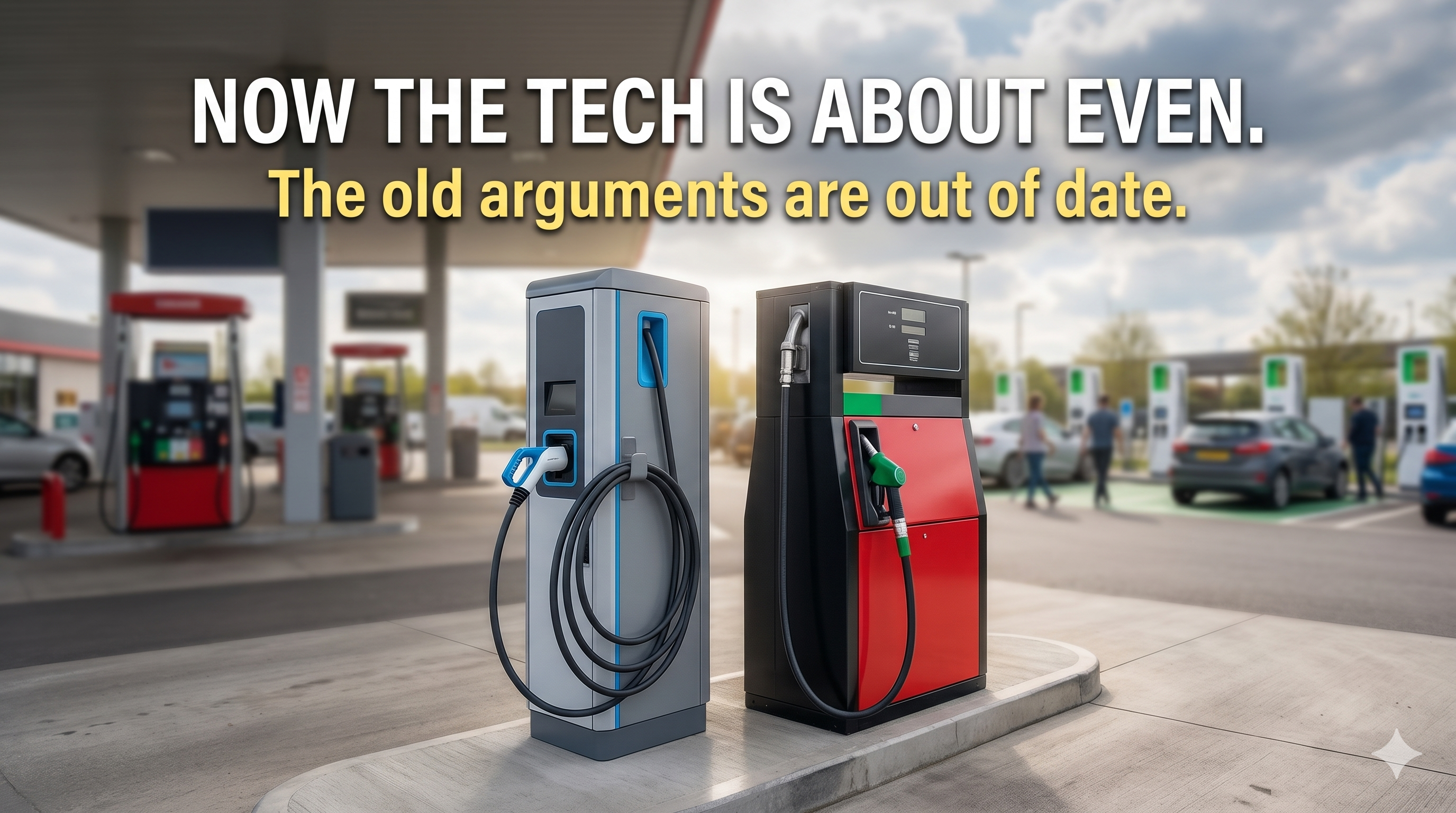
The two real technical objections to mass EV adoption were range and charge time.
Range has been largely answered for most drivers. The argument was always more perception than physics for the majority of use cases. There’s still a range/cost trade-off at the edges, and for certain use cases — long hauls, thin infrastructure corridors — it’s real. But for the suburban commuter with a predictable route, it was a phantom.
Charge time was the harder objection. It’s the one that lands with people who have driving patterns that don’t fit a neat daily commute.
That objection just got answered. CATL has announced a lithium-ion pack that goes from 10% to 80% charge for a long-range car in 5 minutes — essentially what you spend at a gas pump. With a cycle life as good or better than existing packs. That’s not a lab result. That’s a discontinuity arriving at production scale.
The cost curve has been moving the same direction for years. $137/kWh in 2020. $108/kWh in 2025. Consensus puts it at $60-80 by 2030. And unlike the internal combustion engine, which hit a performance plateau a while ago — where further gains tend to require turbos, complexity, and reliability trade-offs — battery technology still has a long way to run on the improvement curve.
The original technical case against EVs is now essentially closed.
The part most people haven’t thought through
Here’s the engineering insight that gets lost in the political argument: the EV value proposition is not uniform across vehicle categories. It runs in opposite directions depending on what you’re building.
A large pickup truck is a worst case. Heavy vehicle requires a big battery. Big battery adds weight. More weight means lower range. Lower range demands an even bigger battery. The vicious circle compounds fast, and the economics get brutal.
A mid-range car is a much better case. A small car is better still. An e-bike is the virtuous circle running full speed — light vehicle, small battery, low cost, genuinely better than the alternative on almost every axis.
The early EV push got this backwards. It over-emphasized large, expensive vehicles in categories where EV physics work against you, and under-served the mid and lower segments where the virtuous circle runs hard. That product mix failure wasn’t inevitable — it was a choice, driven by margin structure and political optics.
The companies that are finally starting to fix this understand where the physics are on their side.
What I expect to happen
The social politics will move on when the machine finds a new nuanced topic to flatten. It always does. The yelling tends to continue well past the point where it makes any sense, but it does eventually stop.
The regulatory environment is already normalizing. The tariff question is real and separate — you don’t abandon it just because the culture war has moved on, because the industrial competition with China doesn’t care about US political cycles.
Quietly, at the mid and lower price points, there’s no deep quitting. The product mix is starting to fill in where it should have been years ago.
By the time the US political environment fully resolves its feelings about EVs, the engineering will be a generation ahead of the debate. The technology wasn’t right five years ago for most buyers. It’s about right today. Tomorrow it will be better, and the gas engine curve doesn’t have the same headroom left to answer with.
The technology lapped the argument. Almost nobody noticed while it was happening.
Mark Harris is a systems and mechanical engineer, recovering from a career in EV power electronics, and the author of Stranded in the Stars (Book One, The Sea of Suns Trilogy). He writes about engineering, technology, and the creative life at This World and Others. The Unretired Engineer is on YouTube at https://www.youtube.com/@Scifiengineer-09

