MIT’s “Double-Bubble” Airliner Gets a Closer Look.


Novel Electronics Could Speed Adoption of Solar Power – Technology Review.
Not a new technology but if these guys can bring it to market at a significantly lower total cost of ownership number they are going to ignite the market.
Biggest issue with SftSwt has always been complexity and consequent reliability issues. If these guys have reduced the parts and interconnect count (in other words integrated the controls and sensors)they are on the right path.
In the NDIA’s National Defense magazine’s blog there is a post: Don’t Rush to Buy New Vehicles, Army and Marine Corps Warned
The traditional approach to updating U.S. military hardware — spending years and billions of dollars on next-generation designs — is no longer working for the Army and the Marine Corps as they seek replacements for their combat vehicles.
——
One reason for the military to hold off on buying new vehicles is that there are no technological silver bullets to make military trucks, tanks and personnel carriers less vulnerable to enemy weapons, …. Adversaries can acquire and deploy antitank weapons and roadside bombs much faster and at far less cost than the U.S. military can build countermeasures and survivable vehicles,
——
It’s not clear that the Army or the Marine Corps can “get out of this box,” Outspending the enemy in this case is a losing battle. … “Adversaries’ use of guided weapons, relatively cheap and rapidly fielded anti-armor weapons … threatens to increase significantly the costs incurred by U.S. ground troops in accomplishing their assigned missions,”
——
The Army’s procurement bureaucracy is still reeling from the failure of its $200 Future Combat Systems. Although the follow-on program, the Ground Combat Vehicle, is far more modest, it is not clear that it (will) offer a substantial technological boost compared to existing vehicles
——-
Army buyers might still be somewhat (IMO are totally) deluded by the thinking that doomed the Future Combat Systems. At the time, FCS officials touted the program for its advanced information network, which would give commanders an instant view of the battlefield and allow them to see the enemy without being detected.
After the termination of FCS, the Army continued the push for an advanced communications network, which is now billed as the services number-one modernization priority. The problem, … is that the Army still assumes it can deploy a network at will. “The assumption is that we are operating in a permissive environment … that once we set up the network, nobody is going to tear it down,”
——
We have operated in a permissive environment, electronically and even threat wise for the past decade at least. We have also operated in a nation building civil war environment in urban, suburban environment. Even in the ‘Stan the military faces an enemy with limited access to weapons beyond RPGs and IEDs but these have proven the Bradley is no longer viable and driven us to develop armored modestly off road vehicles like the Stryker DVH, MATV, and MAXPRO MRAP.
These vehicles use existing technology and are enough over designed to allow for evolution. They are too heavy for the Army and USMC but the effort put into the ‘light weight’ replacement the JLTV Family has already cost huge amounts and the only way the Army/USMC kept the program was mandating a weight(26,000lb), cost ($250,000 ea) and protection (MAXPRO equivalent) and letting everything else float or be a special kit. The program has been a feeding trough for the Mil-Ind-Bandit-complex for several years not for truck builders supported by the Army funding some high end components. In fact the truck builders and high end suppliers have been funding their own pragmatic tech programs based on industrial/commercial insights that in the end the Army and USMC have bought.
Recently a couple of high ups in the acquisition corps said they’ve been meeting the soldiers needs and all the grief about Comanche, Crusader, JLTV EDM, EFV, FCS, etc is all noise. Bull-crap!
Once it might have had some truth, the Army/USMC did projects to build tech and keep design experience honed. Much of the money went to top grade suppliers of engines, suspensions, transmissions, the primes never intended the vehicles to go to production, everyone learnt and had tech on the shelf. Those days are gone.
These days the programs are too tightly focused and the programs are ‘mapped’ to lead to production. So the top tier suppliers go for them, often get more than one ‘team’ funded and develop futuristic Advanced Development Models, designed to highly refined specs that require essentially custom components. To keep their engineering teams fed they keep most of the work in house and over-ride input from the lower tier suppliers they do use. The specifications are too specific and often contradictory, open to interpretation, and all too often evolving. Money swirls down the toilet by the bushel. New management comes in, new ‘baselines’ established more money flushed and eventually the program collapses. Little of the technology is of use elsewhere.
The world class suppliers all largely ignore Army programs because they have spent too much money on programs that are ill conceived and almost bound to fail. Where the automotive industry does work on gov’t programs they try to focus on programs with clear near term needs, like the highly successful, Stryker, MATV, and later MRAPS.
At the end of the day we’ll be better off letting things settle out while we fund evolutionary and component technologies. The thousands of bright young officers coming back from Iraq and the ‘Stan need to settle in, study the world, history and the potential for tightly-constrained battlespaces, they’ll be the ones to figure out what comes next, not the old guard who claim they’re ‘just fine…’

This piece on StratPage rather says it all. It’s kind of interesting, aircraft become more ‘efficient’ in a technical sense of cargo(including fuel/power)/weight as they grow larger…it’s mostly about geometric effects of volume vs. surface area. There is also a tendency to focus on endurance in drones for obvious reasons, which in air vehicles means slow and relatively large wing spans. Consequently the ‘low threat’ generation of UAV’s are all about the same in regards to vulnerability. But the next generation, Quadopters, UCAVs, Avenger, etc, are all higher performance, trading something away for more performance, and will be significantly less vulnerable.
And let’s be clear the first generation were all about experimentation with the basics, not about high intensity combat ops. If you look at a lot of the manned platforms in service, survival in combat has not been a big driver for the last decade.
A short but instructive piece on wireless technology and networking, mind opening.
GM Reveals Dismal Volt Sales in January – Technology Review.
The Volt is a pretty car but it’s just too expensive and too Me-to to gain real share. The Prius is a Toyota and as such, up scale yuppies don’t feel down class when driving it, they feel virtuous.
While the Chevy Brand is beloved by many middle class Americans it’s loved for its trucks and muscle cars, edgier yuppies buy Cadillacs. If the Volt had been a Caddy and a bit more of everything: bigger, striking, powerful, EXPENSIVE it might have had a better chance. Yuppies feel dissed in a Chevy, however green, and the Red Staters aren’t going to buy a smaller, slower, more expensive car when they can get one of the quality new generation GMs, Fords or Chryslers for a few pennies more or less.

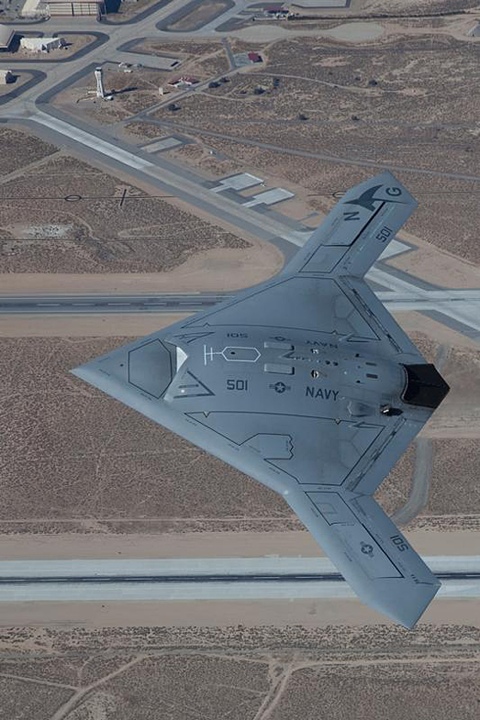
From the SAE aeronautics eNote. Not new news but best picture and ‘technical’ description yet.

Mirasol Color eReader display
I had heard about this technology several times over the years and had not realized that Qualcomm had commercialized it and is actually selling some units though they have not yet had a big ‘insertion’ win as like Nook, Kindle or the like. Unfortunately the first application the Kybo Reader is disappointing and if Qualcomm is not careful it could relegate the technology however good, to backwater.
Mirasol is like eInk a micro machine reflective display and not an emitter of light like an LCD, AMOLED even a plasma display is. The early insight that lead to the Mirasol is that the ‘scales’ on the wings of a butterfly get their vivid colors from an optical ‘trick’ rather than from brute coloration. The scales are very thin and essentially colorless, made of that basic creep bug shell stuff, chitin. The scales are made up of layers of transparent chitin of varying thickness. Light passes through the first layer and is selectively reflected because the thickness of the layers creates an optical cavity that selectively reflects light of a certain frequency while absorbing other frequencies.
Official description Here: Mirasol is made up of millions of pits with reflective bottoms with a multi layer thin-film ‘scale’ floating in the pit. The pit is a form of capacitor that can be positively or negatively charged, in one state the ‘scale’ floats to a position where the pit is a light trap, so it looks black, in the other state the ‘scale’ floats to a position where it reflects Red, Green or Blue very strongly. While changing charge state takes energy once changed there is all but no power demand. The ‘floating’ up and down is over a very short distance and happens very quickly, so you can create a video image with the technology, even in video mode its much less energy intensive than an LCD.
Since it is reflective not emitting it is sunlight readable, in fact like a book the brighter the light the better. It’s an efficient reflector so it’s actually quite readable in dim light and would need only a modest book light to make it readable in the dark. This may make it marginally less compatible with capacitive touch screens, but its possible that other technologies will replace the capacitive screen (I hope) like this interesting concept that turns any surface into a multi-touch interface.
This technology seems ideal for an eReader like the Nook Color that is not intended as a full function tablet but wants to be more the an eReader (eInk really sucks at anything other than page rendition) though it’s quite possible the technology will come on gangbusters for all portables if the technology is really as good as it purports.
Who is Qualcomm and why does it seem strange for them to be in this business? Qualcomm is the company that developed the CDMA (code division multi access)technology used in many phones today, as well as related technologies and has managed to leverage that into one of the significant if somewhat odd players of the mobile tech. For many years they were pushing the PCA phones, the first digital microcell technology that disrupted the old analog cell phone monopolists. THough they started on the digital side eventually they got into the business of designing the chip set for the radio in the phones. I believe it was Qualcomm that effectively proved that SiGe and even pure Si could compete with GaAs chips for the high performance radio frequency parts. Especially when they showed that they could integrate the radio on a single chip and eventually on the chip with the digital parts. They were an early SOC (system on a chip) player. Now they license the ARM technology used in most smart phones and they build one of the competitors in the tablet and smartphone processor offerings. The work on Radio frequency devices gave them experience in MEMS (micro electro mechanical systems) which is the manufacturing technology behind Mirasol. I would imagine that they see a long-term synergy between all these pieces, they essentially build the complete electronic kit set (including smart screen) that a OEM (original equipment manufacturer ) can put in a custom case with their choice of battery and interface thus providing the ability for and OEM to have highly distinctive product without having to have the expensive engineering resources required to design custom electronic ‘guts’ of their custom (semi custom really) product.
Its a bit like Chrysler designing a car kit, the sub frame, engine, suspension, transmission, electric and electronic systems that some custom builder then can take and design a shell around, making it into a sedan, hatchback, coupé, minivan, pickup truck, delivery van, taxi etc….which come to think of it is how many car companies work these days with ‘platforms.’
Sorry used to play in these waters a bit, and still find the technology and business fascinating, Qualcomm is an interesting success story who flies under the radar most of the time. I think the are like a company I work with today, they feel that constant PR flack barrage some companies put out are more about ego and stock price massaging than anything else, while being both a waste of money and potentially self-defeating by giving away too much information and setting the participants up for a fall.

From Technology Can We Build Tomorrow’s Breakthroughs? I think the answer is a resounding yes though I agree there is reason to be cautious.

As I have discussed before there is at least reasonable evidence that manufacturing in the US is on the upswing and while the charts paint a disappointing picture one has to be a bit careful about what is being measured. If mass production were giving way to boutique build +value add, might one miss it because we are importing what are essentially the bricks and mortar (which we by the way mostly designed or own a big part of) and the customization and final build (with their higher margins and more creative content) is done here?
There is an interesting section in here dealing with the founder of A123 and then with a couple of solar cell manufacturers. And the author makes some very telling points. I think they should be emphasized:
The first comment after the article makes the point that established companies have in my way of thinking ‘normalized and processed’ innovation out of their main line business because of the costs. It is easy to project cost and risk with incremental improvements. The costs and risks of really new products/processes (disruptive ones) are much more uncertain, and few managers are allowed the latitude to innovate in big, risky ways.
But this circles back around, does this in fact facilitate the creative destruction that the US industrial base has depended on. Once large corporations run by bull-headed industrialists did the risky stuff. When that generation was replaced by the MBA brigade they froze up. Then the innovations erupted in a series of mid rankers with mavericks at their head or in a series of entrepreneurial start-ups who then took down many of the old guard. Are we seeing the wake of another change of phase…
Anyway a good article but don’t take it as gloom and doom, its pretty evenly pro as well as con.
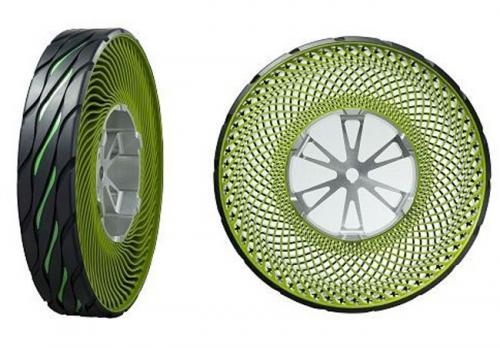
The Bridgestone man at work looks cool and has some advantages, like no punctures.
The spokes are made of reusable thermoplastic resin. In design, interest is drawn toward the thermoplastic fins, staggered so that connections to the hub and the rim do not torque and there is no structural breakdown. The tires’ resin spokes radiate from rim to tread. They curve to the left and right to support vehicle loads.
But one wonders about delamination at speed, effects of dirt and grime etc. But eventually this looks likely to come, their looking at light weight low speed applications first. If we ever see them on r ace cars we’ll know the technology is almost ready for prime time. Michelin and Yokohama have been working on ‘airless’ tires for years as well.
Also in the world of the wheel, another Michelin tech lead:
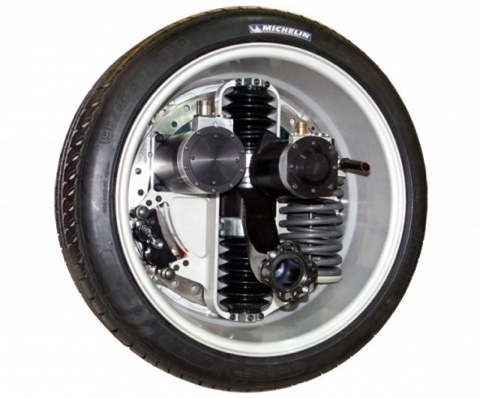
Each Michelin in-wheel motor weighs 42 kilogram (95 pound) and includes a 30 Kilowatt water-cooled drive motor of a similar size to a conventional starter motor. The motor has a spur gear that drives a rind gear on the hub. A second electric motor operates the active suspension via a gear rack and pinion that effectively replaces the normal hydraulic shock absorber (no news on if they are used as regenerative shocks). There is also a coil spring to hold the static load of the car and a small outer rotor disc brake. The wheel motor is attached to the vehicle chassis by a single lower control arm suspension arrangement.
The advantage here is that every wheel station on the car is identical, just programmed to be right front vs. left rear, no heavy suspension elements in the body so a simpler/rugged/lighter cargo tub for the fragile humans. This was the concept that GM touted when they were head over ass in love with fuel cells and the ‘skateboard’ that eventually faded away to make way for the Volt.
 This World and Others
