
Read more at: http://phys.org/news/2013-04-astrophysicists-five-planet-earth-like-exoplanet.html#jCp
Five worlds, some almost right…
Reply


To me it looks like wind power is a long term loser, I think the capital intensive and land intensive technology may be overtaken by solar…partly because solar seems much more amenable to new nanotechnology ‘helpers’ in comparison to the relatively old school large scale engineering materials tech that dominate wind … And it seems like their are many more complex scaling issues with wind in comparison to solar.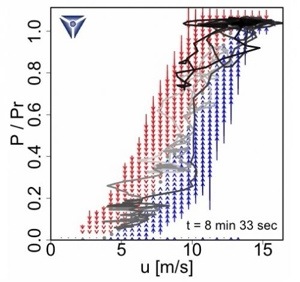
Screenshot … showing the power output vs. wind speed signals for a wind turbine. Credit: Patrick Milan, et al. ©2013 American Physical Society
Shifting winds: A simulation shows the effects of turbulent wakes on downstream wind turbines. The turbulence affects air as high as a kilometer above the ground.
University of Chicago researchers have created a synthetic compound that mimics the complex quantum dynamics observed in photosynthesis. The compound may enable fundamentally new routes to creative solar light harvesting technologies. Credit: Graham Griffin
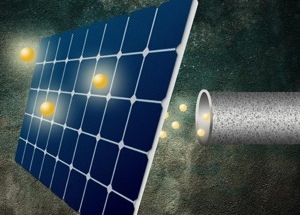
In a standard photovoltaic (PV) cell, each photon knocks loose exactly one electron inside the PV material. That loose electron then can be harnessed through wires to provide an electrical current. But in the new technique, each photon can instead knock two electrons loose. This makes the process much more efficient: In a standard cell, any excess energy carried by a photon is wasted as heat, whereas in the new system the extra energy goes into producing two electrons instead of one.
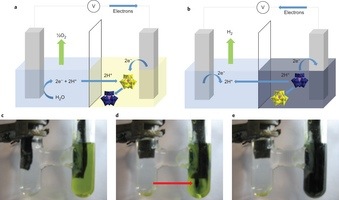
Schematic of the ECPB-based approach to water splitting. Credit: Nature Chemistry.
The process by which plants convert energy from the sun’s rays into chemical ‘fuel’ has inspired a new way of generating clean, cheap, renewable hydrogen
(a) Diagram of the silicon nanopillar solar cell. (b) Diagram of the hybrid energy harvester consisting of a piezoelectric nanogenerator integrated on to of a silicon nanopillar solar cell. Credit: Dae-Yeong Lee, et al. ©2013 IOP Publishing Ltd
Stanford researchers are developing rooftop panels that cool buildings by sending heat back into space, a technique that could be more efficient than running an air conditioner from solar panels.
And if you look you will find much more of the same…in some areas of the world Solar is more cost effective than other albeit expensive sources and the tech tends to be small scale he scale-able and independent of higher level infrastructure, be it a national grid link or capital level finance, and it tends towards robust systems with local failures isolated … It seems likely this is the future and wind will be relegated to niche plays. Which could still be important…. 
Batteries: Cheapest Form of Grid Power? Using a wind energy and expensive lithium-ion batteries, AES Energy Storage is making money by stabilizing the grid.
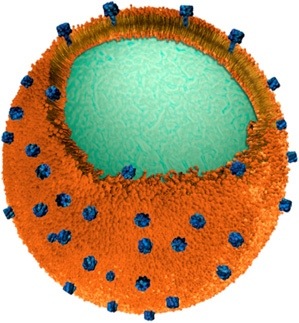
30,000 nano sponges per blood cell membrane, absorbs toxins and decoys the bacterial infection.
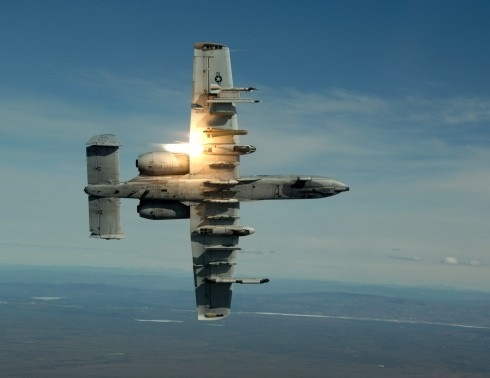
Classic shot of the classic, classy, grungy, so ugly it’s cute, A10 Warthog dropping a flare I think
What caught my eye:
While the APKWS, designed for maximum precision, has a Circular Error Probable (CEP) of about 2-meters, the round has exceeded this benchmark in testing and come within inches of targets at ranges up to 5 kilometers, according to BAE Systems officials.
Think about that … this is a WW II weapon and in the big picture inexpensive trending to dirt cheap. The guidance package-warhead replaces the dumb warhead, it has a trick laser based guidance system that is precise while leaving room for an effective warhead. The guidance system has an inertial reference platform and range finder…about the smarts and sensing of the original iPhone. In the future I see no reason it couldn’t have the ability to switch to pattern recognition guidance in the last few meters to go from inches to millimeters … At which point some targets don’t need an explosive ‘after.’
One Two Three Four, We Could Get A Nuclear War.
ARES a AWST blog….
“money quotes:”
Watts argued that many countries are no longer pursuing nuclear weapons as a direct counter to U.S. nuclear power, but to compensate for relatively weak conventional forces. That includes Russia, where Watts cites president Vladimir Putin’s emphasis on the importance of nuclear weapons, and post-Cold-War doctrinal writings that talk about using limited nuclear attacks as “demonstration and de-escalation” strikes, to deter or terminate a large-scale nuclear war.
…it’s like a police department whose only force option is to blow up the entire block where the perpetrator lives.
Indeed, U.S. extended deterrence is something that not enough people think about when they advocate further cuts in U.S. nuclear forces. The American “umbrella” covers nations such as South Korea, Japan and Turkey, which have the industrial and technological capability to go nuclear very quickly if they feel that they can no longer rely on the U.S.
Watts warns, “limited use of low-yield nuclear weapons will become the new normal and give rise to a second nuclear age whose dangers and uncertainties will dwarf those of the first.”

Crap!

File photo of the NK-33 engine firing on a test stand. Credit: Aerojet
From space flight now an article on Orbital Science’s Anteres launcher, specifically the rocket engines. It’s interesting that the Soviets were so good at some things and awful at others.
But then engineering is a very neutral endeavor and one that can adsorb your passion and develop your stoic nature…very good things in Stalinist Russia.
One should also remember that while ‘the west’ got the ‘brains’ of the Nazi German Rocket cadre (like Werner vonBraun) the Russian’s got the great majority, the working engineer types, who in the end have to slog through the agony of turning strokes of genius into real hardware, and it’s the slog that gets you deep capability not the strokes.
From The American Interest || Walter Russell Mead’s Viameadia:
As is so often the case in American politics, those who produce MSM coverage and those who rely exclusively on it for news were the last to know what was happening. We’ve seen almost nothing but optimistic and encouraging coverage of gun control efforts, ending as usual in painful failure and disillusion. Many gun control advocates and their allies in the MSM are stupified and stunned by the votes.
“Is there really any point in throwing your political career away in order to give a few days’ passing satisfaction to New York Times editorial writers?”
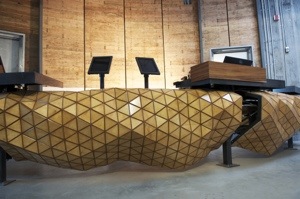
Cool stuff, you have to love wood, seems like another ideal bamboo application too. Wired || Design Firm Creates a Composite Wooden Material That Flexes Like Skin

ars technica article on the F1B engine the derivative of the Saturn 5 main engines competing for the strap on for the Senatorial Launch System… I don’t love the SLS but the F1B is exciting and worthy, I just wish it were part of a more commercially driven program.
2nd page has a great explanation of the difference between kerosene and liquid hydrogen as a fuel for first stage engines, fun for the rocket scientist in all of us…or at least me.





 This World and Others