Unknown's avatar

About Sci Fi Engineer

Husband Father Writer Engineer

The Future of War

The future of war is taking form all around and it is not a vision of super battleships and death rays, though they may exist in infinitesimal numbers the real fighting will be done by tiny groups of specialists (SOCOM, the SEALs and an array of similar highly trained, expensively equipped and lethally effective troops.) Weapons like one discussed in Wired recently, a Proposed program to develop a missile capable of hitting and destroying small targets like SUV’s (60 miles away) that can be fired from another SUV.

SUV being unloaded from a C-17

There is a bit of spy v spy in this and the Wired article is a bit ironic in tone but the truth is this is the future, and in most ways it will continue the trend of things getting better for the majority of humans, it will kill its target without killing hundreds of others and could lead to a ‘decapitation’ strike where the warmaker is taken out of the picture so peace can find a way.  And of course it will be misused, and ill-used and those of good heart and hope will deplore it all.

Of course the use of discrete platforms is nothing new, the recent tragedy in Africa involved a U28.  This is a single engine utility turboprop, built by Pilatus and used all over the world but very intensively in Africa where its low cost of acquisition and operation along with the high reliability of the single turboprop airframe make it highly coveted.  You can think of an SUV as being in the same vein really.

Pilatus, U28

Of course drones will be a big part of future war, though how big and how are interesting questions. If both sides are aggressive users of technology with combat hackers or the like as well as jammers, radio direction finding/ranging and guys (and gals) with skeet shooting guns and skills it should get ‘interesting.’

Here’s a piece of drone related news where things got ‘interesting’ for some bystanders when a crashed drone was given the coup de grâce by one of its robotic compatriots.

Mirasol (Butterfly Wing eReader Screen) out in Asia

An update from TechnologyReview regarding the Qualcom Mirasol based products.  Only in 5.3″ and all obviously based on the same hardware platform right now.  5.3″ is more in line with Asian tastes than US so it makes sense to focus there first  The long hang time (4 years from first hoopla) and small size indicate issues with the manufacturing technology, but nothing helps ManTech more than going to volume.  Hopefully 7, 9 and 11 inch units will follow soon.

Nano Robots Move Out


Mothership?

A fascinating set of articles came out recently discussing the progress in micro and nano robotic techniques above. Is the picture from a short piece in IEEE Spectrum discussing the work of Dr. Ada Poon at the Standford Poon Group who are working on medical applications of beamed power. 

Poon Group Tech Map

Poon Group Tech Map

The basis is this technical paper (PDF).  Which talks about the chip, it essentially couples the beamed energy with a tiny antenna and converts the energy to a form needed to drive the chip using a electromagnetic propulsion fabricated on chip.  Very cool.  I will also point out that the Poon Group appears to be reasonably focused, some similar organizations I have run across or worked with have gotten way too diffuse and seem to wander off topic all the time.  Dr. Poon is doing a good job focusing on some key enabling technologies in the field.

So every battle platform needs its weapons, and what do you know these guys seem to have just the ticket.

Researchers at the Wyss Institute for Biologically Inspired Engineering at Harvard University have developed a robotic device made from DNA that could potentially seek out specific cell targets.

DNA Nanobot Shell

DNA Nanobot Shell

Obviously they are looking to ways to use this in the form of a more traditional delivery system, say a shot, but the Dreadnought could also use these for delivering deadly loads into exactly the right spot possibly repeatedly over time without repeated shots etc.

On its own very cool, in combination with everything else going on, mind-blowing!!

And yet we also complain about the costs of medicine.  The reason that money is put into these efforts is both altruistic and profit driven:

  • Medicine is after all about making life better for human beings
  • These techniques promise profound effects with minimal collateral damage
  • These devices can be fabricated in their thousands using ultra clean and precise techniques that will both lower cost and improve performance.
  • The price performance should move towards a Moore’s Rule like model of decreasing price AND increasing performance on a steep slope.
  • Conditions untreatable today will be treatable
  • People who would have died will live…some with health issues that will make them a drain on the economy.
  • Early clinical trials and during ramp up and cost recoupment the prices will be high because of limited supply and price controls…and people will complain about the cost of medicine.

And so the cycle will go on.  Do not take my screeds against Health Care costs and the Medical Establishment as any kind of Luddism, I want more technology more quickly, its the only path to better human lives.  What I hate is the almost Medieval Economic model of the existing ME in the US.

This explains it all! Really! It does!

As e connected as I am I still enjoy sitting down in the morning and reading the Indy Star in its print form.  I have to admit I sometimes spend more time reading the funnies than anything else, but I do scan the first section (and the first and last page of Metro) But I do often read articles and this OpAn (opinion/analytical) piece from the Washington Post caught my attention.  I think Ezra Klein’s caught on to the problem,

There is a simple reason health care in the United States costs more than it does anywhere else: The prices are higher.

Really! It is almost that damned simple.  This graphic or the table version in the Star is infuriating and eye opening. 

Of course it’s not an explanation in and of itself and one could take Mr. Klein’s piece as a pointless frontal attack on the health care industry but the point is much more subtle. As I have discussed broadly before the issue is that things cost as much as they do because the way the current system creates vast inequality almost on purpose through weak and or distorted pricing signals.

A Gifted Man is a great TV show….how is that relevant? In it Michael Holt a brilliant neurosurgeon finds himself ‘gifted’ with the ghost of his wife, a socially conscious doctor who he had divorced (apparently amicably) years before.  While Michael runs Holt Neuro, an extreme high end clinic for the wealthy and powerful, Anna is running a Free Clinic, Clinca Sanando, in a poor section of the city (NewYork though its portrayed as almost any city.)  Anna has been killed in a hit and run, and her ghost goads him into helping the free clinic which is on the edge of folding.  (I could go on, its good TV but won’t.)

The thing is A Gifted Man points out without grinding ones nose in it the huge disparity in health care between the rich and the poor.  It also make the point that one can do good even superior general medicine in very spartan conditions if you have a dedicated and reasonably competent crew.  You can do even more if you back that up with truly superb facilities for those who need it, but those facilities are very expensive and somehow need to be supported by the clients. 

Now the the article points out the cost of medicine in many countries with more socialized medicine and I grew up in England then in middle class America where the conditions in the Doctors office were more reminiscent of the Clinica than Holt, today, I’m middle upper middle economic tranche and all the offices are much more like Holt than the Clinica, but why? Partially because I bitch if I have to wait for an appointment, and partly because I never see the cost until after the fact (except for dental work beyond the basics…becuase many more people lack dental coverage than lack general health insurance.)  In most ways the reason I go to my general practitioner is because he (or his office) keeps track of my overall health and is a central repository of my health records and I value that.  I’d value it even more if I could see it as a cost rather than an overhead hidden in the other post facto numbers I get….in no other part of my life do I have such uncertainty about the cost and yes perhaps because its hidden I’m not as reticent about going, because I know that in the end I can afford it, but many others are not as lucky and the uncertainty is discouraging, and then there are the folks with no coverage, who get bills many times what I pay…in some part because the Medical Establishment figures that in the end with many of those folks will end up paying pennies on the dollar, if you multiply the dollar by some large factor then the ME is more likely to at least cover costs one way or another.

 I do not ever feel that Micheal Holt does not deserve Holt Neuro or that the folks at the Clinica should have unfettered access to Holt Neuro.  I do not (most of the time) begrudge the well off hospitals their cathedral like front lobbies.  I do feel that the system is seriously distorting the messaging power of pricing and under suppressing the power of pricing the Medical Establishment hold because we are all frail humans who if not now then one day will have health issues to deal with.

Establish portable health savings accounts and require published pricing for standard procedures based on standard practice codes (and all procedures should have such codes and a cost you can find if you look or enquire.)  Don’t take away the tax advantages of the coverage companies provide, but extend it to everyone who buys their own insurance.  Reduce that tax advantage over a couple of decades.  Allow insurance companies to negotiate costs but they have to do so based on standard codes and publish some metric of what they are paying, make it illegal to charge different customers different prices for the same procedure (and don’t allow rebadging, the procedure codes have to be the same for all customers.)   Make it illegal for companies to charge different people different insurance rates, insurance takes into account your age and that’s it, different insurance companies can sell different sets of coverage and different age windows but that’s it.   Make the market place fair and flat.  An actuaries job is to make sure the insurance company collects enough money to cover its costs and make a reasonable profit! But again they have to publish their rates and compete for customers and if the marketplace is open and fair the prices will drop to the minium that covers costs and reasonable profits.

AWST | Electric Propulsion for Airliners

Green Operations

Taxi Electric

Powered wheel-drive systems promise to save fuel and reduce emissions at airports
Graham Warwick/Washington

Taxiing to and from the runway on engine power may soon be a thing of the past as development of electric wheel-drive systems progresses, with the promise of reducing fuel consumption, emissions and noise—and potentially increasing airport capacity.

EasyJet will be the first airline to test an electric taxiing system being developed by Honeywell and Safran. Operational trials on the Airbus A320 are expected to begin in 2013. Lufthansa and L-3 Communications tested an electric-taxi technology demonstrator on an A320 at Frankfurt in December. WheelTug plans to demonstrate a system on a Boeing 737-800 in May, “almost certainly in North America,” the start-up says.

The Honeywell/Safran electric green taxiing system (EGTS) uses electric motors on the main landing-gear wheels, powered by the aircraft’s auxiliary power unit (APU). L-3’s GreenTaxi system also powers the main wheels, but WheelTug’s approach is to drive the nosewheels. German aerospace center DLR demonstrated a powered nosegear on an A320 at Hamburg in June 2011, with the electrical power coming from a fuel cell.

WheelTug is testing its motors in the laboratory and expects to begin tests of the complete wheel package in March, says CEO Isaiah Cox. Details of the May demo have yet to be announced. WheelTug is on track for certification and first deliveries for the Boeing 737NG in mid-2013, he says, and talks have begun with A320 operators. Israel airline El Al has signed a memorandum of understanding, and Cox expects to have “1,000 aircraft in backlog” by late this year.

The Honeywell/Safran partnership has acquired an A320, based at Montpelier, France, which it is using to understand loads and deflections on the landing gear. This aircraft will be used for tests of the EGTS beginning this year, says Brian Wenig, vice president of business development at Honeywell Aerospace. Certification of the system for retrofit and forward fit is targeted for 2016.

Lufthansa Technik and teammates L-3, Airbus, Lufthansa and Frankfurt Airport operator Fraport are scrutinizing data from 14 hr. of taxi trials and will complete an economic benefit analysis in March before deciding whether to proceed to a prototype system, says Christian Mutz, project manager of innovation for Lufthansa Technik.

The GreenTaxi demonstrator used off-the-shelf vehicle motors from German subsidiary L-3 Magnet-Motor. Installation required removal of the brakes from the outer wheel on each pair. A container in the cargo bay provided power conditioning and liquid cooling, which Mutz says proved not to be needed, as the motors stayed cooler than the brakes.

Weight is critical, and the Lufthansa team is looking at a lighter pushback-only system as an alternative to the full capability, as well as a hybrid of the two. A pushback-only system would propel the aircraft at 3 mph, compared with a full system that would be capable of taxiing the aircraft at 30-40 mph, Mutz says.

Able to propel the aircraft at up to 28 mph, WheelTug weighs 300 lb. but is “flight weight”-neutral, as less fuel is required for taxiing, the company says. Minimum fuel burn for a 737 taxiing on one engine averages 15 lb./min., and crews typically add 30 min. of fuel weighing 450 lb. for contingencies. Powering the wheels from the APU cuts taxi fuel burn by up to 85%. “Instead of over 200 kg [440 lb.] of taxi contingency fuel, I can load 60 kg, and have the same operational flexibility,” says Chief Pilot Joseph Goldman.

WheelTug’s business plan is to supply systems and spares free to airlines and share the demonstrated savings. “We can show savings to airlines of $600,000-800,000 a year,” says Cox. “That compares with $1.5-2 million a year for reengining.” Honeywell “conservatively estimates” that the EGTS will save an average $160 per segment, and 130 tons of fuel per year per aircraft, for an A320 or 737 operator, says Wenig.

There is still debate over the right approach. Honeywell/Safran and L-3/Lufthansa say the capability to taxi in all conditions can only be provided by powering the main wheels, as there is not enough weight on the nosewheels to provide the required traction. “We have done tests, and demonstrated operation in ice and snow,” counters Cox.

Other potential benefits of electric taxiing include shorter turnaround times and the ability to position aircraft on the runway at noise-constrained airports so takeoffs can begin as soon as the curfew is lifted, generating more slots. But engine makers are concerned about the lack of warm-up time that could result.
20120221-224508.jpg
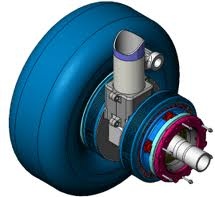
A picture from Chorus Motors, who owns WheelTug, the motors are in the nose wheel which has no braking system so has lots of room for the motors (don’t get me wrong these are powerful motors for their size weight.)

The issue mentioned above and main reason that this is starting on the 737 and A319 is that these are both big and small at the same time.

Compare the landing gear in the pictures below one of a 737 the other of its biiiiig brother the 777.

20120221-225832.jpg

20120221-225921.jpg

There is much more, % wise, weight on little bro’s front wheel. With friction etc you have a practical propulsion system even in crappy frigid/icy weather, after the planes been sitting for a long time, and the tires have flat spots where they contact the ground. With the 777 there is no way that the front wheel can haul that big boy around.

The article discusses work on main gear but here you have to integrate around the brakes. Now there are reasons this would be good beyond taxing but the brakes are hot and dirty, a much tougher environment and for a big boy you would need a lot more than two driven wheels which makes cabling and drives even more of an issue. But at the end of the day this is probably the way aircraft will move on the ground in twenty some years and those future versions of us will wonder why it took so long.

20120221-231528.jpg
Testing out a main gear electric taxi concept, L3/MagnetMotor and Lufthansa.

Historical Perspective and Narrative

20120221-220832.jpg

Walter Russell Mead’s blog serial Beyond Blue, currently at #5, Jobs, Jobs, Jobs (from which the pictures in this piece come) is a fascinating monograph putting the changes our society/economy is going through into perspective. Dr. Mead’s explanation goes back to the 19th century:

In the 19th century, government promoted the rise of the family farm, selling cheaply and ultimately giving away millions of acres of farmland, and promoting the rise of railroads (which could carry the produce of western farms to world markets). In the 20th century the government promoted the rise of large, stable corporate employers that offered armies of white and blue collar employees lifetime employment and a bevy of benefits.

And later this:

Currently, the American legal and regulatory system is set up to bind as many people to employers as possible. The government wants you to be a wage slave and sets up a regulatory framework that keeps as many of us as possible yoked to bosses and management. The IRS doesn’t like the self-employed, fearing they many conceal income. Banks and credit card companies view such people with suspicion, and it is notoriously difficult for start ups and part time enterprises to have access to formal finance. Many services are hard for the self-employed to get on terms like those made available to employees of large corporations: from health insurance to retirement planning, many things are harder and more expensive for the self-employed. The payroll tax system is brutal: the self-employed pay both the employer and employee halves of Social Security and Medicare taxes, almost 20 percent of income and likely to go higher. Many cities will tack on unincorporated business taxes, mass transit taxes, and other interesting feudal exactions and dues.

The gov’t used(s) the current ‘Blue Model’ in some senses as a social damping mechanism because it provides for a more hierarchical top down command system (of interest in the Cold War climate of the 50’s to80’s) while also providing a relatively efficient economy and outlets for frustration from the masses. This model has worked since the collapse of the 19th century model….the great depression…but itself is now becoming unstable/unaffordable in its turn because it requires too much command and control.

Too much how? Well now that a high percentage (all high value) workers have been amplified by basic literacy, information systems and other technology, they are capable of much more than the drudge work they used to perform at the command of a ‘supervisor’ and demand / need more autonomy. Many organizations accommodate and move on and up. Others keep the older structure or some bastardized version and sink into the muck. Companies that almost have to operate in the old mode because they deliver one sort of highly regulated good or another, get radically more expensive compared to near peers operating outside the penumbra of regulation and lose relevance and competitiveness at a steadily increasing speed. Look at the post office, once the epitome of efficiency.

The iPad, Pandora and life

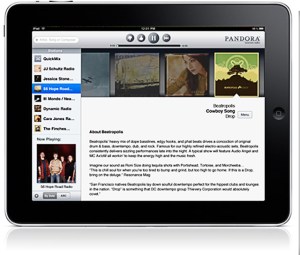
pandora-ipad-landscape

iPad, Pandora App

I’ve said it before but want to  reiterate that Pandora + iPad have made a deeper impact on how I live my life more quickly than any other technology change.  And in some ways that change is more ‘SciFi-ish’ than any other change I have experienced.

Don’t get me wrong other things have had more impact but they were much more profound in and of themselves.

  • Smashing my ankle
  • First Car
  • First Real Job
  • First House
  • Getting Married
  • First Child
  • Second Child
  • First Child going to college….

How can I even compare two pieces of Triviachology like the iPad and Pandora you ask?

Well I have worked from home a significant amount of time since 1997 and I have very consciously tried to limit the amount of paper I generate and find ways to get information in electronic rather than paper form.  I have felt that the eReader was going to reach takeoff eventually and while the pundits always poo poohed it I saw a steady decrease in the Paper load in the engineering world probably a leading edge in the utilization of information that had made it paper heavy for a very long time. When the piles on young and not so young engineers desks began to collect dust I figured it was because they weren’t shuffling through them so often any longer because the primary sources were in electronic not paper form.  The paper was for reference and for making notes on (BtW Paper / print / writing / reading is a fantastic intricate and powerful technology if you stop for a moment to think about it.)

Now I can carry around a single small compact rugged and handsome slab of Al and Glass that is book, magazine, note taking device (typing or hand writing, I take copious ‘ink’ notes on my iPad, Check out the Penultimate app if you want to try it.) calculator with some of the calculators capable of solving and displaying very complex systems of equations (MathStudio or SymCalc HD) and I do some quite complex artwork for fun and other purposes using ArtStudio.  I load a lot of papers and other tech pups (pdf) onto my iPad (iBooks) so I can read them at my leisure. 

Now the iPad is no replacement for a laptop (for me.) But unlike many commentators I do not see that as anything but a special case. It is a fabulous adjunct, extender, even amplifier, but I see it as a reasonable laptop replacement for certain users, especially those who are more interested in consumption than creation.  To be honest I think the combination of an iPad and a smart TV may be all that an even larger cadre of users need.  But that does not denigrate the iPad as a consumption device, it’s an adjunct amplifier to your digital life, that can be a replacement under certain limited circumstances.

So…there you go the iPad as significant life changer, what about Pandora?

Well here my story is a bit weaker and it’s really the combination of Pandora and the iPad and to an extent Netflix streaming service.  And let me tell you right now that I hate TV’s in the bedroom and my wife is addicted to the BBC versions of many US TV procedural cop shows..and insistes on watching them (on her iPad) late at night if she can’t get to sleep……I must have been bad in a very twisted way in some previous life…! Anyway Pandora in itself was a revelation, as I have said before it mix of being able to select music you like and then let it go off and find things similar in ‘feeling’ has opened me up to huge swaths of music I had never heard before.  Add that to the ability to have that music with me most of the time with the iPad and one can feel a bit like one is living in a movie with your own sound track, though I found this soundtrack doesn’t do a good job of foreshadowing the next scene.   And even though I curse Netflix fairly regularly it is nice to be able to browse in ‘the long tail’ of shows, see things I never had a chance to watch, like BBC’s Primeval, or some Nova or History Channel programs. 

So while those two services are not responsible for as profound a change as the iPad is in itself, added to the iPad they are a very profound change in my and my family’s habits…and as one would expect not always for the good.

IPad Neflix App

iPad Netflix App

The Lefty Bosco Picture Show, a cartoon or soul teaser?

20120218-224227.jpg

20120218-224239.jpg

20120218-224258.jpg

You are the co-star of The LeftyBosco Picture Show. In a variety of styles and subjects, from playful to poignant, Keith DuQuette, aka LeftyBosco, presents a drawing a day. Daily drawings by Keith DuQuette engage, inspire and challenge you to add your witty and wise comments. Play along with LeftyBosco and his friends – or have fun watching from the sidelines. The punch line starts here.

Catch it at GoComics.com

Ferret under the cars, the tables, the … Uh shouldn’t go there…

20120218-221136.jpg

Another use for a robot, inspecting for bombs etc, this is the general-robotics Ferret. I find the name of the company interesting it’s turned up in SciFi forever, following General Electric, General Motors, General Mills, General Atomic, etc, etc, it became a claim on greatness then a cliche. The parent company is in electrooptics and it’s influence can be seen in the video glasses. Does not take away from a great idea. I wonder if the inventor was watching his Rumba vacuum under the couch when he had the flash?