
Five worlds, some almost right…

20130421-094407.jpg
The newly discovered planets named Kepler-62e and -f are super-Earths in the habitable zone of a distant sun-like star. The largest planet in the image, Kepler-62f, is farthest from its star and covered by ice. Kepler-62e, in the foreground, is nearer to its star and covered by dense clouds. Closer in orbits a Neptune-size ice giant with another small planet transiting its star. Both habitable-zone planets may be capable of supporting life. Credit: David A. Aguilar (CfA)

Read more at: http://phys.org/news/2013-04-astrophysicists-five-planet-earth-like-exoplanet.html#jCp

Wind vs. Solar … Advantage … Solar

To me it looks like wind power is a long term loser, I think the capital intensive and land intensive technology may be overtaken by solar…partly because solar seems much more amenable to new nanotechnology ‘helpers’ in comparison to the relatively old school large scale engineering materials tech that dominate wind … And it seems like their are many more complex scaling issues with wind in comparison to solar.20130420-131727.jpg

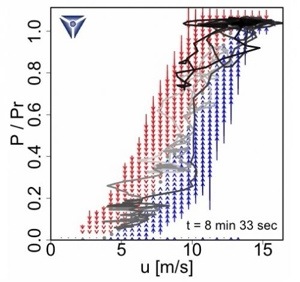
Screenshot … showing the power output vs. wind speed signals for a wind turbine. Credit: Patrick Milan, et al. ©2013 American Physical Society

20130420-132025.jpg

Shifting winds: A simulation shows the effects of turbulent wakes on downstream wind turbines. The turbulence affects air as high as a kilometer above the ground.

20130420-132339.jpg

University of Chicago researchers have created a synthetic compound that mimics the complex quantum dynamics observed in photosynthesis. The compound may enable fundamentally new routes to creative solar light harvesting technologies. Credit: Graham Griffin

20130420-132625.jpg

In a standard photovoltaic (PV) cell, each photon knocks loose exactly one electron inside the PV material. That loose electron then can be harnessed through wires to provide an electrical current. But in the new technique, each photon can instead knock two electrons loose. This makes the process much more efficient: In a standard cell, any excess energy carried by a photon is wasted as heat, whereas in the new system the extra energy goes into producing two electrons instead of one.

20130420-132902.jpg

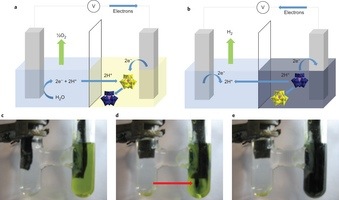
Schematic of the ECPB-based approach to water splitting. Credit: Nature Chemistry.
The process by which plants convert energy from the sun’s rays into chemical ‘fuel’ has inspired a new way of generating clean, cheap, renewable hydrogen

20130420-133252.jpg

(a) Diagram of the silicon nanopillar solar cell. (b) Diagram of the hybrid energy harvester consisting of a piezoelectric nanogenerator integrated on to of a silicon nanopillar solar cell. Credit: Dae-Yeong Lee, et al. ©2013 IOP Publishing Ltd

20130420-133719.jpg

Stanford researchers are developing rooftop panels that cool buildings by sending heat back into space, a technique that could be more efficient than running an air conditioner from solar panels.

And if you look you will find much more of the same…in some areas of the world Solar is more cost effective than other albeit expensive sources and the tech tends to be small scale he scale-able and independent of higher level infrastructure, be it a national grid link or capital level finance, and it tends towards robust systems with local failures isolated … It seems likely this is the future and wind will be relegated to niche plays. Which could still be important…. 20130420-134815.jpg

Batteries: Cheapest Form of Grid Power? Using a wind energy and expensive lithium-ion batteries, AES Energy Storage is making money by stabilizing the grid.

Smart Rock(ets)

20130420-120653.jpg

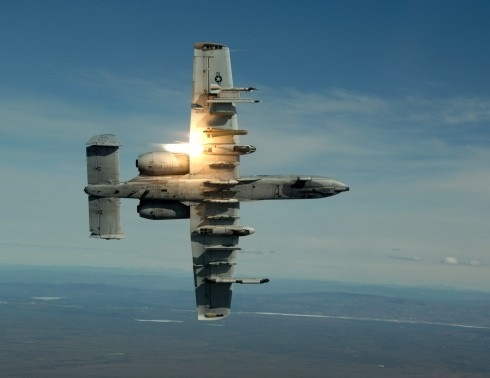
Classic shot of the classic, classy, grungy, so ugly it’s cute, A10 Warthog dropping a flare I think

The new family of 70mm laser guidance plug on warheads are another tick of the game precision warfare revolution.

What caught my eye:

While the APKWS, designed for maximum precision, has a Circular Error Probable (CEP) of about 2-meters, the round has exceeded this benchmark in testing and come within inches of targets at ranges up to 5 kilometers, according to BAE Systems officials.

Think about that … this is a WW II weapon and in the big picture inexpensive trending to dirt cheap. The guidance package-warhead replaces the dumb warhead, it has a trick laser based guidance system that is precise while leaving room for an effective warhead. The guidance system has an inertial reference platform and range finder…about the smarts and sensing of the original iPhone. In the future I see no reason it couldn’t have the ability to switch to pattern recognition guidance in the last few meters to go from inches to millimeters … At which point some targets don’t need an explosive ‘after.’

Soviet era rocket tech powers Anteres

20130418-202818.jpg

File photo of the NK-33 engine firing on a test stand. Credit: Aerojet

From space flight now an article on Orbital Science’s Anteres launcher, specifically the rocket engines. It’s interesting that the Soviets were so good at some things and awful at others.

But then engineering is a very neutral endeavor and one that can adsorb your passion and develop your stoic nature…very good things in Stalinist Russia.

One should also remember that while ‘the west’ got the ‘brains’ of the Nazi German Rocket cadre (like Werner vonBraun) the Russian’s got the great majority, the working engineer types, who in the end have to slog through the agony of turning strokes of genius into real hardware, and it’s the slog that gets you deep capability not the strokes.

The thousand yard stare

20130414-232724.jpg
Another ars technica article on the computer guided rifle. Though really cool tech and something I’d like to try out at the range, it’s a pretty creepy concept when thought about in a little detail (and its obvious that Lee Hutchinson the writer had some qualms.) But every advance in hunting tech has been seen that way … ‘hey Oog that clubs really unfair you ought to use rocks like the rest of the guys!’ … even the barely socially conscious among we advanced (maybe) apes know that killing should not be too easy.

US Air Force = ‘hollow force’ ?

20130414-134725.jpg

20130414-134734.jpg

20130414-134746.jpg

20130414-134756.jpg

20130414-134813.jpg

20130414-134821.jpg

20130414-134831.jpg

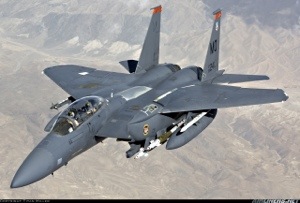
This article on the USAirForce in The American Interest is part of a series, incomplete as of this writing, on the US Armed Forces, and the road forward in this period of draw back and draw down. The ones on the Army and Marines are worthy and insightful but don’t get to the nitty gritty level required for me at least. While this AF article could be argued to be in the same vein I think it’s stronger and that may be because the technology and mission of the AF are very tightly interwoven making it simpler to see the overall threat.

The argument is that the AF has been all but static in the past 20+ years since Desert Storm. That a combination of victors-hubris along with techno-hubris and perhaps political ineptness have left us with a hollow force at the sharp end. The AF is arguably all over its technological mission in support of communication, reconnaissance, threat detection, navigation, etc, and has been shown to be king of battle in low intensity conflict (a turnaround of epic proportions from Vietnam.) But this camouflages the fact that if we had to do Desert Storm against a foe withe the modern equivalent of Saddam’s air defenses we would suffer vastly higher casualty rates, to the point of perhaps not being able to dominate the air space to anything like the same degree, perhaps pushing us back to an earlier era’s loss ratio’s.

There is a call to back the F35 and the NGB (next gen bomber) which I agree with since all other platforms are wearing and aging out (aging out happens as old tech ( particularly electronic and electromechanical) gets impossibly expensive to support because the devices and materials used are obsolete and no longer available sometimes even illegal due to toxicity or country of origin.)

I’m not bought in on the hollowness, yet. Yes the AF / DoD bolloxed the F35 and its now causing the above wear/age issue but does it matter? The first wave B2, B1 and cruise and strike missiles from B52’s etc would take down any known threat’s air defenses long enough for the channel to be cauterized by strike aircraft and special forces…which is what happened in DS. Yes some might have ability to hang tough with fighters, for a few hours, yes some might have backup lines and reserves, but having them and using them are two very different propositions once the AF is in their backfield.

What about a peer / near peer you ask? What peer / near peer I ask? Not NorK NorK, not Iran, not Russia or China either…a limited war against either is essentially the scenario above. Anything more in those two cases and sheer area would provide a huge force multiplier on their side. Thats ignoring the fact that both are serious nuclear powers and serious world diplomatic players who we are Never Going to War With directly until nuclear weapons are off the table…though of course you have to game the doomsday scenarios…but in those cases the war can never expected to be winnable or lovable in a conventional way.

Masten making progress

20130413-193501.jpg
Xaero B vertical landing rocket demonstrator completed first hot fire tests at Mojave, Calif, on April 9.

From AWST space blog this picture and a short piece on Masten Space Systems Xaero B vertical landing rocket demonstrator

The Xaero is a re-configured, more powerful, higher-altitude version of Masten’s Xombie which has been demonstrating precision flight control and landing. This craft should be capable of 6km hops, an even larger upgrade could do 200 km! They will carry various NASA sponsored payloads.

Xombie has demonstrated cm accuracy at touchdown, there is discussion of doing away with the landing legs and coming down into a landing cradle! That would be a big weight savings. If proven here then it would be viable for all of the V-V (Vertical take off Vertical landing) programs such as Blue Origin, SpaceXs fly back Falcons…

What I find interesting is this progress juxtaposed with a piece regarding the AF reusable Booster program, canceled last year. Of course the demo program was ambitious, leap ahead and risky + expensive. Perhaps it shows that the more incremental commercial approach is superior; more robust, affordable and supportable especially with todays design, analysis and fabrication technology.

Optical Research equipment via 3D Printing, signs of things to come.

20130409-212711.jpg
Perhaps not sexy but Right On! Article discusses the huge reduction in cost enabled by fabbing ones own optical components. Once scientists were the smart and the curious exploring the world with tools they made themselves. The wave of design software and fabrication tools, much like the wave of page design software and color printers of two decades ago, presage an utter change in the ability of the Everyman ( either, any sex, age) to explore to build/create and add to the sum of Mankind’s repository of knowledge / value.