Living tissue 3D printed

First fully-cellular liver tissue 3D bioprinted at Organovo

20130503-232416.jpg

Bioprinted human liver with CD31+ microvessels (green) forming within the tissue.

Since liver cells are used in labs to test the toxicity and efficacy of drugs, these printed tissues will first serve that purpose. Soon though, a larger liver will be printed, and it won’t be long after that that printed organs will be tested in animals. It’s a short hop from there to humans.

DARPA Finaly got the X51 to successfully ride its wave

20130503-204016.jpg

Tucked under the B-52H’s port wing, the X-51A is pictured prior to launch on May 1

At www.aviationweek.com

The U.S. Air Force has released new details of the record-breaking hypersonic test flight conducted by the Boeing-built X-51A Waverider demonstrator on May 1. The diminutive scramjet-powered vehicle achieved a blistering Mach 5.1, covering 230 naut. miles in just over six minutes (240 seconds!) over the Point Mugu Naval Air Warfare Center Sea Range in the Pacific.

This technology could be the next breakthrough for space booster technology…next as in ten to twenty years. In the meantime it could fuel a new arms race in rapid strike weapons. This is not a US first move, the Russians, Australians, the Europeans, maybe even the Chinese have been leading in this speed regime up to this point.

NASA may support SST x-plane

20130503-201749.jpg

An artist’s concept shows Lockheed Martin’s low-boom supersonic airliner. (Courtesy: NASA)
At www.flightglobal.com
Science and resultant technology may well have made Low Boom supersonic flight practical. A 100 to 150 passenger aircraft could fly NY to LA in something like 2 hours, making one day two way coast to coast trips a practical comfortable reality for premium passengers. This has been impossible because of the glass breaking, cattle disturbing sonic boom, but now aerodynamics and aircraft technology have shown a road forward.

With the ending of NASA’s last ‘five year plan’ on ultra efficient airliners, money will be available to build a scale but largish (fighter sized I’d guess) x-plane to make test flights provingthe boom mitigating design techniques. This sounds like a great idea, the sort of thing that NASA should be doing, has been doing, quietly, since its founding as NACA all those decades ago.

Galactic Virgin Rockets Away!

20130429-215041.jpg
Love the Logo-shot! The space ship’s pretty simple really, it’s biggest downside would seem to be no fly around capacity if one misses the runway line up, but 1) how often does that happen theses days? 2) if theirs any juice left in the oxidizer tank a short burn would do the trick. Anyone know the plan: depend on getting it right every time or lighting ‘er up for the go-round?

20130429-215802.jpg

The Senatorial Launch System | Asteroid Capture | Clueless Politicians | Pork | Engineering Jobs + Corporate Welfare

20130427-221407.jpg

Broadly, the administration envisions sending a probe as soon as 2017 to capture a 25-foot, 500-ton asteroid and tug it near the moon – possibly to a spot about 277,000 miles from Earth that would use competing gravitational forces to allow it to “sit” there. Astronauts flying NASA’s new Orion capsule and Space Launch System rocket then would visit it to take samples and possibly set foot on its surface.

This plan is getting pushback because its not a return to the moon or a Mars landing plan. But the reality is that this idea is all NASA can afford given the cost involved with the Senatorial ( or Space, take your pick) Launch System A Saturn V + class heavy lift direct ascent launch system

The lack of resistance is tied to Senate support of the Space Launch System. Senators from key NASA states – Florida, Texas and Alabama – pushed President Barack Obama to build it, and the asteroid mission is seen as a way to give purpose to the rocket, once criticized as a “rocket to nowhere.”
Illustrative of that point was the initial reaction of Sen. Richard Shelby, R-Ala.
“NASA should continue to explore the universe and challenge scientific and technical boundaries,” he said in a statement. “However, NASA should maintain focus on its core mission and continue development of the Space Launch System so that it will be ready for any future NASA mission.”

So my question is, why the SLS, don’t get me wrong some of the SLS related work like resurrecting the Saturn V F1 engine (as I pointed to a few days ago) is a good thing, but reality is it should be part of getting a commercial venture to back development. NASA shoulddevelop Orion and its support module, but the booster should be gov’t sponsored / stimulated effort as part of a get to the moon, Mars, big asteroids plan, in support of the commercial civilian space efforts.
If you look at all the recently proposed and ongoing civilian efforts and roll in appropriate gov’mnt support you can see a very robust human and robotic space development plan emerge.
Read more at: http://phys.org/news/2013-04-nasa-chief-asteroid-agency.html/

20130427-221747.jpg

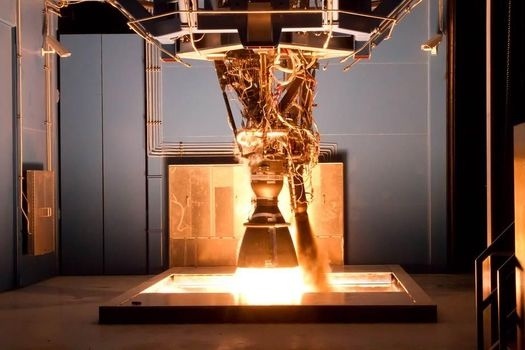
Merlin 1D engine ready for space

The SpaceX Merlin 1D engine, the more powerful, more robust and less expensive
follow on to the operational 1C, has been certified for flight.

20130423-232802.jpg
This is the family, an interesting thing about the Heavy is the plan to have the strap-ons share fuel with the core, consequently when they separate the core is still fully fueled, a big performance increase.

20130423-232817.jpg
The engines have been run far harder than standard rating regimes require, 1) to solidify their ‘man rating’ for future crew lofting flights, 2) because SpaceX wants to reuse them, 3) because SpaceX wants top line insurance rates for their customers even while brining new approaches to the party.

20130423-232832.jpg
Rocket engines, so ugly you just know they’re powerful!

SpaceX Grasshopper, hops up 820ft

Cool videos at the Verge article.

20130423-224330.jpg
Held at height and then landed straight down unaffected by what looks like a reasonable breeze.

Second gen Falcon this year, possibly Falcon Heavy first flight, soft water return for a booster this year and ground return next year! Each demonstrates fundamental capabilities and the power of a committed commercial / civilian play with tech and team unfettered by bull crap FARS oversight dead weight. But each is advancing tech at a rate that seems more reminiscent of the sixties NASA and aviation tech| 2nd gen Falcon: new improved engines, Heavy: buddy tank w/ common boosters engines, any of the above: fly back boosters w/ powered soft landing first at sea then on land. Each step something daring and commercially valuable. I’m not sure how some of the competitors keep from going into terminal depression, if Musk’s SpaceX team nails the string the old guard are toast.

1968

20130423-081645.jpg

20130423-081544.jpg
A long post on a turning point year.

Interesting that Mad Men, the iconic cable TV show about admen in that pivotal era seems to cause so much introspection.

Many reasons, many of today’s thinkers were young then, TV was really getting its legs, technology was vaulting forward but was now seen as a mixed blessing rather than untrammeled good, the almost unlimited growth of industry and regulation…or regulated industry was sputtering as the dead hands of regulation, unionization, corporatist over-reach, the limits of top down management and aging leadership (and infrastructure) began to run up against emergent back pressure from a rising Japan/Asia, Germany/Europe, Communism as an apparently proven long term competitor/threat.

20130423-082324.jpg

20130423-081701.jpg

20130423-081712.jpg

20130423-081741.jpg

20130423-081753.jpg

20130423-081800.jpg

20130423-082822.jpg

20130423-082832.jpg

Zero DS || Wired

20130422-091351.jpg
Article:Alexander George, Photo: Alex Washburn/Wired

When the light turns green and the two-lane road begins an ess turn, it’s clear the Zero DS is a true motorcycle, not just a scooter with sport bike pretensions. This is an electric hoon machine that will put you ahead of almost anything on four wheels. Going from a standstill to 60 mph takes a tick over five seconds, and high-end torque slings the bike through on-ramps with aplomb. The Zero has the power to inspire that smirk of speed euphoria I crave from a bike — something that hasn’t been lost with the removal of a traditional internal combustion engine.

20130422-091619.jpg

As a two-wheeled electric vehicle, the Zero DS is perfect. The engineering has accounted for everything important in a transportation vehicle. Riding the Zero, you think, this is how a civilized society should move about. This is a lithe and efficient vehicle, and an exemplar of what motorized travel should be: four-hundred pounds of weight moving between destinations silently, parking unobtrusively, and most of all, forcing the rider to be deliberate and unwasteful. Take only what can fit in the storage space and travel knowing that you have a finite range and must act resourcefully. Those restrictions, again, keep the Zero from being a true all-around motorcycle, but I like the idea of noble asceticism so long as the thrill of speed remains.