Why Tesla thrives while Fisker dives | MIT TR

20130406-093422.jpg

Tesla Model S

Tesla has had it’s ups and downs while Fisker has had it’s blips and boops, but Elon Musk’s (Tesla and SpaceX) has proven to be a serial innovator with a bloodhound nose for the right technical – business mash up. This MIT Technology Review piece comparing these two iconic eCar companies seems right on. And points to the government force fed A123 battery company as a compounding problem.

20130406-093432.jpg

Fisker Karma

Edited the title only…

Graphene foam

20130405-074734.jpg

Graphene, the material in pencil ‘lead’ has come to be seen as the new wonder carbon, fist it was Buckyballs (Bukminsterfullerene) then nanotubes, now graphene. Each a version of molecular carbon, one in the form of various size soccer ball like structures ( hexagonal flats giving it the form and name since Buckminster Fuller was the prophet of geodesic structures like domes, the last generation of fabric over structure aircraft, etc.) Nanotubes are fine latticework tubes (hexagonal lattice) and graphene is at its most basic a single atom thick sheet lattice (hexagonal again!) graphene has some extraordinary properties of interest to electrical, electronic, electo-optic, structural and other engineering technologies, it could be the basis of ‘the next industrial revolution.’

One of the latest latest graphene breakthroughs is its formation into open cell foams, some that are actually lighter than air! On the order of helium making it potentially possible to form foam balloons that fly. This piece describes the potential to use this ultra light material as a bio scaffold for the creation of organs etc,

Cool, quite literally

New type of solar structure cools buildings in full sunlight | phys.org, new technology based on nano tech material that tunes reflective / radiative properties of a surface, so efficient that its as effective as air conditioning powered by a similar sized PV panel. But this passive tech does not need to face the sun, radiating the heat back to space through the narrow band of frequencies that provide a window through our atmosphere.

20130330-193225.jpg

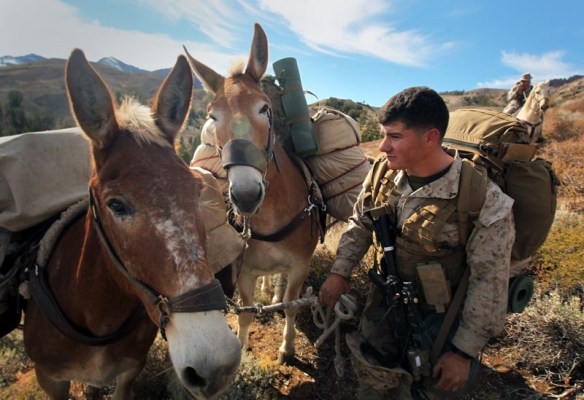
The Virtues of Stubbornness: Mules at War

The Virtues of Stubbornness: Mules at War
20130323-183837.jpg
Lance Cpl. Tyler Langford, anti-tank missileman, 3rd Battalion, 3rd Marine Regiment, leads his pack mule during a hike at Marine Corps Mountain Warfare Training Center Bridgeport, Calif., Oct. 13, 2012. Langford used skills he learned in the Animal Packers Course, taught four times a year at MCMWTC. The 16-day course teaches Marines how to use animals in the region they find themselves in as a logistical tool to transport weapons, ammunition, food, supplies or wounded Marines through terrain that tactical vehicles cannot reach. U.S. Marine Corps photo by Lance Cpl. Ali Azimi

Defense Media Network

Why DARPA has been working BigDog and other legged support robots, problem is that robots don’t eat grass, and can’t be grown on a farm.