At Boingboing a fascinating article about a man and his dogged development of something that might change the world.
Strange thrust: the unproven science that could propel our children into space By: Charles Platt

At Boingboing a fascinating article about a man and his dogged development of something that might change the world.

Anthropic principle and our finely-tuned Universe Ethan Siegel at Starts With A Bang!
How the mis-application of the Anthropic Principle has led factions of scientists away from the search for a natural, physical explanation of our Universe, and why that’s bad for everyone.
Image credit: ESO / T. Preibisch, via http://www.eso.org/public/images/eso1208a/
One of the first things you notice — and it’s self-evident if you think about it — is that the Universe is full of stuff. This in itself is a wondrous thing, because it didn’t need to be that way.
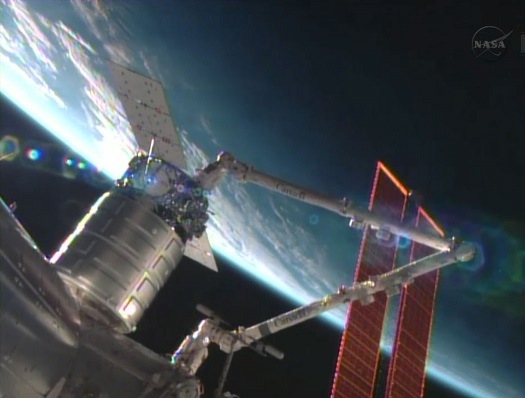
An Orbital Sciences Cygnus cargo ship reached the International Space Station early Sunday and was captured by the lab’s robot arm. The successful rendezvous marked a major milestone for NASA and a program to fund development of commercial cargo carries to replace capacity lost with the space shuttle’s retirement. (Credit: NASA TV)
L. Brad King’s prototype of a ferrofluid ion thruster. When subjected to magnetic field, the points of the crown arise from a ring-shaped trench circling a one-inch block of aluminum. (Credit: Sarah Bird)
then an electric field is applied which makes the ‘points’ extend to nano scale and then emit ionic molecules at high velocity. Very neat, self forming, self healing, some scaling details to work out but this looks very promising. Another tech breakthrough from Air Force R&D.
AUGUST 30, 2013 Care of: Carnival of Space #317Billionaire Peter Thiel funds Positron Dynamics who are developing a 10 microgram per week antimatter factory
For planetary, early interstellar precursor and simple omniplanetary applications, ACMF (antimatter catalyzed fusion) exhibits the best performance. The reference case of a 1-year human round-trip mission to Jupiter with a 10 to 100 metric ton (mT) payload requires an antimatter quantity of 1 to 10 micrograms (μg). It appears as though this requirement could drop into the 1 to 10 ng range for payloads consistent with unmanned, planetary missions.
So fuel for a trip to Jupiter (in one year!) every week.
“The evidence seems to be building that we are actually all Martians; that life started on Mars and came to Earth on a rock,” says Professor Benner. “It’s lucky that we ended up here nevertheless, as certainly Earth has been the better of the two planets for sustaining life. If our hypothetical Martian ancestors had remained on Mars, there might not have been a story to tell.”
Read more at: phys.org
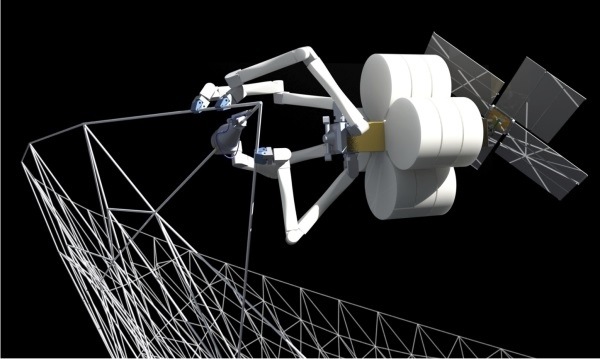
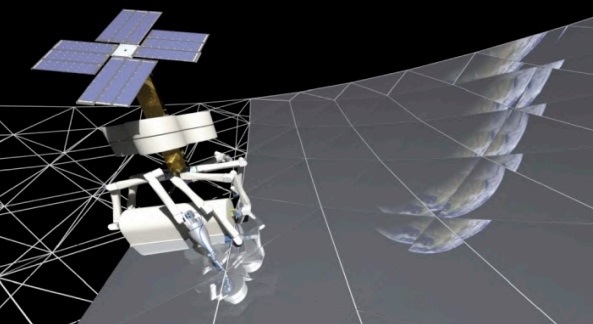
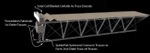
3ders.org a great 3 D printing site has this up…..TUI, a space technology development company based in Bothell, WA is currently developing “SpiderFab” to provide order-of-magnitude packing- and mass- efficiency improvements over current deployable structures and enables construction of kilometer-scale apertures within current launch vehicle capabilities.


Trusselator


SpiderFab project (credit: Tethers.com)
Go NASA!
Here is the TUI SpiderFab site
And remember this, Lego for the MIT set

Dynetics reporting “outstanding” progress on F-1B rocket engine
The prototype components were constructed not with welding and casting, but rather with selective laser melting—a 3D printing technique that uses hot lasers to fuse metal powder into complex shapes. Dynetics and Pratt Whitney Rocketdyne hope to lean heavily on advanced manufacturing techniques like this in order to massively reduce the part count—and hence cost—of the F-1B engine compared to its F-1 predecessor. Current estimates call for a reduction in the combustion chamber from more than 5,000 parts in the F-1 to fewer than 100 parts in the F-1B.
OK I loathe the senate taxripoff system (STS), otherwise known as the space transportation system, but this is absolutely cool. I have to say NASA engineers and scientists have done a lot of really great and innovative stuff, even in these tough times, but as an exploratory risk taking organization…..well they’re a bunch of engineers and scientists lead by bureaucrats and directed by politicians . . . what more is there to say?

See more at: Full Recovery Unlikely for NASA’s Kepler Planet-Hunting Spacecraft.
A sad but not surprising outcome, an unfortunate curtailment of the epoch opening instruments discoveries.