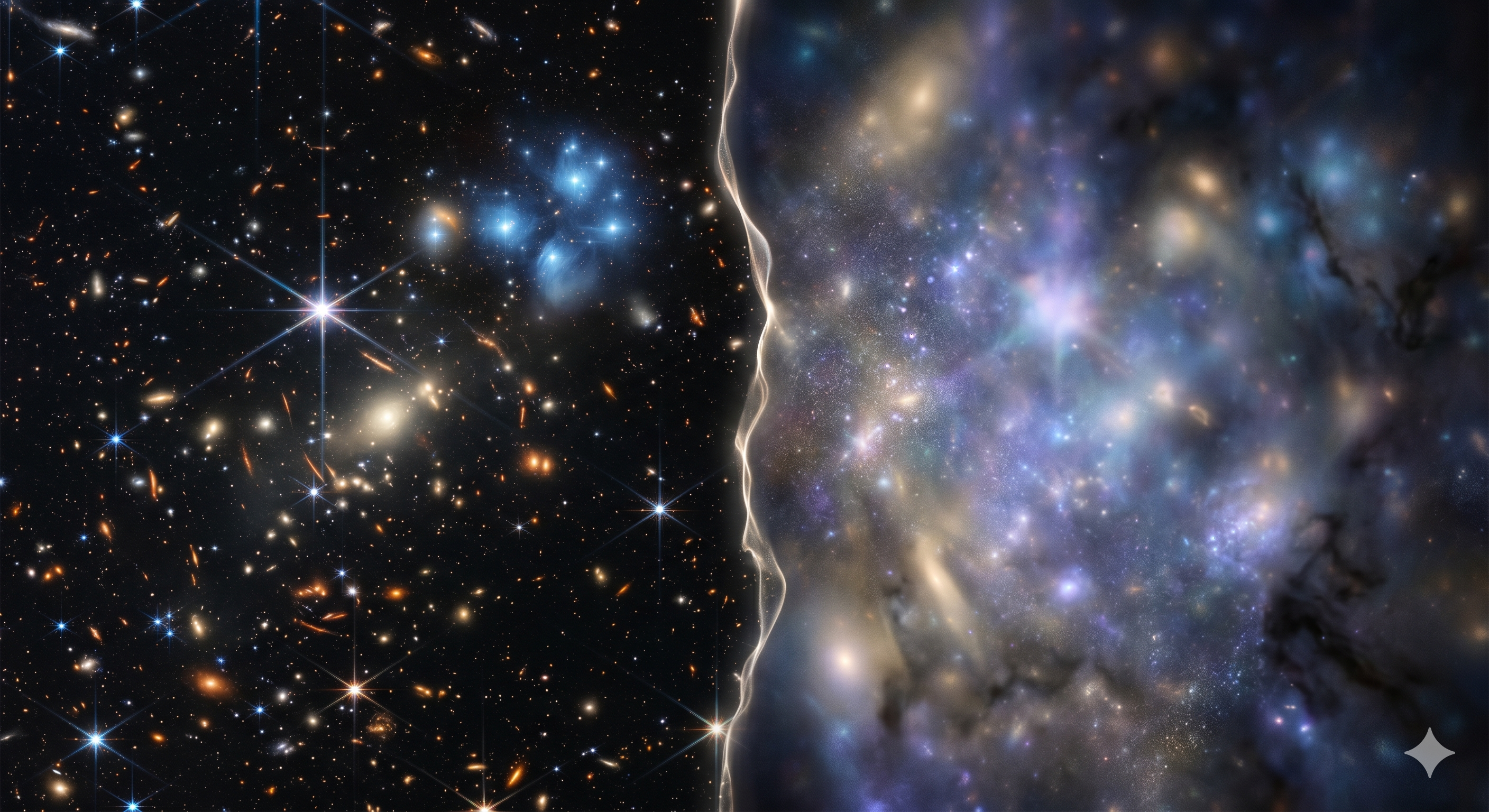
Fine-Tuning: The Argument That Won’t Die

The universe shouldn’t work.

That’s not a philosophical position. It’s an engineering observation. The constants that govern how matter behaves (the strength of gravity, the mass of the electron, the rate at which the universe expands) are set to values so specific that adjusting any of them by a fraction of a percent collapses the whole structure. No stars. No chemistry. No time long enough for anything to happen. The tolerances are absurd.

Physicists call this fine-tuning. The name is polite. What they mean is: the odds against this universe are so extreme that “chance” stops being a useful word for it.


The Two Escapes That Aren’t

Two answers dominate the debate, and neither is as clean as its proponents pretend.

The first is design. Someone set the dials. The universe looks like it was built for life because it was built for life. The problem is that this explains nothing mechanically; it just relocates the question one level up. Who built the builder? And why does a universe designed for life consist of 99.9999% lethal vacuum, with life confined to a thin biological smear on one unremarkable rock?

The second is the multiverse. If you generate enough universes (some versions say 10 to the power of 500, which is a number that has stopped meaning anything), eventually one rolls the right numbers. We’re in that one because we couldn’t exist in any other. This is the Weak Anthropic Principle: we observe what permits our observation. True, trivially. It explains why we’re here without explaining what set the parameters. It also requires an infinite number of unobservable universes as its load-bearing assumption, which puts it in the same epistemic category as the thing it’s trying to replace.

Both positions treat the constants as prior: fixed before any observer arrives. That assumption is where the argument gets interesting.


The Observer Problem

Quantum mechanics has an unresolved problem at its core. A particle exists in a superposition of states until it’s measured. At the moment of measurement, it resolves to one outcome. The math is exact. The mechanism is unknown. Why does observation collapse probability into actuality?

Most physicists park this question and get on with the calculations. A few take it seriously as a clue about the nature of reality.

John Wheeler spent decades on it. His conclusion, which he called the Participatory Anthropic Principle, was that observers don’t just record the universe; they bring it into being. Not metaphorically. Retroactively, through the act of observation, the universe acquires a definite history. Without observers, there is no collapse, no resolution, no definite past. The universe requires participants to be real.

QBism (quantum Bayesianism) pushes this further. The wavefunction isn’t a property of the universe out there; it’s an agent’s belief-state about what they’ll find when they interact with it. Reality is co-created at the moment of contact between observer and system. There is no view from nowhere.

These aren’t fringe positions. They’re minority positions within a field where the majority hasn’t solved the measurement problem either. The standard interpretation (Copenhagen) essentially says: don’t ask. The wavefunction collapses when observed. Move on. That’s not an answer, it’s a professional courtesy.


What We’re Actually Arguing About

The fine-tuning debate has lasted this long because it isn’t really a physics debate. The physics is genuinely unresolved, but the heat comes from elsewhere. Fine-tuning is a mirror. It reflects whatever you bring to it: the theologian sees confirmation, the materialist sees a threat, the philosopher sees an infinite regress.

What it actually is, stripped of the freight, is an open question about the relationship between observers and the reality they observe. That question is at the center of quantum mechanics, unsolved after a century. Anyone who tells you they’ve answered it (with God, with the multiverse, with consciousness) is telling you more about themselves than about the universe.

The constants are what they are. The blueprints are still inside the control room. We’re standing outside, listening to the machinery run, and arguing about what the building is for.


The Inversion

I write sci-fi. I often start with a “what if” and build a universe from there: its physics, its rules, any departures from today’s starting point, then the situation, the characters, and let the story build itself. I discover the story a bit like you do when reading it.

Taking the above as a starting point: what if the constants aren’t set in advance? What if consciousness and cosmos co-emerge, and the tuning is the relationship, not the precondition?

The standard framing puts observers at the end of a long causal chain: universe forms, constants happen to permit chemistry, chemistry permits biology, biology permits minds. Fine-tuning is the mystery at step one.

The inversion says: the chain runs both ways. The universe doesn’t pre-tune for life. It and life arrive together, and the constants we measure are not prior constraints but the record of that co-emergence. We don’t observe a fine-tuned universe. We participate in one.

This has a strange implication for the Fermi paradox. That paradox asks, why, given a universe old enough and large enough to have produced intelligence a thousand times over, do we seem to be alone in our corner of it?

The standard answers are grim (they’re dead, they’re hiding, travel is impossible) or optimistic (we’re early, they’re out there, we haven’t looked hard enough). The inversion suggests something stranger: each consciousness-cluster tunes its local physics. Not deliberately, not by choice. By existing. The region of space we occupy is already, in some structural sense, spoken for. Other intelligences don’t fail to appear nearby because they never had a chance to evolve. This doesn’t rule out life; it says intelligence has an even higher evolutionary mountain to overcome. It can happen, but the positioning required is exquisite. Intelligence is separated by immense time and space by definition.

Light speed remains the speed limit of natural change (at the Planck foam level, tuning can propagate no faster). The observable universe is many billions of light years across. Other consciousness-centers can evolve concurrently (whatever “at the same time” means across cosmological scales) and as their influence zones expand and eventually overlap, they settle toward equilibrium. There’s no reason other intelligences haven’t evolved, won’t evolve. They just do so in ways that place them very far from each other. If they’re too orthogonal to reconcile, the incompatibility itself forces a fork: a separate universe instance where both can exist without contradiction.


The Soft Edge

If the constants are the product of co-emergence rather than prior fixtures, they can’t be infinitely rigid. The consciousness-affected zone is vast, maybe millions of light years across, but we can see vastly further than that. The universe across its whole breadth had to have had us as a possibility from the first, so it will be largely coherent. But at the very edges, looking out into reaches beyond our tuned zone, we might see the occasional wobble against our expectations. We do see things we can’t explain. Maybe that’s one reason.

There also has to be some original malleability in the underlying structure. At the Planck length, if our theories are even close, that’s where it would live. Once set, some mechanism, some momentum, holds things together. What that is remains open. But the what-if builds from here: what if minds operate in a non-deterministic state because we evolved a mechanism that makes us more than puppets of causality? What if that mechanism could be amplified? Could the universe, at small scales, be nudged by will, by perception: a natural ability turned up just enough to matter?

The rules of physics we measure in our tuned pocket are local, not universal. Outside them, things are possible that our physics would classify as impossible. Not because the laws of nature have been broken. Because the laws in that region haven’t fully hardened.

This is what a rigorous theory of magic would look like. Not violation of physics. Physics that hasn’t finished resolving.

This isn’t a claim about how the universe works. It’s a coherent frame, reasonably consistent with what we don’t know about quantum measurement and observer participation, and more interesting than either of the standard escapes.

A novel I’m working on takes this seriously as a premise. It builds from the cosmology down to the plot: what happens when a civilization discovers this reality, and what it means that others in distant galaxies may have known it for a long time and have reason to worry about a new competitor.

The adventure and space opera come with the territory. But the physics is the foundation.

What if our physics is contingent rather than absolute?


If You Want to Pull This Thread

John Wheeler, “Information, Physics, Quantum: The Search for Links” (1989). The paper where Wheeler lays out “It from Bit” and the participatory universe. Dense, but the original argument in his own words.

David Deutsch, The Fabric of Reality (1997). Makes the case for the multiverse more rigorously than most popularizations, and is honest about what it costs philosophically. Good for understanding the strongest version of the position before deciding what you think of it.

Chris Fuchs on QBism. His papers are technical, but his interviews and lectures are accessible. Search “QBism Fuchs” and find a talk. The core idea (that the wavefunction is an agent’s belief, not a fact about the world) takes about twenty minutes to understand and longer to shake.

Nick Bostrom, Anthropic Bias (2002). The most careful treatment of observer-selection effects and the anthropic principle. Dry, rigorous, and it will make you distrust every argument in this space, including the ones in this post.


Tags: physics, philosophy, cosmology, fine-tuning, quantum mechanics, consciousness, Fermi paradox


📺 YouTube: The Unretired Engineer | 🔗 LinkedIn | 📚 Published works — M.A. Harris

Andy Weir’s Genius in Project Hail Mary

Andy Weir has a rare gift: he writes ordinary people — genuinely, recognizably ordinary — who have a skill that is also recognizable, and then puts them in situations where their one extraordinary competence is the only thing standing between them and death (in the case of Project Hail Mary, the extinction of the Human race.) The heroism is quiet and technical and you could almost believe that you could do that in the right circumstances.

You believe it because he’s made you believe in the person first. I saw the movie. I read the book years ago. Both are excellent, and the movie is one of the most faithful book-to-screen adaptations in recent memory.

Like The Martian before it, the film sticks closely to the book in both thesis and spirit. That fidelity matters: both stories rely on the reader/viewer trusting that the protagonist’s problem-solving is real, not movie-magic. Break that contract and the whole thing collapses. Weir earns it on the page; the filmmakers preserved it on screen.

The one genuine gap between novel and film is interior monologue. Novels handle internal states naturally; movies almost cannot. But Weir constructs scenes that externalize internal conflict visually — and those translate superbly.

A couple of minor side arcs from the book are absent, and I think those were wise cuts. They deepened the protagonist on the page but would have felt excessive at feature length.

One thread that bothered me in the book and still bugs me in the movie: Ryland Grace is pulled into the program because in his post-doctoral research he had proposed that alien life does not require water and carbon — and had defended that position to a career-ending degree. When the AstroPhage is first discovered it appears very alien, so Grace is brought in for initial analysis. He then finds it’s made of the same materials as Earth life — which undercuts his entire reason for being there and threatens to sideline him. That it doesn’t is a good twist; go see the movie or read the book for how it resolves.

Here’s where my engineering brain creates further friction. The AstroPhage’s energy density is extraordinary, and the novel acknowledges this and hand-waves it away. I cannot see how any life form built on biology similar to our own could handle those energy levels — it feels bolted in, even if it probably wasn’t. Similarly, Rocky — the alien Grace meets at the target sun — turns out to be exactly what Grace originally proposed: a non-water/carbon life form, which feels a little convenient in vindicating him.

There are complaints about Rocky delivering a specific thematic point about first contact and communication. My view is the opposite (other than the niggle above) that whole piece is brilliantly on point and there would not have been much of a story without it.

None of that diminishes what Weir achieves. He takes relatable people with very human quirks and puts them in situations where they have to fight to survive — and we root for them completely. And here i put the very alien Rocky in the bucket of people…he is about the best alien I have seen in a move ever. I wish I were half the author he is, and I say that as someone who is trying. Project Hail Mary is the rare book where you finish it and immediately want someone else to read it so you can talk about it. The movie earns the same feeling. Go see it.

The Physics Produced the Ship

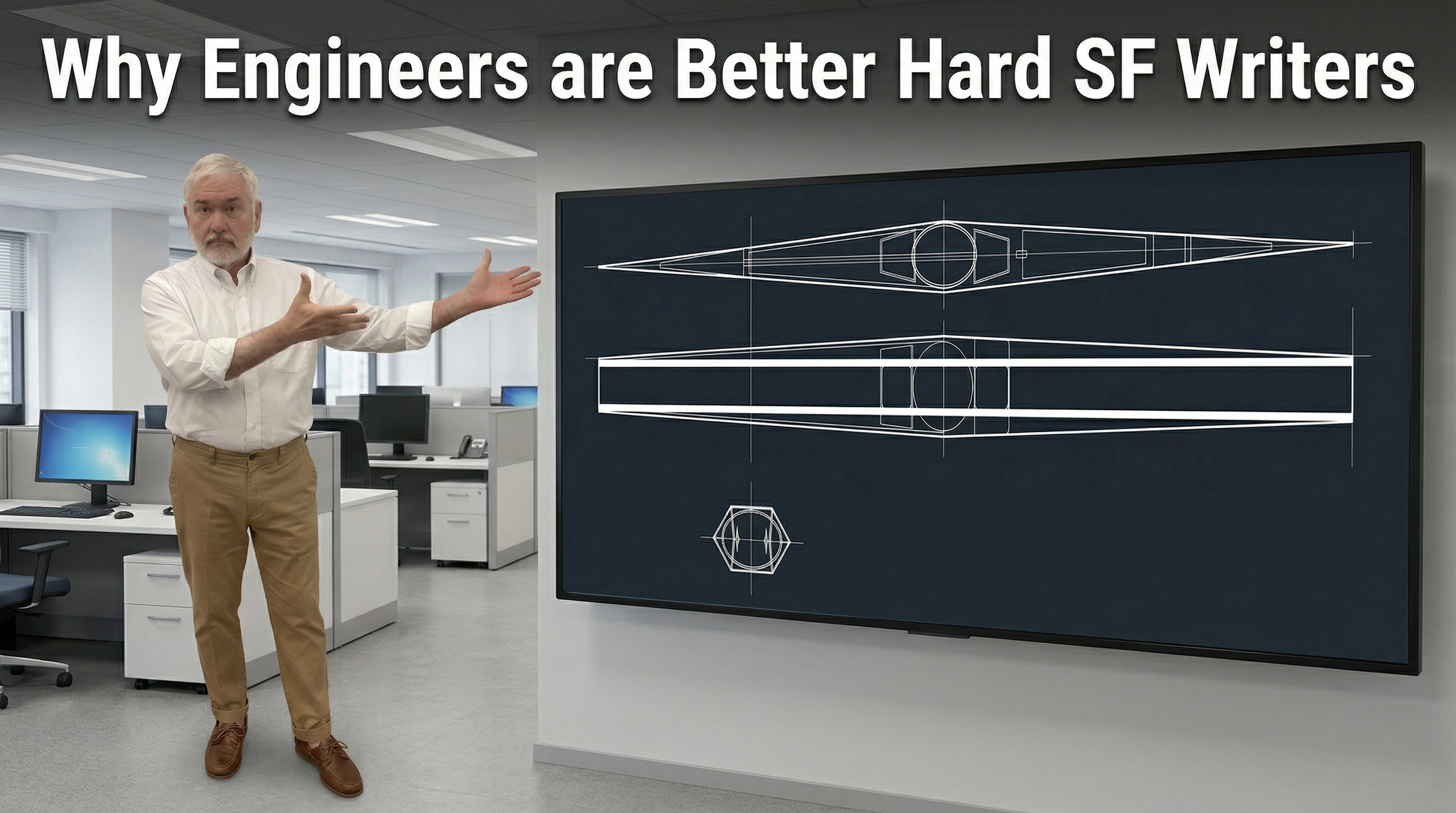
The Dagger Design

Most fictional spacecraft are designed backwards. The writer decides what the ship needs to do dramatically, then invents a reason it can do that. The result is technology that serves the plot. Which is fine, until you need it to do something different in book three, at which point you quietly bend the rules and hope no one notices.

Engineers don’t do that. Not because we’re more disciplined — because we can’t. You don’t change the spec because the schedule is tight. You re-examine the architecture or you live with the constraint.

That instinct, applied to fiction, produces something different.


The principal auxiliary warship in the Sea of Suns universe is called a Dagger. Here’s how it got its name — and it wasn’t because I thought “dagger” sounded good.

The Transit system — the FTL drive in this universe — works through a rail. The rail is a linear gravity generator that manipulates quantum foam to open a wormhole large enough for the ship to pass through. The rail controls volume you can push through: the more mass you want to move between stars, the more rails you need. Compute controls speed: the transit step is a calculation, and the faster you want to step, the more computing capacity you need.

That trade-off isn’t decoration. It’s the architecture.

An auxiliary warship needs to be fast. In this universe, fast means compute capacity. Compute capacity takes up volume inside the vessel. So a fast warship is, almost by definition, a ship that has traded its interior for processors. Twin rails — enough to move a meaningful crew and weapons load — with almost every remaining cubic metre given over to compute. Crew of two to five on a thousand-foot vessel. Not much else aboard.

Now you have a ship that’s fast, carries almost no cargo, and spends all its operational time in real space. Real space means it’s detectable. A detectable warship needs stealth. The most effective passive stealth for a vessel in this universe is minimising cross-section — flat surfaces, minimal radar return. You sheath the hull in flat panels that force the profile into a long, slender blade shape.

The name isn’t metaphor. It’s a description of what the physics produced.

I didn’t design a cool warship and retrofit a justification. The constraints generated the vessel, and then the vessel generated scenes I hadn’t planned, because once you know what a Dagger can and can’t do, certain tactical situations become inevitable.


That’s the engineer’s advantage in hard SF, and it’s not what most people think it is.

It’s not technical accuracy. You’ve invented the technology — accuracy isn’t really the point. It’s that engineering training gives you a specific habit of mind: ask what the constraints produce, not what you need them to produce. Follow the logic. Let the system build itself.

When the system is honest, the world it generates is consistent without effort, because everything follows from the same rules. The Dagger’s tactical role, its crew size, its limitations, the scenarios it enables — none of that required invention. It came out of the trade-off.

The reader doesn’t need to understand the Transit physics to feel that the Dagger is real. They just need to encounter it behaving consistently with itself across the whole story. That consistency is what creates the texture that makes a fictional universe feel inhabited rather than constructed.

Thirty years of engineering taught me that coherent systems generate their own logic. Turns out that works in fiction too.


Why Engineers Write Better Hard SF is on The Unretired Engineer YouTube channel —

Stranded in the Stars, Book One of the Sea of Suns Trilogy, is available on Kindle. The Dagger appears early and often. https://www.amazon.com/Stranded-Stars-M-Harris-ebook/dp/B0GT123PLP

Aliens? The Science Says no….but does it?

Artist’s concept of interstellar object1I/2017 U1 (‘Oumuamua) as it passed through the solar system after its discovery in October 2017. The aspect ratio of up to 10:1 is unlike that of any object seen in our own solar system. Image Credit: European Southern Observatory / M. Kornmesser
From NASA Article

The first known interstellar object to visit our solar system, 1I/2017 U1 ‘Oumuamua, was discovered Oct. 19, 2017 by the University of Hawaii’s Pan-STARRS1 telescope, funded by NASA’s Near-Earth Object Observations (NEOO) Program, which finds and tracks asteroids and comets in Earth’s neighborhood. While originally classified as a comet, observations revealed no signs of cometary activity after it slingshotted past the Sun on Sept. 9, 2017 at a blistering speed of 196,000 miles per hour (87.3 kilometers per second). It was briefly classified as an asteroid until new measurements found it was accelerating slightly, a sign it behaves more like a comet.

This very deep combined image shows the interstellar object ‘Oumuamua at the center of the image. It is surrounded by the trails of faint stars that are smeared as the telescopes tracked the moving comet. Credit: ESO/K. Meech et al.
From NASA Article

The second image is to make you think. Given one of our very powerful telescopes that faint dot circled in the center is all we ever saw of Oumuamua. With our computational tools we could detect that it was accelerating and get an idea of the surface composition but the data we collected was negligible (though also amazing given the distance and velocity of this objectively tiny object.)

Image credit: Kris Snibbe/Harvard file photo.
From Extraterrestrial, Oumamua as Artifiact

Extraterrestrial: On ‘Oumuamua as Artifact

by PAUL GILSTER on FEBRUARY 23, 2021

The reaction to Avi Loeb’s new book Extraterrestrial (Houghton Mifflin Harcourt, 2021) has been quick in coming and dual in nature. I’m seeing a certain animus being directed at the author in social media venues frequented by scientists, not so much for suggesting the possibility that ‘Oumuamua is an extraterrestrial technological artifact, but for triggering a wave of misleading articles in the press. The latter, that second half of the dual reaction, has certainly been widespread and, I have to agree with the critics, often uninformed.

The article in CentauriDreams, as always excellent, discusses the reaction to the book which is very much in line with the arguments of the book itself.

The author of the Book a Harvard Astronomer of high repute, says that the data actually points to Oumuamua being an artifact and that since that theory best fits the data…then it is/was an extraterrestrial visitor. He then goes on review other theories and the way that the science community came together to present a ‘consensus’ that was more about PR and making the life of the average person in the broad community of sky explorers easier rather than doing the hard work of explaining multiple theories and sets of data that left the question very open and leaving a starkly amazing option in play.

Essentially this is about the science and the science community but also about Journalism in its debauched epoch. Many of us grew up with science being pushed as a noble, maybe the last noble, adventure. With heroes and a few villains. Heroes of the mind and of letters and video who didn’t get shot at or mugged or even have to live rough. Carl Sagan, Attenborough, many other names come to mind.

The problem is that these men and women were scientists, academics, with deep knowledge, if often deeply attached to one trope, and great communicators. Far too many of those who followed were/are attached to a trope and its alignment with their desired outcome. Without the background/willingness to understand that even the most beautiful theory may be utterly wrong and always HAS to be able to stand up to any counter evidence presented.

Also the scientific community, once quite a small community is now huge, with all the pressures of a large bureaucratic endeavor to go along to get along; careerism; group think; cliques; etc. And especially in ‘charismatic’ endeavors like space the pressure is to be ‘in the consensus’ and ‘never be caught wrong footed in the lime light.’

Cheers….

Let space bring us together

One of the things that stabilizes a civilization (IMO) is the ability to expand. Like an imaginary pressure vessel with a self replicating gas one can see that at the beginning the gas molecules bouncing around have plenty of space, the ‘pressure’ on the cylinder is negligible and the molecules don’t collide that often. As the molecules become more abundant the pressure and the collisions build. If there is some external source of ‘heat’ say the energy of invention etc, the pressure builds even more and the ‘collisions’ are more violent. Eventually the pressure vessel gives way along fracture lines and explodes releasing the gas into the void….

Carry that image a bit longer, this almost mimics what happened to a lot of the early civilizations. They blew up and dissipated into the wilds leaving almost nothing behind except wreckage.

America (and other civilizational islands let’s call them) had an immense (to them) hinterland. The pressure vessel had something like a sealed bellows (or say a metal balloon) that was stiff, wouldn’t expand easily but could expand. The particles would ‘explore’ this even early on. The cold walls ‘cooled / calmed’ the average energy and allowed the particles to rub along with each other better. As the particles multiply the bellows/balloon expands releasing the pressure on the parent pressure vessel, and providing more wall to absorb energy at the same time.

The human ‘particles’ in our pressure vessel continue to multiply, thankfully, hopefully, at an increasingly slower rate. But the ‘energy’ of invention and desire for ‘happiness’ continues to flow and be amplified by those people/particles. Rearranging the particles…partially solidifying them?…in urban masses lowers the pressure in some ways but does not eliminate it. It provides pseudo new space for the really energetic particles say. But in reality do what we can on this world the pressure will grow too great unless we expand into, we need newSpace.

Even the space (volume) of our solar system is almost infinite from the perspective of the human particles today. And the boundaries of ‘our system’ are only imaginary. The universe is here there and everywhere and there is no reason not to make it ours except fear, mostly fear of ourselves.

We need frontiers, we need places where we can be with ourselves, we need challenge but also calm centers. While the homes we create away from our birthplace will be nothing like what we see today, our descendants will love and hold them just as close to their heart as we hold our home and our memories.

To explore you need Access

Photo of a nuclear thermal propulsion (NTP) system from the Rover/NERVA programs (left) and a cutaway schematic with labels (right). SOURCE: M. Houts et. al., NASA’s Nuclear Thermal Propulsion Project, NASA Marshall Space Flight Center, August 2018, ntrs.nasa.gov/citations/20180006514.
Space Nuclear Propulsion for Human Mars Exploration
National Academics of Sciences, Engineering and Medicine
National Academies Press
2021
[ParabolicArc Executive Summary, Findings & Recommendations from National Academies Report on Space Nuclear Propulsion
February 13, 2021 Doug Messier
]

While a chemically powered trip to Mars is feasible given the ability to lift a lot of mass so orbit, See SpaceX-Elon Musk, this is probably not the solution you would go for first. I think it makes sense as part of the Vision Setting that Musk does but the preference has always been for nuclear propulsion it enables faster (safer) trips and makes reusability even more effective since the ‘shuttles’ are not spending many months in transit each way.

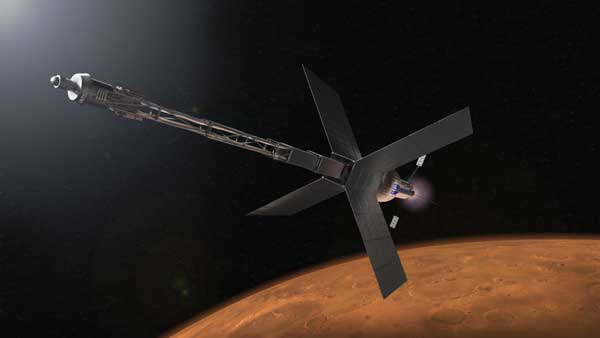
Posit a Freighter something like the illustration below. Departing Mars having dropped of say 2, 3, 4 starships’ worth of cargo. MarsStarships shuttle up and down and provide point to point transport on Mars. EarthStarships shuttle cargo up to earth orbit. Maybe LunarStarships shuttle fuel from production stations on the Moon to reduce the cost of fuel for the starships and the Freighter.

Illustration of a Mars transit habitat and nuclear propulsion system that could one day take astronauts to Mars. (Credits: NASA) [ParabolicArc: Executive Summary, Findings & Recommendations from National Academies Report on Space Nuclear Propulsion February 13, 2021 Doug Messier]

Now you have a system that provides Access to the solar system with significant cargos and the ability to establish and support exploration stations wherever you go.

WOW! A cool SETI theory…

Figure: The Wow! Signal. The peak is 32 times the signal to noise ratio of the observations. Courtesy of Sam Morrell. (From the article)

Not much more to be said so I post the intro to the article from Centauri Dreams, about an article/Theory by James Benford. Cool…

Was the Wow! Signal Due to Power Beaming Leakage?

by PAUL GILSTER on JANUARY 22, 2021

The Wow! signal has a storied history in the SETI community, a one-off detection at the Ohio State ‘Big Ear’ observatory in 1977 that Jim Benford, among others, considers the most interesting candidate signal ever received. A plasma physicist and CEO of Microwave Sciences, Benford returns to Centauri Dreams today with a closer look at the signal and its striking characteristics, which admit to a variety of explanations, though only one that the author believes fits all the parameters. A second reception of the Wow! might tell us a great deal, but is such an event likely? So far all repeat observations have failed and, as Benford points out, there may be reason to assume they must. The essay below is a shorter version of the paper Jim has submitted to Astrobiology.