With the spate of announcements about private space missions over the past year, it’s easy to lose track of the who, what, where, when, why and how of the flights.
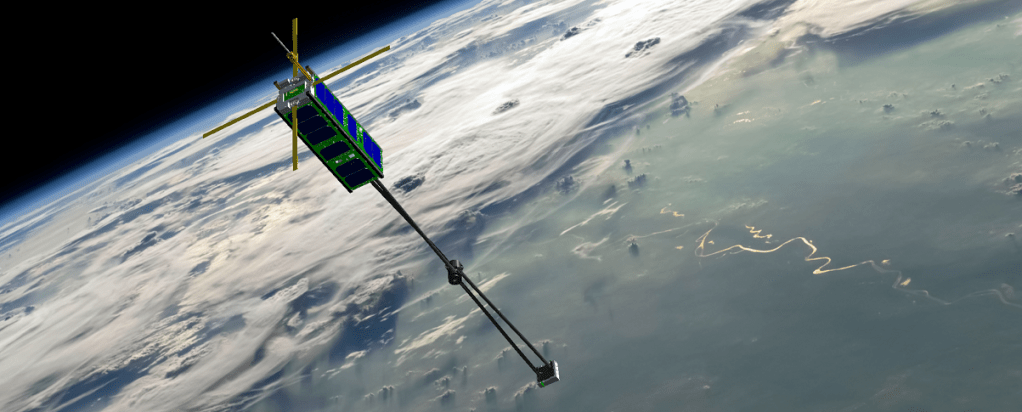
MiTEE is a cool space experiment out of the University of Michigan. Faculty led, undergraduate, graduate and PhD student team, developed and got launched a cube (stack) satellite that is demonstrating the use of tethers for de orbiting spacecraft, a serious need in this day of thousand plus satellite constellations.
As a note of interest this was on the first successful Virgin Orbit launch.
The Wow! signal has a storied history in the SETI community, a one-off detection at the Ohio State ‘Big Ear’ observatory in 1977 that Jim Benford, among others, considers the most interesting candidate signal ever received. A plasma physicist and CEO of Microwave Sciences, Benford returns to Centauri Dreams today with a closer look at the signal and its striking characteristics, which admit to a variety of explanations, though only one that the author believes fits all the parameters. A second reception of the Wow! might tell us a great deal, but is such an event likely? So far all repeat observations have failed and, as Benford points out, there may be reason to assume they must. The essay below is a shorter version of the paper Jim has submitted to Astrobiology.
These craft and others such as craft like the voyagers continue to return immensely valuable data long after their primary mission is complete. One of the things NASA and other space science organizations struggle with is supporting these ships long after the original funding timeline is past. This is a great problem to have and by and large the money is found since these are very cheap deep space projects in the big picture.
So my title, the economy of ‘outer space’ is all about data, science, prospecting right now. These are valuable assets that we need to support to provide returns orders of magnitude greater than the cost in the sense of other ways of getting that data, data that is both live affirming in its fascination and valuable as part of the bedrock of our understanding of the universe.
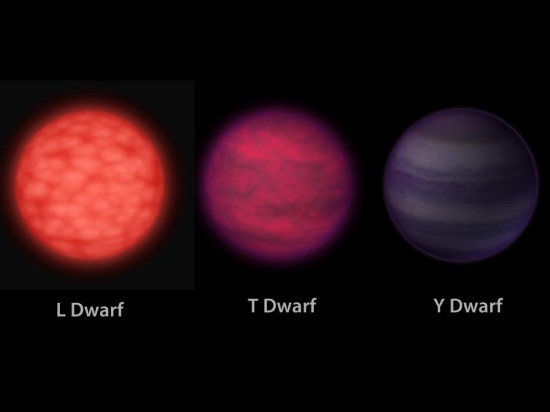
Image: This artist’s conception illustrates what brown dwarfs of different types might look like to a hypothetical interstellar traveler who has flown a spaceship to each one…. Credit: NASA/JPL-Caltech.
There are a class of celestial objects much heavier than our systems Jupiter but about the same size. They are not really planets just balls of dense hot gas, but they are not really stars because they lack the mass to collapse and heat their core to ignite sustained fusion. These Brown Dwarves are probably one of the most common objects in our universe but little is known about them because until recently they were essentially impossible to find. With new tools and new techniques this fascinating class of in between are coming into focus.
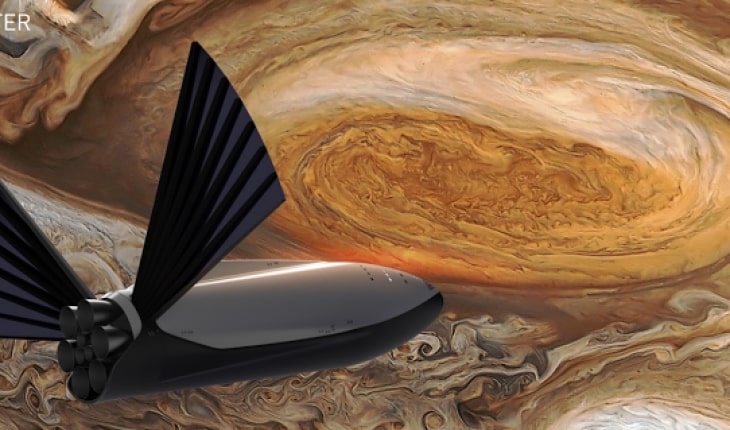
The proposed Juno extended mission (EM) would take advantage of the natural northward progression of the periapsis of the spacecraft’s orbit and the consequent lowering of spacecraft altitudes over Jupiter’s high northern latitudes. The EM would run until the end of the mission, with an expected duration of approximately four years. Under the High and Medium Scenarios, propulsive maneuvers would be utilized not only to target Jupiter-crossing longitude and perijove altitude, as during the prime mission, but also to target close flybys of Ganymede, Europa, and Io. The flyby maneuvers would act to shorten the spacecraft orbital period, yielding more close passes of Jupiter within a given time interval, and increase the rate of northward movement of spacecraft perijove. Under the Low scenario for EM operation, the satellite gravity assists and close satellite flybys would not be attempted.
from the Senior Review
Exciting new data from Jupiter inbound over the next 5 years. Just in time for this….
I follow Centauri Dreams closely, it is a very good source on fascinating articles about what might be called the near universe and our ability to explore it. Dealing with the outer solar system and beyond, near future realistic interstellar exploration in all its technical gore.
A recent article (A Statite ‘Slingshot’ for Catching Interstellar Objects by PAUL GILSTER on JANUARY 5, 2021) dealt with how to intercept/flyby interstellar objects (ISO) like ‘Oumuamua’ the icicleoid. This is very much in line with Arthur C. Clark’s classic (and my near all time favorite Science Fiction) Rendezvous with Rama, about the passage of a vast interstellar space ship through Sol system and a desperate dangerous mission to intercept and explore.
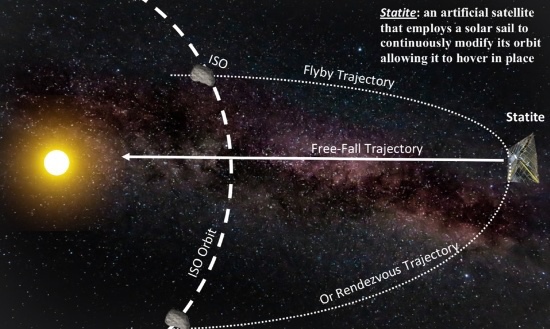
With current technology this appears impossible, you’d have to plan and launch a mission with a Falcon Heavy class craft in a few months to have any kind of chance. But there is a near term possible technology that makes it almost easy. The Statite is a ‘satellite’ that uses a solar sail to ‘hover’ instead of kinetic energy to orbit. Essentially this is storing energy and either the main vehicle or a cube sat sized sub satellite can be dropped straight down the gravity well to gain the velocity required to get the flyby in time. This is REALLY COOL stuff….
From the article, A Statite ‘Slingshot’ for Catching Interstellar Objects.