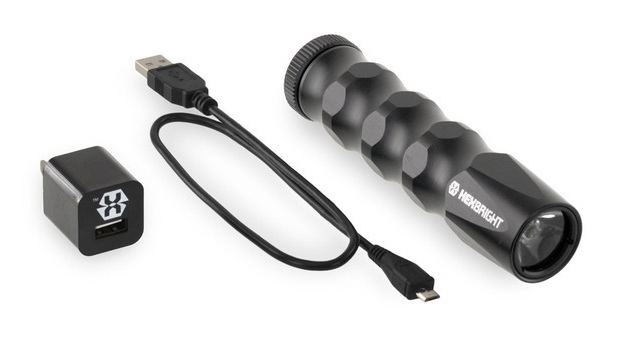
Make magazine article, Kickstarting the Hexbright adventures in flashlight hacking

Make magazine article, Kickstarting the Hexbright adventures in flashlight hacking
From molecules to gallons: Scaling up fuels created by artificial photosynthesis: Sabin Russell @ :phys.org
Ok so I’m a geek but I see this a neat and a form of artistry.
Self similar patterns, derived from nature’s models, provide a route to scale from meters to sub micron with features of self assembly and ‘natural’ scaling. Allowing fluids to flow in and out of a microscopic reaction site at macro-scales.

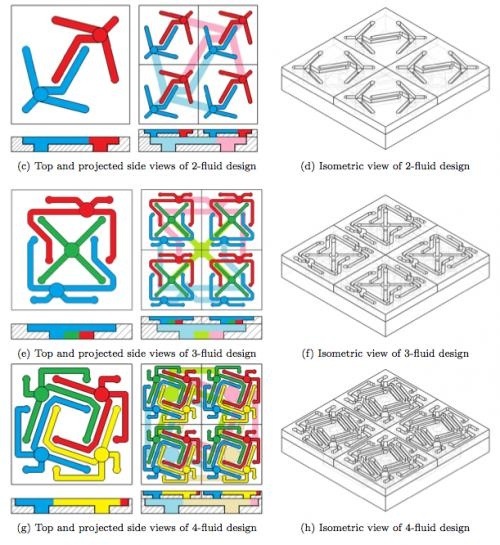
Seems to me it’s at least: attention to detail and a sense of style based on function, and I do not mean style as in surface looks, at least not alone.


This is the family, an interesting thing about the Heavy is the plan to have the strap-ons share fuel with the core, consequently when they separate the core is still fully fueled, a big performance increase.
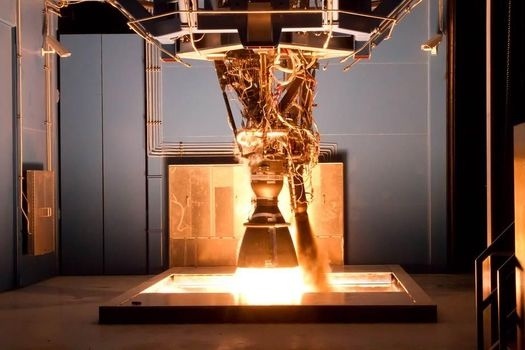
The engines have been run far harder than standard rating regimes require, 1) to solidify their ‘man rating’ for future crew lofting flights, 2) because SpaceX wants to reuse them, 3) because SpaceX wants top line insurance rates for their customers even while brining new approaches to the party.

Rocket engines, so ugly you just know they’re powerful!
Cool videos at the Verge article.

Held at height and then landed straight down unaffected by what looks like a reasonable breeze.
Second gen Falcon this year, possibly Falcon Heavy first flight, soft water return for a booster this year and ground return next year! Each demonstrates fundamental capabilities and the power of a committed commercial / civilian play with tech and team unfettered by bull crap FARS oversight dead weight. But each is advancing tech at a rate that seems more reminiscent of the sixties NASA and aviation tech| 2nd gen Falcon: new improved engines, Heavy: buddy tank w/ common boosters engines, any of the above: fly back boosters w/ powered soft landing first at sea then on land. Each step something daring and commercially valuable. I’m not sure how some of the competitors keep from going into terminal depression, if Musk’s SpaceX team nails the string the old guard are toast.
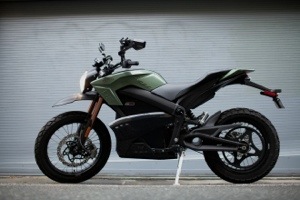
Article:Alexander George, Photo: Alex Washburn/Wired
When the light turns green and the two-lane road begins an ess turn, it’s clear the Zero DS is a true motorcycle, not just a scooter with sport bike pretensions. This is an electric hoon machine that will put you ahead of almost anything on four wheels. Going from a standstill to 60 mph takes a tick over five seconds, and high-end torque slings the bike through on-ramps with aplomb. The Zero has the power to inspire that smirk of speed euphoria I crave from a bike — something that hasn’t been lost with the removal of a traditional internal combustion engine.

As a two-wheeled electric vehicle, the Zero DS is perfect. The engineering has accounted for everything important in a transportation vehicle. Riding the Zero, you think, this is how a civilized society should move about. This is a lithe and efficient vehicle, and an exemplar of what motorized travel should be: four-hundred pounds of weight moving between destinations silently, parking unobtrusively, and most of all, forcing the rider to be deliberate and unwasteful. Take only what can fit in the storage space and travel knowing that you have a finite range and must act resourcefully. Those restrictions, again, keep the Zero from being a true all-around motorcycle, but I like the idea of noble asceticism so long as the thrill of speed remains.

This spectacular image of comet Tempel 1 was taken 67 seconds after it obliterated Deep Impact’s impactor spacecraft. Credit: NASA/JPL-Caltech/UMD
Currently, Bhaskaran is running simulations that make his virtual impactor go splat against the furrowed, organic-rich regolith of asteroid 1999 RQ36. The 1,600-foot-wide (500-meter-wide) space rock is the target of a proposed JPL mission called the Impactor for Surface and Interior Science (ISIS). The impactor spacecraft, which looks a little like a rocket-powered wedding ring, would hitch a free ride into space aboard the rocket carrying NASA’s InSight mission to Mars. The impactor’s trajectory would then loop around Mars and bear down on RQ36.
“One of the things that helps me sleep at night is that we know a lot about RQ36 because it is the target of another NASA mission called OSIRIS-REx,” said Bhaskaran. “But it also provides some challenges because the scientists want us to hit the asteroid at a certain moment in time and at a certain location, so that the OSIRIS-REx spacecraft can be sure to monitor the results from a safe vantage point. It is a challenge but it’s also really exciting.”
Read more at: http://phys.org/news/2013-04-asteroid.html#jCp
To me it looks like wind power is a long term loser, I think the capital intensive and land intensive technology may be overtaken by solar…partly because solar seems much more amenable to new nanotechnology ‘helpers’ in comparison to the relatively old school large scale engineering materials tech that dominate wind … And it seems like their are many more complex scaling issues with wind in comparison to solar.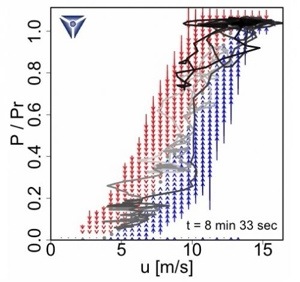
Screenshot … showing the power output vs. wind speed signals for a wind turbine. Credit: Patrick Milan, et al. ©2013 American Physical Society
Shifting winds: A simulation shows the effects of turbulent wakes on downstream wind turbines. The turbulence affects air as high as a kilometer above the ground.
University of Chicago researchers have created a synthetic compound that mimics the complex quantum dynamics observed in photosynthesis. The compound may enable fundamentally new routes to creative solar light harvesting technologies. Credit: Graham Griffin
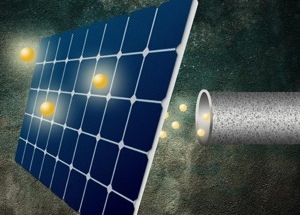
In a standard photovoltaic (PV) cell, each photon knocks loose exactly one electron inside the PV material. That loose electron then can be harnessed through wires to provide an electrical current. But in the new technique, each photon can instead knock two electrons loose. This makes the process much more efficient: In a standard cell, any excess energy carried by a photon is wasted as heat, whereas in the new system the extra energy goes into producing two electrons instead of one.
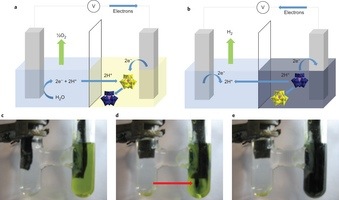
Schematic of the ECPB-based approach to water splitting. Credit: Nature Chemistry.
The process by which plants convert energy from the sun’s rays into chemical ‘fuel’ has inspired a new way of generating clean, cheap, renewable hydrogen
(a) Diagram of the silicon nanopillar solar cell. (b) Diagram of the hybrid energy harvester consisting of a piezoelectric nanogenerator integrated on to of a silicon nanopillar solar cell. Credit: Dae-Yeong Lee, et al. ©2013 IOP Publishing Ltd
Stanford researchers are developing rooftop panels that cool buildings by sending heat back into space, a technique that could be more efficient than running an air conditioner from solar panels.
And if you look you will find much more of the same…in some areas of the world Solar is more cost effective than other albeit expensive sources and the tech tends to be small scale he scale-able and independent of higher level infrastructure, be it a national grid link or capital level finance, and it tends towards robust systems with local failures isolated … It seems likely this is the future and wind will be relegated to niche plays. Which could still be important…. 
Batteries: Cheapest Form of Grid Power? Using a wind energy and expensive lithium-ion batteries, AES Energy Storage is making money by stabilizing the grid.
30,000 nano sponges per blood cell membrane, absorbs toxins and decoys the bacterial infection.

Classic shot of the classic, classy, grungy, so ugly it’s cute, A10 Warthog dropping a flare I think
What caught my eye:
While the APKWS, designed for maximum precision, has a Circular Error Probable (CEP) of about 2-meters, the round has exceeded this benchmark in testing and come within inches of targets at ranges up to 5 kilometers, according to BAE Systems officials.
Think about that … this is a WW II weapon and in the big picture inexpensive trending to dirt cheap. The guidance package-warhead replaces the dumb warhead, it has a trick laser based guidance system that is precise while leaving room for an effective warhead. The guidance system has an inertial reference platform and range finder…about the smarts and sensing of the original iPhone. In the future I see no reason it couldn’t have the ability to switch to pattern recognition guidance in the last few meters to go from inches to millimeters … At which point some targets don’t need an explosive ‘after.’





 This World and Others