
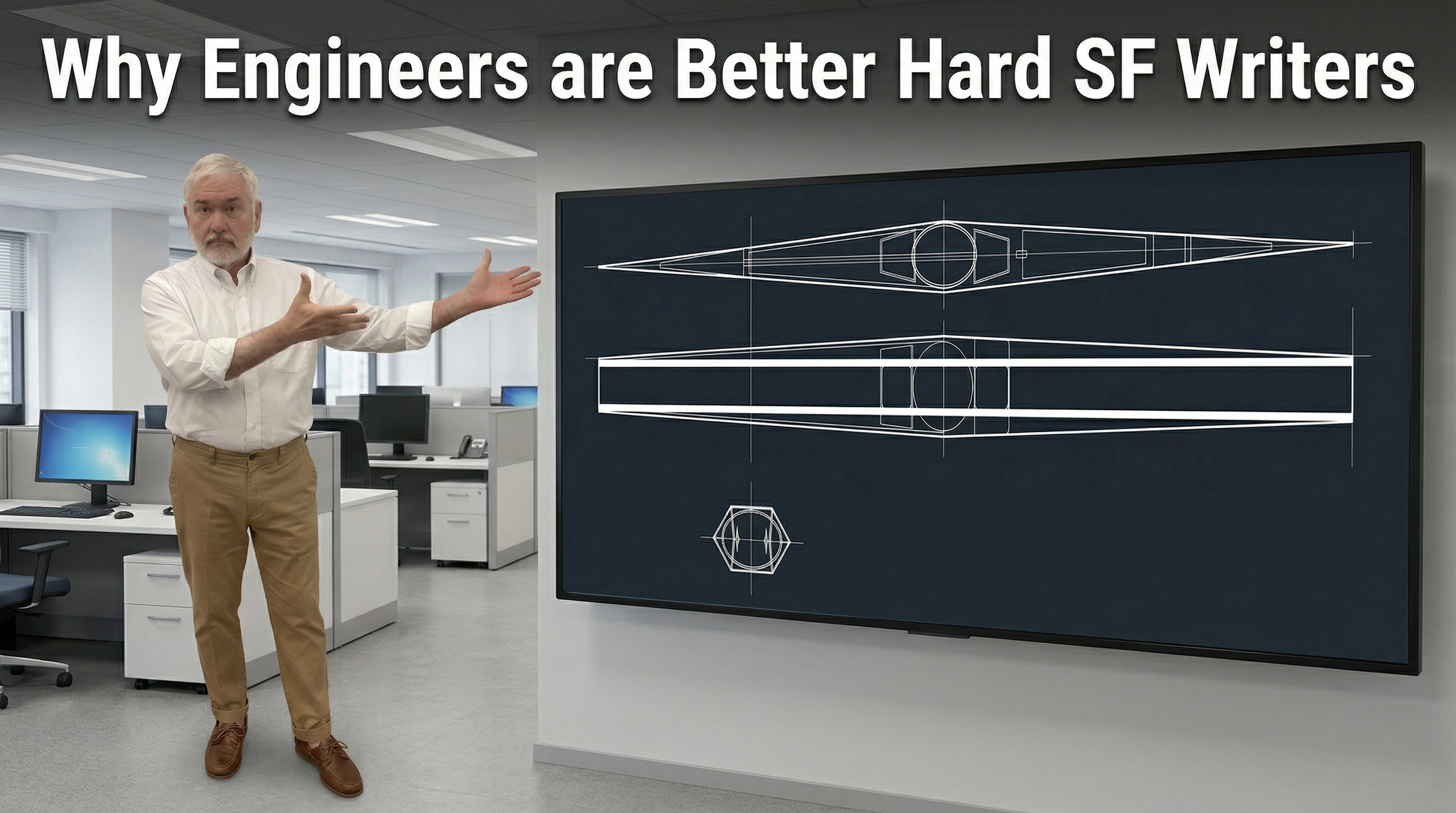
Most fictional spacecraft are designed backwards. The writer decides what the ship needs to do dramatically, then invents a reason it can do that. The result is technology that serves the plot. Which is fine, until you need it to do something different in book three, at which point you quietly bend the rules and hope no one notices.
Engineers don’t do that. Not because we’re more disciplined — because we can’t. You don’t change the spec because the schedule is tight. You re-examine the architecture or you live with the constraint.
That instinct, applied to fiction, produces something different.
The principal auxiliary warship in the Sea of Suns universe is called a Dagger. Here’s how it got its name — and it wasn’t because I thought “dagger” sounded good.
The Transit system — the FTL drive in this universe — works through a rail. The rail is a linear gravity generator that manipulates quantum foam to open a wormhole large enough for the ship to pass through. The rail controls volume you can push through: the more mass you want to move between stars, the more rails you need. Compute controls speed: the transit step is a calculation, and the faster you want to step, the more computing capacity you need.
That trade-off isn’t decoration. It’s the architecture.
An auxiliary warship needs to be fast. In this universe, fast means compute capacity. Compute capacity takes up volume inside the vessel. So a fast warship is, almost by definition, a ship that has traded its interior for processors. Twin rails — enough to move a meaningful crew and weapons load — with almost every remaining cubic metre given over to compute. Crew of two to five on a thousand-foot vessel. Not much else aboard.
Now you have a ship that’s fast, carries almost no cargo, and spends all its operational time in real space. Real space means it’s detectable. A detectable warship needs stealth. The most effective passive stealth for a vessel in this universe is minimising cross-section — flat surfaces, minimal radar return. You sheath the hull in flat panels that force the profile into a long, slender blade shape.
The name isn’t metaphor. It’s a description of what the physics produced.
I didn’t design a cool warship and retrofit a justification. The constraints generated the vessel, and then the vessel generated scenes I hadn’t planned, because once you know what a Dagger can and can’t do, certain tactical situations become inevitable.
That’s the engineer’s advantage in hard SF, and it’s not what most people think it is.
It’s not technical accuracy. You’ve invented the technology — accuracy isn’t really the point. It’s that engineering training gives you a specific habit of mind: ask what the constraints produce, not what you need them to produce. Follow the logic. Let the system build itself.
When the system is honest, the world it generates is consistent without effort, because everything follows from the same rules. The Dagger’s tactical role, its crew size, its limitations, the scenarios it enables — none of that required invention. It came out of the trade-off.
The reader doesn’t need to understand the Transit physics to feel that the Dagger is real. They just need to encounter it behaving consistently with itself across the whole story. That consistency is what creates the texture that makes a fictional universe feel inhabited rather than constructed.
Thirty years of engineering taught me that coherent systems generate their own logic. Turns out that works in fiction too.
Why Engineers Write Better Hard SF is on The Unretired Engineer YouTube channel —
Stranded in the Stars, Book One of the Sea of Suns Trilogy, is available on Kindle. The Dagger appears early and often. https://www.amazon.com/Stranded-Stars-M-Harris-ebook/dp/B0GT123PLP
 This World and Others