Rand Paul on Diplomacy : Unconditional Surrender is Not an option
Why is it that so many see conservatives as absolutists? In reality they are much more likely to understand the limits of power, of hope, of dreams and to take the long view, big changes really happen over decades not years.
Author Archives: Sci Fi Engineer
Anthropic principle and our finely-tuned Universe
Anthropic principle and our finely-tuned Universe Ethan Siegel at Starts With A Bang!
How the mis-application of the Anthropic Principle has led factions of scientists away from the search for a natural, physical explanation of our Universe, and why that’s bad for everyone.
Image credit: ESO / T. Preibisch, via http://www.eso.org/public/images/eso1208a/
One of the first things you notice — and it’s self-evident if you think about it — is that the Universe is full of stuff. This in itself is a wondrous thing, because it didn’t need to be that way.
The US’s (Asia’s) Worst Nightmare: a 4th China-Japan War
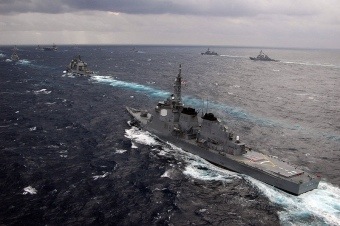
Asia’s Worst Nightmare: A China-Japan War by James Holmes | National Interest | January 5, 2014

A fight over seemingly minor stakes, then, could mushroom into a major conflagration arraying China against the US-Japan alliance. How much passion would an East China Sea imbroglio rouse among the combatants? China and Japan would be all in. Disputes involving sovereignty — particularly territory and resources — tend to drive the perceived value of the political object through the roof. Tokyo and Beijing, moreover, are acutely conscious that the post-1895 status quo is in play. In Clausewitzian parlance, goals of such value merit open-ended efforts of potentially vast magnitude.
Given President Obama’s history of feckless dithering on foreign policy issues this could get really ugly. It seems likely that China will push to take advantage of our real if self inflicted weakness. In effect the administration’s habit of appeasement makes war more, not less, likely.
Disaster at Fukushima set off a race to develop disaster response robots
The DARPA Robotics Challenge (DRC) Trials are taking place this month.

In this Wednesday, Dec. 11, 2013 photo, engineer Nick Letwin watches as the CMU Highly Intelligent Mobile Platform robot, known as CHIMP, is put through some paces as it pulls a fire hose from during a preparation run at the National Robotics Engineering Center in Pittsburgh. Carnegie Mellon researchers are testing the new search-and-rescue robot that will compete in the U.S. Defense Department’s upcoming national robotics competition in Florida. Competitors from other schools and companies will be vying for a $2 million U.S. Defense Department prize. (AP Photo/Keith Srakocic)
Read more at: http://phys.org/news/2013-12-sci-fi-robots-readied-big.html#jCp
On Tuesday, curiosity and expectations were ratcheted up significantly with the unveiling of NASA’s Johnson Space Center entry, a humanoid robot called Valkyrie (R5). This is a 6-foot-two-inch, battery operated robot weighing 286 pounds with 44 degree of freedom. (The Valkyrie has seven degree of freedom arms, for example, with actuated wrists and six degree of freedom hands. Each hand has three fingers and a thumb.)
Read more at: http://phys.org/news/2013-12-valkyrie-darpa-robotics-contender.html#jCp
When walking on muddy or bumpy roads, the two arms of DRC-HUBO become extra legs, enabling stable and agile movements.
Read more at: http://phys.org/news/2013-07-kaist-hubo-ready-darpa-robotics.html#jCp
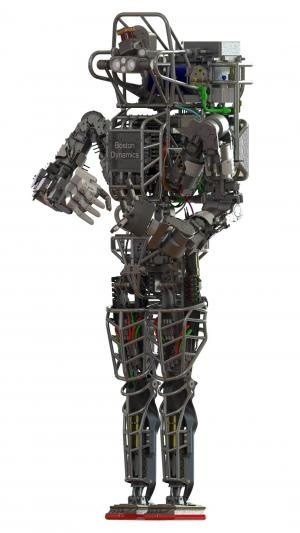
On Monday, July 8, 2013, the seven teams that progressed from DARPA’s Virtual Robotics Challenge (VRC) arrived at the headquarters of Boston Dynamics in Waltham, Mass. to meet and learn about their new teammate, the ATLAS robot. Like coaches starting with a novice player, the teams now have until late December 2013 to teach ATLAS the moves it will need to succeed in the DARPA Robotics Challenge (DRC) Trials where each robot will have to perform a series of tasks similar to what might be required in a disaster response scenario.
Read more at: http://phys.org/news/2013-07-darpa-atlas-robot-unveiled-video.html#jCp
Institutional Decay American Style
The Decay of American Political Institutions
FRANCIS FUKUYAMA Published on December 8, 2013
We have a problem, but we can’t see it clearly because our focus too often discounts any political
institutions in the United States are decaying. This is not the same thing as the broader phenomenon of societal or civilization decline, which has become a highly politicized topic in the discourse about America. Political decay in this instance simply means that a specific political process—sometimes an individual government agency—has become dysfunctional. This is the result of intellectual rigidity and the growing power of entrenched political actors that prevent reform and rebalancing. This doesn’t mean that America is set on a permanent course of decline, or that its power relative to other countries will necessarily diminish. Institutional reform is, however, an extremely difficult thing to bring about, and there is no guarantee that it can be accomplished without a major disruption of the political order. So while decay is not the same as decline, neither are the two discussions unrelated.
Theories of aging and senescence look at build up of damage in DNA, build up of poisons in cells, build up of damage in limited repair tissues, etc. I see government as a living entity with the same sorts of problems. This is why to a large extent progress has occurred with the birth of new governments (and often the death of the prior one.) The US was set up to purposely operate in a sort of continuous creative destruction and did well till the forces of ‘progress’ figured out how to jam a spoke in this wheel of change. For about fifty years things kept going, even got better because competent first generation operators were in place and constant change is not always very pretty. Now we are well into senescence and things are going to hell because this is not an era where sclerotic systems are treated gently.
An Invisible Sword Cuts in all directions…
Kept in the Dark Secrecy is a two-edged sword
By Bill Sweetman
Read Sweetman’s posts on AW weblog ARES, updated daily: AviationWeek.com/ares sweetman@aviationweek.com
AW&ST is doing the reveal on the air forces reason for trying to can GlobalHawk :
Among other things:
Secrecy distorts debate. A House Armed Services Committee hearing
in April bordered on farce. The Air Force has been trying for a couple of years to reduce its fleet of Global Hawk unmanned air systems, because the big UAS is no more survivable than the much less costly General Atomics MQ-9 Reaper, while protecting a classified stealth UAS under development by Northrop Grumman. In that hearing, Lt. Gen. Charles Davis, the USAF’s senior acquisition officer, practically had to play charades to convince Rep. John Gara- mendi (D-Calif.), whose constituents fix Global Hawks for a living, that the Air Force did have a reason for disfavoring his pet bird, without exactly saying what it was, because it was secret.
So you and I paid for hundreds of millions dollars worth of obsolete capability. And heck, the workers can’t support PACs to lobby for their livelihood…
The common shipping container, lynch pin of the consumer paradise
The Shipping Container
A Cyber Monday paean to the unsung hero of consumer capitalism: Craig Martin @ The Atlantic

Busan New Port, South Korea (Reuters).
At the world’s ports, rows of stacks of shipping containers in an array of colors create a rich metallic vibrancy. On construction sites they are used as storage boxes. They can be seen lying prone and rusting in abandoned plots. They perch on the back of trucks speeding down the motorway. On flatbed cars they trundle through railway stations, box upon box upon box.
Tokyo (Reuters)
McLean (U.S. truck operator Malcom McLean’ the container systems inventor) understood that a transition to container shipping would require the complete redesign of the entire freight transport infrastructure: rail cars, ships, trucks, cranes, dockyards, everything. As a starting point, he commissioned the container engineer Keith Tantlinger to design a new aluminum container, and to reconfigure a decommissioned tanker vessel, the Ideal-X, to accommodate the new containers. Tantinger also developed a further piece of equipment, the container spreader bar, which enabled the container to be lifted without the need for stevedores to attach roping. As the economist and historian Marc Levinson has noted, the design of the spreader bar meant that “once the box had been lifted and moved, another flip of the switch would disengage the hooks, without a worker on the ground touching the container.” Container freight was all about increasing the speed of movement and reducing the cost of labor. Although the Ideal-X sailed for the first time as a container vessel in April 1956, it was not until 1970 that the International Organization for Standardization (ISO) agreed on the standardized sizes and certain fixings for containers (or ISO Containers as they are formally named).
The truth is always so much more interesting than the crap I learned in school
The Truth About the “Robber Barons”
Mises Daily: Saturday, September 23, 2006 by Thomas J. DiLorenzo
It’s long but interesting, after reading it think about what has been going on around us for decades, longer really, since what is discussed in this fascinating piece has only gotten worse since the long dead protagonists passed from the stage:
The American economy has always included a mix of market and political entrepreneurs — self-made men and women as well as political connivers and manipulators. And sometimes, people who have achieved success as market entrepreneurs in one period of their lives later become political entrepreneurs. But the distinction between the two is critical to make, for market entrepreneurship is a hallmark of genuine capitalism, whereas political entrepreneurship is not — it is neomercantilism.
In some cases, of course, the entrepreneurs commonly labeled “robber barons” did indeed profit by exploiting American customers, but these were not market entrepreneurs. For example, Leland Stanford, a former governor and US senator from California, used his political connections to have the state pass laws prohibiting competition for his Central Pacific railroad,[1] and he and his business partners profited from this monopoly scheme. Unfortunately, the resentment that this naturally generated among the public was unfairly directed at other entrepreneurs who succeeded in the railroad industry without political interference that tilted the playing field in their direction. Thanks to historians who fail to (or refuse to) make this crucial distinction, many Americans have an inaccurate view of American capitalism.
As a header for the article, DiLorenzo has this quote:
Free-market capitalism is a network of free and voluntary exchanges in which producers work, produce, and exchange their products for the products of others through prices voluntarily arrived at. State capitalism consists of one or more groups making use of the coercive apparatus of the government… for themselves by expropriating the production of others by force and violence.
— Murray N. Rothbard, The Logic of Action (1997)
So the taxonomy here is:
- Free market capitalism
- Political ( crony) capitalism
- State capitalism
But the whole story is much more complex than this article outlines, since all of the actors in the dance, (‘good’ guys and ‘bad’) were acting out of self interest, enlightened self interest, altruistic self interest and more darkly unconscious self interest, based on very, ( by today’s standards, very, very) poor information and worse theories of cause and effect. It is all but certain they were trying to do the best they could for the audience they cared about (sometimes but rarely, just themselves.) Even monsters think they are doing the right thing (sometimes via massive self delusion admittedly) whatever outside observers perceive.
National Novel Writing Month…
If you follow me and glance over ThisWoldAndOthers you will realize, I hope, that I write SciFi, not for a living but for relaxation and as an outlet. I have mentioned NaNoWriMo before but forgot to mention it this year, just in case someone passing by might be interested but not know about it. November is/was the month and I have participated in (and become a winner once more!)
National Novel Writing Month (NaNoWriMo) is a fun, seat-of-your-pants approach to creative writing. On November 1, participants begin working towards the goal of writing a 50,000-word novel by 11:59 p.m. on November 30. Valuing enthusiasm, determination, and a deadline, NaNoWriMo is for anyone who has ever thought fleetingly about writing a novel. Here’s a little more about how it all works.
National Novel Writing Month is also a 501(c)(3) nonprofit that believes your story matters. You know how writing makes the world a more creative, vibrant place. Through NaNoWriMo—as well as our Young Writers Program, the Come Write In program, and Camp NaNoWriMo—we work hard to empower and encourage that vibrant creativity around the world. We can’t do it without writers like you.
NaNoWriMo 2012 at a Glance
341,375 participants started the month as auto mechanics, out-of-work actors, and middle school English teachers. They walked away novelists.
648 volunteer Municipal Liaisons guided 586 regions on six continents.
82,554 students and educators created worlds with the Young Writers Program.
615 libraries opened their doors to novelists through the Come Write In program.
And in 2013, 44,919 Campers participated in Camp NaNoWriMo’s online writing retreat.
The novels not done even at 50k+ words its about 1/2 way, but here is the draft cover….and synopsis…
War of the Worlds?
It’s a Black Swan event, a disaster no one was looking for, despite decades of discussion. A killer asteroid slingshots around the sun and is heading straight for the heart of the US.
A desperate shot with an experimental space plane and obsolete nation killer bomb may save the day. Except worse turns to weird when it becomes obvious that the incoming hundred thousand tons is not an asteroid but a derelict starship.
Weird turns to near certain war when the ‘derelict’ starts spinning out landing craft, does the President destroy it, do the aliens come in peace?
The story of the men and woman who get to put the answers together and live…if they survive…with the consequences.
Talk about taking your breath away
When tectonics killed everything
by Johnny Bontemps

Permian Seafloor — More than 90 percent of ocean species vanished during the Permian extinction. Credit: University of Michigan Exhibit of Natural History
Late Permian (260 million years ago) — All the world’s lands had joined into a single supercontinent, Pangea, and all the world’s sea water had formed a global ocean, Panthalassa. Credit: Ron Blakey, NAU Geology
Some 300 million years ago, at the beginning of the Permian period, all the world’s lands had joined into a single supercontinent, Pangea, and all the world’s sea water had formed a global ocean, Panthalassa.
The formation of Pangea led to higher mountains and deeper oceans. According to an equilibrium principle, a giant continent should have a thicker crust than each scattered continent, and the oceans should become deeper. This recession of water away from the land would have eliminated a lot of the biodiversity that thrives in shallow water near the coasts. This recession would have also led to changes in ocean currents and wind patterns, initiating global climate changes.
What’s more, the inland region of one giant continent would become dry and arid, leading to the disappearance of much vegetation.But something else also went on, deep within the Earth.
When the lands joined, some tectonic plates moved under others and sunk deep into the Earth’s mantle. That cooler material then may have reached all the way to the Earth’s core layer. Evidence for that includes the reversal of Earth’s magnetic field that occurred around that time, an event called the Illawarra magnetic reversal.
The accumulation of cool material near Earth’s core then could have led to the formation of a large mantle plume (by a process called thermo-convection), other researchers had suggested. That “super-plume” would eventually reach the Earth’s surface in two separate bursts—first with an eruption in China 260 million years ago, and then with the other in Russia 251 million years ago.
By that point, all life had nearly vanished.
Read more at: http://phys.org/news/2013-11-tectonics.html#jCp