
 My son and I went to see Man of Steel yesterday and thoroughly enjoyed it. In my opinion ‘Hollywood’ for all the damning it/they take these days is/are in fact incredibly good at making movies that the ‘public’ like me enjoy, see: Star Trek into Darkness, Iron Man III, Oblivion, etc, etc….I will agree that they are not so good at making movies that spark movements, deep introspection, change hearts, etc but the working stiffs out here in the real world can only take so much of that (near zero in my case since I suffer internet news triggered navel starring disorder class one to begin with and go to the movies to get away from the world not to get hammered from one more angle by it .)
Other reviews:
http://booksforkidsblog.blogspot.com/search?q=Man+of+Steel
http://www.npr.org/2013/06/13/189284063/steel-trap-snyders-superman-between-worlds
http://arstechnica.com/gaming/2013/06/man-of-steel-review-a-surprisingly-human-superhuman-story/
Henry Cavil …Clark Kent / Kal-El. Great choice
Amy Adams …Lois Lane. Fun to see
Michael Shannon …General Zod Great choice, great part, good man in evil cause
Diane Lane …Martha Kent Yes!
Russell Crowe …Jor-El Wow!
Harry Lennix …General Swanwick Good pick
Richard Schiff …Dr. Emil Hamilton Good pick
Christopher Meloni…Colonel Nathan Hardy Good pick
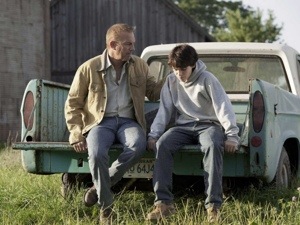
Kevin Costner …Jonathan Kent Oh Yeah!
Laurence Fishburne …Perry White Great supporting role
This is a very good movie despite what some say, though things that I think make it stand out perhaps ruin it for others. It has now been said many times, this is, at its core, a Science Fiction, not a genre Super Hero, movie and that core is very, very good. Man of Steel takes the Superman back story, fleshes it out and draws it out into a fully imagined prequel to the superhero of our childhood. This story of his birth and orphaning to Earth is striking and heart felt.
An artist without the commercial drivers of movie making and IP dollarization might have been able to stop there without much, if any, Super Hero baggage, leaving us with what might have been a timeless piece of work.
What I see as the problem is that the ‘execs’ felt they needed more than a good science fiction movie based on the Superman back story. They wanted a summer blockbuster super hero movie. So the creators gave them a summer blockbuster SciFi blow em up of the Independence Day sub genre and a Super Hero movie of the Spider-Man genre. They then proceeded to lace these pieces together with the science fiction piece, quite successfully mind you, into Man of Steel.
The three movies in one do actually make an entertaining whole with the core Science Fiction story providing gravitas. The other two parts do their thing though too often when two or three of the ‘bits’ have to overlay, things seem to get spoiled.
As said elsewhere some of the action sequences particularly around the Kent’s home town are too drawn out and there is something almost bug like about the super speed fighting that takes you out of the moment.
In the long battle scenes in ‘Smallville,’ Metropolis, even on Krypton, the humans and normal Kryptonians in the battle zone get squished/slaughtered in bushel lots with very little comment. Yet when Zod forces superman to kill him, Cal-El seems incredibly distraught, as distraught as when his adoptive father stops Clark from saving him thus revealing his super powers during late adolescence.
Related side note: My son said he was glad that the creators had not ruined the ‘reality’ of the action sequences by showing repeated miraculous saves. And though from one view it’s a bit cold from my writers perspective he is absolutely right.
There’s a lot one could say about this movie, my bottom line, if you have hesitated to go due to one review or another my suggestion is go, (see the cheap regular version like we did, it’s excellent and I’ve come to the conclusion that 3D, IMAX3D, etc are not really worth the extra price.) The theater we went to was quite well filled for mid afternoon second week with other new starts, and the folks behind us had seen the movie at least once and perhaps twice before and still seemed ready to see it again after the show.
Cheers


