A world (at sea ) of difference

20130516-194752.jpg
20130516-194802.jpg
20130516-194818.jpg
20130516-194826.jpg
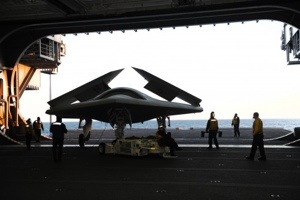
as in many engineering projects the Navy’s UCAV X-47B flight testing and carrier qual seems to have suddenly jumped from baby steps to hyper speed.

Navy officers are very clear on a distinction between the Navy and the Air Force, which insists on talking about remotely piloted aircraft: Navy “unmanned air systems” have operators, not pilots. Of course, the Navy hasn’t been forced to divert a large number of qualified pilots into UAVs, as the USAF has been (Predators and Reapers are the USAF’s second-largest pilot force after the F-16), and will not have to do so for a long time. But the fact remains that flying a UAV with a stick and rudder or any semblance thereof is (to quote an Airbus guy’s comment on the Boeing 777’s back-driven yoke) like putting a steering wheel on a horse. “Pilot” is a bit of a misnomer.
Speaking of pilots, the Navy’s attitude towards adopting the X-47B’s automatic landing technology for manned operations is quite positive. The potential benefits — less wear and tear on airframes and less training time for the air group, along with improved safety — are substantial.

Read more at: http://www.aviationweek.com/Blogs
Wired has a different set of thoughts and more questions here. Wired sometimes seems to confuse the world of war with the world of tech and the world in general with the blue coasts of the US but they do a good job of tracking the tech and monitoring for hubris.

Another example of why important stuff should NOT be left to government bureaucrats

phys.org : Reports from “Humans 2 Mars Summit” suggest dust may prevent human settlement of Mars by Bob Yirka

…. perchlorates appear to be widespread on the planet’s surface. The fine dust material produced by perchloric acid has been known to cause thyroid problems in people here on Earth.
Just as problematic, … is gypsum…. been known to cause a condition similar to black lung in coal miners in people exposed to it for long periods of time.
… known presence of silicates on the Martian surface—if breathed-in they can cause reactions with water in the lungs and result in the creation of harmful chemicals.
Martian dust could pose health hazards because of the difficulty of removing it from space suits and boots. … fear the dust would build up in air filters and living quarters, adding yet another life threatening element to the list of other known hazards (traveling and landing safely, exposure to radiation and cosmic rays, etc.) for the people who seek to colonize the planet.

You can always find some pretext for why not to do something.

This sort of narrow thinking is why it the Mars colonization effort by somewhat older unworried warriors is a great idea, they will lead the way, they may die earlier…will almost certainly die earlier than they would on Earth but in the big picture they will be immortal.

I think that a commercial fly by of Mars possibly convoying with early colony equipment makes a lot of sense. Drop off a 3D printer to start fabbing buildings or building parts. The fly by would work on the tech of getting there and of living in space for long periods. Multiple (4 in a Bigelow Cross?) inflatable Bigelow modules would make a light weight but spacious habitat that one or two couples could live in for the time needed. I would boost and decelerate the complex with an earth orbital tug and have minimal onboard propulsion since its pointless mass to take with you. With the right kit of science and DIY they would keep busy doing various types of investigation the whole time.

Big picture:

  • Asteroid capture and exploitation
  • Refueling / reuse of space side craft
  • Asteroid mining for space side resources and drop side assets
  • L point science platforms with robo and human servicing
  • Low earth orbit hotel/spa/ops-center
  • 4 person large scale spacecraft flyby of Mars
  • Mars colony robot precursor landings
  • Mars colony crew of 6 to 8 no return, first Martians
  • Follow up resource flights to Mars, gradual build up of Mars colony
  • All possible in the next twenty years, tenish if we really pushed, and I think we could commercial/ kick start/survivor fund the whole bloody thing…


    20130510-165250.jpg

    20130510-165307.jpg

    20130510-165326.jpg

    20130510-165343.jpg

    20130510-165409.jpg

    20130510-165425.jpg

    20130510-165501.jpg

    20130510-165528.jpg

    Machine Design | Local-for-local strategy drives U. S. expansion

    An artical / opinion piece in Machine design talks about how reality/ growth caught up with plans an sparked an epiphany: Local-for-local strategy drives U. S. expansion . This seems right and in line with what seems to be happening more broadly which is not a retreat to the USA but a charge into the future. This is all to the good…except in many ways the blue blues less clues have been taking advantage of the disappearance of the factories and their irritatingly outspoken managers / operators to tighten up regulation. Not that regulation is all bad but the regulatory net in blue states/ cities seems to be stifling growth in many places that could do with it.

    Eye Candy

    20130506-131540.jpg

    Wired, young Audubon works

    Living tissue 3D printed

    First fully-cellular liver tissue 3D bioprinted at Organovo

    20130503-232416.jpg

    Bioprinted human liver with CD31+ microvessels (green) forming within the tissue.

    Since liver cells are used in labs to test the toxicity and efficacy of drugs, these printed tissues will first serve that purpose. Soon though, a larger liver will be printed, and it won’t be long after that that printed organs will be tested in animals. It’s a short hop from there to humans.

    DARPA Finaly got the X51 to successfully ride its wave

    20130503-204016.jpg

    Tucked under the B-52H’s port wing, the X-51A is pictured prior to launch on May 1

    At www.aviationweek.com

    The U.S. Air Force has released new details of the record-breaking hypersonic test flight conducted by the Boeing-built X-51A Waverider demonstrator on May 1. The diminutive scramjet-powered vehicle achieved a blistering Mach 5.1, covering 230 naut. miles in just over six minutes (240 seconds!) over the Point Mugu Naval Air Warfare Center Sea Range in the Pacific.

    This technology could be the next breakthrough for space booster technology…next as in ten to twenty years. In the meantime it could fuel a new arms race in rapid strike weapons. This is not a US first move, the Russians, Australians, the Europeans, maybe even the Chinese have been leading in this speed regime up to this point.

    NASA may support SST x-plane

    20130503-201749.jpg

    An artist’s concept shows Lockheed Martin’s low-boom supersonic airliner. (Courtesy: NASA)
    At www.flightglobal.com
    Science and resultant technology may well have made Low Boom supersonic flight practical. A 100 to 150 passenger aircraft could fly NY to LA in something like 2 hours, making one day two way coast to coast trips a practical comfortable reality for premium passengers. This has been impossible because of the glass breaking, cattle disturbing sonic boom, but now aerodynamics and aircraft technology have shown a road forward.

    With the ending of NASA’s last ‘five year plan’ on ultra efficient airliners, money will be available to build a scale but largish (fighter sized I’d guess) x-plane to make test flights provingthe boom mitigating design techniques. This sounds like a great idea, the sort of thing that NASA should be doing, has been doing, quietly, since its founding as NACA all those decades ago.

    Galactic Virgin Rockets Away!

    20130429-215041.jpg
    Love the Logo-shot! The space ship’s pretty simple really, it’s biggest downside would seem to be no fly around capacity if one misses the runway line up, but 1) how often does that happen theses days? 2) if theirs any juice left in the oxidizer tank a short burn would do the trick. Anyone know the plan: depend on getting it right every time or lighting ‘er up for the go-round?

    20130429-215802.jpg